Last updated · Reviewed by Ketki Tidke, Lead Auditor, CyberSapiens · PhishCare is a product developed by CyberSapiens.
Quick answer
A vulnerability assessment finds and ranks as many known weaknesses as possible, mostly with automated scanning. A penetration test goes deeper: a skilled tester tries to exploit the weaknesses to prove how far a real attacker could get. A vulnerability assessment shows breadth, a penetration test shows real-world impact, and most Australian businesses need both, often bought together as VAPT.
Vulnerability assessment vs penetration testing at a glance
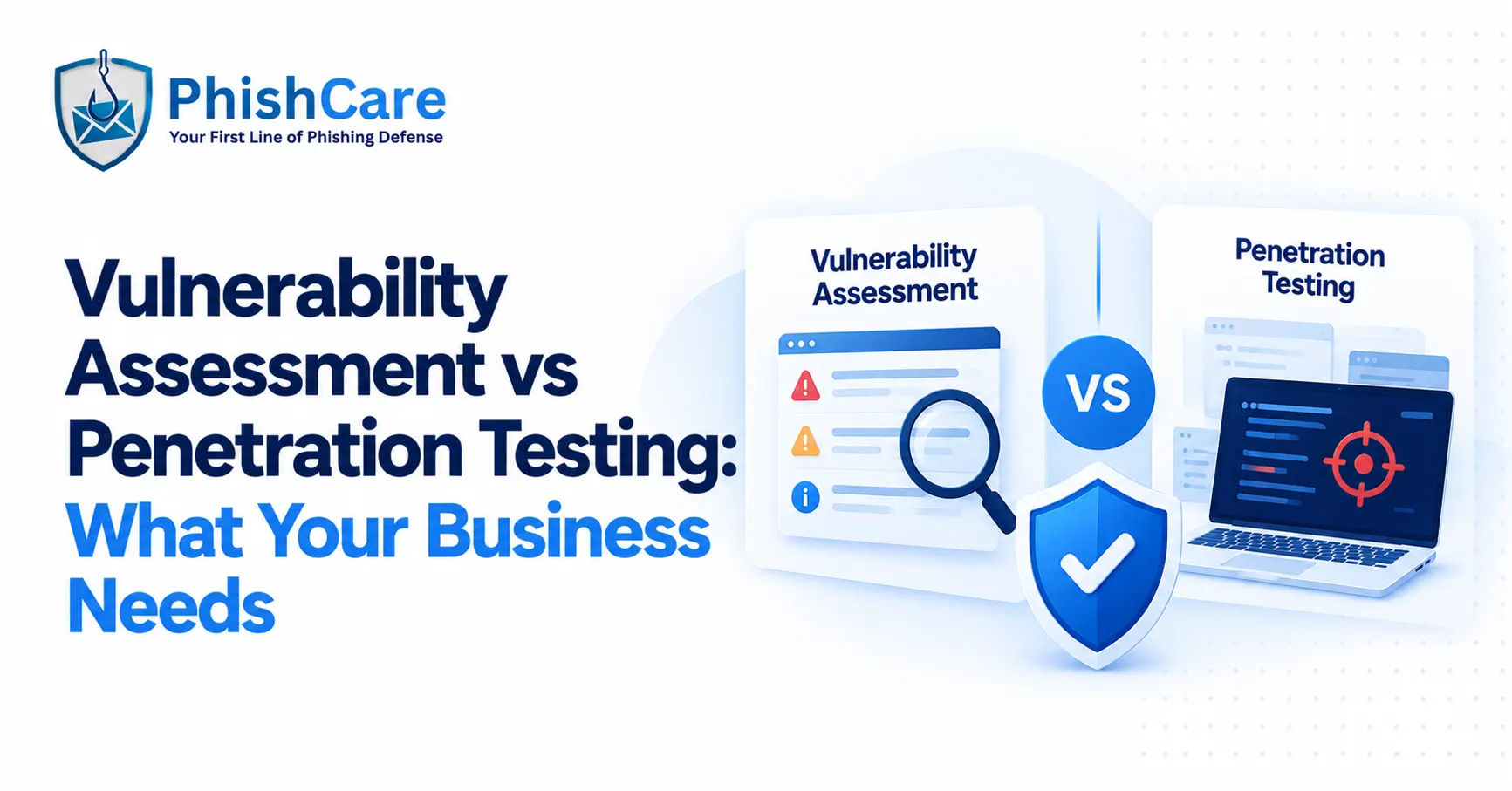
Think of your business as a building. A vulnerability assessment walks around it and lists every unlocked door and window. A penetration test climbs through one of them and shows how far inside it can get.
Scans everything and lists the open doors
Picks a way in and proves how far it goes
What is a vulnerability assessment?
A vulnerability assessment is a systematic review of your systems to find known security weaknesses, such as missing patches, outdated software, weak settings and exposed services. It relies mostly on automated vulnerability scanning tools, with a security specialist checking the results, removing false positives and ranking each finding by severity.
The goal is coverage. A good assessment looks at as many systems as possible and gives you a prioritised list to fix. It does not try to break in, so it cannot tell you whether a weakness is actually exploitable or what an attacker could reach through it.
A vulnerability scan is the automated part on its own. A vulnerability assessment adds expert review and context. Regular scanning is also part of the patching strategies in the ASD Essential Eight.
What is a penetration test?
A penetration test is an authorised, simulated cyber attack. A skilled tester uses the same techniques as real attackers to exploit weaknesses, chain them together and show exactly what could be accessed, such as customer records, admin accounts or financial systems.
The goal is depth and proof. Penetration testing finds problems that scanners miss, such as business logic flaws, broken access control and combinations of low-risk issues that become critical together. It is mostly manual and takes longer, so it usually costs more than a vulnerability assessment.
Common types include network penetration testing (external and internal) and web application penetration testing, along with API, mobile and cloud testing.
Key differences side by side
| Attribute | Vulnerability assessment | Penetration test |
|---|---|---|
| Main question | What weaknesses do we have? | What could an attacker actually do? |
| Approach | Mostly automated scanning plus review | Mostly manual, hands-on exploitation |
| Focus | Breadth: as many systems as possible | Depth: real attack paths and impact |
| Exploits weaknesses? | No | Yes, safely and with permission |
| Finds logic flaws? | Rarely | Yes |
| False positives | More likely | Low, because findings are proven |
| Typical frequency | Monthly or quarterly, often continuous | Yearly and after major changes |
| Output | Prioritised list of weaknesses | Proven findings, attack paths, fixes and retest |
| Relative cost | Lower | Higher, from AUD 2,800 ex GST at CyberSapiens |
Which one does your business need?
Start with a vulnerability assessment if
- You have never checked your systems before
- You want a baseline and a patching plan
- You need regular, ongoing checks between tests
Choose a penetration test if
- A customer, insurer or auditor asked for one
- You are launching an app or a major change
- You hold sensitive, health or payment data
Do both (VAPT) if
- You want full coverage and proof
- You are working towards ISO 27001 or SOC 2
- You want the best value from one engagement
What is VAPT?
VAPT stands for vulnerability assessment and penetration testing. It combines the two: the assessment covers the whole environment quickly, and the penetration test digs into the highest-risk areas to prove what is exploitable. You get breadth and depth in one report.
In Australia, most people search for and ask for “penetration testing”, but a quality penetration test usually includes a vulnerability assessment step. At CyberSapiens, every penetration testing engagement starts with discovery and scanning before manual testing, and includes a free retest of critical and high findings.

Not sure which one you need?
Tell Claude Pinto, Director at CyberSapiens Australia, who is asking and why. You will get honest advice, a clear scope and a fixed price within 24 hours.
What auditors, insurers and customers usually ask for
ISO 27001
Requires you to manage technical vulnerabilities. Regular assessments plus a penetration test are a common way to show this to your auditor.
SOC 2
Not named as mandatory, but auditors and enterprise customers commonly expect a recent penetration test report.
PCI DSS
Asks for both: vulnerability scans every three months and penetration testing at least every 12 months. See the PCI Security Standards Council.
Cyber insurers and customers
Questionnaires often ask when your last penetration test was done and whether critical findings were fixed.
Want to see where you stand first? Start with our cyber security audit checklist or book a full cyber security audit.
How much do they cost in Australia?
A vulnerability assessment usually costs less than a penetration test, because most of the work is automated. A penetration test costs more because a skilled tester spends days testing by hand. At CyberSapiens, penetration testing includes the vulnerability assessment step and a free retest.
| CyberSapiens test (small business) | AUD, ex GST |
|---|---|
| External network (up to 10 IPs) | 2,800 to 4,500 |
| Internal network (up to 25 hosts) | 4,500 to 7,000 |
| Web application | 4,500 to 7,500 |
| Startup Essentials (web app plus external network) | 6,900 to 9,900 |
For medium and enterprise prices, see our full guide to penetration testing cost in Australia.
How often should you do each?
- Vulnerability scanning: at least monthly, and more often for internet-facing systems.
- Vulnerability assessment: quarterly, with expert review of the scan results.
- Penetration test: at least once a year, and after major changes such as a new app release, a cloud migration or a new office network.
Vulnerability assessment vs penetration testing FAQs
What is the main difference between a vulnerability assessment and a penetration test?
A vulnerability assessment finds and ranks known weaknesses, mostly with automated tools. A penetration test exploits weaknesses by hand to prove what a real attacker could access. One gives breadth, the other gives depth and proof.
Is a vulnerability scan the same as a penetration test?
No. A vulnerability scan is automated and lists possible weaknesses. A penetration test adds manual testing to confirm which weaknesses can actually be exploited and how far an attacker could get.
What does VAPT stand for?
VAPT stands for vulnerability assessment and penetration testing. It combines a broad vulnerability assessment with a deeper penetration test in one engagement.
Which is better, a vulnerability assessment or a penetration test?
Neither is better on its own. A vulnerability assessment is best for regular, wide coverage, and a penetration test is best for proving real risk. Most businesses run regular assessments and at least one penetration test a year.
Does a penetration test include a vulnerability assessment?
A quality penetration test usually starts with discovery and vulnerability scanning before manual testing. At CyberSapiens, every penetration test includes this step and a free retest of critical and high findings.
How much does a penetration test cost in Australia?
CyberSapiens penetration testing starts from AUD 2,800 excluding GST for an external network test of up to 10 IPs, and AUD 4,500 to 7,500 for a single web application.
Get breadth and depth in one engagement
Fixed prices from AUD 2,800 ex GST, results in 2 to 3 weeks and a free retest of critical and high findings.
CyberSapiens Australia, Lvl 1 206 Lorimer St, Port Melbourne · sales@phishcare.comContent Reviewed By

Ketki works with public, private and government clients across Australia on security assurance, connecting vulnerability assessment and penetration testing results to ISO 27001, SOC 2, PCI DSS and Essential Eight requirements.
View Ketki Tidke’s LinkedIn profile