Deepfake scams and AI voice cloning have become two of the fastest-growing cyber threats facing businesses in 2026. Powered by artificial intelligence, these attacks enable cybercriminals to impersonate executives, employees, vendors, and trusted contacts with alarming realism. What once required advanced technical expertise can now be achieved using publicly available AI tools, making social engineering attacks more convincing and harder to detect.
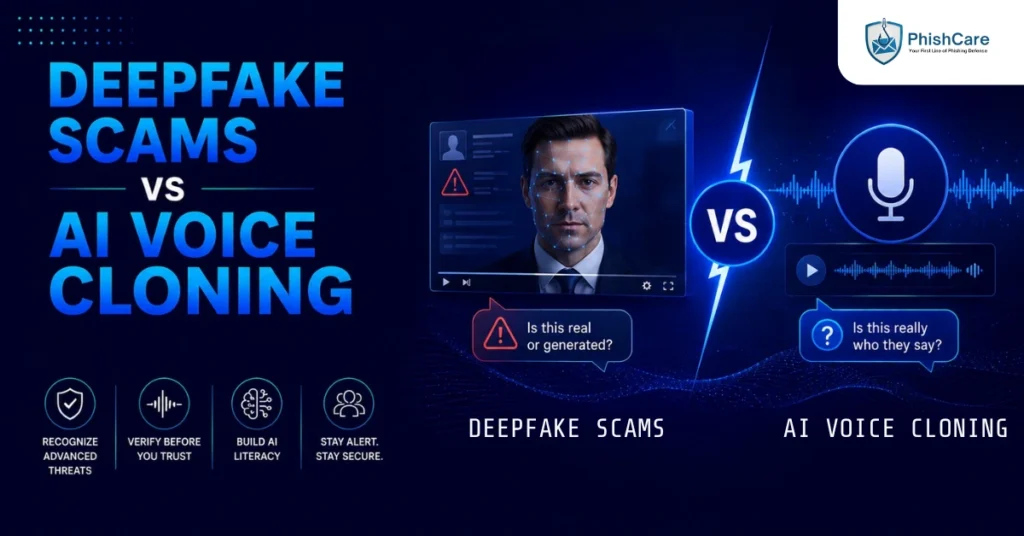
While both threats rely on synthetic media and impersonation, they are not the same. Deepfake scams typically use manipulated videos or images to create false visual identities, whereas AI voice cloning focuses on generating realistic speech that mimics a person’s voice. Understanding the difference is essential for security teams, business leaders, and employees responsible for approving sensitive requests or financial transactions.
Executive Summary
Deepfake Scams
Use AI-generated or manipulated videos and images to impersonate individuals and create false trust.
AI Voice Cloning
Uses AI to replicate a person’s speech patterns and voice characteristics for fraudulent communication.
Business Risk
Both attacks are increasingly used in executive impersonation, invoice fraud, business email compromise, and financial scams.
What You’ll Learn in This Guide
- The key differences between deepfake scams and AI voice cloning
- How cybercriminals use these technologies to target organizations
- Real-world examples of AI-powered fraud attacks
- The risks these threats pose to businesses and employees
- Practical steps organizations can take to reduce exposure
- How security awareness training and phishing simulations help strengthen human defenses
What Are Deepfake Scams?
Deepfake scams are cyber fraud attacks that use artificial intelligence to create highly realistic fake videos, images, or digital identities. By analyzing existing photos, videos, and audio recordings, AI models can generate convincing content that appears to show a real person saying or doing something they never actually did.
For businesses, deepfake scams are particularly dangerous because they exploit trust. A manipulated video of a CEO, executive, vendor, or public figure can be used to influence employees, authorize payments, share confidential information, or damage an organization’s reputation. As AI tools become more accessible, the quality of deepfake content continues to improve, making visual verification alone increasingly unreliable.
How Deepfake Scams Work
1. Data Collection
Attackers gather publicly available videos, photos, interviews, webinars, and social media content of the target.
2. AI Generation
Machine learning models create synthetic videos or images that closely resemble the target individual.
3. Social Engineering
The fake content is used to manipulate victims into taking actions such as transferring funds or sharing sensitive information.
Common Types of Deepfake Scams
Executive Impersonation
Fraudsters create fake videos of company leaders to authorize payments, approve transactions, or influence employees.
Investment & Financial Fraud
Fake endorsements or fabricated interviews are used to promote fraudulent investment opportunities.
Reputation Manipulation
Edited videos can spread misinformation, damage brand credibility, or create public confusion.
Why Deepfake Scams Are Growing
The rapid adoption of generative AI has significantly lowered the barrier to creating realistic fake media. Cybercriminals no longer need advanced editing skills to launch convincing impersonation campaigns. Combined with publicly available executive videos, social media content, and online presentations, deepfake technology has become a powerful tool for modern social engineering attacks.
What Is AI Voice Cloning?
AI voice cloning is the process of using artificial intelligence to replicate a person’s voice by analyzing recordings of their speech. Modern voice synthesis models can learn tone, pitch, accent, speaking style, and pronunciation patterns from only a small amount of audio, allowing attackers to generate speech that sounds remarkably authentic.
Unlike deepfake scams, which focus on visual deception through fake videos and images, AI voice cloning targets the human tendency to trust familiar voices. Cybercriminals often use cloned voices to impersonate executives, managers, vendors, family members, or trusted contacts in order to create urgency and manipulate victims into taking action.
How AI Voice Cloning Works
1. Voice Collection
Attackers gather audio samples from interviews, webinars, podcasts, social media videos, or public presentations.
2. AI Voice Training
Voice synthesis models analyze speech patterns and create a digital replica capable of generating new conversations.
3. Fraud Execution
The cloned voice is used in phone calls, voice messages, or virtual meetings to convince victims that the request is legitimate.
Common AI Voice Cloning Attacks
CEO Fraud
Finance teams receive urgent calls that appear to come from senior executives requesting wire transfers or confidential financial information.
Vendor Payment Scams
Attackers impersonate suppliers or partners and request changes to payment details or banking information.
Help Desk & Account Takeover Fraud
Cybercriminals use cloned voices to bypass identity verification processes and gain unauthorized access to accounts or systems.
Why AI Voice Cloning Is a Growing Business Threat
Many organizations still rely on voice-based trust for approvals, financial transactions, and urgent decision-making. Attackers exploit this trust by creating realistic voice messages that sound like executives, managers, or trusted partners.
Because a cloned voice can trigger an emotional and immediate response, employees may act before verifying the request through established security procedures. This makes AI voice cloning one of the most effective forms of modern social engineering and business fraud.
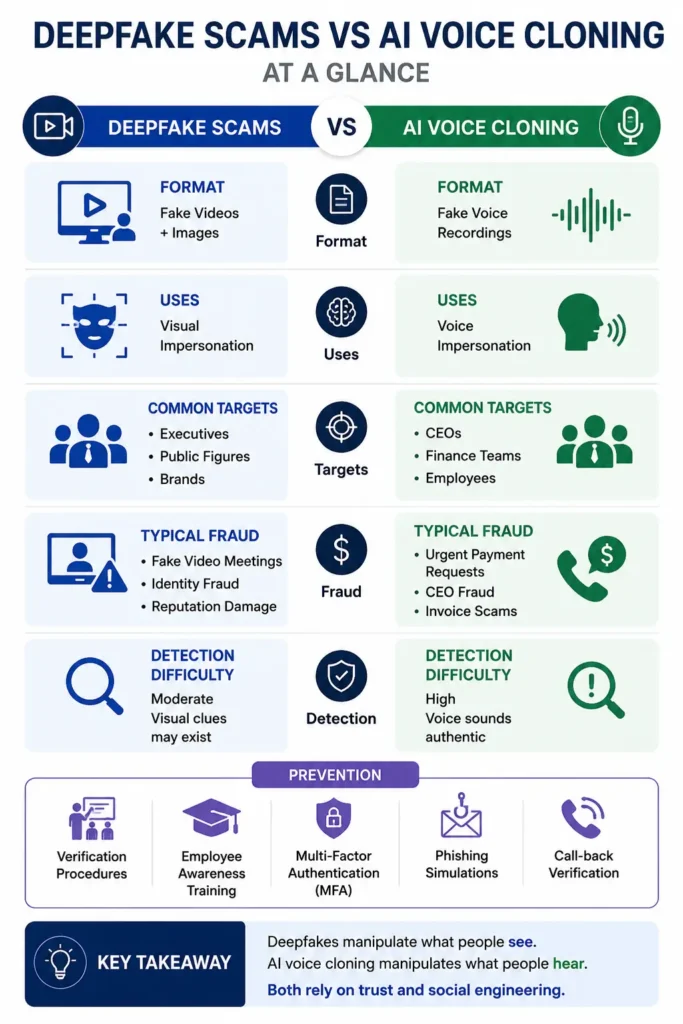
Deepfake Scams vs AI Voice Cloning: Key Differences
Although deepfake scams and AI voice cloning are often discussed together, they use different forms of synthetic media and present different challenges for organizations. Understanding these differences helps security teams develop stronger verification processes and employee awareness programs.
| Factor | Deepfake Scams | AI Voice Cloning |
|---|---|---|
| Primary Medium | Videos, images, and visual content | Audio, phone calls, and voice messages |
| Type of Deception | Visual impersonation | Voice impersonation |
| Typical Targets | Executives, public figures, brands | CEOs, finance teams, employees |
| Common Attack Method | Fake video meetings and identity fraud | Urgent payment requests and CEO fraud |
| Required Content | Photos, videos, and facial data | Audio recordings and speech samples |
| Detection Difficulty | Moderate, visual inconsistencies may appear | High, especially during short calls |
| Primary Goal | Manipulate what victims see | Manipulate what victims hear |
| Business Impact | Reputation damage, misinformation, fraud | Financial loss, payment fraud, account compromise |
Quick Takeaway
The simplest way to understand the difference is this:
Deepfake Scams
Focus on manipulating what people see through AI-generated videos, images, and visual identities.
AI Voice Cloning
Focus on manipulating what people hear through AI-generated speech that sounds like a trusted individual.
Both techniques ultimately rely on social engineering. The technology may differ, but the goal remains the same: gaining trust quickly enough to influence decisions, obtain sensitive information, or trigger unauthorized financial transactions.
How Cybercriminals Use Deepfake Scams and AI Voice Cloning Attacks
Cybercriminals are increasingly combining artificial intelligence with social engineering to make fraud attempts more convincing than ever before. Instead of relying solely on phishing emails or fake websites, attackers can now impersonate trusted individuals through realistic videos, images, and cloned voices to influence decisions and bypass traditional security checks.
For businesses, the greatest risk is not the technology itself but the trust it creates. Employees are naturally more likely to respond to requests that appear to come from executives, managers, vendors, or colleagues. Deepfake scams and AI voice cloning exploit this trust to accelerate fraud and increase the likelihood of success.
Executive Impersonation Fraud
Attackers create fake videos or cloned voice calls that appear to come from senior executives. Employees may receive urgent instructions to transfer funds, approve payments, or disclose confidential information without following standard verification procedures.
Vendor Payment Redirection
Cybercriminals impersonate suppliers or business partners and request changes to banking details. A convincing voice call or video message can make fraudulent payment requests appear legitimate.
Business Email Compromise Support
Deepfakes and voice clones are increasingly used alongside phishing emails. A fraudulent email followed by a convincing phone call can significantly increase the likelihood of employee compliance.
Help Desk Social Engineering
Attackers may use cloned voices to impersonate employees when contacting support teams, attempting to reset passwords, bypass verification controls, or gain unauthorized access to corporate systems.
Typical Attack Flow
Gather public videos, audio recordings, and social media content.
Generate realistic synthetic media using AI tools.
Create urgency through calls, messages, or video interactions.
Manipulate victims into sharing data, credentials, or payments.
Why These Attacks Are So Effective
Traditional phishing attacks often rely on suspicious links, poor grammar, or unfamiliar senders. Deepfake scams and AI voice cloning attacks remove many of these warning signs by leveraging trusted identities and realistic communication methods.
When employees see a familiar face or hear a familiar voice, they are more likely to respond quickly without verifying the request. This is why organizations increasingly need awareness training, verification workflows, and phishing simulation programs that prepare employees for modern AI-powered social engineering threats.
Real-World Examples of Deepfake and AI Voice Cloning Attacks
Deepfake scams and AI voice cloning attacks are no longer theoretical threats. Organizations across multiple industries have experienced real financial losses, reputational damage, and operational disruption caused by increasingly sophisticated AI-powered impersonation attacks.
The examples below demonstrate how cybercriminals exploit trust, urgency, and familiarity to manipulate employees and bypass traditional security controls.
Executive Voice Impersonation Fraud
In several reported incidents, finance employees received urgent phone calls that appeared to come from senior executives. The attackers used AI-generated voices that closely matched the executive’s speech patterns, convincing staff to process high-value financial transactions before verification procedures could be completed.
Fake Video Conference Meetings
Cybercriminals have used AI-generated video technology to impersonate executives during virtual meetings. Employees believed they were interacting with legitimate leadership figures, leading to unauthorized approvals, information disclosure, and fraudulent transactions.
Vendor and Supplier Payment Fraud
Attackers impersonate trusted suppliers using cloned voices and convincing communication tactics. Finance teams receive requests to update banking information or redirect payments, resulting in funds being transferred to attacker-controlled accounts.
What These Incidents Have in Common
Trust Exploitation
Attackers leverage trusted identities rather than technical vulnerabilities.
Urgency
Victims are pressured to act quickly before verifying requests.
Human Decision-Making
The attack succeeds when people trust the message rather than validating it.
The Key Lesson for Organizations
The most successful deepfake and AI voice cloning attacks do not rely on breaking through firewalls or exploiting software vulnerabilities. Instead, they target human trust and decision-making processes.
As synthetic media becomes more realistic, organizations should assume that seeing a familiar face or hearing a familiar voice is no longer sufficient proof of identity. Verification procedures, callback policies, multi-factor authentication, and employee awareness training are becoming critical defenses against AI-powered impersonation attacks.
Which Threat Is More Dangerous for Businesses?
When comparing deepfake scams vs AI voice cloning, many organizations ask the same question: which threat poses the greater risk? The reality is that both can cause significant financial and reputational damage, but their impact often depends on how they are used and who they target.
While deepfake scams attract more media attention because of realistic videos and visual manipulation, AI voice cloning is often considered the more immediate business threat. Most organizations conduct daily approvals, financial discussions, and sensitive conversations over phone calls, voice messages, and virtual meetings, making voice-based impersonation attacks highly effective.
Expert Assessment
For most organizations today, AI voice cloning presents the higher operational risk because it can be deployed quickly, requires minimal interaction, and exploits existing business communication channels. However, deepfake scams are evolving rapidly and may become increasingly effective as video-based collaboration continues to grow.
Why AI Voice Cloning Is Often More Dangerous
- Requires only short audio samples
- Works through phone calls and voice messages
- Creates urgency during live conversations
- Targets finance, HR, and executive teams directly
- Can bypass visual verification controls
Why Deepfake Scams Remain a Serious Threat
- Can influence large audiences simultaneously
- Create highly convincing visual evidence
- Damage brand reputation and public trust
- Support misinformation campaigns
- Increase the effectiveness of broader fraud operations
The Bigger Risk: Combined Attacks
The most concerning trend is not choosing between deepfake scams and AI voice cloning. It is the growing use of both technologies together.
A cybercriminal may send a phishing email, follow up with a cloned voice call, and then reinforce the request with a fake video message. When multiple channels support the same fraudulent request, employees may perceive the communication as legitimate and act without additional verification.
Bottom Line
Organizations should not focus solely on whether deepfake scams or AI voice cloning is more dangerous. Both threats exploit trust, authority, and human decision-making. The most effective defense is a combination of employee awareness training, strong verification procedures, multi-factor authentication, callback validation policies, and regular phishing simulation exercises that prepare employees for modern AI-powered social engineering attacks.
How Organizations Can Defend Against AI-Powered Social Engineering
As deepfake scams and AI voice cloning technologies become more sophisticated, organizations can no longer rely solely on traditional security controls. Since these attacks primarily target human trust rather than technical vulnerabilities, effective defense requires a combination of security processes, employee awareness, and verification mechanisms.
The most resilient organizations assume that voices, videos, and messages can be manipulated. Instead of trusting appearances, they establish clear procedures for validating sensitive requests before taking action.
Implement Verification Procedures
Require independent verification for financial transactions, banking detail changes, password resets, and requests involving sensitive information. A simple secondary approval process can prevent costly mistakes.
Use Call-Back Validation
If a request is received through a phone call, voice message, or video meeting, verify it using a known and trusted contact method rather than responding directly through the original communication channel.
Strengthen Multi-Factor Authentication
Multi-factor authentication adds an additional layer of protection, reducing the likelihood that attackers can gain access even if they successfully impersonate a trusted individual.
Build a Human Firewall
Technology alone cannot stop social engineering attacks. Employees remain the final decision-makers when approving payments, sharing information, or responding to urgent requests.
Regular security awareness training helps employees recognize suspicious behavior, question unexpected requests, and follow established verification procedures even when communications appear legitimate.
Recommended Security Controls
✓ Formal approval workflows for financial transactions
✓ Verification of executive and vendor requests
✓ Multi-factor authentication across critical systems
✓ Regular security awareness training
✓ Phishing simulation exercises
✓ Incident reporting and escalation procedures
Preparing for the Next Generation of Attacks
As artificial intelligence continues to evolve, attackers will gain access to more convincing impersonation capabilities. Organizations that invest in employee awareness, structured verification processes, and continuous testing programs will be better positioned to identify and stop AI-powered fraud attempts before they result in financial or operational damage.
Why Employee Awareness Is Critical in the Age of Deepfakes and AI Voice Cloning
The biggest challenge with deepfake scams and AI voice cloning attacks is that they target people rather than technology. Firewalls, email filters, and endpoint security solutions play an important role, but they cannot prevent an employee from trusting a convincing voice, video, or urgent request.
As AI-powered impersonation attacks become more realistic, organizations need employees who can recognize social engineering techniques, question unexpected requests, and follow verification procedures even when communications appear genuine.
How PhishCare Helps Organizations Build a Human Firewall
PhishCare, developed by CyberSapiens, helps organizations strengthen employee awareness through realistic phishing simulations, security awareness initiatives, and behavior-focused testing programs designed to improve resilience against modern social engineering attacks.
By exposing employees to realistic attack scenarios in a controlled environment, organizations can identify vulnerabilities, reinforce security best practices, and create a stronger culture of cyber awareness.
Phishing simulations conducted across multiple industries
Awareness improvement success rate across simulation programs
Industries regularly served including finance, banking, healthcare, and IT
Trusted by Organizations Across Multiple Industries






What Security Teams Say
“We recently used PhishCare for a phishing simulation, and I’ve got to say, their email templates were top-notch. The realism and variety of the templates were impressive, really testing our team’s vigilance. The level of detail they put into crafting these emails was evident, making the simulation both challenging and effective. It’s clear they know their stuff when it comes to cybersecurity. Highly recommend them!”
Lachlan Glen
Operations and Plan Management Team Leader – LDS
Beyond Awareness Training
Employee awareness programs are most effective when they are reinforced through regular testing and measurable outcomes. Phishing simulations help organizations understand how employees respond to realistic threats and provide valuable insights for continuous improvement.
PhishCare’s campaign reports provide an additional documentation boost for organizations working towards ISO 27001, SOC 2 Type II, PCI DSS, HIPAA, or NIST CSF, where ongoing security awareness training is recognized as a best practice by auditors and certification bodies.
Deepfake & AI Voice Cloning Readiness Checklist
The rise of AI-powered impersonation attacks means organizations need more than technical security controls. Use this checklist to assess your readiness against deepfake scams, AI voice cloning, and other forms of social engineering fraud.
Quick Self-Assessment
If your organization cannot confidently answer “Yes” to most of the questions below, there may be opportunities to strengthen your defenses against AI-driven social engineering attacks.
Verification & Approval Controls
Employee Awareness
- Regular security awareness training is conducted.
- Employees understand deepfake and AI voice cloning risks.
- Staff know how to report suspicious requests.
- Executives participate in awareness initiatives.
Technical Security Controls
- Multi-factor authentication is enforced.
- Privileged access is reviewed regularly.
- Email security controls are actively monitored.
- Incident response procedures are documented.
Maturity Score Guide
High Exposure
Significant improvement opportunities exist.
Moderate Readiness
Core controls exist but gaps remain.
Strong Readiness
Good defenses against impersonation attacks.
Next Step
The most effective way to measure employee readiness is through realistic testing. Simulated phishing campaigns and security awareness exercises help organizations identify risky behaviors before attackers do.
Key Takeaways: Deepfake Scams vs AI Voice Cloning
Deepfake scams and AI voice cloning are rapidly transforming the social engineering landscape. While both rely on artificial intelligence and impersonation, they use different methods to exploit trust and influence human decisions. Understanding these threats is the first step toward building stronger organizational resilience.
Deepfake Scams
- Focus on visual impersonation.
- Use AI-generated videos and images.
- Can influence employees, customers, and the public.
- Often used for fraud, misinformation, and reputation attacks.
AI Voice Cloning
- Focus on audio impersonation.
- Uses synthetic speech and cloned voices.
- Frequently targets finance and operational teams.
- Often used in CEO fraud and payment scams.
The Most Important Insight
Organizations should not assume that seeing a familiar face or hearing a familiar voice is proof of identity. Modern AI tools can create highly convincing impersonations that bypass instinctive trust. Verification procedures, employee awareness, and continuous security testing are becoming essential safeguards against AI-powered fraud.
Summary Checklist
Frequently Asked Questions
Below are answers to some of the most common questions businesses ask about deepfake scams, AI voice cloning, and AI-powered social engineering threats.
What is the difference between deepfake scams and AI voice cloning?
Deepfake scams use AI-generated videos, images, or visual content to impersonate individuals, while AI voice cloning creates synthetic speech that mimics a person’s voice. Deepfakes target what people see, whereas voice cloning targets what people hear.
Can AI voice cloning be detected?
Some AI-generated voices may contain subtle inconsistencies, but modern voice cloning technology has become increasingly realistic. Organizations should rely on verification procedures and callback validation rather than attempting to identify cloned voices by sound alone.
Are deepfake scams used in business fraud?
Yes. Deepfake scams have been used to impersonate executives, influence employees, support financial fraud, and spread misinformation. As video conferencing becomes more common, organizations should be prepared for increasingly sophisticated visual impersonation attacks.
How do cybercriminals create AI-generated voices?
Attackers collect publicly available audio from interviews, webinars, podcasts, videos, or social media content. AI models analyze speech patterns and generate synthetic voice recordings that closely resemble the target individual’s voice.
How can organizations protect employees from deepfake and AI voice cloning attacks?
Organizations should implement verification procedures, callback validation policies, multi-factor authentication, incident reporting processes, and regular security awareness training to help employees recognize and respond appropriately to suspicious requests.
Can phishing simulation training help prevent AI-powered scams?
Yes. Phishing simulations help employees develop stronger threat recognition skills and reinforce verification behaviors. Regular simulations can improve awareness and reduce the likelihood of successful social engineering attacks, including those supported by AI-generated content.
Content Reviewed By

Nawaz is a practising security analyst specializing in phishing simulation campaigns, employee awareness assessments, red team exercises, and ethical hacking. He leads phishing simulation deployments at PhishCare, a product developed by CyberSapiens, with hands-on experience evaluating and deploying phishing simulation tools across organizations in multiple industries and regions globally. His work includes helping organizations strengthen defenses against phishing attacks, social engineering threats, business email compromise, deepfake scams, and AI-powered impersonation attacks.
View LinkedIn ProfilePrepare Your Employees for Deepfake Scams, AI Voice Cloning, and Modern Social Engineering Attacks
Cybercriminals are increasingly using AI-generated voices, fake videos, and sophisticated impersonation techniques to target organizations. Strengthen your human firewall with realistic phishing simulations, employee awareness training, and measurable security outcomes.
Trusted by organizations across finance, banking, healthcare, and IT sectors with 3000+ phishing simulations conducted and a 90% awareness improvement success rate.