Why Brisbane Businesses Need More Than Traditional Security Awareness Training
Cybercriminals continue to target employees through phishing emails that imitate trusted brands, business partners, cloud platforms, and financial institutions. While traditional security awareness training helps employees understand cyber risks, organizations often struggle to measure whether that knowledge translates into real-world behaviour.
This is where phishing simulation platforms play an important role. By safely testing employees with realistic phishing scenarios, organizations can identify behavioural risks, deliver targeted awareness training, and improve their overall security posture.
For Brisbane businesses facing increasing risks from credential theft, business email compromise (BEC), invoice fraud, and account takeover attacks, phishing simulations provide practical insight into how employees respond when confronted with suspicious emails in a controlled environment.
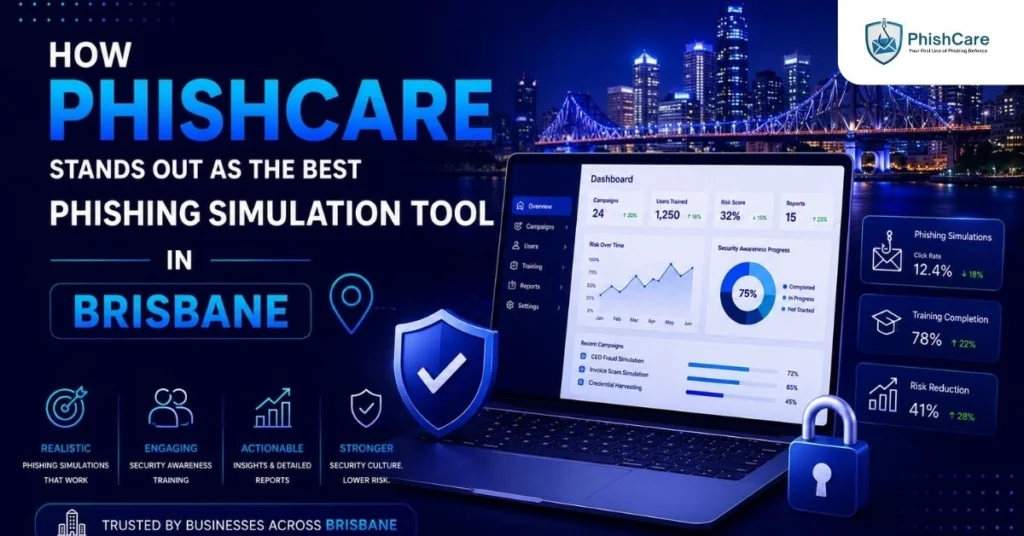
PhishCare, developed by CyberSapiens, combines phishing simulations, employee awareness training, behavioural analytics, and detailed reporting into a single platform. In this guide, we explore how PhishCare stands out as one of the leading phishing simulation tools for Brisbane organizations looking to reduce human cyber risk and strengthen their security awareness programs.
Why Brisbane Businesses Are Increasingly Being Targeted by Phishing Attacks
Phishing remains one of the most effective attack methods used by cybercriminals because it targets people rather than technology. Even organizations with strong technical security controls can be vulnerable when employees unknowingly click malicious links, open infected attachments, or share credentials through convincing phishing emails.
Brisbane organizations across healthcare, professional services, education, construction, and financial services continue to face phishing attempts that mimic trusted suppliers, cloud applications, payroll systems, and business partners. These attacks are designed to exploit everyday workflows and create a false sense of urgency.
Common Phishing Threats Facing Brisbane Organizations
The challenge for many organizations is that traditional awareness sessions cannot accurately measure how employees react when confronted with a realistic phishing attempt. Understanding actual employee behaviour requires continuous testing in controlled environments.
This is why phishing simulations have become an important component of modern security awareness programs. By safely replicating real-world attack scenarios, organizations can identify vulnerable areas, deliver targeted education, and continuously strengthen their human layer of defence.
How We Evaluated Phishing Simulation Tools
Choosing a phishing simulation platform involves more than simply sending simulated phishing emails. Organizations need a solution that can accurately measure employee behaviour, support ongoing awareness programs, provide actionable reporting, and scale alongside business requirements.
To assess what makes a phishing simulation platform effective for Brisbane businesses, we focused on the criteria that security teams, IT managers, compliance professionals, and business leaders commonly consider when evaluating security awareness solutions.
Realistic Phishing Simulations
Effective platforms should offer realistic phishing scenarios that reflect modern attack techniques and employee workflows.
Reporting & Analytics
Detailed reporting should provide visibility into clicks, credential submissions, reporting rates, trends, and employee risk levels.
Awareness Training Integration
Simulation results should be linked to targeted awareness training that helps employees improve over time.
Ease of Deployment
Organizations should be able to launch, manage, and monitor campaigns efficiently without excessive administrative effort.
Scalability
The platform should support organizations of different sizes, from growing businesses to large enterprises.
Compliance-Friendly Reporting
Security teams benefit from documented awareness activities and reporting that support broader governance, risk, and compliance initiatives.
What Sets High-Performing Platforms Apart?
The most effective phishing simulation platforms do more than measure click rates. They help organizations continuously improve employee awareness through realistic testing, targeted education, behavioural analytics, and actionable reporting that supports long-term risk reduction.
How PhishCare Compares to Typical Phishing Simulation Platforms
Many phishing simulation tools offer basic campaign functionality, but organizations often require more than email testing alone. The ability to combine realistic phishing simulations, employee awareness training, risk visibility, and actionable reporting can significantly improve the effectiveness of a security awareness program.
| Capability | PhishCare | Typical Platforms |
|---|---|---|
| Realistic Phishing Simulations | ✓ | ✓ |
| Employee Awareness Training | ✓ | Varies |
| Behaviour-Based Risk Insights | ✓ | Varies |
| Detailed Campaign Reporting | ✓ | ✓ |
| Custom Campaign Scenarios | ✓ | Limited |
| Awareness Progress Tracking | ✓ | Varies |
| Compliance-Friendly Documentation | ✓ | Varies |
Why This Matters
Effective phishing simulation programs should help organizations move beyond measuring clicks. By combining realistic testing, awareness training, behavioural insights, and reporting, organizations can better understand employee risk levels and continuously strengthen their security culture.
Real-World Phishing Simulation Capabilities That Help Reduce Human Risk
Modern phishing attacks are constantly evolving. Employees are no longer targeted only through generic spam emails. Today’s phishing campaigns often imitate trusted brands, cloud platforms, executives, vendors, payroll systems, and business applications that employees interact with daily.
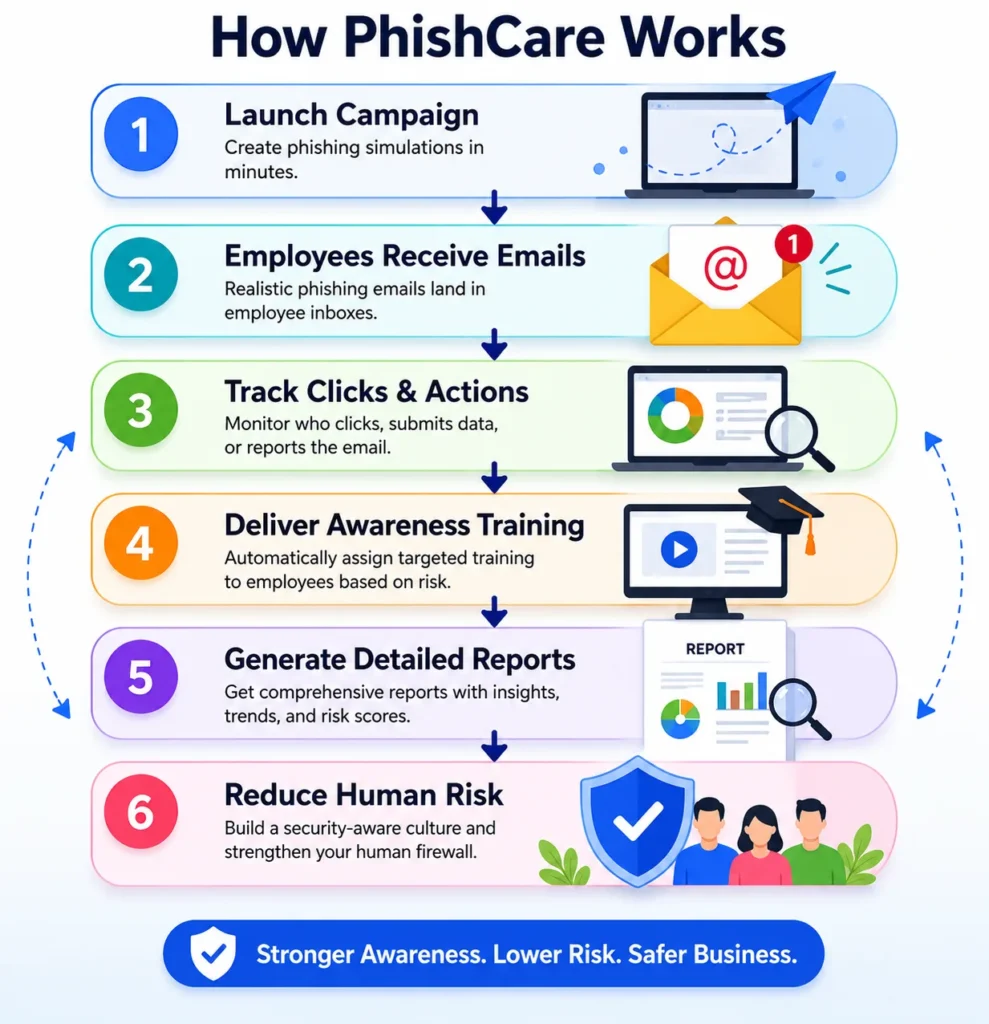
To help organizations prepare for these threats, PhishCare enables security teams to run realistic phishing simulations that mirror the tactics commonly used by cybercriminals while providing measurable insights into employee behaviour.
Realistic Attack Scenarios
Simulate phishing campaigns that resemble real-world threats such as credential harvesting, invoice fraud, file-sharing requests, account verification emails, and executive impersonation attempts.
Targeted Employee Testing
Deliver campaigns to specific departments, teams, or employee groups to better understand where additional awareness efforts may be beneficial.
Behaviour Tracking
Monitor how employees interact with simulated phishing emails, including clicks, reporting activity, and other awareness-related actions.
Awareness Reinforcement
Reinforce security awareness through educational content and training experiences that help employees recognise suspicious emails more effectively.
Campaign Reporting
Access detailed reporting that provides visibility into campaign performance, employee engagement, and overall awareness trends.
Continuous Improvement
Organizations can use campaign outcomes to identify recurring risks and strengthen awareness programs over time.
From Testing Employees to Building a Security-Aware Culture
The goal of phishing simulations is not to catch employees making mistakes. The objective is to help individuals recognise phishing attempts, improve reporting behaviour, and create a stronger security culture across the organization. Regular simulations provide valuable insights that help businesses reduce human-related cyber risk over time.
How Phishing Simulations Support Compliance and Audit Readiness
Security awareness is an important component of many modern cybersecurity and compliance frameworks. While compliance programs often focus on policies, processes, and technical controls, employee awareness remains a critical factor in reducing the risk of phishing attacks, credential theft, and social engineering incidents.
Organizations that conduct regular phishing simulations gain valuable visibility into employee awareness levels while creating documented evidence of ongoing security awareness initiatives. These insights can help demonstrate continuous improvement efforts across broader governance, risk, and compliance programs.
ISO 27001
Supports ongoing security awareness activities and helps organizations measure employee engagement with phishing awareness initiatives.
SOC 2 Type II
Provides documented awareness activities that can contribute to demonstrating security-focused employee education programs.
PCI DSS
Helps reinforce employee awareness around phishing risks that could impact payment card environments and sensitive data handling.
HIPAA
Supports awareness efforts aimed at reducing human-related risks that could affect protected health information.
NIST CSF
Complements security awareness and workforce education initiatives that contribute to stronger cyber resilience.
Compliance-Friendly Reporting and Documentation
PhishCare’s campaign reports provide an additional documentation boost for organizations working towards ISO 27001, SOC 2 Type II, PCI DSS, HIPAA, and NIST CSF, where ongoing security awareness training is recognized as a best practice by auditors and certification bodies.
Detailed reporting helps organizations track participation, identify improvement opportunities, demonstrate awareness efforts, and maintain visibility into employee-focused security initiatives over time.
Industries in Brisbane That Benefit Most from Phishing Simulations
While phishing attacks can affect organizations of any size, certain industries are frequently targeted because they handle sensitive information, financial transactions, customer records, or critical business operations. Regular phishing simulations help these organizations identify employee risk patterns and strengthen security awareness across the workforce.
Brisbane businesses operating in the following sectors can particularly benefit from ongoing phishing simulation programs and employee awareness initiatives.
Healthcare
Healthcare providers manage large volumes of sensitive patient information and are frequently targeted by phishing campaigns designed to steal credentials or gain unauthorized access to systems.
Financial Services
Banks, accounting firms, insurance providers, and financial advisors are common targets for credential theft, invoice fraud, and business email compromise attacks.
Education
Educational institutions often manage large user populations and multiple systems, making phishing awareness an important part of cybersecurity programs.
Construction & Engineering
Organizations working with suppliers, contractors, and project payments can be exposed to phishing attempts involving invoice manipulation and payment redirection.
Professional Services
Law firms, consultants, and business service providers frequently handle confidential information that can attract phishing and social engineering attempts.
Government & Public Sector
Public sector organizations often face phishing campaigns that attempt to gain access to sensitive systems, citizen data, and internal communications.
One Common Challenge Across Every Industry
Regardless of industry, employees remain one of the most targeted attack vectors. Regular phishing simulations help organizations understand behavioural risks, improve awareness levels, and build a stronger human layer of defence against evolving phishing threats.
Why Organizations Choose PhishCare
Organizations need more than occasional phishing tests. They need a practical way to measure employee awareness, identify behavioural risks, and continuously improve their security culture. PhishCare helps organizations achieve these objectives through realistic phishing simulations, awareness training, and actionable reporting.
Developed by CyberSapiens, PhishCare is designed to help organizations build long-term resilience against phishing attacks while providing security teams with meaningful insights into employee behaviour and awareness trends.
Easy Campaign Management
Launch and manage phishing simulation campaigns efficiently while maintaining visibility into campaign performance and employee engagement.
Realistic Training Experience
Employees learn through realistic phishing scenarios that reflect the tactics commonly used by modern cybercriminals.
Actionable Reporting
Detailed reports help security teams identify trends, measure awareness progress, and make informed decisions about future training efforts.
Behaviour-Focused Approach
Focus on understanding how employees respond to phishing attempts rather than relying solely on theoretical training outcomes.
Supports Security Awareness Programs
Helps organizations build ongoing awareness initiatives that encourage employees to recognise and report suspicious activity.
Scalable for Growing Organizations
Suitable for organizations of different sizes that want to strengthen employee awareness and reduce phishing-related risks.
The Goal Is Continuous Improvement
Successful security awareness programs are built over time. By combining phishing simulations, employee education, behavioural insights, and reporting, organizations can continuously strengthen their ability to identify and respond to phishing threats.
Frequently Asked Questions
What is a phishing simulation tool?
A phishing simulation tool helps organizations safely test employee responses to realistic phishing emails. These simulations provide insights into employee awareness levels and help identify areas where additional training may be beneficial.
How often should Brisbane businesses run phishing simulations?
Many organizations run phishing simulations quarterly or monthly to maintain awareness and measure behavioural improvements. The appropriate frequency depends on organizational risk, industry requirements, and employee awareness objectives.
Can phishing simulations improve employee security awareness?
Yes. Regular phishing simulations provide practical learning experiences that help employees recognise suspicious emails, understand common attack techniques, and improve reporting behaviour over time.
Are phishing simulation reports useful for compliance programs?
Phishing simulation reports can provide an additional documentation boost for organizations working towards ISO 27001, SOC 2 Type II, PCI DSS, HIPAA, and NIST CSF, where ongoing security awareness training is recognized as a best practice.
Why do organizations choose PhishCare?
Organizations choose PhishCare because it combines phishing simulations, employee awareness training, behavioural insights, and detailed reporting into a single platform developed by CyberSapiens.
Content Reviewed By

Nawaz is a practising security analyst specializing in phishing simulation campaigns, employee awareness assessments, red team exercises, and ethical hacking.
He leads phishing simulation deployments at PhishCare, a product developed by CyberSapiens, with hands-on experience evaluating and deploying phishing simulation tools across organizations in multiple industries and regions globally.
View LinkedIn ProfileReady to Strengthen Your Human Layer of Defence?
Discover how PhishCare helps Brisbane organizations reduce phishing-related risks through realistic phishing simulations, employee awareness training, behavioural insights, and detailed reporting.
Whether you’re building a new security awareness program or enhancing an existing one, PhishCare provides the tools needed to measure employee behaviour and support long-term cyber resilience.