Why PhishCare Is the Best Phishing Simulation and Security Awareness Training Platform in San Francisco
San Francisco organizations face increasingly sophisticated phishing attacks targeting employees, executives, contractors, and remote teams. PhishCare helps businesses reduce human cyber risk through realistic phishing simulations, engaging security awareness training, and measurable reporting.
What You’ll Learn
- Why phishing remains a major cybersecurity challenge for San Francisco organizations.
- How phishing simulation platforms should be evaluated.
- What separates effective awareness programs from generic training.
- How realistic phishing simulations help improve employee behavior.
- Why organizations choose PhishCare for continuous awareness and testing.
Why Phishing Remains a Major Threat for San Francisco Businesses
San Francisco is home to technology companies, financial institutions, healthcare providers, startups, and professional service firms that manage large volumes of sensitive information every day. This concentration of valuable data makes organizations in the region attractive targets for cybercriminals seeking credentials, financial information, intellectual property, and access to critical systems.
While organizations continue investing in advanced cybersecurity technologies, attackers increasingly focus on exploiting human behavior. A single employee clicking a malicious link, opening a weaponized attachment, or responding to a fraudulent request can create opportunities for credential theft, business email compromise, ransomware deployment, and financial fraud.
Why Employees Continue to Be Targeted
Modern phishing campaigns are designed to appear legitimate. Attackers often impersonate executives, trusted vendors, cloud platforms, HR departments, financial institutions, and internal teams. These messages are carefully crafted to create urgency and encourage employees to act before verifying authenticity.
Business Email Compromise
Attackers impersonate executives, managers, or suppliers to trick employees into transferring funds, sharing sensitive information, or changing payment details.
Credential Theft Campaigns
Fake Microsoft 365, Google Workspace, banking, and SaaS login pages continue to be one of the most common techniques used to steal employee credentials.
AI-Assisted Social Engineering
Cybercriminals increasingly use AI-generated content to create convincing phishing messages that appear personalized, professional, and trustworthy.
Technology Alone Cannot Stop Every Phishing Attack
Email security gateways, endpoint protection, and cloud security tools play an important role in reducing risk. However, sophisticated phishing attacks frequently bypass technical controls. Organizations that combine security technologies with continuous phishing simulations and employee awareness training are often better positioned to identify and respond to evolving threats.
Why This Matters for San Francisco Organizations
Whether operating in finance, healthcare, technology, banking, or professional services, organizations must ensure employees can recognize and respond appropriately to phishing attempts. Continuous awareness training and realistic phishing simulations help transform security awareness from a compliance exercise into an ongoing risk reduction strategy.
How We Evaluated Phishing Simulation Platforms
Choosing a phishing simulation platform is not simply about sending test emails. The most effective platforms help organizations identify human risk, improve employee behavior, measure awareness progress, and provide actionable insights that security teams can use to strengthen their overall cybersecurity posture.
For this evaluation, we focused on the capabilities that matter most to organizations looking to build a long-term security awareness program rather than conducting one-time phishing tests.
Evaluation Criteria
We assessed phishing simulation and security awareness platforms based on realism, reporting quality, ease of deployment, training effectiveness, scalability, compliance support, and the ability to deliver measurable improvements in employee security behavior.
Realistic Phishing Simulations
The quality and realism of phishing templates directly impact awareness outcomes. Effective simulations should reflect current phishing techniques, including credential theft, executive impersonation, invoice fraud, and cloud login attacks.
Reporting & Analytics
Organizations need visibility into click rates, credential submissions, reporting behavior, department-level performance, and overall risk trends to measure improvement over time.
Employee Learning Experience
Training should be engaging, practical, and easy to understand. Employees are more likely to retain knowledge when learning is delivered through relevant scenarios and timely reinforcement.
Ease of Deployment
Security teams should be able to launch campaigns quickly, manage users efficiently, and automate recurring awareness activities without excessive administrative effort.
Scalability & Flexibility
Whether supporting a startup or a large enterprise, a platform should accommodate different organizational structures, locations, and awareness maturity levels.
Compliance & Documentation
Campaign reports can provide an additional documentation boost for organizations working toward ISO 27001, SOC 2 Type II, PCI DSS, HIPAA, and NIST CSF, where ongoing security awareness training is recognized as a best practice.
What Separates Strong Platforms from Basic Awareness Tools?
The most effective phishing simulation platforms go beyond measuring who clicked a link. They help organizations understand why employees fall for attacks, identify recurring risk patterns, deliver targeted learning opportunities, and continuously improve security awareness across the workforce.
Comparing Security Awareness Approaches
Not all security awareness programs deliver the same outcomes. Many organizations still rely on annual training sessions that provide limited visibility into employee behavior. Modern phishing simulation platforms focus on continuous testing, measurable improvement, and ongoing reinforcement.
| Evaluation Area | Traditional Awareness Programs | PhishCare Approach |
|---|---|---|
| Training Frequency | Annual or infrequent sessions | Continuous awareness and phishing simulations |
| Threat Realism | Generic examples | Realistic phishing scenarios based on modern attack techniques |
| Employee Testing | Limited practical assessment | Ongoing behavior testing and measurement |
| Risk Visibility | Basic completion tracking | Detailed reporting and actionable insights |
| Performance Measurement | Difficult to quantify | Trackable metrics and improvement trends |
| Compliance Support | Limited documentation | Campaign reports and awareness evidence for audit preparation |
Key Takeaway
The goal of a phishing simulation platform is not simply to identify who clicks on suspicious emails. The most effective programs help organizations continuously reduce human cyber risk through realistic testing, targeted education, measurable reporting, and long-term behavioral improvement.
Why Organizations Choose PhishCare
Many phishing simulation platforms focus solely on sending phishing emails and tracking click rates. While those capabilities are important, organizations increasingly need a more comprehensive approach that helps employees recognize threats, improve decision-making, and reduce overall human cyber risk.
PhishCare, developed by CyberSapiens, combines realistic phishing simulations, employee awareness training, detailed reporting, and expert support to help organizations build stronger security awareness programs that deliver measurable results.
Realistic Phishing Scenarios
PhishCare uses realistic phishing simulations that mirror the tactics used by modern attackers, helping employees identify suspicious emails before they become security incidents.
Actionable Reporting
Security teams gain visibility into user behavior, click rates, credential submissions, reporting activity, and awareness trends through detailed campaign analytics.
Continuous Awareness
Awareness is reinforced through recurring simulations and ongoing education, helping employees build stronger security habits over time.
Easy Deployment
Organizations can launch phishing campaigns quickly and efficiently, making it easier to scale awareness programs across departments and locations.
Compliance-Friendly Documentation
Campaign reports can provide additional documentation support for organizations working toward ISO 27001, SOC 2 Type II, PCI DSS, HIPAA, and NIST CSF awareness initiatives.
Expert-Led Support
Organizations benefit from the cybersecurity expertise of CyberSapiens, helping teams design awareness programs that align with their business objectives and risk profile.
Building a Stronger Human Firewall
Cybersecurity awareness is most effective when employees actively participate in identifying and responding to threats. By combining realistic simulations, practical learning experiences, and measurable reporting, PhishCare helps organizations transform employees from potential targets into an active layer of cyber defense.
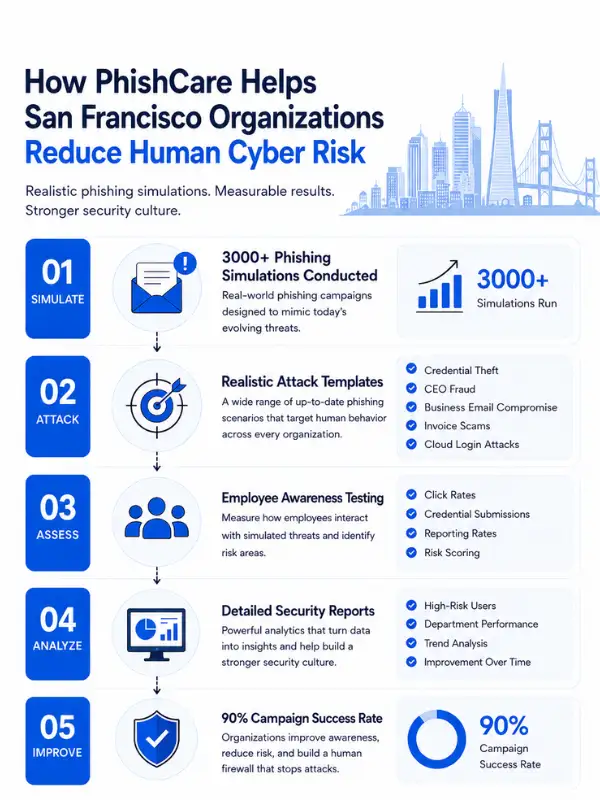
3000+ Phishing Simulations and a 90% Campaign Success Rate
Building an effective security awareness program requires more than occasional employee training. Organizations need continuous testing, measurable reporting, and practical learning experiences that help employees identify phishing attempts before they become incidents. Through thousands of phishing simulations, PhishCare has helped organizations strengthen awareness and reduce human cyber risk.
What Drives These Results?
Realistic Attack Scenarios
Employees are exposed to phishing simulations that mirror real-world threats, including credential harvesting, executive impersonation, invoice fraud, and cloud login attacks.
Continuous Reinforcement
Awareness improves when employees receive ongoing testing and education rather than relying solely on annual cybersecurity training programs.
Actionable Analytics
Detailed reporting helps organizations identify high-risk users, measure awareness improvement, and make informed security decisions.
Moving Beyond Compliance-Driven Awareness
Organizations that regularly test and educate employees are better positioned to reduce phishing risk over time. PhishCare’s campaign reports can also provide an additional documentation boost for organizations working toward ISO 27001, SOC 2 Type II, PCI DSS, HIPAA, and NIST CSF awareness initiatives where ongoing employee education is recognized as a best practice.
Industries We Support
Every industry faces unique phishing threats. Financial institutions are targeted by payment fraud scams, healthcare organizations face patient data risks, and technology companies are frequently targeted for credentials and intellectual property. PhishCare helps organizations deliver industry-relevant phishing simulations and security awareness programs that reflect the threats employees are most likely to encounter.
Finance
Financial organizations face constant phishing attempts involving payment fraud, invoice scams, account compromise, and credential theft. PhishCare helps employees identify and respond to these high-risk scenarios.
Banking
Banking teams are frequently targeted by sophisticated social engineering campaigns designed to obtain sensitive information or initiate unauthorized transactions. Continuous phishing simulations help strengthen employee vigilance.
Healthcare
Healthcare organizations handle sensitive patient information and are often targeted by phishing attacks seeking credentials, records access, or ransomware deployment opportunities.
Information Technology
Technology organizations face phishing attacks targeting developer accounts, cloud platforms, administrative credentials, and business communication systems. Awareness programs help reduce exposure to these risks.
Industry-Specific Awareness Delivers Better Results
Employees are more likely to engage with security awareness programs when the simulations reflect realistic situations they may encounter in their daily work. Industry-specific phishing campaigns help improve relevance, participation, and long-term retention of cybersecurity best practices.
Designed for Organizations of All Sizes
Whether you are a growing startup, a mid-sized business, or a large enterprise, PhishCare provides the flexibility to deploy phishing simulations, awareness campaigns, and reporting programs that align with your organization’s security objectives and workforce size.
Realistic Phishing Templates and Employee Testing
Employees are far more likely to develop strong phishing detection skills when simulations closely resemble the threats they encounter in real life. Generic awareness emails often fail to prepare users for modern phishing tactics. PhishCare helps organizations create realistic phishing experiences that test awareness in a practical and measurable way.
Why Realistic Simulations Matter
Cybercriminals continually evolve their tactics. Employees need exposure to realistic attack scenarios that mirror current phishing techniques, helping them recognize suspicious messages before they become security incidents.
CEO Fraud Emails
Employees receive simulated executive impersonation emails that test their ability to identify urgent requests, payment fraud attempts, and business email compromise tactics.
Credential Harvesting Attacks
Simulated Microsoft 365, Google Workspace, and cloud platform login pages help organizations assess employee readiness against credential theft attempts.
Invoice and Payment Scams
Finance and procurement teams can be tested using realistic invoice fraud and payment redirection scenarios that reflect common attack methods.
Cloud Service Notifications
Simulated file-sharing requests, password expiry notices, and account verification messages help employees recognize common phishing lures.
What Employee Testing Measures
Measure engagement with simulated phishing campaigns.
Identify employees who may require additional awareness support.
Evaluate susceptibility to credential theft scenarios.
Track how effectively employees identify and report suspicious emails.
From Awareness to Action
The goal of phishing simulations is not to catch employees making mistakes. The objective is to create learning opportunities that improve awareness, encourage reporting, and help build a stronger security culture across the organization.
Reporting, Analytics, and Compliance Support
Running phishing simulations is only one part of an effective awareness program. Security leaders need visibility into employee behavior, risk trends, and awareness progress to make informed decisions. PhishCare provides detailed reporting and actionable insights that help organizations measure and improve their security awareness initiatives over time.
Why Reporting Matters
Without measurable data, it becomes difficult to determine whether awareness efforts are improving employee behavior. Reporting helps organizations identify high-risk areas, track progress, and demonstrate the effectiveness of their security awareness programs.
Click Rate Analysis
Understand how employees interact with phishing emails and identify groups that may require additional awareness reinforcement.
Credential Submission Tracking
Measure susceptibility to credential theft scenarios and identify employees who may need targeted education.
Threat Reporting Metrics
Track how often employees identify and report suspicious emails, helping measure positive security behaviors.
Department Insights
Compare awareness performance across teams, departments, and business units to prioritize future training efforts.
Key Reporting Metrics Organizations Can Track
| Metric | What It Measures | Business Value |
|---|---|---|
| Open Rate | Email engagement | Campaign participation visibility |
| Click Rate | Interaction with phishing links | Risk identification |
| Credential Submission | Credential theft susceptibility | Targeted awareness actions |
| Report Rate | Threat reporting behavior | Positive security culture indicator |
| Trend Analysis | Performance over time | Awareness program effectiveness |
Supporting Security and Compliance Initiatives
PhishCare campaign reports can provide an additional documentation boost for organizations working toward ISO 27001, SOC 2 Type II, PCI DSS, HIPAA, and NIST CSF initiatives, where ongoing security awareness training is widely recognized as a cybersecurity best practice. Reporting helps demonstrate awareness activities, participation levels, and continuous improvement efforts.
Turn Awareness Data into Actionable Security Improvements
The most valuable awareness programs are those that continuously evolve. By combining realistic phishing simulations with detailed analytics and reporting, organizations can make data-driven decisions that strengthen employee resilience and reduce cybersecurity risk.
What Organizations Say About PhishCare
The effectiveness of a phishing simulation platform is best measured by the organizations that use it. PhishCare helps businesses strengthen employee awareness through realistic phishing campaigns, practical learning experiences, and measurable security outcomes.
We recently used PhishCare for a phishing simulation, and I’ve got to say, their email templates were top-notch. The realism and variety of the templates were impressive, really testing our team’s vigilance. The level of detail they put into crafting these emails was evident, making the simulation both challenging and effective. It’s clear they know their stuff when it comes to cybersecurity. Highly recommend them.
LDS
Realistic Campaigns
Organizations consistently value realistic phishing templates because they help employees experience the types of attacks commonly used by cybercriminals.
Meaningful Learning
The goal is not simply identifying who clicks on phishing emails. Effective simulations create learning opportunities that improve awareness and decision-making.
Measurable Results
Security teams gain valuable insights into employee behavior, helping organizations continuously strengthen their security awareness programs.
Why Customer Feedback Matters
A successful phishing simulation program should not only measure employee behavior but also provide realistic learning experiences that strengthen an organization’s overall security culture. Feedback from organizations helps demonstrate how awareness programs perform in real-world environments.
Trusted by Organizations for Phishing Simulation and Security Awareness Training
Organizations across finance, banking, healthcare, technology, and professional services use PhishCare to strengthen employee awareness, test phishing readiness, and build a stronger security culture. Our experience delivering phishing simulations across multiple industries helps organizations better understand and reduce human cyber risk.









Built for Organizations That Take Security Awareness Seriously
Effective security awareness programs require more than annual training sessions. Organizations need realistic phishing simulations, measurable reporting, and continuous reinforcement to improve employee awareness and reduce human cyber risk. PhishCare helps deliver all three through a practical and scalable platform.
Why Security Awareness Training Needs Continuous Reinforcement
Many organizations still rely on annual cybersecurity awareness sessions as their primary method of employee education. While awareness training remains an important part of a cybersecurity strategy, cyber threats evolve continuously. Employees who receive training once a year may struggle to recognize sophisticated phishing attacks months later when real threats appear in their inboxes.
The Challenge with One-Time Awareness Training
Knowledge fades over time. Employees often return to daily business priorities and gradually become less vigilant when identifying suspicious emails, login requests, payment instructions, or unexpected file-sharing notifications. Continuous reinforcement helps keep cybersecurity awareness fresh and relevant.
Threats Continuously Evolve
Cybercriminals constantly adapt their phishing techniques. New attack methods emerge regularly, making ongoing awareness education essential for maintaining employee readiness.
Employees Learn Through Practice
Realistic phishing simulations provide practical experience that helps employees build stronger threat recognition skills than theoretical training alone.
Behavior Changes Over Time
Consistent reinforcement helps transform awareness from a training requirement into a lasting security habit across the organization.
Continuous Awareness Cycle
Deliver awareness education.
Conduct realistic phishing simulations.
Analyze user behavior and trends.
Refine awareness initiatives continuously.
Building a Long-Term Security Culture
Organizations that combine ongoing awareness training with realistic phishing simulations create a stronger security culture over time. Continuous reinforcement helps employees remain vigilant, encourages threat reporting, and supports a proactive approach to reducing human cyber risk.
Why PhishCare Stands Out for San Francisco Organizations
San Francisco organizations operate in one of the most technology-driven business environments in the world. Employees work across cloud platforms, collaborate remotely, handle sensitive data, and face increasingly sophisticated phishing attacks. Security awareness programs must evolve accordingly. PhishCare helps organizations move beyond generic awareness training and adopt a practical, measurable approach to reducing human cyber risk.
Built for Modern Security Awareness Programs
Rather than treating awareness training as a one-time exercise, PhishCare supports continuous learning through realistic phishing simulations, ongoing employee education, measurable reporting, and practical reinforcement that helps organizations strengthen security behavior over time.
Realistic Attack Simulation
Employees are tested using phishing scenarios that reflect current attack techniques, helping organizations evaluate readiness against real-world threats.
Actionable Reporting
Detailed campaign analytics provide valuable insights into employee behavior, awareness trends, reporting rates, and areas requiring further reinforcement.
Continuous Awareness Reinforcement
Regular simulations and ongoing education help keep cybersecurity awareness relevant throughout the year rather than limiting learning to annual training events.
Scalable Deployment
Whether supporting startups, growing businesses, or enterprise environments, PhishCare can scale to meet varying workforce sizes and awareness objectives.
Why Organizations Choose PhishCare
Helping Organizations Build a Stronger Human Firewall
Technology alone cannot stop every phishing attack. Employees remain one of the most targeted elements of modern cyberattacks. By combining realistic phishing simulations, awareness training, reporting, and continuous reinforcement, PhishCare helps organizations strengthen their first line of defense against phishing threats.
Explore PhishCare Resources
Whether you are evaluating phishing simulation platforms, building a security awareness program, or looking to improve employee resilience against phishing attacks, the resources below can help you better understand how PhishCare supports modern cybersecurity awareness initiatives.
Download a Sample Report
See the type of reporting, analytics, and campaign insights organizations receive after running phishing simulations with PhishCare.
Download Sample ReportView Product Brochure
Explore platform capabilities, phishing simulation features, awareness training options, reporting functionality, and deployment details.
Download BrochureTalk to Our Team
Discuss your phishing awareness objectives, deployment requirements, reporting needs, and employee training strategy with our team.
Contact UsWhy Organizations Start with These Resources
Review the type of insights and metrics available after phishing campaigns.
Explore phishing simulation, awareness training, and reporting capabilities.
Understand how awareness programs can be aligned with organizational goals.
Take the Next Step Toward Stronger Security Awareness
Organizations that continuously test and educate employees are better positioned to reduce phishing risk and strengthen cybersecurity resilience. Explore the resources above or connect with our team to learn how PhishCare can support your awareness objectives.
Phishing Simulation and Security Awareness Training FAQs
Below are answers to common questions organizations ask when evaluating phishing simulation platforms and security awareness training programs.
What is a phishing simulation platform?
A phishing simulation platform allows organizations to send realistic but safe phishing emails to employees. The goal is to evaluate awareness levels, identify risky behaviors, and provide learning opportunities that help employees recognize and respond to phishing attacks.
Why are phishing simulations important?
Phishing simulations help organizations understand how employees respond to suspicious emails in realistic situations. They provide measurable insights into awareness levels and help reinforce cybersecurity best practices through practical experience.
How often should phishing simulations be conducted?
The ideal frequency depends on organizational needs, industry risks, and employee awareness maturity. Many organizations conduct recurring phishing simulations throughout the year to continuously reinforce awareness and measure improvement.
Can phishing simulation reports support compliance initiatives?
PhishCare campaign reports can provide an additional documentation boost for organizations working toward ISO 27001, SOC 2 Type II, PCI DSS, HIPAA, and NIST CSF initiatives where ongoing security awareness training is recognized as a cybersecurity best practice.
What types of phishing attacks can be simulated?
Organizations can simulate a variety of attack scenarios including credential theft campaigns, executive impersonation attempts, invoice fraud, cloud login phishing, file-sharing notifications, and other common social engineering tactics.
Why do San Francisco organizations choose PhishCare?
Organizations choose PhishCare for realistic phishing simulations, employee awareness training, detailed reporting, continuous reinforcement, and the ability to measure and improve cybersecurity awareness across the workforce.
Author & Content Reviewer

Mohammed Nawaz Sajjad is a practicing cybersecurity professional specializing in phishing simulations, employee security awareness assessments, social engineering risk analysis, red team engagements, and ethical hacking. He works directly with organizations to evaluate employee readiness against modern phishing attacks, including executive impersonation, credential harvesting campaigns, invoice fraud attempts, and business email compromise scenarios.
Through his work with PhishCare, a phishing simulation and security awareness training platform developed by CyberSapiens, he has contributed to cybersecurity awareness initiatives across finance, banking, healthcare, technology, and professional services sectors. His experience includes helping organizations improve phishing detection capabilities, strengthen employee cyber resilience, and build stronger security cultures through realistic phishing simulation programs.
His areas of expertise include phishing simulation campaigns, cybersecurity awareness training, cyber resilience programs, vulnerability assessments, red teaming, ethical hacking, and security awareness program development aligned with modern cybersecurity best practices.
View LinkedIn ProfileProtect Your Organization Against Modern Phishing Attacks
PhishCare helps organizations identify human cyber risk through realistic phishing simulations, engaging security awareness training, and actionable reporting. Join organizations across finance, banking, healthcare, and technology that are building stronger security cultures through continuous awareness programs.
Trusted by organizations across finance, banking, healthcare, IT, and professional services to improve phishing awareness, strengthen employee resilience, and reduce human cyber risk.