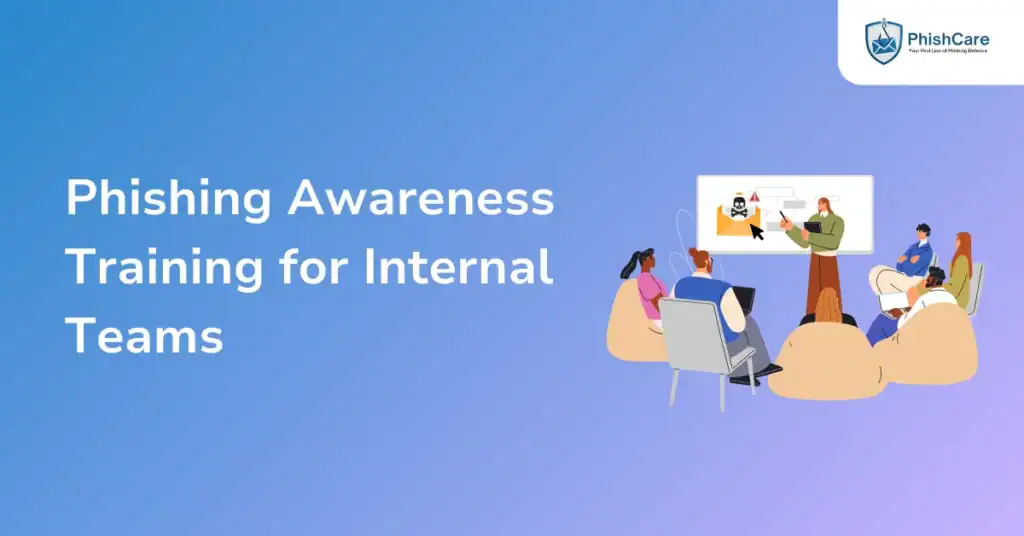
Phishing continues to be one of the most effective and financially damaging cyber attack vectors, not because organizations lack security technology, but because attackers have fundamentally changed how they operate. Modern phishing is no longer about exploiting technical vulnerabilities. It is about exploiting trust, routine, and human judgment inside organizations.
Over the last decade, businesses have invested heavily in email security gateways, endpoint detection, identity controls, and AI-driven threat detection. Yet phishing-led incidents remain a leading cause of data breaches, ransomware outbreaks, financial fraud, and operational disruption. This contradiction has led many organizations to quietly question the value of phishing awareness training for internal teams.
If security tools are smarter and threats are supposedly easier to detect, why do employees still need training? The answer lies in understanding how phishing has evolved and why internal teams have become the primary target rather than the weakest link.
How Phishing Has Evolved Beyond “Suspicious Emails”
Early phishing attacks relied on volume and obvious deception. Poor grammar, generic messaging, and suspicious links made detection relatively straightforward. Awareness training focused on teaching employees how to spot these signs. Today’s phishing attacks look nothing like that.
Modern phishing campaigns are highly contextual. Messages reference real vendors, ongoing projects, internal tools, and legitimate business processes. Attackers time their messages to coincide with payroll cycles, audits, vendor payments, or executive travel. In many cases, phishing emails contain no malware, no malicious attachments, and no detectable anomalies.
Instead, they rely on persuasion. When a phishing message looks and feels like routine work, it bypasses technical defenses and lands directly in the hands of an employee. At that moment, security becomes a human decision rather than a technical one.
Why Internal Teams Are the Primary Target
Internal teams are not targeted because they lack awareness. They are targeted because they are trusted participants in critical workflows. Finance teams authorize payments and process invoices. HR teams manage payroll, identity data, and onboarding. Operations teams coordinate with suppliers and service providers. Leadership teams hold authority that can override established controls.
Attackers design phishing campaigns specifically around these roles. They understand approval paths, escalation patterns, and organizational hierarchy. By impersonating a vendor, a colleague, or a senior executive, attackers exploit the very trust that allows organizations to function efficiently. This is why phishing awareness training cannot be treated as a basic hygiene exercise. Internal teams sit at the intersection of trust and access, making their decisions central to organizational security.
The False Sense of Security Created by Technical Controls
Advanced security tools are essential, but they create a dangerous illusion when organizations assume they can compensate for human risk entirely. Email security platforms are effective at blocking known threats, but they cannot reliably detect contextually legitimate messages that exploit business logic rather than technical flaws. Collaboration tools, messaging platforms, and voice communication channels were designed for productivity, not threat detection.
Once a phishing attempt reaches an employee and appears legitimate, technology steps aside. The final decision rests with the person reading the message. Phishing awareness training exists to prepare employees for that moment, not to replace technical controls, but to complement them where they inevitably fall short.
Why PhishCare is the Best Phishing Awareness Platform for Internal Teams

- Customizable Templates
- Awareness Module
- Assessment Test
- Comprehensive Tracking
- Graphical Dashboard Access
- Campaign Report
- Custom Domain Integration
Why Traditional Awareness Training Often Fails
Many organizations already run phishing awareness training, yet incidents persist. This is not because training is unnecessary, but because it is often poorly aligned with real-world conditions.
Traditional programs focus on theoretical knowledge. Employees are shown examples of phishing emails, taught to look for red flags, and tested through quizzes. While this builds basic understanding, it does not prepare employees for realistic scenarios where messages are well-written, urgent, and familiar. Phishing attacks succeed under pressure, distraction, and cognitive overload. Static training delivered once a year does not change behavior in those moments. Awareness without practice does not translate into readiness.
What Effective Phishing Awareness Training Must Address
For phishing awareness training to be genuinely effective for internal teams, it must focus on behavior rather than information. Employees need to understand how psychological manipulation works. Authority bias, urgency, familiarity, and helpfulness are the core levers attackers use. Training must help employees recognize when these triggers are being exploited, even when the message itself looks legitimate.
Equally important is building verification habits. Employees should be trained to pause and verify requests involving payments, access changes, or sensitive data, regardless of who appears to be asking. Verification should be normalized as a security practice, not discouraged as inefficiency.
Finally, training must reflect how work actually happens. Phishing is no longer confined to email. Internal teams are targeted through collaboration platforms, messaging apps, voice calls, shared documents, and even video meetings. Awareness programs must address this broader attack surface.
Why Phishing Simulation Changes the Effectiveness of Training
Phishing awareness training becomes significantly more effective when combined with realistic phishing simulation. Simulation allows organizations to test how internal teams behave under real conditions, rather than assuming awareness based on completion rates or quiz scores. Safe, controlled phishing simulations expose employees to realistic attack scenarios without causing harm.
Through simulation, organizations can identify where hesitation occurs, which departments are most exposed, and which attack types are most effective. This data reveals behavioral risk that traditional training cannot surface. Repeated simulations also build instinctive responses. Employees become more comfortable pausing, verifying, and reporting suspicious activity because they have experienced similar scenarios before.
How PhishCare Supports Awareness Training for the Internal Teams
PhishCare integrates phishing simulation directly into awareness training, allowing organizations to move from theoretical education to measurable behavior change.
Using a structured, end-to-end simulation process, PhishCare helps organizations define objectives, establish baseline awareness, design realistic phishing scenarios, and execute controlled campaigns that mirror real attacker techniques. Employee responses are tracked in detail, providing insight into awareness maturity and behavioral risk.
Crucially, learning is reinforced in context. When employees miss warning signs or fall for a simulation, targeted awareness training is delivered close to the moment of error. This approach improves long-term judgment rather than short-term compliance and helps build a culture where security awareness is continuous rather than episodic.
The Business Impact of Well-Executed Awareness Training
Effective phishing awareness training reduces more than just the likelihood of a successful attack. It reduces the downstream impact of incidents that do occur. Employees who are trained and confident are more likely to report suspicious activity early, allowing security teams to contain threats before they spread. This reduces investigation time, response costs, operational disruption, and regulatory exposure.
From a leadership perspective, awareness training supported by simulation provides measurable evidence of risk reduction. It allows organizations to demonstrate due diligence, improve audit readiness, and justify security investments based on behavioral outcomes rather than assumptions.
Why Phishing Awareness Training Is Still Necessary, Just Not the Old Way
The question is not whether phishing awareness training is still necessary for internal teams. The question is whether it is being delivered in a way that matches the reality of modern attacks. Phishing has become more targeted, more contextual, and more psychologically sophisticated. Internal teams have become a primary attack surface because they are embedded in trusted workflows. Technology alone cannot prevent mistakes made in good faith. Awareness training remains essential, but only when it is continuous, behavior-driven, and reinforced through realistic simulation.
Organizations that treat phishing awareness as a checkbox exercise remain exposed. Those that treat it as a core security capability are far better positioned to reduce real-world risk. When internal teams understand how phishing works, recognize manipulation, verify high-risk requests, and report suspicious activity confidently, they stop being passive targets. They become an active human firewall that complements technical defenses rather than undermining them. That transformation is what modern phishing awareness training is meant to achieve.
Frequently Asked Questions
1. Why do internal teams still need phishing awareness training if security tools are advanced?
Because once a phishing message reaches an employee, the decision to act or verify is entirely human.
2. Is phishing awareness training only relevant for non-technical staff?
No. Finance teams, HR teams, executives, and technical users are all frequently targeted due to their access and authority.
3. How often should phishing awareness training be conducted?
It should be continuous and reinforced regularly, not limited to annual sessions.
4. What role does phishing simulation play in training?
Simulation tests real behavior, reveals hidden risk, and reinforces learning through realistic scenarios.
5. Can phishing awareness training actually reduce financial loss?
Yes. Many high-impact phishing incidents are preventable when employees are trained to pause, verify, and report.