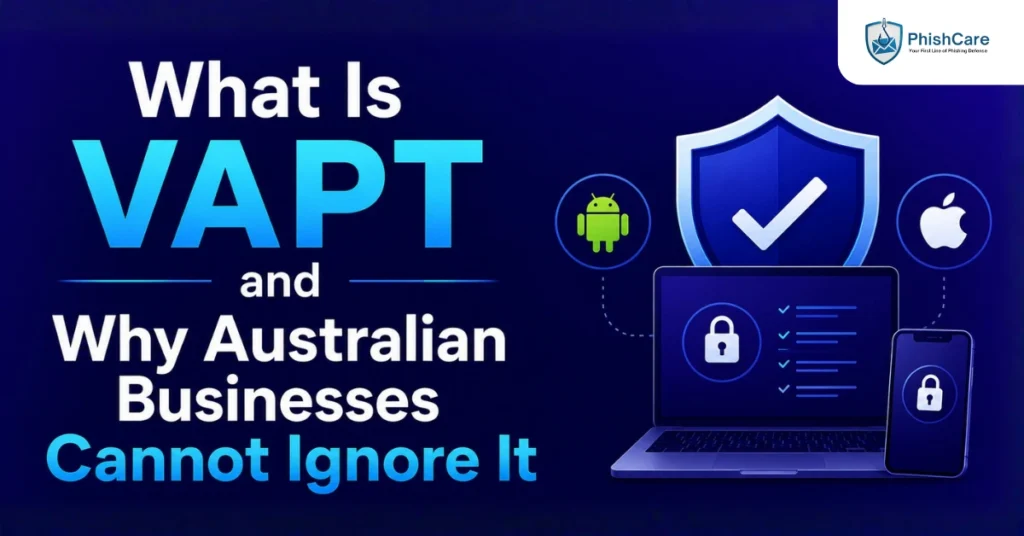
Every week, Australian businesses face phishing attempts, credential theft, ransomware drops, and application exploits. Most of these attacks succeed not because the attacker was sophisticated, but because nobody had ever tested whether the target could withstand one.
VAPT — Vulnerability Assessment and Penetration Testing — is the structured process of finding those weaknesses before an attacker does. It is one of the most direct, evidence-based ways an organisation can understand its real security posture, not just its assumed one.
This guide explains what VAPT means, how it works, what types of testing exist, how pricing is determined in Australia, and what to look for when choosing a provider.
What Is VAPT?
VAPT stands for Vulnerability Assessment and Penetration Testing. A vulnerability assessment identifies and classifies security weaknesses in your systems. Penetration testing actively exploits those weaknesses under controlled, authorised conditions to confirm their real-world impact. Together, they give organisations a verified picture of their actual security exposure — not a theoretical one.
What Does VAPT Mean?
VAPT is a two-phase approach to security testing. The two components are closely related but serve different purposes.
Vulnerability Assessment
A systematic scan and review of an environment — applications, networks, infrastructure, or cloud systems — to identify known weaknesses. It produces a ranked list of issues by severity. It tells you what could be exploited.
Penetration Testing
A trained security analyst attempts to exploit identified vulnerabilities in a controlled, authorised environment. It demonstrates real-world impact — whether an attacker could access sensitive data, escalate privileges, pivot across a network, or exfiltrate information. It tells you what an attacker could actually achieve.
Used together, VAPT gives a business both breadth — what is exposed — and depth — how severe the damage could be if that exposure were exploited by a real attacker.
VA vs Pentest vs VAPT
Identifies what is vulnerable. Does not confirm exploitability or real-world impact.
Attempts exploitation but may lack the structured discovery phase that surfaces all weaknesses.
Combines both phases for a complete picture — systematic discovery followed by confirmed exploitation and business impact evidence.
The term VAPT is widely used across Australia, India, the UK, and Southeast Asia. In the United States, the process is more commonly referred to as penetration testing or a pentest. The methodology is the same regardless of the label used.
Why VAPT Matters for Australian Businesses in 2026
Australia has seen a sharp increase in reported cyber incidents over the past three years. The Australian Signals Directorate’s annual cyber threat report consistently identifies exploitation of public-facing applications and phishing as the two most common initial access vectors for serious incidents affecting Australian organisations.
Several factors make VAPT particularly relevant for Australian organisations right now.
Notifiable Data Breaches Scheme
Organisations covered by the Privacy Act must notify the Office of the Australian Information Commissioner when a data breach is likely to result in serious harm. A successful attack carries both regulatory and reputational consequences. VAPT helps identify the vulnerabilities that could lead to such a breach before an attacker finds them.
ACSC Essential Eight
The Australian Cyber Security Centre’s baseline framework includes controls that are directly tested during a VAPT engagement — including patching applications, patching operating systems, and restricting administrative privileges. Organisations seeking higher maturity levels benefit directly from regular penetration testing as evidence that controls are working as intended.
ISO 27001 and SOC 2 Type II
Both frameworks recognise regular security testing as a best practice. VAPT findings and remediation records are used by organisations to support their compliance documentation and demonstrate ongoing security improvement to auditors. Phishing simulation reports from PhishCare add further documentation depth for the human layer of security controls.
Cyber Insurance Requirements
Cyber insurance providers in Australia are increasingly asking applicants to provide evidence of penetration testing as part of the underwriting process. Without it, premiums rise or coverage is restricted. A current VAPT report demonstrates proactive security management to insurers.
The question is not whether your systems have vulnerabilities.
Every system does. The question is whether you find them before an attacker does — and whether you have the evidence to show auditors, insurers, and clients that you take security seriously.
View VAPT Services by CyberSapiensTypes of VAPT — What Gets Tested
VAPT is not a single service. It covers several distinct domains, and most organisations need more than one type depending on their environment, industry, and compliance obligations.
Web Application VAPT
Tests web-facing applications for vulnerabilities including SQL injection, cross-site scripting, broken authentication, insecure direct object references, and other issues aligned with the OWASP Top 10. This is the most common type for SaaS companies, fintech platforms, healthcare portals, and any business with a customer-facing web application.
Web Application VAPT by CyberSapiensMobile Application VAPT
Tests iOS and Android applications for insecure data storage, improper session handling, weak encryption, API exposure, and platform-specific vulnerabilities. As mobile banking, healthcare apps, and enterprise tools expand across Australia, mobile VAPT has become an essential part of any application security programme.
Mobile Application VAPT by CyberSapiensAPI VAPT
Modern applications rely heavily on APIs to connect services, share data, and enable integrations. API security testing examines authentication controls, rate limiting, data exposure, and input validation across REST and GraphQL APIs. Many significant data breaches in recent years originated from poorly secured APIs that went untested.
API VAPT by CyberSapiensInfrastructure and Network VAPT
Tests internal and external network infrastructure, firewalls, routers, switches, and servers for misconfigurations, unpatched services, and exploitable vulnerabilities. Critical for organisations with on-premises infrastructure or hybrid cloud environments across Australian locations.
Network VAPT by CyberSapiensCloud Penetration Testing
Tests cloud environments for misconfigured storage buckets, overpermissioned IAM roles, exposed management interfaces, and other cloud-specific risks. Cloud misconfigurations remain one of the most common causes of large-scale data exposure for Australian businesses operating on AWS, Microsoft Azure, and Google Cloud Platform.
IoT Device VAPT
Tests connected devices including industrial sensors, building management systems, medical devices, and operational technology for firmware vulnerabilities, insecure communication protocols, and default credential exposure. IoT attack surfaces are frequently overlooked and are an increasingly targeted entry point.
IoT Device VAPT by CyberSapiensThick Client and Thin Client VAPT
Tests desktop and browser-based applications that interact with backend systems, covering issues in client-side logic, memory handling, and communication security. Often overlooked in favour of web application testing, these environments carry significant risk in enterprise settings.
Thick and Thin Client VAPT by CyberSapiensHow a VAPT Engagement Works
Understanding the process helps organisations prepare properly, set realistic expectations, and get more value from the engagement. A structured VAPT follows six clearly defined phases.
Scoping
The organisation and the testing team agree on the scope — which systems, applications, or environments will be tested, what the testing boundaries are, and what the success criteria look like. Clear scoping prevents disruption to production systems and ensures the right assets are prioritised based on risk.
Reconnaissance
The analyst gathers information about the target environment. This includes open-source intelligence (OSINT), subdomain enumeration, technology fingerprinting, and review of publicly available information. Reconnaissance mirrors what a real attacker would do before attempting an intrusion — and it often reveals more exposure than organisations expect.
Vulnerability Identification
A combination of automated scanning tools and manual testing techniques identifies potential vulnerabilities. Automated tools are fast and broad. Manual testing finds logical flaws, business logic errors, and chained vulnerabilities that scanners consistently miss. Quality VAPT relies on both — not one in place of the other.
Exploitation
The analyst attempts to exploit confirmed vulnerabilities in a controlled, authorised way. The goal is to demonstrate real-world impact — not just list findings. This phase separates a genuine penetration test from a vulnerability scan. It is where chained attacks, privilege escalation paths, and lateral movement are confirmed or ruled out.
Note: All exploitation is conducted within the agreed scope and boundaries only. No production data is exfiltrated. Activity is logged and can be provided as part of the engagement record.
Reporting
A detailed report is produced covering all findings, their severity ratings (Critical, High, Medium, Low, Informational), evidence of exploitation, and specific remediation guidance. Quality reports are written for two audiences: the technical team who will fix the issues, and the executive team who needs to understand business risk and compliance implications.
Remediation Support and Retesting
After the organisation addresses the findings, a retest confirms that vulnerabilities have been resolved correctly and that no new issues were introduced during remediation. This step is critical for compliance evidence — auditors expect to see that findings were not only identified but closed.
See What a VAPT Report Looks Like
PhishCare publishes a sample phishing simulation report so organisations can review the reporting format before committing to an engagement. A structured, evidence-based report is the primary deliverable of any security testing exercise.
Download PhishCare Sample ReportWhat Determines VAPT Cost in Australia
VAPT pricing in Australia is not fixed. It varies based on several factors specific to each organisation and engagement. Understanding what drives cost helps businesses scope their engagement appropriately and avoid paying for testing that does not match their risk profile.
The following are the primary factors that influence what a VAPT engagement costs.
Factor 1
Scope and Number of Assets
A single web application with five user roles is priced differently from an environment that includes ten microservices, three APIs, and a mobile app. More assets, more endpoints, and more complex user permission structures all increase the time and skill required.
Factor 2
Type of Testing Required
Web application VAPT, mobile VAPT, API testing, cloud penetration testing, and network infrastructure testing each require different skill sets, tools, and time. A full-scope engagement across multiple domains carries a higher investment than a single-type assessment.
Factor 3
Application Complexity
A simple brochure website requires less testing time than a multi-tenant SaaS platform with payment processing, third-party integrations, and role-based access controls. Complexity in business logic is where manual testing time is concentrated most.
Factor 4
Manual vs Automated Testing Ratio
Automated scans are faster and cheaper but miss business logic vulnerabilities, authentication bypasses, and chained exploits. Engagements with a higher ratio of manual analyst time reflect more rigorous testing — and typically deliver findings that an automated tool would never surface.
Factor 5
Remediation Retesting
Some providers include a retest cycle within the engagement fee. Others charge separately. For compliance purposes, a retest confirmation is important — it provides the evidence that vulnerabilities identified were actually fixed, not just noted.
Factor 6
Compliance Documentation Requirements
Organisations undergoing ISO 27001, SOC 2 Type II, PCI DSS, or ACSC Essential Eight assessments may require the VAPT report in a specific format with particular evidence standards. Engagements scoped for compliance-grade reporting take additional care in documentation and audit trail.
Important: Automated Scans Are Not VAPT
A cheap automated scan is not a substitute for manual penetration testing.
Automated tools identify known CVEs and common misconfigurations. They cannot find business logic flaws, authentication bypasses, or attack paths that require human reasoning to construct. For compliance purposes, most frameworks and auditors require evidence of manual penetration testing — a scan report alone is not accepted as equivalent. The investment in a proper VAPT engagement reflects the depth of coverage your organisation actually needs.
Discuss Your VAPT Scope with CyberSapiensVAPT and Compliance in Australia
VAPT sits at the intersection of security and compliance for most Australian organisations. Several frameworks explicitly reference penetration testing as a recognised best practice, and auditors increasingly expect to see documented evidence of security testing as part of any certification or assessment process.
The following frameworks are directly relevant to Australian businesses considering a VAPT engagement.
Higher maturity levels under the ACSC Essential Eight require organisations to test whether security controls are working as intended. VAPT provides the technical evidence that patching, access controls, and configuration hardening controls are effective in practice — not just documented in policy. CyberSapiens provides ACSC Essential Eight compliance support for Australian organisations across all maturity levels.
Annex A controls related to information security testing are supported by documented VAPT findings and remediation records. Organisations working towards ISO 27001 certification in Australia benefit from VAPT reports as supporting evidence that technical controls have been assessed and validated against real-world attack scenarios. Ongoing security testing is recognised as a best practice by certification bodies.
Organisations undergoing SOC 2 Type II compliance in Australia benefit from VAPT reports as evidence of technical control testing across the audit period. Auditors working within the Trust Services Criteria framework expect to see documented security testing covering availability, confidentiality, and processing integrity controls. VAPT findings and remediation records strengthen the overall evidence package.
Requirement 11 of PCI DSS requires organisations that handle cardholder data to conduct regular penetration testing of their systems and network segmentation controls. This is one of the few frameworks where penetration testing is a defined requirement rather than a general best practice recommendation. CyberSapiens provides PCI DSS compliance support for Australian businesses handling payment data.
For Australian health organisations and those working with US-regulated clients, VAPT supports the identification and risk management requirements under both HIPAA and the NIST Cybersecurity Framework. CyberSapiens provides HIPAA compliance support for organisations operating across both Australian and international regulatory environments.
Strengthening the Human Layer
PhishCare’s phishing simulation campaign reports provide an additional documentation boost for organisations working towards ISO 27001, SOC 2 Type II, PCI DSS, HIPAA, or NIST CSF, where ongoing security awareness training is recognised as a best practice by auditors and certification bodies. VAPT addresses the technical layer. PhishCare addresses the human layer. Together, they cover the two most common initial attack vectors in Australian cyber incidents.
What to Look for in a VAPT Provider in Australia
Not all providers are equal. These are the factors that matter most when selecting a VAPT partner for an Australian business.
Manual Testing Capability
Ask whether the engagement includes manual exploitation, not just automated scanning. A reputable provider will confirm this clearly in its methodology documentation and explain how analysts validate risk beyond scanner output.
Reporting Quality
The report is the primary deliverable. Ask to see a sample report. It should include proof-of-concept evidence, clear severity ratings, business impact context, and actionable remediation steps written for both technical and executive audiences.
Industry Experience
VAPT for a fintech platform is different from VAPT for a healthcare portal or a cloud-native SaaS product. Choose a provider with demonstrated experience in your sector, since threat models and attack paths vary widely by industry.
Remediation Support
Testing without remediation guidance leaves organisations with a list of problems and no clear path forward. A quality provider offers retesting after fixes are applied and helps ensure the final report can be used as audit evidence.
Location and Accountability
While VAPT can be conducted remotely, having an Australian provider ensures clear jurisdiction, better accountability, and support that aligns with local business and compliance expectations.
CyberSapiens in Australia
VAPT Services Delivered Across Australia
CyberSapiens provides VAPT services from its Port Melbourne base, with remote delivery across Sydney, Melbourne, Perth, Brisbane, Adelaide, and regional Australia. Their team of senior security analysts covers web application, mobile, API, cloud, IoT, network, and infrastructure testing.
Supporting Compliance Services
CyberSapiens also supports organisations with broader compliance and testing needs through cloud, infrastructure, and sector-specific assessments. These services can be combined with VAPT to support risk management and audit readiness.
Frequently Asked Questions About VAPT
What does VAPT stand for?
VAPT stands for Vulnerability Assessment and Penetration Testing. Vulnerability assessment identifies and ranks security weaknesses in a system. Penetration testing actively exploits those weaknesses under controlled conditions to confirm their real-world impact and severity.
How is VAPT different from a vulnerability scan?
A vulnerability scan uses automated tools to identify known issues. VAPT includes manual testing by a trained analyst who attempts to exploit findings, chain vulnerabilities, and demonstrate actual business impact. For compliance and insurance purposes, manual penetration testing is typically the expectation, not just automated scanning.
How long does a VAPT engagement take in Australia?
Scope determines duration. A focused web application VAPT typically takes a few business days. A full-scope engagement covering multiple applications, cloud environments, and network infrastructure can take several weeks. A reputable provider should give you a timeline estimate during scoping.
Is VAPT required for ISO 27001 or SOC 2?
Neither ISO 27001 nor SOC 2 Type II mandates VAPT as a strict requirement. However, both frameworks recognise ongoing security testing as a best practice, and auditors regularly expect to see evidence of penetration testing during certification reviews.
Can VAPT be done remotely for businesses outside Melbourne?
Yes. Most VAPT work is conducted remotely using secure, encrypted testing environments. CyberSapiens serves clients across Sydney, Perth, Brisbane, Adelaide, and regional Australia, as well as international clients, from its Port Melbourne base.
Ready to know where your business is exposed?
CyberSapiens provides manual penetration testing across web applications, mobile apps, cloud environments, APIs, and network infrastructure for Australian businesses.

Content Reviewed by Abdul Rameez
Senior Security Analyst, CyberSapiens
Senior Security Analyst | Mentor | Bug Hunter | Security Researcher | VAPT | Web VAPT | Mobile VAPT | Ethical Hacker | Security Consultant
Abdul Rameez is a Senior Security Analyst at CyberSapiens with 4 years of hands-on experience across vulnerability assessment, penetration testing, mobile application security, web application security, ethical hacking, bug hunting, and security research. He reviews VAPT content to ensure technical accuracy, practical relevance, and alignment with real-world testing practices.
Book a Consultation
Ready to strengthen your security posture with VAPT?
CyberSapiens helps Australian businesses identify weaknesses across web applications, mobile apps, APIs, cloud environments, and networks. If you need a structured assessment with clear remediation guidance, the team can scope the right engagement for your environment.