If your Indian SaaS company, IT services firm, or fintech business is trying to close contracts with US or global enterprise clients, you have probably already been asked one question: “Do you have a current SOC 2 report?”
SOC 2 Type 2 compliance has become the baseline security credential that US enterprise procurement teams, investors, and legal departments expect before signing vendor contracts. For Indian companies competing in global markets, not having a SOC 2 Type 2 report means losing deals to competitors who do.
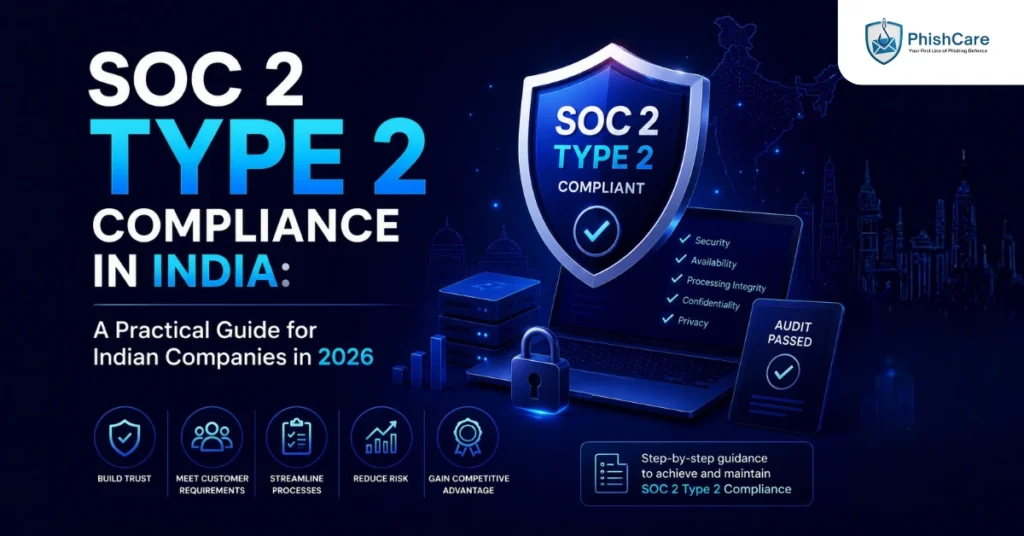
This guide breaks down everything Indian businesses need to know about SOC 2 Type 2 compliance in India in 2026. It covers what the certification actually involves, how it differs from Type 1, what the observation period requires, how it aligns with Indian regulations like the DPDP Act 2023 and RBI cybersecurity guidelines, and what a realistic timeline and cost look like for Indian organisations.
Key Takeaways from This Guide
SOC 2 Type 2 evaluates whether your security controls work effectively over a 6 to 12 month observation period, not just whether they exist on paper.
Indian SaaS, IT services, BPO, and fintech companies need SOC 2 Type 2 to win and retain long-term US enterprise contracts.
SOC 2 Type 2 controls map directly to India’s DPDP Act 2023, RBI cybersecurity guidelines, and SEBI framework requirements.
CyberSapiens has certified 50+ organisations with a 100% audit pass rate and delivers SOC 2 Type 1 in 6 to 8 weeks as a fast-track starting point.
What Is SOC 2 Type 2 and Why It Matters for Indian Companies
SOC 2 (System and Organisation Controls 2) is a security and compliance framework developed by the American Institute of Certified Public Accountants (AICPA). It defines how organisations must manage and protect customer data based on five Trust Services Criteria: Security, Availability, Processing Integrity, Confidentiality, and Privacy.
A SOC 2 Type 2 report goes beyond a point-in-time check. It evaluates whether your security controls were properly designed and operated effectively over a defined observation period, typically 6 to 12 months. An independent, AICPA-licensed CPA firm conducts the audit and issues the report.
For Indian companies, SOC 2 Type 2 compliance in India serves a very specific commercial purpose. US enterprise clients, UK procurement teams, and global investors treat a current SOC 2 Type 2 report as the single most trusted proof of a vendor’s security posture. It replaces lengthy security questionnaires and accelerates deal cycles.
Indian SaaS companies exporting to the US market, IT services firms handling sensitive client data under global contracts, BPO providers processing confidential information for international businesses, and fintech companies operating under RBI cybersecurity oversight all face growing pressure to hold a current SOC 2 Type 2 report.
Without it, Indian businesses consistently lose enterprise deals to certified competitors. With it, the procurement conversation shifts from “prove your security” to “let us review your SOC 2 report and move forward.”
SOC 2 Type 1 vs Type 2: Which One Does Your Indian Business Need?
Both SOC 2 Type 1 and Type 2 verify your security controls, but they differ in scope, timeline, and the weight they carry with enterprise clients and investors. Understanding the difference helps Indian businesses plan their certification journey without overspending or underdelivering.
| Criteria | SOC 2 Type 1 | SOC 2 Type 2 |
|---|---|---|
| What It Evaluates | Controls are properly designed at a single point in time | Controls are properly designed and operating effectively over time |
| Audit Type | Point-in-time snapshot | 6 to 12 month observation period |
| Typical Timeline | 6 to 8 weeks | 9 to 14 months total |
| Evidence Required | Controls exist at audit date | Controls worked consistently over the observation period |
| Cost | Lower due to shorter audit window | Higher due to extended observation and testing |
| Enterprise Client Weight | Accepted for initial onboarding and deal closure | Required for long-term contracts and annual renewals |
| Investor Acceptance | Satisfies Series A due diligence | Expected for Series B and institutional investors |
| Best For | Urgent deal closure, first certification, startups | Enterprise growth, recurring contracts, global scale |
Most Indian businesses follow a practical two-step path. They start with SOC 2 Type 1 to close an immediate enterprise deal or satisfy an investor’s due diligence requirement. Once the Type 1 report is issued, they transition directly into the SOC 2 Type 2 observation period. This approach avoids delays on active deals while building toward the stronger, long-term credential that enterprise clients expect for contract renewals.
CyberSapiens recommends this staged approach for most Indian organisations and manages the full transition from Type 1 to Type 2 as a single engagement.
Who Needs SOC 2 Type 2 Certification in India?
SOC 2 Type 2 is not a legal mandate in India. It is a commercial requirement driven by international enterprise clients, investors, and procurement teams. The following types of Indian businesses face the strongest demand for SOC 2 Type 2 certification.
SaaS Companies
Indian SaaS businesses selling to US, UK, Canadian, or Australian enterprise buyers are consistently asked for a current SOC 2 Type 2 report before contracts are signed. Without it, deals stall or move to a certified competitor.
IT Services and Outsourcing
Indian IT services companies handling sensitive client data under global contracts face SOC 2 Type 2 as a standard vendor onboarding requirement from enterprise clients in the US and Europe.
BPO and KPO Companies
Indian BPO and KPO providers processing confidential information for international businesses use SOC 2 Type 2 to replace the dozens of individual security questionnaires they receive from global clients every year.
Fintech and Payment Technology
Indian fintech businesses operating under RBI cybersecurity guidelines find that SOC 2 Type 2 controls map directly to RBI framework requirements, satisfying both international clients and domestic regulatory expectations.
Healthcare IT Companies
Indian healthcare technology firms handling patient data for international clients need SOC 2 Type 2 Privacy criteria to satisfy data protection obligations across jurisdictions.
Startups Raising Series B+
US venture capital and private equity firms increasingly require SOC 2 Type 2 during due diligence for Series B and later rounds. Indian startups without it face delays or reduced valuations.
Cloud and Managed Service Providers
Indian cloud service providers and MSPs serving enterprise or government clients face SOC 2 Type 2 Availability and Security criteria as baseline contract requirements.
The demand for SOC 2 Type 2 is strongest in Indian tech hubs. Organisations in Bangalore, Mumbai, Hyderabad, and Pune account for a large share of SOC 2 certifications in India, driven by the concentration of SaaS, IT services, and fintech businesses in these cities.
The Five Trust Services Criteria Behind Every SOC 2 Type 2 Audit
Every SOC 2 Type 2 audit is built on the Trust Services Criteria defined by the AICPA. These criteria set the standard for what auditors evaluate when examining your organisation’s controls. The full criteria, including the revised points of focus published in 2022, are maintained in TSP Section 100.
Security
Required in Every SOC 2 Audit
Security is the only mandatory Trust Services Criterion. It covers protection against unauthorised access, both physical and logical. This includes access controls, multi-factor authentication, firewall configurations, intrusion detection, and vulnerability management. Every SOC 2 Type 2 report must include Security.
Availability
Optional
Availability evaluates whether your systems are operational and accessible as committed to clients. It covers uptime monitoring, disaster recovery, business continuity planning, and capacity management. Indian SaaS companies with SLA commitments to enterprise clients typically include Availability in their SOC 2 scope.
Processing Integrity
Optional
Processing Integrity verifies that system processing is complete, accurate, timely, and authorised. Indian fintech companies and payment technology businesses handling financial transactions commonly include this criterion.
Confidentiality
Optional
Confidentiality addresses protection of information designated as confidential, such as client intellectual property, financial data, or legal documents. Indian BPO and KPO companies handling sensitive client information frequently include this criterion.
Privacy
Optional · DPDP Act Aligned
Privacy governs how personal information is collected, used, retained, disclosed, and disposed of. With India’s DPDP Act 2023 now in effect, the Privacy criterion has become increasingly relevant for Indian organisations processing personal data of Indian citizens or international customers.
The right combination of criteria depends on your business model, the data you handle, and what your enterprise clients expect. Most Indian SaaS and IT services companies start with Security and Availability, then add Privacy or Confidentiality based on client requirements.
How SOC 2 Type 2 Aligns with India’s Regulatory Landscape
One of the strongest reasons for Indian companies to pursue SOC 2 Type 2 is that it creates dual compliance value. The controls you build for SOC 2 Type 2 map directly to several Indian regulatory frameworks, which means a single compliance engagement can satisfy both your international SOC 2 auditor and your domestic legal obligations.
Federal Law
DPDP Act 2023
India’s Digital Personal Data Protection Act (DPDP Act) 2023 introduced binding obligations for how Indian businesses collect, process, retain, and protect personal data. SOC 2 Privacy and Security Trust Services Criteria directly address core DPDP Act requirements, including data minimisation, purpose limitation, security safeguards, and breach notification. Indian organisations pursuing SOC 2 Type 2 with Privacy included gain documented evidence of DPDP Act alignment as a natural outcome of the certification process.
Fintech
RBI Cybersecurity Guidelines
The Reserve Bank of India’s cybersecurity framework for banks, NBFCs, and payment system operators maps closely to SOC 2 Security and Availability controls. Indian fintech companies and banking technology suppliers pursuing SOC 2 Type 2 find that the same controls satisfying their SOC 2 auditor also demonstrate alignment with RBI cybersecurity expectations.
Capital Markets
SEBI Cybersecurity Framework
SEBI’s cybersecurity and cyber resilience framework for market infrastructure institutions and registered intermediaries aligns with SOC 2 controls covering access management, incident response, and business continuity. Indian capital market technology businesses can use SOC 2 Type 2 as a strategic investment that serves both international clients and SEBI regulatory expectations.
Cloud and SaaS
MeitY Cloud Security Policy
India’s Ministry of Electronics and Information Technology cloud security guidelines align with SOC 2 Security and Availability criteria. Indian cloud service providers and SaaS companies targeting government and enterprise clients benefit from this overlap.
The practical advantage is clear. Instead of running separate compliance projects for international certification and Indian regulatory obligations, Indian businesses can build one set of controls that satisfies multiple requirements through a single SOC 2 Type 2 engagement.
What the SOC 2 Type 2 Observation Period Actually Involves
The observation period is what separates SOC 2 Type 2 from Type 1 and is the part that most Indian businesses underestimate. During this period, your security controls must not just exist on paper. They must operate effectively and consistently, and you must collect evidence proving it.
How Long Is the Observation Period?
The standard observation period for SOC 2 Type 2 runs 6 to 12 months. Most Indian organisations choose a 6-month observation window for their first Type 2 audit, then extend to 12 months for subsequent renewals.
What Auditors Look For
During the observation period, your AICPA-licensed CPA auditor will examine evidence that controls operated as intended throughout the entire window. This is not a spot check. Auditors test a sample of events across the full observation period. Evidence they examine includes access logs showing who accessed what systems and when, records of user access reviews conducted at regular intervals, vulnerability scan results and remediation timelines, incident response records showing how security events were handled, backup logs showing automated backups ran successfully and were tested, change management records proving production changes were approved and documented, and vendor assessment records for third-party suppliers with access to your data.
The Most Common Observation Period Mistake
The biggest observation period failure for Indian companies is inconsistency. Controls that were active for five months but lapsed in month six create audit findings. A vulnerability scan schedule that skipped two months creates an audit finding. An access review that was conducted in January but not repeated until July creates an audit finding. The observation period rewards organisations that build controls into daily and weekly operations, not organisations that scramble to collect evidence at the end.
How to Prepare
The most effective approach is to start collecting evidence from day one of the observation period. CyberSapiens sets up evidence collection processes at the start of every SOC 2 Type 2 engagement so that Indian organisations are building their audit evidence file continuously throughout the observation window, not retroactively.
Common SOC 2 Type 2 Audit Failures Indian Companies Should Avoid
Based on patterns observed across SOC 2 engagements with Indian organisations, these are the control areas where audit findings most commonly occur during the Type 2 observation period.
Inconsistent User Access Reviews
Auditors expect documented user access reviews at regular intervals, typically quarterly. Indian companies often conduct an initial review but fail to maintain the cadence across the full observation period. Every review must be documented with timestamps, approver names, and any changes made.
Gaps in Vulnerability Scanning
Running vulnerability scans is not enough. Scans must run on schedule, results must be documented, and remediated vulnerabilities must have a clear evidence trail showing the fix and the timeline. Skipped months or undocumented remediation create findings.
Missing or Incomplete Incident Response Records
If a security incident occurred during the observation period, auditors expect a complete record: detection, escalation, containment, resolution, and post-incident review. Indian organisations sometimes resolve incidents informally without documenting the process, which creates audit gaps.
Weak Change Management Documentation
Production system changes must be approved, tested, and logged. Indian development teams sometimes deploy changes without formal approval documentation, especially in fast-moving SaaS environments. During the observation period, every production change needs an audit trail.
Incomplete Vendor Risk Management
If third-party vendors have access to your systems or data, auditors expect documented vendor assessments. Indian companies frequently overlook this control for smaller or long-standing vendor relationships.
Lapsed Employee Security Training
If your SOC 2 scope includes security awareness training, auditors expect completion records for all employees within the observation period. New hires who missed onboarding training or employees who did not complete annual refresher training create findings.
The pattern across all these failures is the same: the control existed, but the evidence of consistent operation was missing. SOC 2 Type 2 rewards operational discipline, not just policy documentation.
How CyberSapiens Helps Indian Companies Achieve SOC 2 Type 2
CyberSapiens is a globally recognised cybersecurity and compliance firm that has guided 50+ organisations through SOC 2 certification with a 100% audit pass rate and zero failed audits. For Indian businesses, CyberSapiens provides end-to-end SOC 2 Type 2 support, from the initial gap assessment through to the final audit report issued by an independent, globally recognised CPA firm.
What the CyberSapiens SOC 2 Engagement Covers
The process starts with a free gap assessment where CyberSapiens evaluates your current security posture against SOC 2 Trust Services Criteria and delivers a detailed gap report with a fixed-price quote within 24 hours.
From there, CyberSapiens handles scope definition to keep the audit focused and cost-effective, builds a prioritised remediation roadmap, and develops all required SOC 2 policies and procedures including Information Security Policy, Incident Response Plan, Access Control Policy, Change Management Policy, and Business Continuity Plan.
CyberSapiens then implements technical and administrative controls, sets up evidence collection processes from day one of the observation period, conducts an internal readiness assessment before the official audit, and manages the entire audit process with the independent CPA firm.
50+
Clients Certified
100%
Audit Pass Rate
6-8
Weeks for Type 1
0
Failed Audits
Key Differentiators for Indian Companies
CyberSapiens is an ISO 27001:2022 certified company, which means the firm operates under the same rigorous security standards it helps clients achieve. Every Indian engagement includes explicit mapping of SOC 2 controls against DPDP Act 2023 obligations, RBI cybersecurity guidelines, and SEBI framework requirements where applicable. This means one engagement satisfies both international certification and domestic regulatory alignment.
The official SOC 2 audit is conducted by Accorp Partners, a globally recognised AICPA-licensed CPA firm. The resulting report is accepted by US enterprise clients, global investors, and procurement teams worldwide.
CyberSapiens delivers SOC 2 Type 1 in 6 to 8 weeks as a fast-track starting point, with the Type 2 observation period managed as a seamless continuation. Services are delivered remotely across all of India. To compare top SOC 2 compliance vendors in India, CyberSapiens combines certified expertise, fixed pricing, and a proven track record that generalist consultants cannot match.
Case Study: How Sciative Solutions Achieved SOC 2 Compliance with CyberSapiens
Client Success Story
Sciative Solutions, a technology and SaaS company, engaged CyberSapiens to achieve SOC 2 compliance. The engagement moved Sciative from ad-hoc security processes to a structured, compliance-driven operating model.
By aligning with SOC 2, Sciative built a secure, reliable, and enterprise-ready platform. The certification gave them independently verified proof of their security posture, which they could share directly with enterprise clients and investors.
SOC 2 Type 2 Certified
Enterprise-Ready Platform
Zero Audit Failures
Structured Compliance Model
CyberSapiens managed the full journey for Sciative, from gap assessment through policy development, control implementation, evidence collection, and final audit with the independent CPA firm. This is a representative example of how CyberSapiens works with Indian technology companies across industries.
Running Phishing Simulations as an Additional Layer of SOC 2 Readiness
While SOC 2 Type 2 does not specifically require phishing simulations, several Trust Services Criteria, particularly CC2.2 (communication about internal controls) and CC1.4 (commitment to competence), reference the need for ongoing security awareness among employees.
Organisations that run regular phishing simulation campaigns as part of their employee security awareness programme build a stronger evidence base during the SOC 2 Type 2 observation period. Phishing simulation reports demonstrate that employees are being tested, that click rates are being tracked over time, and that training is being delivered based on real behavioural data rather than generic annual slide decks.
For Indian companies going through SOC 2 Type 2, adding phishing simulations to the security awareness programme provides an additional documentation boost that auditors recognise as a best practice. Tools like PhishCare, developed by CyberSapiens, allow organisations to run targeted phishing simulation campaigns and generate detailed reports that can be included as SOC 2 evidence.
This is not a mandatory component of SOC 2 certification. It is an additional layer that strengthens the overall security awareness posture and gives auditors more confidence in the operating effectiveness of awareness-related controls during the observation period.
Frequently Asked Questions: SOC 2 Type 2 Compliance in India
What is the difference between SOC 2 Type 1 and Type 2 for Indian companies?
SOC 2 Type 1 evaluates whether your security controls are properly designed at a single point in time. SOC 2 Type 2 evaluates whether those same controls operated effectively over a continuous observation period of 6 to 12 months. Type 1 is faster and suits urgent deal closures. Type 2 carries more weight with long-term enterprise clients and investors. Most Indian businesses start with Type 1 and transition directly into the Type 2 observation period.
How long does SOC 2 Type 2 certification take in India?
SOC 2 Type 2 typically takes 9 to 14 months in total. This includes the preparation and remediation phase followed by the 6 to 12 month observation period and the final audit. CyberSapiens delivers SOC 2 Type 1 in 6 to 8 weeks as a fast-track first step, with the Type 2 observation period beginning immediately after.
How much does SOC 2 Type 2 cost for Indian businesses?
The cost depends on organisation size, number of systems in scope, and whether you are pursuing Type 1 or Type 2. CyberSapiens provides a fixed-price, all-inclusive quote within 24 hours of the free gap assessment. The quote covers gap assessment, policy development, control implementation, evidence collection, readiness review, and full audit support with no hidden costs.
Does SOC 2 Type 2 help with DPDP Act 2023 compliance?
Yes. SOC 2 Privacy and Security Trust Services Criteria directly address core DPDP Act 2023 obligations, including data minimisation, purpose limitation, security safeguards, and breach notification. CyberSapiens builds SOC 2 controls with DPDP Act mapping included, so one engagement satisfies both international certification and Indian data protection compliance.
Which Trust Services Criteria should Indian companies include in their SOC 2 audit?
Security is the only mandatory criterion in every SOC 2 audit. Most Indian SaaS and IT services companies also include Availability. Fintech companies typically add Processing Integrity. Companies handling personal data under the DPDP Act 2023 should consider Privacy. The right combination depends on your business model and client requirements. CyberSapiens determines the optimal criteria selection during the free gap assessment.
Can Indian startups get SOC 2 Type 2 before raising Series B funding?
Yes, but the timeline must be planned carefully. SOC 2 Type 2 requires a 6 to 12 month observation period, so Indian startups should begin the process well before the fundraise timeline. A practical approach is to start with SOC 2 Type 1 (achievable in 6 to 8 weeks) to satisfy initial investor due diligence, then complete the Type 2 observation period before or during the Series B process.

About the Author
Ketki Tidke
Ketki specialises in Governance, Risk and Compliance with extensive experience providing cybersecurity consulting to public, private, and government clients across Australia. She has managed GRC projects across ISO 27001, PCI DSS, NIST CSF, Essential Eight, APRA CPS 234, VPDSS, and ISM frameworks.
Connect on LinkedInStart Your SOC 2 Type 2 Journey in India Today
CyberSapiens guides Indian businesses from gap assessment to official SOC 2 report with certified SOC 2 experts, a proven fast-track pathway, and a 100% audit pass rate across 50+ organisations. Get your free SOC 2 gap assessment and fixed-price quote within 24 hours. No commitment. No hidden costs.