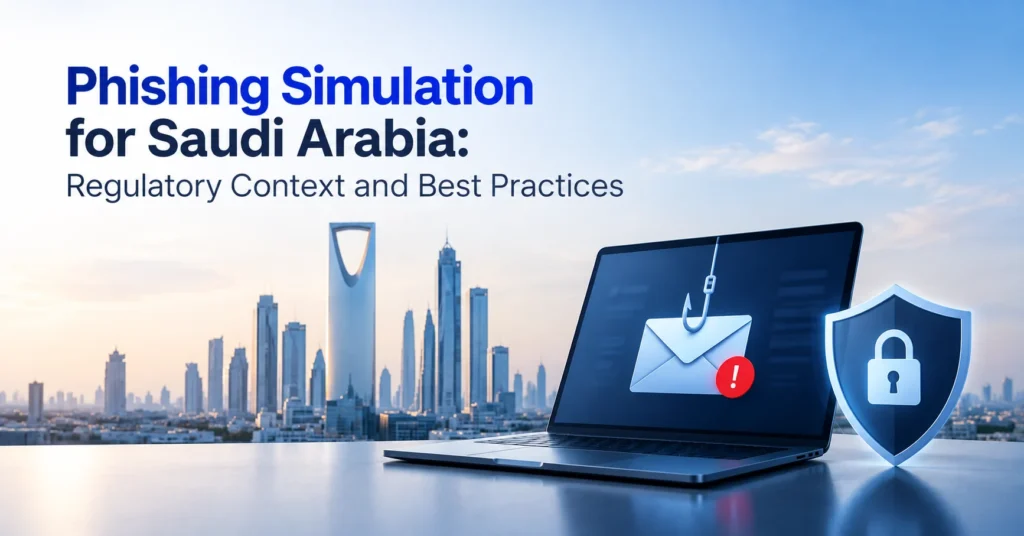
Saudi Arabia’s Vision 2030 has driven one of the fastest digital transformations of any economy in the region, and the regulatory response has kept pace. As of January 2026, mandatory baseline cybersecurity controls now apply to every private-sector company in the Kingdom, not just organizations formally designated as critical national infrastructure. For businesses building or refreshing a phishing simulation program, understanding this shifting regulatory landscape matters as much as understanding the threat itself.
This guide covers Saudi Arabia’s current regulatory framework for cybersecurity, the most common attack patterns businesses in the Kingdom actually face, and what to know before running a phishing simulation program.
In Short
Saudi Arabia’s National Cybersecurity Authority recently extended mandatory cybersecurity controls to nearly every private company in the country, not just critical infrastructure operators. Combined with an actively enforced Personal Data Protection Law carrying fines up to SAR 10 million for repeat violations, businesses now face a compliance environment where documented phishing simulation evidence increasingly matters.
What Saudi Regulation Expects From Businesses
Saudi Arabia operates under three main regulatory frameworks that businesses need to understand, and for many organizations, more than one applies simultaneously. According to ISECURION’s coverage of Saudi Arabia’s regulatory expansion, the National Cybersecurity Authority’s Essential Cybersecurity Controls (ECC-2:2024) set the baseline for government entities and critical national infrastructure, the Saudi Arabian Monetary Authority’s Cybersecurity Framework governs financial institutions, and the Personal Data Protection Law, enforced by the Saudi Data and Artificial Intelligence Authority, governs how personal data is handled across the board.
The most significant recent development is the NCA’s release of NCNICC-1:2025 in January 2026, which extends mandatory baseline cybersecurity controls to effectively every private-sector company operating in the Kingdom, regardless of whether they were previously designated as critical national infrastructure. Businesses that previously assumed NCA frameworks only applied to a narrow category of critical operators need to reassess that scope immediately. The ECC’s 2024 update also introduced a cybersecurity Saudization requirement, adding a workforce localization dimension to compliance that is distinct to the Kingdom.
Enforcement is active, not theoretical. SDAIA issued 48 enforcement decisions against organizations in a single recent review cycle, with PDPL fines reaching 5 million Saudi riyals per breach for a first offense, doubling to 10 million riyals for repeat violations, alongside potential criminal liability for unlawful disclosure of sensitive personal data. High-risk breaches must be reported to SDAIA within 72 hours of an organization becoming aware of them.
The Most Common Attack Vector in Saudi Arabia
Despite the sophistication of the regulatory environment, the most common way organizations in Saudi Arabia actually get compromised remains straightforward. According to Sharp Innovation’s analysis of cybersecurity threats facing Saudi businesses, social engineering attacks, particularly phishing delivered through email, SMS, and WhatsApp specifically, remain the most common initial attack vector in the Kingdom, a pattern that reflects how heavily WhatsApp is used for both personal and business communication regionally. Our guide on smishing covers the broader pattern of SMS and messaging-app-based phishing this reflects.
Credential stuffing represents a related, significant risk: employees who reuse passwords across work and personal accounts are routinely targeted with automated attacks using stolen credentials from unrelated global data breaches, with a success rate higher than most internal IT teams realize. Multi-factor authentication across critical systems, particularly email, VPN, and administrative access, is widely identified as the single most effective control against this specific pattern, though it works best alongside awareness training that helps employees recognize the phishing attempts that often precede credential theft in the first place.
A Note on Language and Templates
As with other Arabic-speaking markets, it is worth addressing directly: PhishCare’s phishing simulation templates are currently available in English only, without native Arabic-language template support. Given how prominently WhatsApp and SMS phishing feature in the Saudi threat landscape, often in Arabic, organizations with a substantial Arabic-speaking workforce should factor this into their testing plans and may want to supplement English-language simulation with separately developed Arabic-language awareness materials for the channels and employee groups where this matters most.
What This Means for Testing Your Team
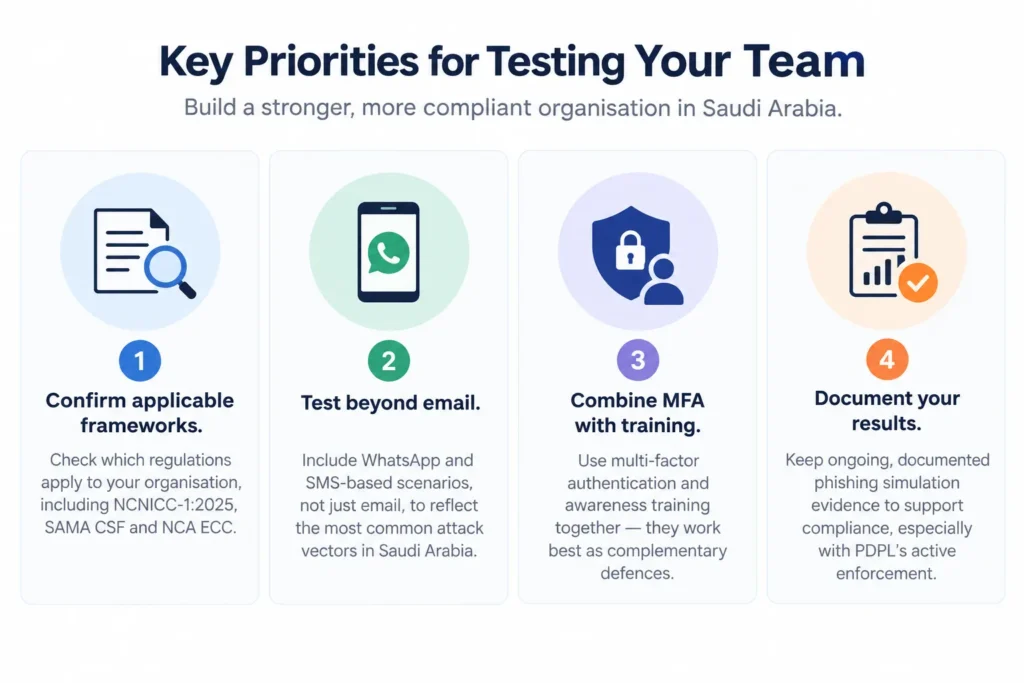
A few practical priorities follow specifically from Saudi Arabia’s current regulatory and threat environment:
1. Confirm which frameworks actually apply to your organization.
With NCNICC-1:2025 extending baseline requirements to nearly all private companies, and SAMA CSF and NCA ECC frequently overlapping for regulated entities like banks, businesses should not assume they fall outside scope without confirming directly.
2. Test for WhatsApp and SMS-based scenarios, not just email.
Given how consistently these channels are named as the most common attack vector in the Kingdom, awareness training built around email alone leaves a significant gap.
3. Treat MFA and awareness training as complementary, not substitutes.
Credential stuffing succeeds specifically where password reuse is common, and awareness training that helps employees recognize the phishing attempts that harvest those credentials in the first place strengthens MFA rather than duplicating it.
4. Document testing evidence with PDPL’s active enforcement in mind.
With SDAIA issuing dozens of enforcement decisions annually, ongoing, documented phishing simulation results support a stronger compliance position than a single historical training record.
Building a Testing Program
Saudi organizations evaluating phishing simulation platforms can also review our existing roundup of the top 10 phishing simulation software options for staff training in Saudi Arabia for a broader platform comparison. For getting started specifically, our guide on how to run a phishing test for employees covers the practical first-campaign workflow, and understanding what phishing is and how it works provides useful foundation for building a testing program from the ground up.
Tracking results over successive campaigns through an employee phishing risk score produces exactly the kind of ongoing, documented evidence that supports a stronger position under Saudi Arabia’s actively enforced compliance frameworks, rather than a single point-in-time assessment.
Final Thoughts
Saudi Arabia’s cybersecurity regulatory environment has moved quickly from a narrow, critical-infrastructure-only scope to something close to universal mandatory coverage for private businesses, alongside an actively enforced data protection law with real financial and legal consequences. Combined with a threat landscape where WhatsApp and SMS phishing feature as prominently as email, businesses building a testing program need an approach that reflects both the specific regulatory expectations and the specific channels attackers in the Kingdom actually use.
FAQ
What cybersecurity regulations apply to businesses in Saudi Arabia?
Three main frameworks apply: the NCA’s Essential Cybersecurity Controls for government and critical infrastructure, SAMA’s Cybersecurity Framework for financial institutions, and the Personal Data Protection Law, enforced by SDAIA, which applies broadly to organizations handling personal data.
What changed in Saudi Arabia’s cybersecurity regulations in 2026?
The NCA released NCNICC-1:2025 in January 2026, extending mandatory baseline cybersecurity controls to effectively every private-sector company in the Kingdom, regardless of whether they were previously classified as critical national infrastructure.
What are the penalties for PDPL violations in Saudi Arabia?
PDPL fines reach 5 million Saudi riyals for a first offense, doubling to 10 million riyals for repeat violations, with potential criminal liability for unlawful disclosure of sensitive personal data. High-risk breaches must be reported to SDAIA within 72 hours.
What is the most common cyberattack method in Saudi Arabia?
Social engineering and phishing, delivered through email, SMS, and WhatsApp specifically, remain the most common initial attack vector for Saudi organizations, reflecting how heavily WhatsApp is used for business communication in the region.
Does PhishCare offer Arabic-language phishing simulation templates?
Not currently. PhishCare’s templates are available in English only. Organizations with a substantial Arabic-speaking workforce should factor this into their testing plans, particularly given how much regional phishing activity happens through Arabic-language WhatsApp and SMS messages.
Content Reviewed By

Nawaz is a practising security analyst specializing in phishing simulation campaigns, employee awareness assessments, red team exercises, and ethical hacking.
He leads phishing simulation deployments at PhishCare, a product developed by CyberSapiens, with hands-on experience evaluating and deploying phishing simulation tools across organizations in multiple industries and regions globally.
View LinkedIn ProfileReady to Strengthen Your Phishing Simulation Program?
Saudi Arabia’s regulatory environment now expects documented cybersecurity practice from nearly every private company. See how realistic phishing simulation supports that with a free PhishCare demo account, no credit card required.