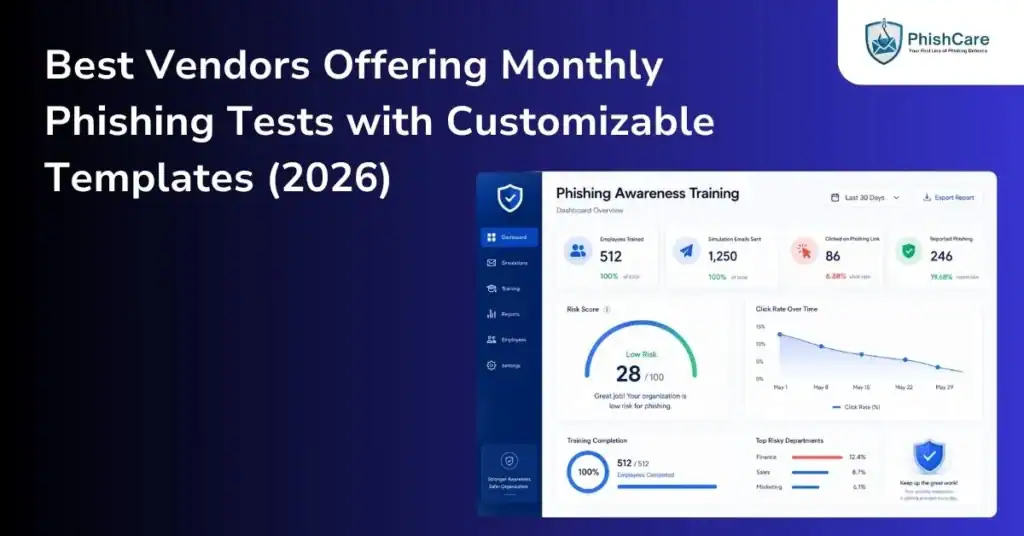
Why Organizations Run Monthly Phishing Tests Instead of Annual Training
Modern phishing attacks evolve too quickly for annual awareness sessions to remain effective throughout the year. Organizations are increasingly adopting recurring phishing simulations to create continuous awareness habits, reinforce reporting behavior, and measure employee response improvements over time.
Threat Tactics Change Frequently
Attackers constantly modify phishing emails using fake cloud alerts, invoice fraud, HR impersonation, banking notifications, and credential harvesting pages. Monthly phishing campaigns help employees recognize evolving attack styles more consistently.
Employee Behavior Improves Through Repetition
Security awareness becomes more effective when employees repeatedly encounter realistic phishing scenarios. Continuous simulations help reinforce cautious behavior and improve reporting confidence across departments.
Security Teams Need Measurable Insights
Monthly phishing testing platforms provide visibility into click rates, credential submissions, repeat-risk users, reporting behavior, and department-level awareness trends that help security teams improve training strategies.
Why Customizable Phishing Templates Matter
Generic phishing simulations often fail to reflect the actual attack patterns employees encounter daily. Vendors offering customizable phishing templates allow organizations to create realistic simulations tailored to specific departments, workflows, and business operations.
For example, finance teams may receive invoice fraud simulations, HR departments may encounter payroll or benefits-related phishing emails, and remote teams may face fake VPN or cloud-sharing notifications. This level of contextual relevance significantly improves employee engagement and simulation effectiveness.
Organizations evaluating phishing simulation vendors should prioritize platforms that support recurring campaigns, editable phishing templates, landing page customization, campaign automation, multilingual support, and actionable reporting dashboards.
Why Organizations Run Monthly Phishing Tests Instead of Annual Training
Modern phishing attacks evolve too quickly for annual awareness sessions to remain effective throughout the year. Organizations are increasingly adopting recurring phishing simulations to create continuous awareness habits, reinforce reporting behavior, and measure employee response improvements over time.
Threat Tactics Change Frequently
Attackers constantly modify phishing emails using fake cloud alerts, invoice fraud, HR impersonation, banking notifications, and credential harvesting pages. Monthly phishing campaigns help employees recognize evolving attack styles more consistently.
Employee Behavior Improves Through Repetition
Security awareness becomes more effective when employees repeatedly encounter realistic phishing scenarios. Continuous simulations help reinforce cautious behavior and improve reporting confidence across departments.
Security Teams Need Measurable Insights
Monthly phishing testing platforms provide visibility into click rates, credential submissions, repeat-risk users, reporting behavior, and department-level awareness trends that help security teams improve training strategies.
Why Customizable Phishing Templates Matter
Generic phishing simulations often fail to reflect the actual attack patterns employees encounter daily. Vendors offering customizable phishing templates allow organizations to create realistic simulations tailored to specific departments, workflows, and business operations.
For example, finance teams may receive invoice fraud simulations, HR departments may encounter payroll or benefits-related phishing emails, and remote teams may face fake VPN or cloud-sharing notifications. This level of contextual relevance significantly improves employee engagement and simulation effectiveness.
Organizations evaluating phishing simulation vendors should prioritize platforms that support recurring campaigns, editable phishing templates, landing page customization, campaign automation, multilingual support, and actionable reporting dashboards.
How We Evaluated the Best Vendors Offering Monthly Phishing Tests with Customizable Templates
Not all phishing simulation vendors provide the same level of realism, reporting visibility, campaign flexibility, or employee engagement capabilities. To identify the best platforms for recurring phishing awareness testing, we evaluated vendors across multiple operational, technical, and usability factors that matter to modern organizations.
Template Customization Flexibility
We evaluated how effectively vendors support editable phishing templates, branding customization, landing page personalization, multilingual simulations, and role-based phishing scenarios for different departments.
Monthly Campaign Automation
Recurring phishing simulations should run efficiently without excessive manual work. We reviewed campaign scheduling, automation workflows, user grouping, recurring simulation setup, and scalability for distributed teams.
Reporting and Visibility
Reporting quality plays a major role in improving awareness programs. We analyzed dashboards, click-rate analytics, credential submission tracking, risk insights, and downloadable phishing simulation reports.
Realism and User Engagement
Effective phishing awareness testing depends on how realistic the phishing emails appear to employees. Vendors were assessed based on simulation realism, campaign variety, and user interaction quality.
Compliance and Documentation Support
We considered how reporting and campaign documentation support organizations working toward ISO 27001, SOC 2 Type II, HIPAA, PCI DSS, and broader security awareness best practices.
Ease of Deployment and Management
Security teams need phishing platforms that are easy to configure, deploy, and manage across multiple departments and employee groups without adding unnecessary operational complexity.
What Organizations Should Prioritize When Choosing a Phishing Simulation Vendor
Many organizations focus only on template volume when comparing phishing simulation vendors. However, long-term awareness effectiveness depends more on realistic customization, recurring campaign consistency, reporting clarity, and how well the platform adapts to changing phishing attack patterns.
The best vendors offering monthly phishing tests with customizable templates combine automation, usability, analytics, and employee engagement into a scalable awareness program that security teams can continuously improve over time.
Comparison of the Best Vendors Offering Monthly Phishing Tests with Customizable Templates
Organizations evaluating phishing simulation platforms should compare more than just email template libraries. Recurring campaign automation, customization flexibility, reporting visibility, deployment simplicity, and long-term employee engagement all play an important role in building an effective phishing awareness program.
| Vendor | Monthly Automation | Template Customization | Reporting | Best For |
|---|---|---|---|---|
| PhishCare | Advanced recurring campaign scheduling | Editable phishing emails and landing pages | Detailed awareness and click analytics | SMBs, enterprise teams, compliance-focused organizations |
| KnowBe4 | Automated phishing campaigns | Large template library | Awareness and risk scoring dashboards | Large enterprise awareness programs |
| Cofense | Recurring phishing simulation support | Custom campaign creation | Threat reporting insights | Security operations and enterprise teams |
| Hoxhunt | Continuous adaptive simulations | AI-driven personalized templates | Behavior-focused reporting | Organizations focused on behavior change |
| Microsoft Attack Simulator | Integrated Microsoft simulation workflows | Basic simulation customization | Microsoft security reporting integration | Microsoft 365 ecosystem users |
Key Differences Between Monthly Phishing Simulation Vendors
Some phishing simulation platforms prioritize enterprise-scale automation, while others focus heavily on user behavior analytics or template personalization. The right solution depends on organizational goals, security maturity, internal resources, compliance requirements, and the level of phishing realism required for employee testing.
Organizations looking for long-term phishing awareness improvement should prioritize vendors that combine customizable phishing templates, recurring campaign automation, actionable reporting, and scalable employee engagement instead of relying solely on static awareness training sessions.
Why Organizations Choose PhishCare for Monthly Phishing Simulations
PhishCare, developed by CyberSapiens, helps organizations run recurring phishing simulations using realistic customizable templates, automated campaigns, employee awareness tracking, and detailed reporting dashboards designed for modern security awareness programs.
Built for Continuous Employee Security Awareness
PhishCare enables organizations to move beyond one-time awareness sessions by running recurring phishing campaigns that continuously evaluate employee behavior, improve reporting culture, and simulate real-world phishing attack techniques.
Customizable Phishing Templates
Organizations can customize phishing email templates, landing pages, branding elements, and simulation workflows to mirror realistic phishing attacks targeting different departments and employee roles.
Automated Monthly Campaigns
PhishCare supports recurring phishing simulations through automated scheduling, campaign segmentation, user grouping, and continuous employee awareness testing across distributed teams.
Actionable Reporting Dashboards
Detailed reporting dashboards help organizations monitor click behavior, credential submissions, high-risk users, reporting patterns, and awareness improvement trends over time.
Trusted by Organizations Across Multiple Industries









What Security Teams Say About PhishCare
“We recently used PhishCare for a phishing simulation, and I’ve got to say, their email templates were top-notch. The realism and variety of the templates were impressive, really testing our team’s vigilance. The level of detail they put into crafting these emails was evident, making the simulation both challenging and effective. It’s clear they know their stuff when it comes to cybersecurity. Highly recommend them!”
Why Customizable Phishing Templates Are Critical for Effective Employee Testing
Generic phishing simulations often fail to create realistic learning experiences for employees. Modern organizations require phishing templates that can closely mirror real-world attack techniques, department workflows, communication styles, and evolving social engineering tactics.
Department-Specific Simulations
Finance teams, HR departments, IT administrators, healthcare staff, and remote employees face very different phishing attack styles. Customizable phishing templates allow organizations to simulate threats that closely match real operational environments.
Improved Employee Engagement
Employees are more likely to engage seriously with phishing awareness programs when simulations resemble actual business communications instead of obviously fake or repetitive training emails.
Continuous Adaptation to Threat Trends
Cybercriminals constantly evolve phishing tactics using cloud notifications, invoice fraud, fake login alerts, password reset requests, and collaboration platform impersonation. Editable templates help organizations keep simulations relevant over time.
Examples of Realistic Phishing Simulation Scenarios
Finance Teams
Invoice fraud emails, payment approval requests, banking impersonation campaigns, and fake procurement notifications.
HR Departments
Payroll update requests, benefits enrollment scams, recruitment phishing attempts, and fake employee policy notifications.
Remote Workforce
VPN expiration notices, fake collaboration invites, cloud-sharing requests, password reset emails, and MFA verification scams.
Healthcare & IT Teams
Credential harvesting pages, software update impersonation, patient data access scams, and fake security alert notifications.
How Customizable Templates Improve Long-Term Security Awareness
Organizations that regularly refresh phishing simulations with customizable templates often experience stronger employee participation, better phishing recognition, improved reporting culture, and reduced phishing fatigue compared to repetitive static awareness programs.
The best vendors offering monthly phishing tests with customizable templates provide security teams with the flexibility to continuously adapt simulations based on emerging phishing trends, employee behavior analytics, and organizational risk patterns.
Industries That Benefit Most from Monthly Phishing Simulations
While phishing attacks affect organizations of every size, certain industries face significantly higher exposure due to sensitive data handling, financial transactions, remote workforce operations, regulatory pressure, and daily interaction with external vendors or customers.
High Exposure to Financial Fraud
Financial institutions frequently face phishing attacks involving fake invoices, payment authorization requests, banking impersonation, wire transfer fraud, and executive impersonation attempts. Monthly phishing simulations help finance teams identify and respond to evolving fraud techniques more effectively.
Protection of Sensitive Patient Data
Healthcare organizations are common phishing targets because of electronic medical records, insurance information, and time-sensitive operational workflows. Recurring phishing simulations help healthcare employees identify malicious links, fake patient communications, and credential theft attempts.
Remote Workforce & Cloud Security Risks
Technology companies often operate distributed environments with cloud-based collaboration systems and remote access infrastructure. Employees regularly encounter phishing attempts disguised as cloud-sharing requests, MFA alerts, password reset notifications, and collaboration platform invitations.
Large Employee Attack Surface
Organizations with large workforces face increased phishing exposure because of multiple departments, suppliers, external communication channels, and varying levels of employee cybersecurity awareness. Continuous phishing testing helps reduce organization-wide human risk.
Why Monthly Simulations Work Better Across High-Risk Industries
Continuous Awareness Reinforcement
Frequent phishing simulations help employees stay alert to evolving social engineering attacks throughout the year instead of relying on annual awareness sessions.
Improved Risk Visibility
Security teams can identify departments, users, or workflows that consistently show higher phishing susceptibility and adjust awareness programs accordingly.
Support for Security Best Practices
Recurring phishing awareness campaigns provide ongoing documentation and employee training visibility that support broader cybersecurity and compliance initiatives.
Building Industry-Specific Phishing Awareness Programs
Organizations achieve stronger awareness outcomes when phishing simulations reflect realistic industry-specific attack patterns. A healthcare employee may encounter fake patient record notifications, while a finance employee may see payment approval fraud attempts or banking impersonation emails.
The best vendors offering monthly phishing tests with customizable templates help organizations continuously adapt phishing simulations to evolving industry threats, employee behaviors, and operational workflows while maintaining long-term security awareness engagement.
How Monthly Phishing Simulations Improve Security Awareness and Audit Readiness
Modern compliance frameworks increasingly emphasize continuous employee security awareness instead of one-time annual training exercises. Monthly phishing simulations help organizations maintain measurable awareness programs while improving employee preparedness against evolving phishing attacks.
Continuous Awareness Documentation
Recurring phishing campaigns provide ongoing documentation of employee awareness activities, campaign participation, reporting behavior, and phishing simulation engagement throughout the year.
Behavioral Risk Tracking
Security teams can identify high-risk users, recurring click patterns, credential submission trends, and departments requiring additional awareness reinforcement through measurable phishing simulation reporting.
Support for Security Best Practices
Monthly phishing awareness programs support broader cybersecurity initiatives by reinforcing employee vigilance, reporting culture, and ongoing awareness education across the organization.
How Phishing Simulation Reports Help Security Teams
Employee Awareness Visibility
Security teams gain measurable visibility into employee awareness performance through phishing click tracking, reporting analytics, and campaign participation data.
Trend Analysis Over Time
Recurring simulations help organizations monitor awareness improvements, identify repeat-risk users, and evaluate how employee behavior changes across multiple campaigns.
Audit Documentation Support
Phishing simulation reporting provides additional awareness documentation that may support organizations working toward ISO 27001, SOC 2 Type II, HIPAA, PCI DSS, and NIST CSF security awareness best practices.
Compliance Frameworks Commonly Associated with Security Awareness Programs
| Framework | Awareness Relevance |
|---|---|
| ISO 27001 | Employee security awareness training and phishing simulations are widely recognized as part of ongoing security awareness best practices. |
| SOC 2 Type II | Organizations commonly maintain recurring security awareness activities and employee training documentation to strengthen internal security programs. |
| HIPAA | Healthcare organizations frequently use phishing awareness training to help employees identify social engineering attacks targeting patient information. |
| PCI DSS | Organizations handling payment information often reinforce employee awareness against phishing attempts targeting financial and transaction systems. |
| NIST CSF | Security awareness education and phishing preparedness are commonly associated with broader organizational cybersecurity maturity initiatives. |
Why Continuous Phishing Awareness Matters More Than Annual Training Alone
Organizations face phishing attacks throughout the year, not just during annual awareness training cycles. Monthly phishing simulations help reinforce employee vigilance continuously while allowing security teams to adapt awareness programs based on changing phishing techniques and employee response patterns.
The best vendors offering monthly phishing tests with customizable templates help organizations build measurable, repeatable, and scalable awareness programs that support long-term cybersecurity resilience and operational risk reduction.
How Organizations Use Monthly Phishing Simulations to Strengthen Employee Awareness
Organizations across finance, healthcare, IT, banking, and enterprise environments increasingly use recurring phishing simulations to improve employee awareness, reduce phishing susceptibility, and strengthen long-term cybersecurity resilience against evolving social engineering attacks.
Phishing Simulations Executed
Organizations use recurring phishing campaigns to continuously evaluate employee awareness, identify risky behavior patterns, and strengthen reporting culture across departments.
Awareness Campaign Effectiveness
Recurring phishing simulations help organizations improve employee vigilance, increase phishing reporting confidence, and reduce exposure to social engineering attacks over time.
Industries Supported
Different industries face different phishing threats. Monthly simulations help organizations create awareness programs aligned with industry-specific attack patterns and operational workflows.
Organizations Using PhishCare for Phishing Awareness Programs
Security Team Feedback on PhishCare
We recently used PhishCare for a phishing simulation, and I’ve got to say, their email templates were top-notch. The realism and variety of the templates were impressive, really testing our team’s vigilance. The level of detail they put into crafting these emails was evident, making the simulation both challenging and effective. It’s clear they know their stuff when it comes to cybersecurity. Highly recommend them!
Why Organizations Continue Running Monthly Phishing Simulations
Phishing attacks continue evolving through credential harvesting, fake collaboration requests, invoice fraud, cloud impersonation, and business email compromise campaigns. Organizations increasingly recognize that recurring phishing simulations provide stronger long-term awareness reinforcement compared to isolated annual training sessions.
The best vendors offering monthly phishing tests with customizable templates help organizations build continuous awareness programs that improve employee vigilance, strengthen reporting culture, and reduce operational phishing risks over time.
Key Features to Look for Before Choosing a Monthly Phishing Simulation Vendor
Choosing the right phishing simulation platform requires more than comparing template libraries or pricing plans. Organizations should evaluate how effectively the platform supports long-term employee awareness improvement, phishing campaign management, reporting visibility, and realistic phishing simulation capabilities.
Recurring Campaign Automation
The platform should support automated monthly phishing campaigns, recurring scheduling, employee grouping, role-based targeting, and simplified awareness program management for long-term operational efficiency.
Customizable Email Templates
Organizations should prioritize phishing simulation vendors that allow editing of email content, branding, landing pages, multilingual phishing templates, and department-specific phishing scenarios.
Detailed Reporting Dashboards
Effective reporting should include phishing click analytics, credential submission tracking, employee risk insights, awareness trend analysis, downloadable reports, and department-level visibility.
Realistic Phishing Simulation Scenarios
The best phishing awareness platforms continuously update simulations using modern phishing techniques such as fake cloud notifications, MFA requests, invoice fraud, collaboration platform impersonation, and credential harvesting attacks.
Scalability Across Teams
Organizations with multiple departments or distributed workforces need phishing simulation platforms capable of scaling campaigns efficiently across large employee groups and remote environments.
Ease of Deployment and Management
Security teams benefit from platforms that simplify deployment, user onboarding, campaign creation, reporting access, and recurring awareness management without adding operational complexity.
Questions Organizations Should Ask Before Selecting a Vendor
Can campaigns run automatically every month?
Recurring campaign automation helps maintain continuous awareness programs without requiring manual phishing simulation setup every cycle.
Can phishing templates be customized easily?
Organizations should confirm whether phishing emails, branding, landing pages, and simulation workflows can be tailored for realistic employee testing.
Does the platform provide measurable reporting?
Security awareness effectiveness should be measurable through dashboards, phishing click tracking, reporting analytics, and employee awareness trend visibility.
Can the platform scale with organizational growth?
As organizations grow, phishing awareness platforms should continue supporting larger employee groups, distributed teams, and evolving security awareness requirements.
Selecting a Vendor That Supports Long-Term Awareness Improvement
The most effective phishing simulation platforms help organizations build sustainable awareness programs instead of treating phishing training as a one-time compliance activity. Continuous employee testing, realistic simulations, measurable reporting, and adaptable phishing scenarios are essential for long-term security awareness success.
The best vendors offering monthly phishing tests with customizable templates provide organizations with the flexibility, visibility, and automation needed to continuously strengthen employee cybersecurity awareness against evolving phishing threats.
Best Vendors Offering Monthly Phishing Tests with Customizable Templates
Phishing attacks continue evolving through credential theft campaigns, invoice fraud, cloud impersonation, collaboration platform abuse, and executive impersonation tactics. Organizations increasingly recognize that recurring phishing simulations provide stronger long-term employee awareness reinforcement than isolated annual security training sessions.
Continuous Employee Awareness
Monthly phishing simulations help organizations continuously reinforce employee awareness against evolving phishing attacks instead of relying on one-time annual awareness exercises.
Customizable Templates Improve Realism
Editable phishing templates allow organizations to simulate realistic attack scenarios aligned with specific industries, departments, workflows, and employee responsibilities.
Reporting Helps Measure Risk Reduction
Detailed phishing simulation dashboards provide visibility into employee click behavior, reporting culture, recurring risk patterns, and awareness improvement trends over time.
What Organizations Should Prioritize in a Phishing Simulation Platform
Recurring Monthly Automation
Organizations benefit from platforms that simplify recurring phishing campaign scheduling and long-term awareness management.
Realistic Simulation Scenarios
Modern phishing awareness programs should simulate cloud impersonation, invoice fraud, MFA abuse, fake login alerts, and collaboration platform phishing attempts.
Actionable Awareness Reporting
Security teams should have access to measurable awareness analytics, phishing click visibility, reporting trends, and downloadable phishing simulation reports.
Strengthen Employee Awareness with Recurring Phishing Simulations
PhishCare helps organizations run recurring phishing simulations using customizable templates, automated campaigns, detailed awareness reporting, and realistic phishing scenarios designed to improve employee vigilance against evolving cyber threats.
FAQs About Monthly Phishing Tests with Customizable Templates
Organizations evaluating phishing simulation vendors often compare automation, reporting, template customization, awareness effectiveness, and scalability before selecting a long-term phishing awareness platform.
What are monthly phishing tests?
Monthly phishing tests are recurring phishing simulations designed to evaluate how employees respond to realistic phishing emails over time. Organizations use these campaigns to strengthen employee awareness, improve reporting culture, and reduce phishing-related risks continuously throughout the year.
Why are customizable phishing templates important?
Customizable phishing templates allow organizations to simulate realistic phishing attacks aligned with specific departments, industries, workflows, and employee responsibilities. This improves phishing simulation realism and increases employee engagement with awareness programs.
How often should phishing simulations be conducted?
Many organizations conduct phishing simulations monthly to maintain continuous employee awareness and adapt training to evolving phishing attack techniques. Recurring simulations also help security teams measure awareness improvements more effectively over time.
Can phishing simulation reports support compliance initiatives?
Phishing simulation reports provide additional documentation support for organizations working toward ISO 27001, SOC 2 Type II, PCI DSS, HIPAA, and NIST CSF awareness best practices by helping demonstrate ongoing employee security awareness activities.
Which industries benefit most from phishing awareness testing?
Finance, banking, healthcare, IT, SaaS companies, enterprise organizations, and remote workforce environments commonly benefit from recurring phishing simulations because these industries face high exposure to phishing and social engineering attacks.
What should organizations look for in a phishing simulation vendor?
Organizations should evaluate recurring campaign automation, customizable phishing templates, reporting dashboards, simulation realism, scalability, ease of deployment, and employee engagement capabilities before selecting a phishing awareness platform.
Content Reviewed By

Mohammed Nawaz Sajjad
Nawaz is a practising security analyst specializing in phishing simulation campaigns, employee awareness assessments, red team exercises, and ethical hacking. He works closely with organizations across finance, healthcare, IT, banking, and enterprise sectors to evaluate phishing risks and strengthen employee cybersecurity awareness programs.
He leads phishing simulation deployments at PhishCare, a phishing awareness platform developed by CyberSapiens, with hands-on experience running recurring phishing campaigns, customizable phishing simulations, awareness reporting, and employee security assessments across multiple industries globally.
Run Recurring Phishing Simulations with Realistic Customizable Templates
PhishCare helps organizations improve employee awareness through recurring phishing simulations, realistic phishing email templates, automated campaigns, and measurable reporting dashboards designed to reduce phishing-related risks across modern workplaces.
PhishCare’s campaign reports provide an additional documentation boost for organizations working towards ISO 27001, SOC 2 Type II, PCI DSS, HIPAA, or NIST CSF, where ongoing security awareness training is recognized as a best practice by auditors and certification bodies.