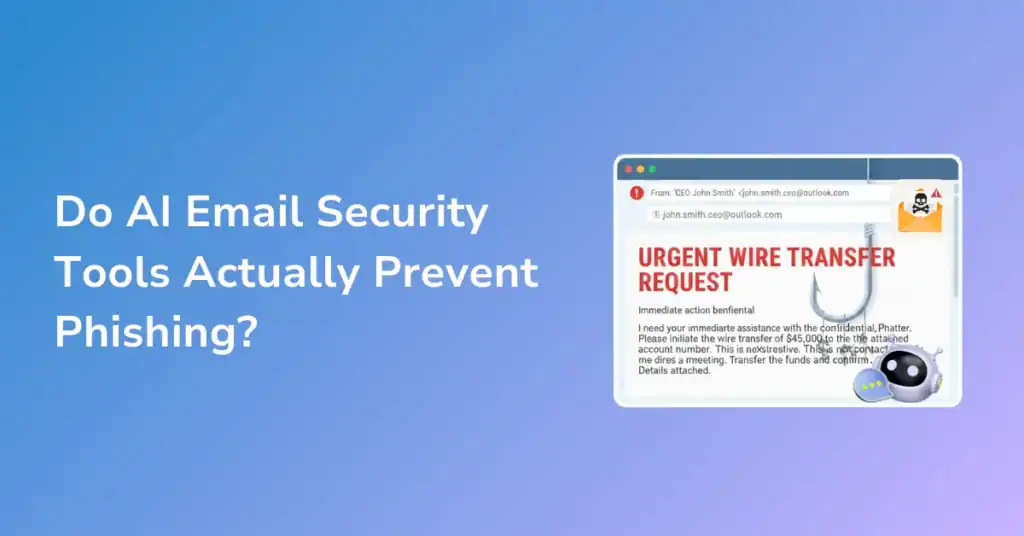
Phishing continues to be one of the most successful cyberattack methods because it targets human behaviour rather than technical vulnerabilities. As organisations strengthen firewalls, endpoint protection, and network monitoring, attackers increasingly focus on email as the primary entry point. This has led to rapid adoption of AI-powered email security tools that promise advanced detection of malicious messages before they reach employee inboxes.
In recent years, artificial intelligence has significantly improved email filtering capabilities. Machine learning models can analyse sender behaviour, domain anomalies, language patterns, embedded URLs, and attachment characteristics at scale. These tools claim to detect both known phishing campaigns and previously unseen threats using behavioural analysis rather than static rules.
However, the growing reliance on AI email security raises an important question for security leaders. Do these tools truly prevent phishing attacks, or do they simply reduce the volume of malicious emails while residual risk remains?
Understanding the role of AI in phishing prevention requires a realistic assessment of both its strengths and its limitations. While AI has enhanced detection accuracy and reduced exposure to large scale phishing campaigns, it does not eliminate the human element that attackers continue to exploit. A comprehensive approach to phishing defence must evaluate where AI succeeds, where it struggles, and how it fits into a broader security strategy.
How AI Email Security Tools Detect Phishing
Modern AI email security solutions use machine learning models trained on vast datasets of legitimate and malicious email traffic. Instead of relying solely on static rules or known signatures, these systems analyse behavioural signals and contextual indicators.
Common detection techniques include:
- Sender reputation and domain analysis
- Anomaly detection in communication patterns
- Natural language processing to identify social engineering cues
- URL and attachment sandboxing
- Detection of look alike domains and brand impersonation
By analysing thousands of signals per message, AI systems can identify suspicious behaviour that traditional filters may miss.
What AI Email Security Tools Prevent Effectively
AI email security tools are particularly strong in the following areas:
1. Blocking Mass Phishing Campaigns
Automated phishing attacks that rely on volume and repeated patterns are often detected quickly by AI models.
2. Identifying Malicious Links and Attachments
Advanced URL analysis and sandboxing can prevent users from accessing known or suspicious destinations.
3. Detecting Spoofing and Domain Impersonation
AI can identify subtle domain variations designed to mimic legitimate organisations.
4. Reducing Email-Based Malware
AI systems often integrate with threat intelligence feeds and behavioural detection to stop malware delivery attempts. For many organisations, this significantly reduces inbox level exposure.
Where AI Email Security Tools Have Limitations
Despite strong detection capabilities, AI is not a complete safeguard.
1. Highly Targeted Spear Phishing
Personalised phishing emails crafted using publicly available information may not trigger obvious technical anomalies.
2. Compromised Internal Accounts
If an attacker gains access to a legitimate employee account, AI systems may struggle to differentiate malicious messages from normal communication.
3. Contextual Manipulation
AI may not fully understand the internal context. For example, a fake request that aligns with a real ongoing project may appear legitimate at a technical level.
4. Evolving Social Engineering Techniques
New tactics may initially bypass detection until models adapt. These limitations highlight why AI alone cannot eliminate phishing risk.
Why Employee Awareness Still Matters
Technology reduces exposure, and people reduce impact. When phishing emails bypass filters, employees become the final line of defence. Organisations that combine AI email protection with continuous phishing simulation and awareness training typically see stronger outcomes.
Benefits of combining AI with training include:
- Faster reporting of suspicious emails
- Lower credential submission rates
- Reduced repeat risk behaviour
- Stronger security culture
So Do AI Email Security Tools Actually Prevent Phishing?
AI email security tools prevent a large percentage of phishing attempts, especially automated and pattern-based attacks. They reduce volume, improve detection accuracy, and strengthen email filtering. However, they do not prevent all phishing. Highly targeted, context-aware, or insider-based attacks may still reach employees. Organisations that treat AI as part of a layered defence strategy, rather than a standalone solution, are better positioned to manage phishing risk effectively.
Frequently Asked Questions
1. Can AI stop all phishing emails?
No. AI significantly reduces phishing exposure but cannot guarantee complete prevention, particularly against targeted attacks.
2. Are AI tools better than traditional email filters?
Yes. AI adds behavioural analysis and adaptive learning that improve detection compared to static rule based systems.
3. Should organisations rely only on AI for phishing prevention?
No. AI should be combined with employee awareness training and phishing simulations for comprehensive protection.
4. Do AI systems improve over time?
Yes. Machine learning models adapt based on new data, reported threats, and evolving attack patterns.