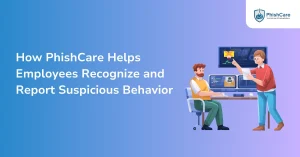
Suspicious behaviour in digital workplaces has become one of the most consistent contributors to cybersecurity incidents. Modern attacks rarely rely on obvious malware or visibly malicious content. Instead, they use impersonation, urgency, and routine-looking communication to manipulate human judgment. As a result, employees are now the primary decision-makers when a potential threat appears in the inbox.
Industry-level security studies over the last several years consistently show that a large majority of successful cyber incidents begin with human interaction, most commonly through phishing and social engineering. This makes the ability to recognise and report suspicious behaviour one of the most important cyber security skills in any organisation. This is the specific risk area that PhishCare is designed to address through awareness and simulation-based training.
Why Recognition and Reporting Matter in Modern Cybersecurity
Email security gateways, endpoint protection, and spam filters remain essential components of any security stack. However, many of today’s phishing emails are engineered to bypass these technical defences. They often contain no malicious attachments, no obviously dangerous links, and no visual indicators that automated tools can easily flag.
In these situations, the final security decision rests with the employee who is reading the message. If that individual is uncertain about whether the email is suspicious or delays reporting it for verification, the threat can move unnoticed through the firm. This is why human awareness plays a decisive role in secondary attack prevention, even when strong technical controls are in place. This is the human defence layer that PhishCare is designed to strengthen through continuous awareness and simulation-based training.
What PhishCare Is Designed to Do
PhishCare is a phishing simulation and awareness training platform created to help organisations measure, improve, and sustain employee readiness against phishing and deceptive communication.
PhishCare does not attempt to block or filter email traffic. Instead, it focuses on preparing employees for the exact moment when a suspicious message bypasses technical controls and reaches their inbox. It allows organisations to simulate realistic phishing attempts, observe how employees respond, and deliver targeted awareness training based on real behaviour rather than assumptions.
How PhishCare Trains Employees to Recognize Suspicious Behavior
PhishCare runs controlled phishing simulation campaigns that replicate the same social engineering techniques used by real attackers. Employees receive simulated emails that closely resemble routine business communication, including executive impersonation, vendor requests, document-sharing alerts, and account access notifications.
Because these scenarios reflect real working conditions, employee reactions are natural rather than rehearsed. When an employee responds incorrectly, PhishCare immediately presents a short awareness explanation. This explains what made the message suspicious and what indicators should have triggered closer inspection.
This real-time learning model reinforces recognition at the exact moment vulnerability appears, rather than relying on delayed classroom-style instruction.
Why PhishCare is the Best Phishing Simulation and Cyber Security Awareness Training Tool
- Customizable Templates
- Awareness Module
- Assessment Test
- Comprehensive Tracking
- Graphical Dashboard Access
- Campaign Report
- Custom Domain Integration
How PhishCare Strengthens Reporting Behaviour
Many employees hesitate to report suspicious messages because they fear being incorrect, creating unnecessary alarms, or appearing careless. This hesitation often allows threats to circulate internally. PhishCare addresses this through repetition and normalisation. Reporting becomes part of the training experience rather than a reaction to a real incident.
Over time, employees become more confident in identifying questionable communication and more comfortable reporting it for review. Organisations that implement simulation-based awareness programs consistently observe improvements in reporting speed, reporting accuracy, and early threat visibility.
How Tracking and Analytics Reveal Real Human Risk
PhishCare provides end-to-end visibility across simulation campaigns. Organisations can review how employees interact with each simulated phishing message from delivery through final response. This includes whether the email was opened, whether links were clicked, whether credentials were attempted, and whether the email was reported.
This behavioural data allows security leaders to identify patterns of vulnerability across roles, departments, and business functions. Instead of relying on theoretical risk assumptions, decision-makers gain insight into actual human exposure within the organisation.
How Awareness Training Becomes Targeted Rather Than Generic
Because PhishCare is driven by real behavioural data, awareness training can be aligned with actual risk trends. Employees who struggle with specific deception patterns receive focused reinforcement on those scenarios. High-risk business units receive more frequent simulation exposure without overloading lower-risk teams.
This data-informed approach ensures that awareness programs stay relevant and practical rather than repetitive and disconnected from real threats.
Why Simulation-Based Learning Creates Stronger Retention
Traditional awareness programs often rely on annual training videos, static policy documents, or compliance slides. While informative, these formats rarely reshape behavior under pressure. Simulation-based training creates experiential learning. Employees remember scenarios they almost fell for. They remember the hesitation, the doubt, and the correction. This emotional memory strengthens future detection capability far more effectively than passive material.
This is why organizations that rely on simulation-based awareness consistently see stronger long-term behavioral improvement.
How PhishCare Reduces Risk Without Making Technical Promises
PhishCare does not claim it will stop all phishing emails. No awareness platform can offer that guarantee. What PhishCare does is reduce the probability that a phishing attempt will succeed once it reaches an employee.
By strengthening recognition, building consistent reporting habits, and reinforcing verification behaviour, PhishCare lowers the likelihood of credential compromise, financial fraud, and internal spread of phishing attacks.
How Employees Become an Active Security Layer
As awareness matures, employees stop reacting automatically to unexpected requests. They begin to pause, review details, verify with secondary channels, and escalate suspicious communication for review.
At this stage, the workforce ceases to be a passive target and becomes an active security layer. This behavioural transformation is the true outcome of effective awareness training.
Why Recognition and Reporting Are Central to Cyber Resilience
Cyber resilience depends on early detection and rapid containment. Recognition prevents the initial mistake. Reporting prevents lateral movement and escalation. Together, they determine whether a phishing attempt becomes a minor incident or a major breach.
PhishCare strengthens both of these functions through continuous, realistic, and behavior-driven training.
Building a Sustainable Human Defence with PhishCare
Attack techniques will continue evolving. The one element attackers consistently exploit is human trust. Technical defenses remain essential, but they cannot eliminate deception-based risk on their own.
PhishCare helps organisations build a sustainable human defence by training employees to recognise deception, question unfamiliar requests, and report suspicious behaviour promptly. This awareness-first strategy enhances resilience at the point where technology alone is insufficient.
FAQs
1. How does PhishCare help employees recognise suspicious behaviour?
PhishCare uses realistic phishing simulations that mirror real deception techniques. When employees respond incorrectly, they receive immediate awareness guidance explaining what indicators were missed.
2. How does PhishCare improve reporting behaviour?
PhishCare integrates reporting into training. Employees learn that reporting is an expected security action, which removes hesitation and improves response speed and accuracy.
3. Does PhishCare block phishing emails?
No. PhishCare does not block or filter emails. It trains employees to recognise and report suspicious behaviour after emails reach the inbox.
4. Can PhishCare identify high-risk departments?
Yes. PhishCare provides behaviour-based analytics that reveal which roles and departments show higher susceptibility to phishing during simulations.
5. Is PhishCare suitable for large enterprises and small teams?
Yes. PhishCare scales across organisation sizes without requiring complex infrastructure or large security teams.