How PhishCare Helps Employees Recognize and Report Suspicious Behavior
Employees remain one of the most targeted entry points for cybercriminals. Even with advanced email security controls in place, phishing attacks, social engineering attempts, and suspicious communications can still reach inboxes and business systems. The difference between a prevented incident and a successful breach often comes down to whether an employee can identify suspicious behavior and report it quickly.
PhishCare, developed by CyberSapiens, helps organizations strengthen this critical human layer of defense through realistic phishing simulations, targeted awareness training, and continuous behavior improvement programs. By exposing employees to real-world attack scenarios in a controlled environment, organizations can build stronger threat recognition skills and encourage faster reporting of suspicious activity.
Executive Summary
Organizations that encourage employees to identify and report suspicious behavior early can significantly reduce phishing-related risks. PhishCare helps build this reporting culture through continuous simulations, awareness reinforcement, measurable reporting insights, and actionable training programs that strengthen long-term security behavior.
Why Employees Miss Suspicious Behavior in Real Environments
Most employees understand that phishing attacks exist. The challenge is recognizing suspicious behavior when it appears during a busy workday, blended into normal business communication. Cybercriminals deliberately design attacks to look legitimate, making detection far more difficult than many organizations expect.
Urgency and Time Pressure
Employees often make quick decisions when responding to urgent requests, invoices, password resets, executive messages, or account notifications. Attackers exploit this pressure to reduce critical thinking and encourage immediate action.
Increasingly Realistic Attacks
Modern phishing emails closely resemble legitimate business communications. Branding, language, formatting, and sender impersonation techniques can make malicious messages difficult to distinguish from genuine emails.
Lack of Practical Experience
Many employees receive annual awareness training but rarely encounter realistic attack scenarios. Without hands-on experience, it becomes harder to recognize subtle warning signs during real-world situations.
The Gap Between Awareness and Action
A common challenge for organizations is that employees may understand phishing concepts in theory but struggle to apply that knowledge when faced with an actual suspicious email. Recognizing a threat requires observation, judgment, confidence, and the willingness to take action.
This is why security awareness programs are most effective when they combine education with realistic simulations. Repeated exposure to phishing scenarios helps employees develop the habit of pausing, evaluating, and reporting suspicious activity before it becomes a security incident.
Why This Matters for Security Teams
Every suspicious email reported by an employee provides an opportunity for security teams to investigate potential threats before they spread. Organizations that encourage reporting behavior can identify attacks earlier, reduce response times, improve visibility into user risk, and strengthen overall cyber resilience.
How PhishCare Builds Recognition Skills Through Simulations
Reading about phishing attacks is helpful, but employees develop stronger threat recognition skills when they experience realistic attack scenarios firsthand. PhishCare helps organizations move beyond awareness theory by providing phishing simulations that mirror the techniques attackers use in real-world campaigns.
Learning Through Realistic Experiences
PhishCare delivers carefully designed phishing simulations that expose employees to realistic scenarios such as invoice fraud, credential harvesting attempts, executive impersonation, cloud service notifications, HR-related messages, and other social engineering techniques commonly used by cybercriminals.
Rather than relying solely on classroom-style learning, employees gain practical experience identifying suspicious indicators within emails, links, attachments, and sender information. This repeated exposure helps build recognition patterns that can be applied during actual cyber threats.
Recognize Suspicious Senders
Employees learn how attackers imitate trusted brands, vendors, executives, and colleagues while hiding malicious intent behind seemingly legitimate communications.
Identify Social Engineering Tactics
Simulations help employees spot urgency, fear, curiosity, authority abuse, and other psychological triggers commonly used to manipulate user behavior.
Evaluate Risk Before Acting
Repeated simulations encourage employees to slow down, assess potential warning signs, and verify requests before clicking links or sharing sensitive information.
Why Repetition Improves Threat Recognition
Cybersecurity awareness is most effective when employees regularly practice identifying threats rather than completing a single annual training session. PhishCare reinforces learning through ongoing simulations that help employees recognize patterns, build confidence, and strengthen decision-making skills over time.
With more than 3,000 phishing simulations conducted across organizations in finance, banking, healthcare, IT, and other sectors, PhishCare has helped organizations create stronger human defenses against phishing attacks and social engineering threats.
The goal is not to trick employees. The goal is to help them build the confidence and experience needed to recognize suspicious behavior before it leads to a security incident. Every simulation becomes a learning opportunity that strengthens long-term cyber awareness.
How PhishCare Improves Reporting Behavior and Response Time
Recognizing a suspicious email is only part of the defense process. Employees must also feel confident enough to report it. Fast reporting enables security teams to investigate potential threats earlier, contain risks faster, and protect other users before an attack spreads across the organization.
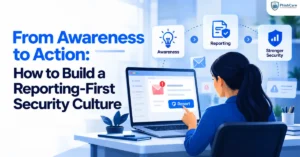
Turning Awareness Into Action
Many organizations discover that employees hesitate to report suspicious emails because they are unsure whether the message is truly malicious. Others worry about creating unnecessary work for the IT or security team. This hesitation can delay incident response and increase organizational risk.
PhishCare helps eliminate this uncertainty by creating a reporting-focused security culture where employees understand that reporting potential threats is always encouraged. Over time, repeated phishing simulations help employees become more confident in recognizing warning signs and taking action when something looks suspicious.
Build Reporting Confidence
Employees gain practical experience identifying suspicious emails and learn that reporting concerns is a positive security behavior, even when uncertainty exists.
Reduce Response Delays
Faster reporting gives security teams earlier visibility into potential threats, allowing them to investigate and respond before an incident escalates.
Strengthen Security Awareness
Employees become active participants in organizational security rather than passive recipients of training, creating a stronger human defense layer.
How Reporting Benefits the Entire Organization
Earlier detection of phishing campaigns targeting multiple employees.
Improved visibility into emerging attack techniques and user risk trends.
More effective incident response through earlier investigation and containment.
Continuous improvement of employee awareness and threat recognition skills.
Creating a Reporting-First Security Culture
Organizations that consistently encourage employees to report suspicious emails and unusual activity are often better positioned to detect threats before significant damage occurs. PhishCare helps reinforce this behavior through realistic simulations, awareness reinforcement, and measurable reporting insights that support long-term cybersecurity maturity.
The PhishCare Process Framework: From Awareness to Continuous Improvement
Building strong phishing awareness is not a one-time activity. Organizations achieve better results when employee education, simulations, reporting behavior, and performance measurement work together as part of a continuous improvement cycle. PhishCare follows a structured framework designed to strengthen security behavior over time.
Awareness → Simulation → Detection → Reporting → Improvement
Awareness Creates the Foundation
Employees learn how phishing attacks operate, what suspicious behavior looks like, and why cybercriminals target people. This knowledge creates the foundation for better security decisions.
Simulations Reinforce Learning
Realistic phishing simulations allow employees to apply awareness training in practical situations. This hands-on experience improves retention and strengthens recognition skills.
Detection Becomes a Habit
Repeated exposure helps employees identify suspicious emails, unusual requests, malicious links, and social engineering tactics more effectively.
Reporting Supports Rapid Response
Employees become comfortable reporting concerns, helping security teams investigate potential threats earlier and improve incident response readiness.
Continuous Improvement Drives Long-Term Results
The final stage of the framework focuses on measurement and improvement. Reporting rates, simulation outcomes, and user behavior trends provide valuable insights that help organizations strengthen awareness programs over time. This continuous cycle enables security teams to move beyond one-time training initiatives and build a sustainable security culture across the organization.
3000+ Simulations and Industry Experience
Security awareness programs deliver the greatest value when they are built on real-world experience. Through thousands of phishing simulation campaigns, PhishCare has helped organizations understand employee risk patterns, improve reporting behavior, and strengthen overall phishing resilience.
PhishCare by the Numbers
Finance & Banking
Financial organizations face constant phishing attempts targeting credentials, payment processes, and sensitive customer information. Simulations help employees recognize increasingly sophisticated attack techniques.
Healthcare
Healthcare organizations manage sensitive patient information and often operate under strict compliance requirements. Employee awareness plays a critical role in reducing phishing-related risks.
IT & Technology
Technology teams frequently face credential theft attempts, cloud account attacks, and business email compromise threats. Simulations help maintain vigilance against evolving attack methods.
Experience That Supports Security Awareness Maturity
Running phishing simulations at scale provides valuable insights into how employees respond to different attack techniques, communication styles, and social engineering tactics. These insights help organizations continuously improve awareness programs and strengthen reporting culture.
Beyond awareness training, phishing simulation reports can provide an additional documentation boost for organizations working toward ISO 27001, SOC 2 Type II, PCI DSS, HIPAA, and NIST CSF, where ongoing security awareness training is recognized as a best practice by auditors and certification bodies.
What Security Teams Say About PhishCare
Effective phishing simulations should do more than test employees. They should create meaningful learning experiences that help organizations improve threat recognition, reporting behavior, and overall cybersecurity awareness.
“We recently used PhishCare for a phishing simulation, and I’ve got to say, their email templates were top-notch. The realism and variety of the templates were impressive, really testing our team’s vigilance.
The level of detail they put into crafting these emails was evident, making the simulation both challenging and effective. It’s clear they know their stuff when it comes to cybersecurity. Highly recommend them!”
LDS
Why Customer Feedback Matters
Security awareness programs are most effective when employees engage with realistic attack scenarios that closely resemble the threats they may encounter in their day-to-day work. High-quality phishing simulations help transform awareness from a compliance exercise into a practical security skill.
Organizations consistently look for simulation platforms that provide realistic phishing templates, measurable reporting insights, and actionable recommendations. These elements help security teams identify behavioral gaps and continuously strengthen organizational resilience against phishing attacks.
Building Trust Through Real-World Experience
With more than 3,000 phishing simulations conducted across multiple industries, PhishCare continues to help organizations improve employee awareness, strengthen suspicious activity reporting, and reduce phishing-related risks through realistic and engaging security training experiences.
Organizations That Trust PhishCare
Organizations across finance, banking, healthcare, technology, and professional services use PhishCare to strengthen employee awareness, improve suspicious activity reporting, and reduce phishing-related risks through realistic simulation programs.
Trusted by Growing Businesses and Enterprise Teams









Why Organizations Continue to Choose PhishCare
Realistic phishing simulations designed around current attack techniques.
Actionable reporting insights that help security teams improve awareness programs.
Scalable phishing simulation campaigns suitable for organizations of all sizes.
Continuous employee learning that strengthens long-term cyber resilience.
Building a strong security culture requires more than technology alone. Organizations that invest in employee awareness, realistic phishing simulations, and proactive reporting programs are often better positioned to identify threats early and reduce cybersecurity risk across the business.
Benefits of Early Suspicious Activity Reporting
The sooner a suspicious email, message, or activity is reported, the more opportunities an organization has to prevent a cybersecurity incident. Early reporting gives security teams valuable time to investigate, contain, and respond before threats can cause widespread damage.
Why Reporting Speed Matters
Cyber threats rarely affect just one employee. A single phishing campaign may target dozens or even hundreds of users simultaneously. When employees quickly report suspicious activity, security teams gain visibility into potential attacks before they spread across the organization.
Faster Incident Response
Security teams can investigate suspicious activity earlier, reducing the time available for attackers to compromise systems, accounts, or sensitive information.
Reduced Organizational Risk
Early alerts help contain threats before multiple employees interact with malicious links, attachments, or fraudulent requests.
Better Threat Intelligence
Reported incidents provide valuable insights into attacker behavior, helping organizations improve future defenses and awareness programs.
How Early Reporting Creates a Stronger Security Culture
Employees become active contributors to organizational security.
Security awareness becomes a daily habit rather than an annual exercise.
Teams gain confidence in identifying and escalating suspicious activity.
Organizations improve overall cyber resilience through collective vigilance.
From Detection to Prevention
One employee reporting a suspicious email may prevent dozens of others from interacting with the same threat. This is why leading organizations encourage employees to report concerns immediately rather than waiting for confirmation that a message is malicious.
PhishCare helps organizations build this proactive reporting mindset through realistic phishing simulations, practical awareness training, and measurable reporting insights that reinforce positive security behaviors over time.
How Security Teams Use Reporting Data for Continuous Improvement
Phishing simulations do more than measure who clicks a link. They generate valuable behavioral insights that help organizations understand employee awareness levels, identify risk patterns, and continuously improve their cybersecurity training strategy.
Turning Employee Behavior Into Actionable Security Intelligence
Every phishing simulation campaign generates data that can help security teams understand where employees are succeeding, where additional awareness is needed, and how organizational risk changes over time. These insights support smarter decision-making and more targeted awareness initiatives.
Identify High-Risk Trends
Reporting data helps security teams understand which phishing themes, communication styles, or attack techniques are most likely to influence employee behavior.
Measure Awareness Progress
Organizations can track improvements in reporting behavior, recognition rates, and employee engagement across multiple simulation campaigns.
Prioritize Training Efforts
Insights from simulations allow organizations to focus awareness initiatives on the areas where employees need the most support.
Key Metrics Security Teams Monitor
Employee reporting rates across phishing campaigns.
Trends in suspicious email recognition and identification.
Recurring attack themes that create the highest user risk.
Departmental or organizational awareness improvements over time.
Supporting Long-Term Security Maturity
Organizations that regularly review phishing simulation results gain a clearer understanding of their human risk landscape. Instead of relying on assumptions, security leaders can make informed decisions based on measurable employee behavior and reporting patterns.
PhishCare provides detailed reporting and campaign insights that help organizations continuously refine their awareness programs, improve reporting culture, and strengthen overall cybersecurity resilience.
Why Organizations Choose PhishCare
Organizations today need more than occasional awareness sessions to address phishing risks. They need a practical and measurable approach that helps employees recognize threats, report suspicious behavior, and continuously improve their security awareness. PhishCare was designed to support this objective through realistic simulations, actionable insights, and ongoing employee engagement.
Key Advantages of PhishCare
Realistic Phishing Simulations
Employees experience phishing scenarios that closely resemble real-world attacks, helping them develop stronger threat recognition skills.
Reporting-Focused Awareness
Programs are designed not only to improve detection but also to encourage faster reporting of suspicious activity.
Actionable Security Insights
Detailed campaign reporting helps organizations identify risk trends, awareness gaps, and improvement opportunities.
Continuous Learning Approach
Regular simulations and awareness activities help reinforce positive security behaviors throughout the year.
Built for Multiple Industries
PhishCare supports organizations across finance, banking, healthcare, technology, professional services, and other sectors where employee awareness plays a critical role in cybersecurity risk management.
Backed by Practical Experience
With more than 3,000 phishing simulations conducted, PhishCare brings practical experience that helps organizations create effective awareness programs and measurable outcomes.
Helping Build a Stronger Human Firewall
Technology remains an important part of cybersecurity, but employees often represent the final line of defense against phishing attacks. By helping users recognize suspicious behavior, make safer decisions, and report potential threats quickly, PhishCare strengthens the human side of organizational security.
A Platform Designed for Long-Term Security Improvement
Rather than focusing on one-time training events, PhishCare helps organizations establish a continuous cycle of awareness, simulation, reporting, measurement, and improvement. This approach enables businesses to strengthen security culture, improve employee engagement, and reduce phishing-related risks over time.
Key Takeaways: How PhishCare Helps Employees Recognize and Report Suspicious Behavior
Strong cybersecurity awareness is not built through a single training session. It develops through continuous learning, realistic simulations, practical experience, and a culture that encourages employees to report suspicious activity without hesitation.
What Organizations Gain with PhishCare
Employees become better at identifying suspicious emails, phishing attempts, and social engineering tactics.
Reporting confidence improves, helping security teams gain earlier visibility into potential threats.
Organizations reduce phishing-related risk through ongoing awareness and simulation programs.
Security teams receive actionable insights that support continuous improvement initiatives.
Employees develop practical experience through realistic phishing simulations rather than theoretical training alone.
Organizations strengthen their overall security culture and human firewall against evolving cyber threats.
The Bigger Picture
Cybercriminals continue to refine phishing and social engineering techniques, making employee awareness more important than ever. Even advanced security technologies cannot stop every threat from reaching end users. Employees who know how to recognize suspicious behavior and report concerns quickly provide a valuable layer of protection.
By combining realistic phishing simulations, continuous awareness initiatives, and measurable reporting insights, PhishCare helps organizations create lasting behavioral change and stronger cybersecurity resilience.
Security Awareness Works Best When It Becomes a Habit
The most successful organizations do not treat phishing awareness as a one-time compliance exercise. They create an environment where employees regularly practice threat recognition, report suspicious activity confidently, and contribute to a stronger security culture every day. That is the long-term objective PhishCare is designed to support.
Frequently Asked Questions About PhishCare and Suspicious Activity Reporting
Below are answers to common questions organizations ask about phishing simulations, employee awareness, suspicious email reporting, and how PhishCare helps improve security behavior.
How does PhishCare help employees recognize suspicious behavior?
PhishCare uses realistic phishing simulations and security awareness training to expose employees to real-world attack scenarios. This practical experience helps users identify phishing indicators, suspicious links, social engineering tactics, and other warning signs before they become security incidents.
Why is reporting suspicious emails important?
Early reporting helps security teams investigate potential threats before they affect additional employees or business systems. Fast reporting can reduce response times and improve overall organizational security visibility.
What types of phishing simulations does PhishCare provide?
PhishCare supports a wide range of phishing simulation scenarios, including credential harvesting attempts, invoice fraud, executive impersonation, cloud service notifications, HR-themed attacks, and other social engineering techniques commonly used by cybercriminals.
Can phishing simulation reports support compliance initiatives?
Yes. Phishing simulation reports can provide an additional documentation boost for organizations working toward ISO 27001, SOC 2 Type II, PCI DSS, HIPAA, and NIST CSF, where ongoing security awareness training is widely recognized as a cybersecurity best practice.
How many phishing simulations has PhishCare conducted?
PhishCare has conducted more than 3,000 phishing simulation campaigns across organizations in industries including finance, banking, healthcare, technology, and professional services.
How can organizations get started with PhishCare?
Organizations can start by assessing employee phishing awareness levels through a phishing simulation campaign and then build an ongoing awareness program using PhishCare’s training, reporting, and behavioral improvement capabilities.
Content Reviewed By

Mohammed Nawaz Sajjad is a practising cybersecurity professional specializing in phishing simulations, employee awareness programs, security assessments, red team exercises, and ethical hacking initiatives. He works closely with organizations to evaluate human cyber risk and strengthen employee resilience against phishing attacks and social engineering threats.
As a senior security analyst at CyberSapiens, Nawaz has contributed to the delivery of more than 3,000 phishing simulation campaigns across multiple industries, helping organizations improve threat recognition, reporting behavior, and long-term cybersecurity awareness. His experience includes working with finance, banking, healthcare, and technology organizations to build stronger human-centered security programs.
His practical experience with phishing simulation deployments, employee behavior analysis, and security awareness initiatives helps ensure that the guidance presented in this article reflects real-world cybersecurity challenges and proven awareness-building practices.
View LinkedIn ProfileTurn Employees Into a Stronger Line of Defense Against Phishing Attacks
Help your employees recognize suspicious behavior, report threats faster, and build long-term cybersecurity awareness through realistic phishing simulations and measurable security training programs from PhishCare.
Trusted by organizations across finance, banking, healthcare, IT, and professional services with 3,000+ phishing simulations delivered and a 90% campaign success rate.