For organizations working toward ISO 27001 compliance, human error remains one of the most significant security risks. While technical controls are essential, phishing attacks continue to bypass security systems by targeting employees through social engineering, credential theft, and deceptive email campaigns.
Modern phishing attacks are designed to imitate trusted vendors, cloud platforms, finance departments, and internal executives with increasing accuracy. Even organizations with advanced email security can still face compromise if employees are not trained to identify and report suspicious activity.
This is why phishing awareness programs and phishing simulation exercises are becoming an important part of broader ISO 27001 security strategies. Structured awareness initiatives help organizations reduce human-risk exposure, improve reporting behavior, and strengthen ongoing security awareness efforts across teams.
Why Phishing Awareness Matters for ISO 27001
ISO 27001 strongly emphasizes employee awareness, security responsibility, and continuous improvement. While phishing simulations are not specifically mandated by the framework, many organizations use recurring awareness campaigns to strengthen security culture and improve measurable awareness outcomes.
PhishCare’s phishing simulation reports provide an additional documentation boost for organizations working toward ISO 27001, SOC 2 Type II, PCI DSS, HIPAA, or NIST CSF, where ongoing security awareness training is recognized as a best practice by auditors and certification bodies.
Employees remain one of the most targeted entry points for phishing, credential theft, and social engineering attacks.
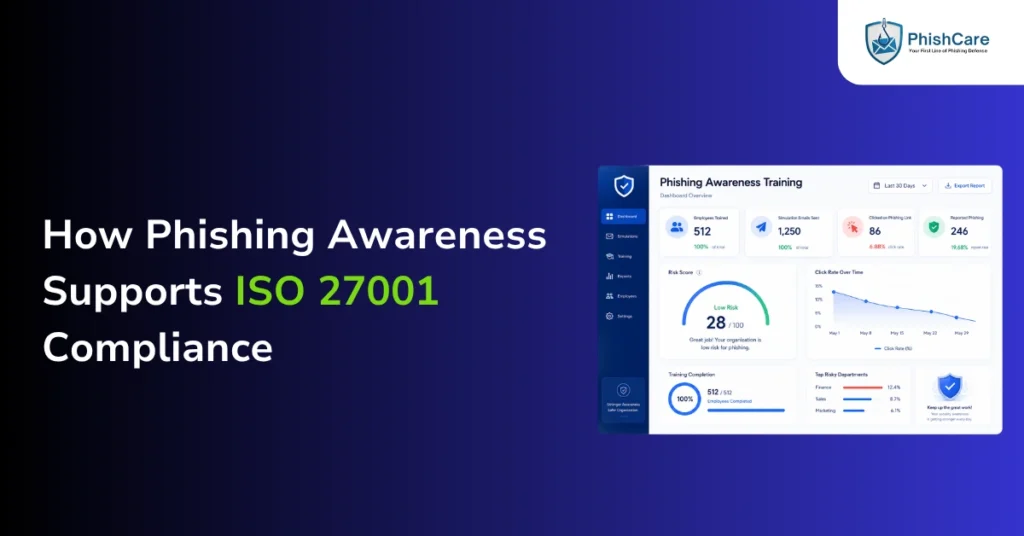
Recurring phishing simulations help organizations measure reporting behavior and identify awareness gaps across departments.
Awareness reporting and campaign metrics can help demonstrate continuous improvement activities during internal reviews and audits.
Why Phishing Remains One of the Biggest Human Security Risks
Despite improvements in endpoint protection, email filtering, and cloud security controls, phishing attacks continue to be one of the most successful methods used by attackers. Modern phishing campaigns are designed to manipulate human behavior rather than directly exploit technical vulnerabilities.
Attackers now use highly convincing phishing techniques that imitate trusted vendors, HR departments, financial institutions, cloud services, and even internal executives. These campaigns often appear legitimate enough to bypass suspicion, especially when employees are under pressure, distracted, or unfamiliar with evolving phishing tactics.
Common Phishing Attack Techniques Organizations Face
Credential Harvesting
Fake login portals designed to steal Microsoft 365, VPN, or cloud platform credentials.
Business Email Compromise
Executive impersonation emails targeting finance teams and payment workflows.
Malicious Attachments
Invoices, PDFs, spreadsheets, and ZIP files used to deliver malware or ransomware payloads.
QR Code Phishing
Attackers use QR codes in emails to redirect employees to credential theft pages.
Many successful breaches begin with a single employee interaction. Clicking a malicious link, downloading an infected attachment, or submitting credentials to a fake login page can expose sensitive systems, financial information, and cloud infrastructure access.
This is why phishing awareness is increasingly viewed as a core component of practical cyber risk management. Organizations that continuously educate employees and measure awareness behavior are often better positioned to reduce human-risk exposure and improve overall security resilience.
Security Exposure
Successful phishing attacks can lead to credential theft, ransomware infections, unauthorized access, and sensitive data exposure.
Operational Impact
Phishing incidents can disrupt operations, create financial loss, damage trust, and increase incident response workload.
Compliance Pressure
Organizations are increasingly expected to demonstrate ongoing employee awareness efforts and measurable security improvement activities.
How ISO 27001 Approaches Security Awareness and Human Risk
ISO 27001 focuses on building a structured information security management system that helps organizations identify, manage, and reduce security risks across people, processes, and technology. While technical controls are important, the framework also recognizes that employees play a major role in protecting organizational data and systems.
Employees interact daily with email systems, cloud platforms, financial workflows, shared documents, and external communications. Because phishing attacks specifically target human behavior, awareness and training become important parts of reducing organizational risk exposure.
Core ISO 27001 Awareness Objectives
ISO 27001 encourages organizations to ensure employees understand their security responsibilities, recognize potential threats, and follow appropriate reporting and security procedures.
Security Responsibilities
Employees should understand how their actions impact organizational security and compliance efforts.
Threat Awareness
Organizations should educate employees about evolving cyber threats, including phishing and social engineering attacks.
Incident Reporting
Employees should know how and when to report suspicious emails, unusual activity, or potential incidents.
ISO 27001 also emphasizes continuous improvement. Awareness initiatives should not remain static or become a once-per-year compliance exercise. Organizations are encouraged to regularly review awareness effectiveness, monitor risks, and improve security practices over time.
| ISO 27001 Area | Awareness Contribution |
|---|---|
| Security Awareness & Training | Educates employees on phishing threats, reporting behavior, and cyber hygiene practices. |
| Incident Management | Improves employee ability to identify and report suspicious activity quickly. |
| Risk Reduction | Helps reduce exposure to credential theft, malware, and social engineering attacks. |
| Continuous Improvement | Provides measurable awareness data that organizations can review and improve over time. |
Awareness Is More Than a Compliance Checkbox
Organizations that treat awareness as an ongoing operational activity rather than a once-a-year requirement are often better positioned to improve security culture, reduce human-risk exposure, and strengthen long-term compliance readiness.
Why Phishing Simulations Provide Measurable Awareness Evidence
One of the biggest challenges organizations face during security reviews and audit preparation is demonstrating that awareness initiatives are active, measurable, and continuously improving over time. Policies and training records alone may not provide enough visibility into how employees actually respond to phishing threats in real-world scenarios.
Phishing simulations help organizations generate measurable awareness data that can be reviewed internally to evaluate employee behavior, reporting patterns, and awareness effectiveness across departments.
What Organizations Can Measure Through Phishing Simulations
Employee Click Behavior
Identifies how employees respond when exposed to simulated phishing emails and malicious links.
Credential Submission Risk
Highlights employees who attempt to enter credentials into simulated phishing portals.
Reporting Improvements
Tracks how quickly employees identify and report suspicious emails over time.
Department-Level Exposure
Provides visibility into teams or departments that may require additional awareness support.
Organizations often use phishing simulation reporting to evaluate whether awareness initiatives are improving employee security behavior over time. Repeated campaigns can help security teams identify trends, monitor improvements, and focus training efforts where risk exposure remains high.
Awareness Reporting and Compliance Readiness
PhishCare’s phishing simulation reports provide an additional documentation boost for organizations working toward ISO 27001, SOC 2 Type II, PCI DSS, HIPAA, or NIST CSF, where ongoing security awareness training is recognized as a best practice by auditors and certification bodies.
While phishing simulations are not a replacement for broader governance, policies, or risk management controls, they can support operational awareness visibility and continuous improvement initiatives within security programs.
Examples of Useful Awareness Reporting Metrics
| Reporting Metric | Operational Insight |
|---|---|
| Campaign Participation | Measures awareness engagement across employees and departments. |
| Click-Through Trends | Tracks whether phishing susceptibility decreases over time. |
| Reporting Response Time | Measures how quickly suspicious emails are escalated internally. |
| Repeat User Behavior | Identifies employees requiring additional awareness reinforcement. |
| Departmental Trends | Highlights operational areas with higher phishing-risk exposure. |
Common Awareness Gaps Organizations Face Before ISO 27001 Audits
Many organizations begin strengthening their phishing awareness initiatives only after identifying gaps during internal reviews, security assessments, or ISO 27001 audit preparation activities. While policies and awareness documentation may already exist, operational visibility into employee behavior is often limited.
Awareness programs that are inconsistent, difficult to measure, or disconnected from real phishing behavior can create security blind spots that increase human-risk exposure over time.
Annual-Only Training
Many organizations still rely on once-a-year awareness presentations that may not reflect evolving phishing tactics or current attack trends.
No Measurable Awareness Data
Without phishing simulations or awareness reporting, organizations may struggle to evaluate actual employee phishing behavior.
Limited Reporting Culture
Employees may not know how to escalate suspicious emails quickly, which can delay incident response during real attacks.
Generic Awareness Content
Static training materials may reduce employee engagement and fail to simulate realistic phishing scenarios.
Common Awareness Gaps and Their Potential Risks
| Awareness Gap | Potential Security Impact |
|---|---|
| No phishing simulations | Limited visibility into employee phishing susceptibility. |
| No reporting workflow awareness | Delayed escalation of suspicious emails and incidents. |
| Generic awareness content | Low employee engagement and poor retention. |
| No role-based awareness | Higher-risk departments may remain more vulnerable. |
| No awareness trend tracking | Organizations cannot easily measure awareness improvement over time. |
Awareness Maturity Requires Continuous Improvement
Organizations that maintain recurring awareness campaigns, measurable reporting, and phishing simulations are often better positioned to identify weaknesses before they become real security incidents.
Continuous awareness improvement also helps organizations strengthen operational security culture rather than treating awareness as a one-time compliance exercise.
By identifying awareness gaps early and improving employee phishing resilience over time, organizations can reduce human-risk exposure while strengthening broader information security management efforts.
How PhishCare Helps Organizations Improve Awareness Programs
PhishCare, developed by CyberSapiens, helps organizations strengthen employee phishing awareness through recurring phishing simulations, reporting visibility, and measurable awareness tracking. The platform is designed to help organizations evaluate employee behavior while supporting broader security awareness initiatives.
Organizations can use phishing simulations to better understand how employees respond to social engineering attempts, identify awareness gaps, and improve reporting behavior across teams over time.
Key Awareness Capabilities Organizations Can Use
Custom Phishing Simulations
Run realistic phishing campaigns that simulate modern attack techniques employees may encounter in real environments.
Awareness Reporting
Track employee click behavior, reporting trends, credential submission attempts, and awareness improvements.
Department-Level Visibility
Identify operational areas or departments that may require additional phishing awareness reinforcement.
Continuous Awareness Tracking
Measure awareness improvements over time through recurring phishing campaigns and employee reporting metrics.
How Organizations Commonly Use Awareness Reporting
Organizations often use phishing simulation reports internally to evaluate employee awareness maturity, identify high-risk behavior trends, and support ongoing security awareness activities.
Awareness Improvement Tracking
Monitor whether phishing susceptibility decreases across repeated awareness campaigns.
Operational Risk Visibility
Identify departments or user groups with higher phishing-risk exposure.
Security Reporting Behavior
Evaluate how quickly employees escalate suspicious emails and phishing attempts.
Awareness Reporting and Compliance Programs
PhishCare’s phishing simulation reports provide an additional documentation boost for organizations working toward ISO 27001, SOC 2 Type II, PCI DSS, HIPAA, or NIST CSF, where ongoing security awareness training is recognized as a best practice by auditors and certification bodies.
Summary: Why Phishing Awareness Matters for ISO 27001
Phishing attacks continue to target employees through increasingly sophisticated social engineering techniques. While technical controls remain critical, organizations also need strong employee awareness programs to reduce human-risk exposure and strengthen long-term security resilience.
ISO 27001 emphasizes awareness, employee responsibility, incident reporting, and continuous improvement across information security programs. Recurring phishing awareness campaigns and phishing simulations help organizations support these objectives through measurable awareness activities and ongoing employee education.
Human Risk Remains a Major Threat
Employees continue to be targeted through phishing emails, credential theft campaigns, and social engineering attacks.
Awareness Programs Improve Security Culture
Recurring awareness initiatives help employees recognize suspicious behavior and improve reporting practices.
Measurable Reporting Supports Visibility
Phishing simulations provide operational visibility into employee awareness trends and reporting behavior.
Continuous Improvement Matters
Organizations that continuously improve awareness programs are often better positioned for long-term security maturity.
Building a Stronger Human Firewall
Technology alone cannot eliminate phishing risk. Organizations that combine employee awareness, phishing simulations, reporting culture, and continuous improvement practices often develop stronger resilience against social engineering threats.
As phishing attacks continue evolving, awareness programs are becoming an increasingly important part of broader information security management strategies and operational compliance readiness initiatives.
Frequently Asked Questions
Organizations preparing for ISO 27001 audits often have questions about phishing awareness, phishing simulations, employee training expectations, and awareness reporting practices. Below are some of the most common questions security teams and compliance stakeholders ask.
Does ISO 27001 require phishing awareness training?
ISO 27001 strongly emphasizes employee security awareness and training as part of broader information security management practices. Phishing awareness initiatives help organizations address human-risk exposure and improve employee understanding of modern cyber threats.
Are phishing simulations mandatory for ISO 27001 compliance?
No. ISO 27001 does not specifically mandate phishing simulations. However, many organizations use phishing simulations as part of ongoing awareness and human-risk reduction strategies.
How often should phishing awareness campaigns be conducted?
Many organizations conduct phishing awareness campaigns quarterly or monthly to maintain employee engagement, improve reporting behavior, and measure awareness progress over time.
Can phishing simulation reports help during audit preparation?
Phishing simulation reports can provide additional operational visibility into awareness activities, reporting behavior, and measurable awareness initiatives during internal security reviews and audit preparation.
What awareness metrics are commonly tracked in phishing simulations?
Common awareness metrics include click-through rates, credential submission attempts, reporting rates, repeat-user behavior, campaign participation, and department-level phishing exposure trends.
How does phishing awareness improve security culture?
Recurring awareness campaigns help employees recognize suspicious activity more effectively, improve reporting confidence, and strengthen overall organizational security behavior over time.
Content Reviewed By

Mohammed Nawaz Sajjad
Nawaz is a practising security analyst specializing in phishing simulation campaigns, employee awareness assessments, red team exercises, and ethical hacking. He works closely with organizations evaluating phishing-risk exposure, employee reporting behavior, and operational awareness maturity across multiple industries and regions.
He leads phishing simulation deployments at PhishCare, a platform developed by CyberSapiens, with hands-on experience supporting organizations implementing recurring phishing awareness initiatives and measurable security awareness programs.
View LinkedIn ProfileStrengthen Employee Phishing Awareness and Support Your Security Program
PhishCare helps organizations run phishing simulations, improve employee reporting behavior, and gain measurable visibility into phishing-risk exposure through recurring awareness campaigns and reporting insights.
Run phishing simulations regularly to improve employee awareness and reporting behavior over time.
Track awareness trends, reporting metrics, and employee phishing-risk exposure across departments.
PhishCare reporting provides an additional documentation boost for organizations strengthening awareness maturity.