Cybersecurity and regulatory compliance are now tightly linked to how well an organisation understands and manages human risk. With over 90 percent of cyberattacks estimated to originate from phishing emails, a single employee’s oversight can trigger data breaches, regulatory penalties, financial loss, and reputational damage.
To address this, many businesses are adopting phishing simulation services and platforms that not only test employees but also generate detailed phishing simulation reports. These reports are where the true value lies. They transform simulated phishing activity into measurable insight that improves security, supports compliance, and protects profitability.
PhishCare , is one such platform that specialises in running realistic phishing campaigns and converting the results into clear, actionable reports.
Why Phishing Simulation Reports Matter to Business Performance
Phishing simulations alone are just exercises. It is the reporting and analysis that turn them into a strategic tool. Phishing simulation reports give leadership evidence of how employees behave under realistic attack conditions, which departments face the highest exposure, and whether awareness training is actually working.
Instead of relying on assumptions about user awareness, organisations get concrete data: who opened, who clicked, who submitted data, and who reported the message. This visibility allows businesses to prevent incidents instead of reacting to them after the fact.
10 Ways Phishing Simulation Reports Boost Company Security and Profits
1. Employees as the First Line of Defense
Phishing simulation reports clearly show how effective employees are at recognising and handling suspicious messages. They reveal patterns of behaviour: users who routinely ignore simulated phishing, users who click without checking, and users who reliably report.
This insight helps organisations treat employees as an intentional, trained first line of defence rather than an unpredictable risk. PhishCare’s reports, built from realistic phishing campaigns, highlight exactly where targeted security awareness training is needed to strengthen that frontline.
2. Reduced Risk of Data Breaches
Data breaches are expensive, both financially and operationally. Phishing simulation reports expose vulnerabilities long before real attackers encounter them.
By examining trends in user susceptibility, organisations can identify high-risk teams, frequent clickers, or common types of phishing lures that succeed. With PhishCare, these findings are clearly documented so that corrective actions and follow-up training can be prioritised. This proactive approach significantly lowers the likelihood of a phishing incident turning into a full-scale breach.
3. Measurable Cybersecurity Awareness
Awareness is only valuable if it can be measured. Phishing simulation reports turn abstract training into quantifiable performance.
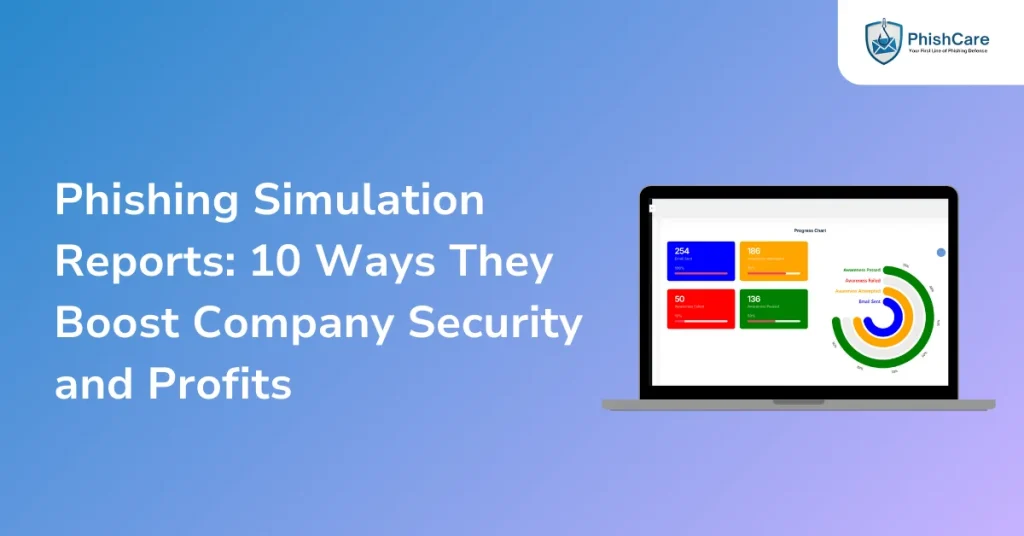
PhishCare tracks metrics such as open rates, click rates, credential submission attempts, reporting rates, and improvement across repeated campaigns. These metrics show whether awareness training is effective and where it needs adjustment. During internal reviews or board presentations, these numbers demonstrate that security awareness is not just a checkbox but a measurable risk control.
4. Stronger Regulatory Compliance Evidence
Regulations such as GDPR, HIPAA, ISO 27001 and SOC 2 emphasise ongoing training, risk assessment, and documented proof. Phishing simulation reports provide that evidence.
Reports generated by a platform like PhishCare show that the organisation is regularly conducting phishing tests, conducting phishing risk assessments, and providing follow-up training based on results. This documentation supports audit requirements and reduces the scramble for proof during compliance reviews.
5. Reinforced Security-First Culture
When results from phishing simulations are transparently reported and discussed, employees become more engaged in the security process.
Phishing simulation reports show progress over time. Staff see that their actions matter and that improvements are noticed. PhishCare’s reporting model supports this cultural shift by presenting information in a way that can be shared with leadership, managers, and teams without shaming individuals. The result is a more mature, security-aware workplace.
6. Early Identification of Weak Points
Phishing simulation reports reveal things that technical tools cannot. They show which people, roles, and departments are consistently falling for simulated phishing emails and fake scam emails.
These weak points are often where attackers would succeed first in a real scenario. Using PhishCare, organisations can design custom training plans for those high-risk groups and test them again in follow-up campaigns. This cycle closes gaps before a real criminal exploits them.
7. Better Support for Compliance Audits
During audits, it is no longer sufficient to say that security training exists. Auditors expect to see records of what was done, who participated, and how effective it has been.
Phishing simulation reports from tools like PhishCare serve as ready-made audit support. They show the frequency of phishing tests, performance trends, maturity levels, and remediation steps taken. This makes it far easier to demonstrate adherence to awareness and training controls in standards like ISO 27001 and supports evidence requirements in GDPR and HIPAA.
8. Continuous Improvement in Human Risk
Cyber risk is not static. Attack techniques evolve, staff change roles, and new employees join. Phishing simulation reports help organisations track risk over time rather than treating awareness as a one-off project.
With PhishCare, each campaign adds data to a longer-term picture: click rates trending down, reporting rates rising, and maturity levels improving. This continuous visibility allows organisations to show not just that training exists, but that human risk is actively being reduced.
9. Enhanced Management Oversight
CISOs, compliance officers, and IT leaders need meaningful metrics to make informed decisions about budget, tools, and training. Phishing simulation reports provide the human-risk metrics they need.
PhishCare’s reports give leadership a clear view of which areas need investment, which awareness initiatives are working, and where additional controls may be required. This helps align cybersecurity decisions with actual user behaviour instead of assumptions.
10. Documented Proof of Training and Accountability
Many regulations and internal policies require organisations to prove that employees have received security awareness training and been part of phishing training for organisations. Phishing simulation tools such as PhishCare automatically generate those records.
Reports show who was targeted, who engaged, who clicked, who reported, and what remediation was provided. This creates a traceable record of accountability that can be used internally and externally to demonstrate that the organisation is taking training seriously.
Here is the Sample PhishCare Report
Download Free Phishing Simulation Report:
How PhishCare Generates Actionable Phishing Simulation Reports
PhishCare is designed not only to run simulations but to structure them in a methodical, report-driven way.
1. Phishing Simulation Methodology
PhishCare follows a clear process based on industry best practices. Campaigns begin with scoping and information gathering, move into attack planning and scenario design, followed by simulation execution, monitoring, and final reporting. This mimics the lifecycle of a real attacker, but in a controlled, safe environment.
2. Maturity Levels and Risk Interpretation
One of PhishCare’s strengths is its use of maturity levels to interpret the results of a phishing simulation. Based on campaign outcomes, user maturity is classified into categories such as Low, Medium, High, and Outstanding. These levels depend on the percentage of users who were phished.
For example, if more than 75 percent of users are phished, maturity is considered low, and risk is high. If less than 25 percent are phished, maturity is outstanding and risk is comparatively lower. This simple mapping allows non-technical stakeholders to understand the organisation’s exposure quickly.
3. From Report Data to Remediation
PhishCare reports go beyond statistics. They point towards next steps: which departments need focused training, where additional simulations should be run, and what kind of content is required for awareness reinforcement. Over time, repeated reports build a clear story of improvement, or highlight areas where further action is necessary.
Phishing Simulation Reports as a Strategic Tool for Security and Profitability
Phishing simulation reports are far more than technical summaries of user behavior. When used correctly, they become strategic business tools that directly influence both security strength and financial performance. By translating employee actions into measurable risk data, these reports allow organizations to understand exactly where their exposure lies, how likely a real-world breach could occur, and what financial impact that breach might carry.
With PhishCare , organizations run realistic simulated phishing campaigns and convert the results into structured, decision-ready reports. These insights allow leadership teams to proactively reduce attack success rates before real attackers exploit the same weaknesses. Fewer successful phishing attacks mean lower chances of ransomware incidents, credential theft, fraudulent transactions, data loss, and regulatory violations, all of which carry significant direct and indirect financial costs.
From a profitability perspective, phishing simulation reports help organizations:
- Avoid breach-related expenses such as incident response, forensic investigation, downtime, customer notification, and legal penalties
- Reduce regulatory and audit-related risks that can lead to fines and operational restrictions
- Lower cyber insurance premiums by demonstrating measurable risk reduction and active awareness programs
- Protect revenue streams by minimizing operational interruptions caused by cyber incidents
From a security standpoint, these reports enable continuous risk visibility, targeted remediation, and long-term improvement in human defense maturity. Over time, this creates a more resilient organization that is harder to exploit, easier to audit, and better positioned to scale securely. If your organization wants to stay audit-ready, secure, and aware, PhishCare is the trusted solution to make compliance effortless.
Frequently Asked Questions
1. How do phishing simulation reports improve company security?
Phishing simulation reports reveal how employees actually behave when exposed to simulated phishing attacks. They highlight which users and departments are most vulnerable, enabling targeted training and reducing the likelihood of successful real-world attacks.
2. How do these reports support regulatory compliance?
Reports document that phishing simulations and cyber security awareness training are conducted regularly. This helps satisfy evidence requirements in frameworks such as GDPR, HIPAA, ISO 27001, and SOC 2, where ongoing training and risk management must be demonstrated.
3. What kind of data does a phishing simulation report from PhishCare include?
PhishCare reports include delivery, open, click, and submission metrics, reporting behaviour, department-wise results, maturity levels, and recommendations for improvement based on the simulation outcomes.
4. How often should organisations run phishing simulations to generate useful reports?
Most organisations benefit from running simulations multiple times per year. Regular testing ensures that reports reflect current user behaviour and allow trends in improvement or regression to be tracked over time.
5. Why use a managed phishing simulation tool like PhishCare instead of ad-hoc tests?
A managed tool like PhishCare provides structured methodology, professional templates, detailed analytics, maturity scoring, and audit-ready reports. This saves internal effort and ensures simulations are realistic, consistent, and aligned with compliance and security goals.