Remote work has transformed how organisations operate. Employees now access systems, communicate with teams, and manage business processes from home networks, shared spaces, and mobile devices. While this shift has improved flexibility and productivity, it has also introduced new cyber security challenges, particularly in the form of phishing attacks .
Phishing threats in remote work environments have increased significantly in recent years. Attackers recognise that remote employees are more reliant on digital communication and may not have the same level of security oversight as they would in an office setting. Without direct access to IT support or secure corporate networks, employees often make independent decisions when interacting with emails, links, and requests.
In 2026, phishing attacks targeting remote workers are more sophisticated than ever. Messages are tailored to mimic internal communication, collaboration tools, and cloud-based platforms. Attackers use urgency, familiarity, and impersonation to create convincing scenarios that encourage employees to act quickly.
A single phishing interaction in a remote work environment can lead to credential compromise, unauthorised system access, or financial fraud. Because remote employees are often the first line of interaction with these threats, strengthening awareness and behaviour is critical. Understanding how phishing attacks exploit remote work environments is essential for organisations seeking to protect their workforce and maintain secure operations.
Why Remote Work Increases Phishing Risk
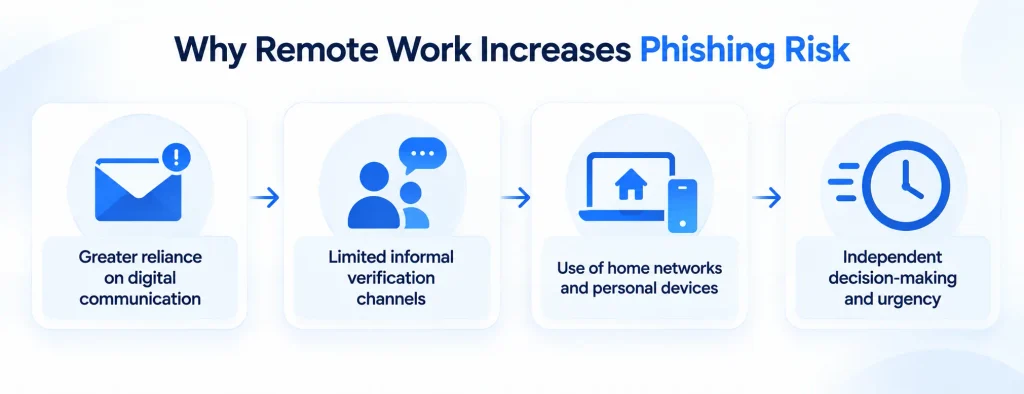
Remote work environments introduce several factors that increase exposure to phishing attacks. One of the most significant changes is the reliance on email and digital communication for nearly all business interactions.
In traditional office settings, employees can verify requests in person or consult colleagues quickly. In remote environments, these informal verification channels are limited. Employees are more likely to rely solely on email or messaging platforms, which attackers can easily impersonate.
Home networks and personal devices may also lack the same level of security as corporate environments. This creates additional opportunities for attackers to exploit vulnerabilities. Isolation is another factor. Remote employees often work independently, which can lead to quicker decision-making without peer validation. Attackers use this to their advantage by creating urgent scenarios that require immediate action.
Common Phishing Scenarios Targeting Remote Employees
Phishing attacks in remote work environments often mimic routine digital interactions. Attackers frequently impersonate internal communication, such as messages from managers requesting urgent approvals or document reviews. These emails are designed to appear consistent with remote workflows.
Another common scenario involves fake notifications from collaboration tools or cloud platforms. Employees may receive emails prompting them to log in to access shared files or update account credentials.
Payment-Related Phishing
Payment-related phishing is also prevalent. Attackers may impersonate finance teams or vendors, requesting changes to payment details or approval of urgent transactions. Because these scenarios align with everyday remote work activities, employees may not immediately recognise them as threats.
The Role of Cloud Platforms and Collaboration Tools
Remote work relies heavily on cloud-based applications and collaboration tools. While these platforms enable productivity, they also provide new avenues for phishing attacks.
Attackers often create phishing emails that mimic notifications from platforms such as file-sharing services, project management tools, or email systems. These messages may include links to fake login pages designed to capture credentials.
Once credentials are compromised, attackers can access corporate systems, send additional phishing emails from legitimate accounts, and move laterally within the organisation. Because these platforms are widely used, employees may trust notifications without verifying their authenticity.
Human Behaviour in Remote Environments
Phishing attacks are effective because they exploit human behaviour. In remote environments, certain behavioural patterns increase vulnerability.
Employees may respond quickly to emails due to workload pressure or perceived urgency. Without immediate access to colleagues for verification, decisions are often made independently. Familiarity also plays a role. Emails that appear to come from known contacts or internal systems are more likely to be trusted.
Additionally, remote employees may experience alert fatigue due to the high volume of digital communication. This can reduce attention to detail when reviewing messages. Strengthening awareness helps employees recognise these patterns and respond more cautiously.
Strengthening Remote Workforce Security
Reducing phishing risk in remote environments requires a combination of awareness, process, and technology.
Employees should be trained to recognise phishing indicators such as unexpected requests, unusual sender addresses, and links that lead to login pages. Training should be tailored to remote workflows and common digital interactions.
Verification processes are essential. Employees should confirm sensitive requests through alternate communication channels before taking action.
Multi-factor authentication adds layer of protection by reducing the impact of compromised credentials. Organisations should also be aware of phishing techniques designed to bypass MFA without a password .
Encouraging a strong reporting culture ensures that suspicious emails are escalated quickly, allowing security teams to respond before the threat spreads.
Enhancing Awareness for Remote Teams With PhishCare
Remote employees benefit significantly from practical exposure to phishing scenarios that reflect their daily work environment. PhishCare supports organisations through structured phishing simulation campaigns designed for modern remote workflows.
PhishCare simulations replicate scenarios commonly encountered by remote employees, including cloud login prompts, document-sharing requests, and internal communication impersonation. These simulations help employees recognise threats within familiar digital contexts.
When employees interact incorrectly with simulated phishing emails, PhishCare provides immediate feedback explaining the warning signs that were missed. This moment-based learning reinforces awareness and improves future decision-making.
PhishCare also provides behavioural reporting insights that allow organisations to track improvements in employee vigilance across remote teams. These insights help identify high-risk patterns and guide targeted awareness efforts.
By combining realistic simulation with continuous reinforcement, organisations can strengthen remote workforce security and reduce phishing-related risk.
Building Resilience in a Remote-First World
Remote work is likely to remain a permanent part of modern business operations. As organisations continue to adopt flexible work models, cyber security strategies must evolve to address new risks.
Phishing attacks will continue to target remote employees because they rely heavily on digital communication and independent decision-making. Strengthening awareness, encouraging verification, and reinforcing secure behaviour are essential steps in reducing these risks. Organisations that prioritise remote workforce security will be better positioned to protect systems, data, and operations in an increasingly distributed environment.
Frequently Asked Questions
Why are remote employees targeted by phishing attacks?
Remote employees rely heavily on digital communication and may lack immediate access to verification channels, making them more susceptible to phishing attempts.
What are common phishing threats in remote work environments?
Common threats include fake login pages, impersonation of managers or colleagues, cloud platform notifications, and fraudulent payment requests.
How can organisations protect remote employees from phishing?
Organisations can provide awareness training, implement multi-factor authentication, establish verification processes, and encourage reporting of suspicious emails.
Do cloud platforms increase phishing risk?
Cloud platforms themselves are secure, but attackers often impersonate them in phishing emails to capture employee credentials.
How often should remote employees receive phishing awareness training?
Training should be continuous, supported by regular phishing simulations to reinforce awareness and adapt to evolving threats.
Content Reviewed By

Nawaz is a practising security analyst specializing in phishing simulation campaigns,
employee awareness assessments,
red team exercises,
and ethical hacking.
He leads phishing simulation deployments at PhishCare,
a product developed by CyberSapiens,
with hands-on experience evaluating and deploying phishing simulation tools
across organizations in multiple industries and regions globally.
Strengthen Your Remote Workforce Security
Strengthen employee awareness with realistic phishing simulations designed for modern remote workflows.