Phishing attacks continue to be one of the most effective methods cybercriminals use to compromise organizations. From credential theft and business email compromise to ransomware delivery, a single phishing email can expose sensitive systems, disrupt operations, and create significant financial and reputational damage.
Organizations across Canada are increasingly investing in phishing simulation and cyber security awareness training to strengthen employee vigilance and reduce human risk. In this guide, we explore the top 10 benefits of choosing PhishCare, a phishing simulation and awareness training platform developed by CyberSapiens, and how it helps organizations build a stronger security culture.
PhishCare combines realistic phishing simulations, employee awareness training, detailed reporting, and actionable insights to help organizations identify risky behaviors before real attackers do. With more than 3,000+ phishing simulations delivered and a reported 90% campaign success rate, organizations across finance, banking, healthcare, and IT sectors use PhishCare to improve employee awareness and strengthen cyber resilience.
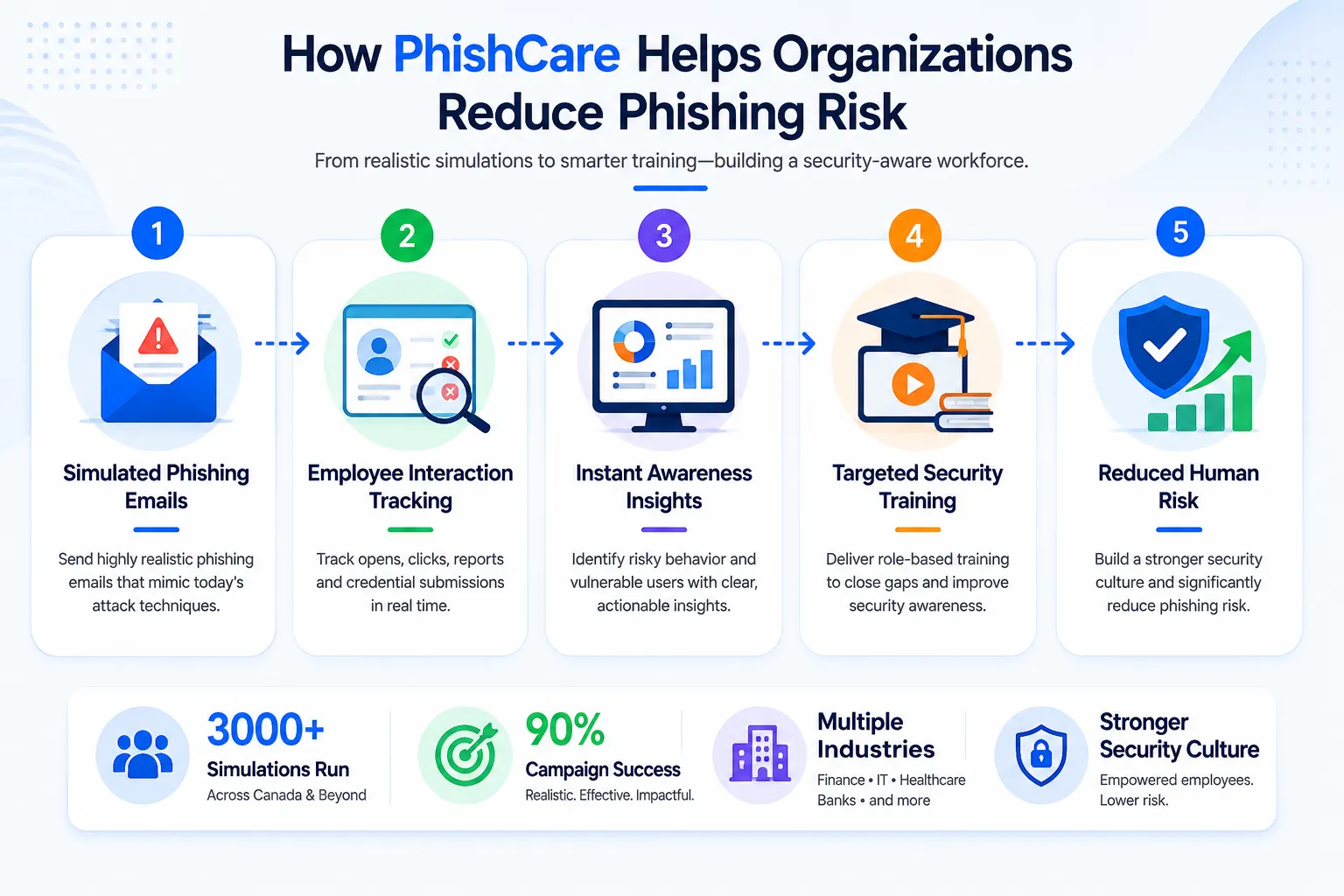
How PhishCare Helps Organizations Reduce Phishing Risk
A simple 5-step process that helps organizations build awareness, identify risk, and strengthen employee security behavior.
Realistic Phishing Simulations That Mirror Modern Threats
Many phishing awareness programs fail because employees can easily identify the simulated emails as fake. Modern cybercriminals, however, use highly convincing phishing techniques that closely resemble legitimate business communications. Effective phishing simulations must therefore reflect the real-world threats employees encounter daily.
PhishCare provides realistic phishing simulations designed to replicate current attack methods, including credential harvesting attempts, invoice scams, executive impersonation attacks, cloud account alerts, business email compromise scenarios, and urgent payment requests. These simulations help organizations accurately measure employee awareness levels while identifying users who may require additional training.
Common Phishing Scenarios Simulated by PhishCare
Emails appearing to come from senior leadership requesting urgent actions.
Credential theft campaigns targeting cloud accounts and business applications.
Fake invoices and payment requests designed to trick finance teams.
Notifications that mimic trusted platforms and software providers.
Why This Matters for Canadian Organizations
Organizations across Canada face increasingly sophisticated phishing attacks targeting remote workers, Microsoft 365 environments, finance teams, healthcare staff, and executives. By exposing employees to realistic phishing simulations in a controlled environment, organizations can identify vulnerabilities early and improve employee response before an actual attack occurs.
Detailed Reporting and Actionable Insights
Running a phishing simulation is only valuable if organizations can clearly understand employee behavior and identify areas for improvement. Without meaningful reporting, security teams may struggle to determine which users are at risk, how awareness levels are changing over time, or where additional training is needed.
PhishCare provides comprehensive campaign reporting that transforms simulation results into actionable security insights. Security teams can monitor employee engagement, identify risky behaviors, track awareness improvements, and make data-driven decisions to strengthen their organization’s security posture.
Key Metrics Tracked by PhishCare
Measure how many employees interact with simulated phishing emails.
Identify users who engage with potentially malicious links.
Understand which employees may be most vulnerable to credential theft attacks.
Track how effectively employees recognize and report suspicious emails.
How Reporting Improves Security Awareness Programs
- Identify departments or teams with higher phishing susceptibility.
- Measure employee awareness improvements over multiple campaigns.
- Prioritize targeted security awareness training for vulnerable users.
- Track engagement levels and training effectiveness.
- Demonstrate ongoing awareness initiatives to leadership and stakeholders.
- Support continuous improvement of organizational security culture.
Supporting Audit Readiness and Security Best Practices
Detailed phishing simulation reports provide valuable documentation for organizations working toward stronger security governance and awareness programs. Reporting demonstrates ongoing employee awareness initiatives and helps security teams show measurable progress over time.
PhishCare’s campaign reports provide an additional documentation boost for organizations working towards ISO 27001, SOC 2 Type II, PCI DSS, HIPAA, and NIST CSF, where ongoing security awareness training is recognized as a best practice by auditors and certification bodies.
Targeted Security Awareness Training for Employees
Technology alone cannot stop phishing attacks. Even organizations with advanced security controls remain vulnerable when employees are not equipped to recognize suspicious emails, fraudulent links, or social engineering tactics. Effective cyber security awareness training helps employees become an active layer of defense against cyber threats.
PhishCare goes beyond phishing simulations by helping organizations identify knowledge gaps and reinforce security awareness through targeted education. Instead of delivering generic training to everyone, organizations can focus awareness efforts on users and departments that require additional support, creating more meaningful learning outcomes.
Key Security Awareness Topics Employees Learn
Identify suspicious sender addresses, links, attachments, and social engineering tactics.
Understand how attackers attempt to steal usernames, passwords, and authentication details.
Recognize fraudulent requests involving invoices, payments, and executive impersonation.
Learn how and when to report suspicious emails to security teams.
Why Targeted Training Is More Effective
Traditional Approach
- Same training for everyone
- Limited personalization
- Lower employee engagement
- Difficult to measure effectiveness
PhishCare Approach
- Training based on actual simulation results
- Focused learning for high-risk users
- Improved engagement and retention
- Measurable awareness improvement over time
Building a Stronger Security Culture
The most successful security programs focus on creating lasting behavioral change rather than simply completing annual compliance training. When employees regularly participate in phishing simulations and awareness initiatives, security becomes part of everyday decision-making.
Organizations that combine phishing simulations with ongoing awareness education are often better positioned to reduce human risk, improve reporting rates, and strengthen their overall cyber resilience. Over time, employees become more confident in identifying and responding to potential threats before they impact the business.
Measurable Improvement in Employee Awareness Over Time
One of the biggest challenges organizations face is determining whether their security awareness initiatives are actually making a difference. Completing training modules alone does not necessarily translate into safer employee behavior. Organizations need measurable indicators that demonstrate awareness improvements and reduced susceptibility to phishing attacks.
PhishCare helps organizations track progress through recurring phishing simulations and detailed campaign analytics. By comparing results across multiple campaigns, security teams can identify trends, measure behavioral improvements, and continuously strengthen their awareness programs.
What Organizations Can Measure
Track decreases in employee interactions with simulated phishing links.
Monitor how often employees proactively report suspicious emails.
Identify reductions in employee and department-level risk exposure.
Measure awareness improvements across months and quarters.
Why Continuous Measurement Matters
Cyber threats evolve constantly, and employee awareness should evolve alongside them. Organizations that regularly assess employee behavior gain better visibility into emerging risks and can adapt training strategies before attackers exploit weaknesses.
Rather than relying on assumptions, measurable awareness programs provide leadership teams with clear evidence of progress and help justify ongoing investments in security awareness initiatives.
Real-World Impact Across Industries
Organizations in finance, banking, healthcare, and IT often face a higher volume of phishing attempts due to the sensitive nature of the data they manage. Measuring employee awareness over time helps these organizations reduce risk and strengthen their overall security posture.
With more than 3,000+ phishing simulations delivered and a reported 90% campaign success rate, PhishCare enables organizations to benchmark awareness levels, identify improvement opportunities, and foster a stronger culture of cybersecurity awareness.
Supports Compliance and Security Best Practices
Organizations today are expected to demonstrate that they actively educate employees about cybersecurity risks and maintain ongoing security awareness initiatives. Whether operating in finance, healthcare, banking, technology, or professional services, organizations must show that security awareness is an ongoing process rather than a one-time activity.
Phishing simulations and awareness programs help organizations reinforce secure behavior, document employee participation, and maintain visibility into human-related cyber risks. These activities contribute to stronger security governance and support broader cybersecurity objectives.
How PhishCare Supports Security Programs
Run recurring phishing campaigns and awareness initiatives throughout the year.
Maintain records of awareness activities and employee participation.
Identify departments and users that may require additional awareness support.
Provide leadership teams with measurable awareness and risk metrics.
| Security Framework | Awareness Training Consideration |
|---|---|
| ISO 27001 | Employee security awareness is recognized as an important security control. |
| SOC 2 Type II | Organizations commonly demonstrate security awareness initiatives as part of their security program. |
| PCI DSS | Security awareness activities help support payment security practices. |
| HIPAA | Healthcare organizations often incorporate awareness training into security programs. |
| NIST CSF | Security awareness contributes to workforce cybersecurity readiness. |
A Valuable Addition to Audit Readiness Efforts
Security awareness programs are increasingly viewed as a critical component of modern cybersecurity strategies. Regular phishing simulations provide organizations with measurable evidence of awareness activities and employee engagement.
PhishCare’s campaign reports provide an additional documentation boost for organizations working towards ISO 27001, SOC 2 Type II, PCI DSS, HIPAA, and NIST CSF, where ongoing security awareness training is recognized as a best practice by auditors and certification bodies.
Customizable Campaigns for Different Industries and Departments
Not every organization faces the same phishing threats. A healthcare provider, financial institution, technology company, or manufacturing business may encounter very different attack techniques. Similarly, employees in finance, HR, executive leadership, and IT departments are often targeted with highly specific phishing campaigns designed around their responsibilities.
PhishCare allows organizations to tailor phishing simulations based on industry-specific risks, department-level attack scenarios, employee roles, and organizational objectives. This creates more realistic learning experiences and provides more accurate insight into employee preparedness.
Industry-Specific Phishing Scenarios
Payment fraud, invoice scams, wire transfer requests, and executive impersonation attacks.
Patient record notifications, compliance alerts, and healthcare system login requests.
Cloud service alerts, MFA notifications, password reset emails, and admin account attacks.
Document-sharing requests, contract approvals, and client communication scams.
Department-Level Targeting Delivers Better Results
Cybercriminals frequently tailor attacks to specific job functions. A phishing email targeting a finance manager often looks very different from one targeting an HR professional or IT administrator. Running department-specific simulations helps organizations evaluate how employees respond to realistic threats relevant to their daily responsibilities.
Invoice fraud, payment requests, vendor impersonation.
Resume submissions, employee portal notifications.
CEO fraud, urgent approvals, confidential requests.
Account security alerts, MFA requests, cloud platform notices.
More Relevant Simulations Lead to Better Awareness
Employees are more likely to engage with training when phishing simulations reflect the types of communications they regularly receive. Customized campaigns create realistic learning opportunities, improve participation, and help employees develop practical skills that can be applied in real-world situations.
With experience supporting organizations across finance, banking, healthcare, and IT sectors, PhishCare helps deliver phishing simulations that align with industry-specific threats while providing meaningful insight into employee readiness and organizational risk.
Easy Deployment and Scalable Management
Many organizations delay phishing simulation programs because they assume implementation will be complex, resource-intensive, or difficult to manage across large teams. In reality, effective security awareness initiatives should be easy to launch, simple to administer, and scalable as the organization grows.
PhishCare is designed to help organizations deploy phishing simulation campaigns efficiently while maintaining flexibility across departments, locations, and employee groups. Whether an organization has 50 employees or several thousand users, campaigns can be managed consistently without creating unnecessary administrative overhead.
Key Advantages of a Scalable Phishing Simulation Platform
Deploy simulations efficiently without lengthy setup processes.
Run campaigns by department, location, role, or organization-wide.
Manage multiple campaigns and reporting activities from a single platform.
Expand awareness initiatives as teams, locations, and business units grow.
Why Scalability Matters
As organizations grow, cybersecurity awareness requirements become more complex. New employees join regularly, departments expand, and threat landscapes continue to evolve. A scalable phishing simulation platform helps ensure that awareness programs remain effective without requiring significant additional effort from security or IT teams.
Organizations can maintain consistent awareness initiatives, monitor employee progress, and continuously assess risk while keeping administrative workloads manageable.
Ideal for Organizations of All Sizes
Small Businesses
Establish a strong security awareness foundation without requiring dedicated security resources.
Mid-Sized Organizations
Scale phishing simulations across departments while maintaining centralized oversight.
Enterprise Organizations
Support large employee populations, multiple offices, and diverse business units efficiently.
Built for Long-Term Security Awareness Success
Successful phishing simulation programs are not one-time projects. They require continuous execution, measurement, and improvement. A platform that is easy to deploy and scale allows organizations to maintain ongoing awareness initiatives without disrupting daily operations.
By simplifying campaign management while supporting organizational growth, PhishCare helps businesses maintain effective phishing awareness programs that evolve alongside changing cyber threats and workforce requirements.
Trusted by Organizations Across Multiple Industries
Choosing a phishing simulation platform is about more than features. Organizations want confidence that the platform has been successfully used in real-world environments and can support diverse security awareness requirements. Trust is built through proven experience, measurable outcomes, and successful deployments across multiple industries.
PhishCare has helped organizations strengthen employee awareness through realistic phishing simulations, targeted security training, and detailed reporting. With experience supporting organizations across finance, banking, healthcare, and IT sectors, PhishCare continues to help teams build stronger defenses against phishing attacks and social engineering threats.
Organizations That Have Used PhishCare








PhishCare by the Numbers
What Customers Say About PhishCare
“We recently used PhishCare for a phishing simulation, and I’ve got to say, their email templates were top-notch. The realism and variety of the templates were impressive, really testing our team’s vigilance. The level of detail they put into crafting these emails was evident, making the simulation both challenging and effective. It’s clear they know their stuff when it comes to cybersecurity. Highly recommend them!”
Continuous Risk Assessment and Improvement
Cyber threats constantly evolve, and employee awareness should evolve alongside them. Regular phishing simulations help organizations continuously assess human risk, identify emerging vulnerabilities, and adjust awareness programs accordingly.
Instead of relying on annual training alone, organizations can build an ongoing improvement cycle where awareness is measured, reinforced, and optimized through recurring simulations and targeted education.
Strengthens Overall Cyber Resilience
The ultimate goal of phishing simulation and awareness training is not simply reducing click rates. It is creating a workforce that can recognize threats, respond appropriately, and actively contribute to organizational security.
By combining realistic phishing simulations, targeted training, actionable reporting, and continuous measurement, PhishCare helps organizations reduce human risk and strengthen their overall cybersecurity posture.
Summary: Why Organizations Choose PhishCare
- Realistic phishing simulations that mirror modern threats
- Detailed reporting and actionable security insights
- Targeted security awareness training
- Measurable improvement in employee awareness
- Support for security governance and best practices
- Industry-specific and department-focused campaigns
- Easy deployment and scalable management
- Trusted by organizations across multiple industries
- Continuous risk assessment and awareness improvement
- Stronger organizational cyber resilience
Frequently Asked Questions
How often should phishing simulations be conducted?
Most organizations benefit from running phishing simulations monthly or quarterly to maintain awareness and measure employee progress consistently.
Can phishing simulations help reduce employee risk?
Yes. Regular phishing simulations help employees recognize suspicious emails and develop safer decision-making habits over time.
Which industries benefit most from phishing awareness training?
Finance, banking, healthcare, technology, government, education, and professional services organizations all benefit from phishing awareness initiatives.
Can phishing simulation reports support audit preparation?
PhishCare campaign reports provide an additional documentation boost for organizations working towards ISO 27001, SOC 2 Type II, PCI DSS, HIPAA, and NIST CSF where ongoing awareness programs are considered a best practice.
How does PhishCare measure employee awareness?
Organizations can monitor metrics such as email opens, link clicks, credential submissions, reporting rates, and awareness trends across multiple campaigns.
Ready to Test Your Employees Against Realistic Phishing Attacks?
See how PhishCare helps organizations reduce phishing risk through realistic simulations, targeted awareness training, and actionable reporting.
Content Reviewed By

Mohammed Nawaz Sajjad is a practicing security analyst specializing in phishing simulation campaigns, employee awareness assessments, red team exercises, and ethical hacking. He leads phishing simulation deployments at PhishCare, a product developed by CyberSapiens, with hands-on experience helping organizations evaluate and strengthen their human security defenses through realistic phishing simulations and targeted awareness programs. His work spans multiple industries, including finance, banking, healthcare, and information technology, where he assists organizations in improving employee cyber awareness, reducing phishing susceptibility, and strengthening overall cyber resilience.
View LinkedIn Profile