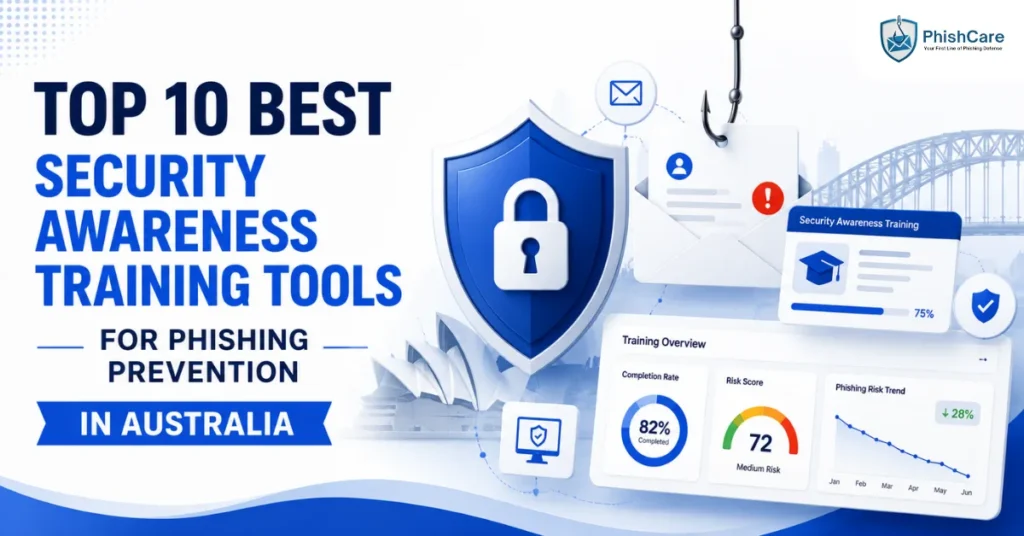
Cyber threats continue to evolve, but attackers still rely heavily on one of the most effective attack vectors: people. From credential theft and business email compromise to ransomware delivery, phishing remains a leading cause of security incidents across Australian organizations. As a result, businesses are increasingly investing in security awareness training platforms that combine employee education, phishing simulations, behavioral analytics, and reporting to reduce human cyber risk.
Top Security Awareness Training Platforms at a Glance
This guide evaluates Australia’s leading security awareness training tools based on phishing simulation quality, training effectiveness, reporting capabilities, ease of deployment, scalability, compliance support, and overall value for organizations of different sizes.
To make this comparison practical rather than theoretical, we reviewed platforms based on real-world usability, training content quality, phishing simulation realism, reporting depth, compliance alignment, and long-term employee engagement. We also considered feedback from organizations operating in sectors such as finance, healthcare, banking, and information technology.
Why Trust This Review?
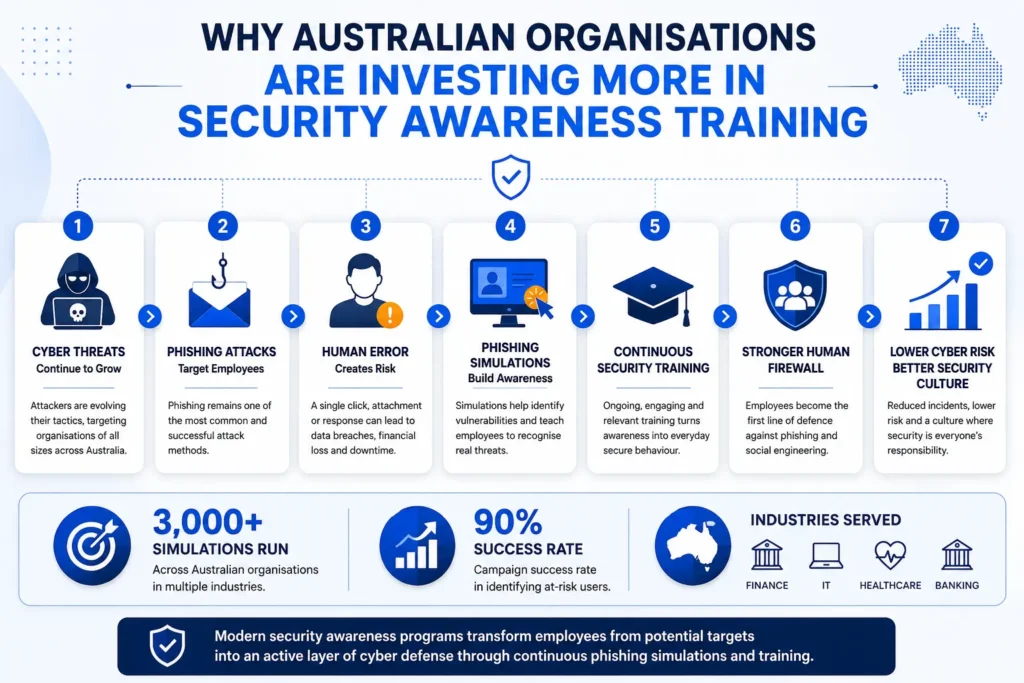
This guide incorporates insights from phishing simulation programs delivered across multiple industries. Platforms were evaluated against criteria that matter most to Australian organizations, including employee engagement, phishing detection improvement, reporting visibility, deployment simplicity, and support for ongoing security awareness initiatives. PhishCare alone has supported more than 3,000 phishing simulations across industries including finance, healthcare, banking, and IT, helping organizations build stronger security awareness cultures and measurable risk reduction programs.
How We Evaluated Security Awareness Training Tools
Many security awareness training comparisons focus only on feature lists. In practice, however, the success of a platform depends on how effectively it changes employee behavior, reduces phishing susceptibility, and provides measurable insights to security teams.
To create this list, we evaluated each platform against the criteria most relevant to Australian organizations, including businesses operating in finance, healthcare, banking, government, education, and technology sectors.
1. Phishing Simulation Realism
The effectiveness of a phishing simulation depends heavily on realism. We assessed the quality of phishing templates, customization capabilities, localization options, and the platform’s ability to replicate modern attack techniques employees encounter daily.
2. Training Content Quality
Security awareness programs are only effective when employees engage with them. We reviewed training modules, micro-learning content, interactive lessons, quizzes, and ongoing education resources.
3. Reporting & Risk Visibility
Organizations need clear visibility into employee risk levels. We examined dashboards, employee risk scoring, trend analysis, executive reporting, and campaign performance metrics.
4. Ease of Deployment
Implementation should not require extensive resources. We considered onboarding experience, campaign setup simplicity, email integration options, and administrative overhead.
5. Compliance Support
Security awareness initiatives are often part of broader governance and compliance programs. We evaluated reporting capabilities that can provide additional documentation support for organizations working toward ISO 27001, SOC 2 Type II, PCI DSS, HIPAA, and NIST CSF best practices.
6. Long-Term Employee Engagement
The most successful platforms continuously improve user behavior over time. We assessed automation, recurring campaigns, adaptive learning capabilities, gamification features, and employee participation rates.
Our Evaluation Framework
Rather than focusing solely on brand recognition, we prioritized practical outcomes. The highest-ranked platforms demonstrated a strong balance between phishing simulation effectiveness, employee education, reporting depth, deployment simplicity, and measurable risk reduction.
Organizations that consistently run phishing simulations and awareness programs often see significant improvements in employee vigilance. Based on industry experience across more than 3,000 phishing simulations, recurring campaigns combined with relevant training remain one of the most effective approaches to strengthening an organization’s human security layer.
Security Awareness Training Tools Comparison
Choosing the right security awareness platform depends on your organization’s size, security maturity, training goals, and reporting requirements. The table below provides a high-level comparison of the leading security awareness training tools available to Australian organizations in 2026.
| Platform | Phishing Simulation | Training Content | Risk Reporting | Best For |
|---|---|---|---|---|
| PhishCare | Excellent | Excellent | Advanced | SMBs, Mid-Market & Enterprise |
| KnowBe4 | Excellent | Excellent | Advanced | Large Enterprises |
| Hoxhunt | Very Good | Excellent | Good | Employee Engagement |
| Proofpoint | Excellent | Good | Advanced | Enterprise Security Teams |
| Mimecast Awareness Training | Very Good | Good | Good | Existing Mimecast Users |
| Cofense | Excellent | Good | Advanced | Threat-Driven Programs |
| Terranova Security | Good | Excellent | Good | Compliance-Focused Teams |
| Infosec IQ | Good | Very Good | Good | Growing Organizations |
| ESET Awareness Training | Good | Good | Moderate | SMBs |
| usecure | Good | Good | Good | Small & Mid-Sized Businesses |
Key Takeaway
While all the platforms listed offer phishing awareness capabilities, they differ significantly in ease of deployment, training depth, reporting visibility, and long-term employee engagement. Organizations seeking a balanced combination of phishing simulations, awareness training, employee risk measurement, and compliance-friendly reporting often prioritize platforms that deliver both usability and measurable security outcomes.
Why Australian Organisations Are Investing More in Security Awareness Training
Australian organisations are facing an increasingly sophisticated threat landscape where cybercriminals target employees as often as they target technology. While businesses continue investing in endpoint security, email protection, and cloud security controls, attackers frequently bypass these defenses through phishing, social engineering, and credential theft campaigns aimed directly at staff.
As a result, security awareness training has evolved from an annual compliance activity into an ongoing risk management strategy. Modern organisations are using phishing simulations and continuous awareness programs to build stronger security cultures, improve employee vigilance, and reduce the likelihood of successful phishing attacks.
1. Human Error Remains a Major Risk
Many security incidents begin with a single employee clicking a malicious link, opening a harmful attachment, or sharing sensitive information. Security awareness programs help employees recognize suspicious activity before it becomes a security incident.
2. Phishing Attacks Are Becoming More Convincing
Modern phishing emails often mimic trusted brands, vendors, financial institutions, and internal communications. Regular phishing simulations help employees learn how to identify realistic attack techniques in a controlled environment.
3. Security Awareness Is Now Continuous
Annual training sessions are no longer enough. Leading organizations now run monthly or quarterly phishing simulations supported by bite-sized awareness content and ongoing employee education.
The Shift from Awareness to Human Risk Management
Organizations are increasingly moving beyond simple awareness training and adopting human risk management approaches. Instead of measuring whether employees completed a training course, security teams now focus on behavioral improvements, phishing susceptibility trends, and measurable reductions in risk over time.
This shift has increased demand for platforms that combine phishing simulations, employee risk scoring, training content, automated campaigns, and executive reporting into a single solution.
What Australian Businesses Are Looking For in 2026
Realistic phishing simulations that reflect current attack techniques.
Automated training campaigns that reduce administrative workload.
Employee risk scoring and department-level visibility.
Clear reporting that supports internal governance and audit readiness.
Scalable platforms suitable for both growing businesses and enterprises.
Actionable insights that help security teams improve outcomes over time.
The platforms featured in this guide were selected because they address these evolving requirements while helping organizations create a stronger human firewall against phishing and social engineering attacks.
PhishCare
PhishCare is a phishing simulation and security awareness training platform developed by CyberSapiens. Designed for modern organizations, it combines realistic phishing simulations, employee awareness training, risk scoring, automated campaigns, and executive reporting in a single platform.
Among the platforms evaluated in this guide, PhishCare stood out for its balance of usability, training effectiveness, reporting visibility, and deployment simplicity. The platform is designed to help organizations continuously improve employee security awareness while providing security teams with actionable insights into human cyber risk.
Why PhishCare Ranked #1
Realistic Phishing Simulations
Launch realistic phishing campaigns using professionally designed templates that reflect current attack techniques targeting employees.
Employee Risk Scoring
Identify high-risk users and departments through measurable employee behavior and phishing simulation results.
Awareness Training Modules
Deliver ongoing awareness training that helps employees recognize phishing attempts, social engineering attacks, and common cybersecurity threats.
Executive Reporting
Generate detailed reports that provide visibility into campaign performance, employee engagement, and awareness improvements over time.
Customer Feedback
“We recently used PhishCare for a phishing simulation, and I’ve got to say, their email templates were top-notch. The realism and variety of the templates were impressive, really testing our team’s vigilance.
The level of detail they put into crafting these emails was evident, making the simulation both challenging and effective. It’s clear they know their stuff when it comes to cybersecurity. Highly recommend them!”
Compliance & Audit Support
PhishCare’s campaign reports provide an additional documentation boost for organizations working towards ISO 27001, SOC 2 Type II, PCI DSS, HIPAA, or NIST CSF, where ongoing security awareness training is recognized as a best practice by auditors and certification bodies.
Key Features That Helped PhishCare Stand Out
While many security awareness platforms offer phishing simulations and employee training, PhishCare distinguishes itself through a practical combination of realistic attack simulations, behavioral insights, automated awareness programs, and easy-to-understand reporting. The platform is designed to help organizations continuously improve employee awareness while reducing administrative complexity for security teams.
Realistic Phishing Templates
Launch phishing campaigns using realistic templates designed to simulate common attack techniques targeting modern organizations.
Employee Risk Scoring
Identify employees and departments that may require additional awareness training through measurable risk indicators.
Automated Campaign Scheduling
Schedule monthly, quarterly, or custom phishing simulations without manually managing every campaign.
Awareness Training Library
Support employee education with awareness modules focused on phishing, social engineering, password security, and cyber hygiene.
Executive Dashboards
Provide leadership teams with clear visibility into awareness performance, employee engagement, and risk trends.
Compliance-Friendly Reporting
Generate reports that support internal governance initiatives and security awareness documentation efforts.
How PhishCare Creates Continuous Security Awareness
Why Security Teams Prefer PhishCare
Security awareness initiatives are most successful when they are simple to manage and easy for employees to engage with. PhishCare focuses on practical deployment, measurable outcomes, and ongoing awareness improvements rather than one-time training exercises.
This approach enables organizations to build a stronger security culture while maintaining visibility into employee behavior, phishing susceptibility, and awareness program effectiveness over time.
Top 10 Best Security Awareness Training Tools for Phishing Prevention in Australia
The following platforms were selected based on phishing simulation capabilities, employee training effectiveness, reporting visibility, deployment simplicity, scalability, and overall suitability for Australian organizations. Each platform offers a different approach to improving security awareness and reducing phishing-related risks.
1. PhishCare
PhishCare is a phishing simulation and security awareness training platform developed by CyberSapiens. It combines realistic phishing simulations, awareness learning modules, employee risk scoring, automated campaigns, and executive reporting within a single platform.
Best suited for organizations seeking measurable improvements in employee security awareness while maintaining simple administration and strong reporting visibility.
2. KnowBe4
KnowBe4 is one of the most widely recognized security awareness platforms globally. It offers a large training library, phishing simulation tools, and extensive content designed for enterprise-scale awareness programs.
3. Hoxhunt
Hoxhunt focuses on gamified security awareness training and adaptive learning experiences. Its approach is designed to increase employee engagement through interactive phishing simulations and personalized learning paths.
4. Proofpoint Security Awareness Training
Proofpoint combines phishing simulations, threat intelligence insights, and security awareness content. The platform is often adopted by larger organizations seeking advanced reporting and enterprise-level integrations.
5. Mimecast Awareness Training
Mimecast offers awareness training capabilities alongside its email security ecosystem. Organizations already using Mimecast often benefit from streamlined administration and integrated reporting.
6. Cofense
Cofense focuses heavily on phishing defense and employee reporting capabilities. The platform is particularly known for helping organizations improve phishing detection and reporting behavior.
7. Terranova Security
Terranova Security provides awareness training programs with a strong focus on education, compliance support, and employee engagement. It is often used within structured governance and awareness initiatives.
8. Infosec IQ
Infosec IQ offers phishing simulations, awareness campaigns, and training content designed to help organizations improve employee cyber awareness while maintaining administrative simplicity.
9. ESET Cybersecurity Awareness Training
ESET’s awareness training platform is designed for organizations seeking practical employee education alongside broader cybersecurity initiatives. It includes phishing awareness and cyber hygiene training modules.
10. usecure
usecure focuses on helping small and mid-sized businesses automate awareness training, phishing simulations, and user risk management. Its simplified deployment model appeals to growing organizations with limited resources.
Quick Summary
Every platform on this list can help improve employee awareness and phishing resilience. However, organizations looking for a balanced combination of phishing simulations, awareness training, employee risk visibility, campaign automation, and reporting often prioritize platforms that deliver measurable outcomes without unnecessary complexity. This is one of the key reasons PhishCare ranks first in this comparison.
How to Choose the Right Security Awareness Platform
Not all security awareness platforms are built for the same objectives. Some focus heavily on training content, while others prioritize phishing simulations, employee risk analysis, automation, or enterprise integrations. The right choice depends on your organization’s size, security maturity, compliance goals, and employee engagement requirements.
Before selecting a platform, it is important to evaluate how well the solution aligns with your security awareness strategy rather than simply comparing feature lists.
1. Assess Phishing Simulation Quality
Look for realistic phishing templates, campaign customization options, landing page simulations, and reporting capabilities that accurately reflect modern phishing threats.
2. Evaluate Training Content
The most effective platforms provide engaging awareness content, short learning modules, quizzes, and ongoing education rather than relying on one-time training sessions.
3. Review Reporting Capabilities
Reporting should help security teams identify high-risk users, monitor trends, track training completion, and demonstrate awareness program progress to leadership.
4. Consider Automation Features
Automation reduces administrative effort by enabling recurring campaigns, scheduled training, user grouping, and automated reporting workflows.
5. Measure Scalability
Choose a platform that can support future growth, additional departments, multiple locations, and evolving awareness requirements without significant operational changes.
6. Focus on Employee Engagement
Awareness programs succeed when employees actively participate. Look for platforms that encourage ongoing engagement through relevant content and regular reinforcement.
Security Awareness Platform Evaluation Checklist
The Most Important Question to Ask
Instead of asking which platform has the most features, organizations should ask which platform is most likely to improve employee behavior over time. The ultimate goal of security awareness training is not simply delivering content. It is helping employees recognize threats, make better security decisions, and contribute to a stronger security culture.
Platforms that combine realistic phishing simulations, continuous awareness training, behavioral insights, and actionable reporting typically deliver the strongest long-term outcomes.
Security Awareness Training and Compliance Programs
Security awareness training is no longer viewed solely as an employee education initiative. Many organizations now incorporate phishing simulations and awareness programs into broader governance, risk management, and compliance strategies. While awareness training alone does not guarantee compliance, it plays an important role in helping organizations strengthen their security posture and demonstrate ongoing security improvement efforts.
Modern phishing simulation platforms provide visibility into employee behavior, training participation, phishing susceptibility, and awareness progress over time. These insights can help security teams document awareness activities and support internal security governance programs.
How Security Awareness Supports Modern Compliance Initiatives
Organizations increasingly use phishing simulations and awareness programs to demonstrate that security education is being delivered consistently across the workforce. Regular training activities help create a culture of security while providing measurable data on employee engagement and risk reduction efforts.
Many frameworks and standards recognize the value of ongoing security awareness training as part of a comprehensive cybersecurity program, particularly where human risk management is an important consideration.
ISO 27001
Organizations implementing an Information Security Management System (ISMS) often include employee awareness initiatives as part of broader information security controls and risk management activities.
SOC 2 Type II
Security awareness programs can help organizations demonstrate ongoing employee security education efforts that contribute to stronger operational security practices and control effectiveness.
PCI DSS
Businesses handling payment card information often use security awareness programs to educate employees about phishing threats, credential security, and safe handling of sensitive information.
HIPAA
Healthcare organizations frequently incorporate awareness training to help employees recognize phishing attacks, protect sensitive data, and strengthen overall cybersecurity practices.
NIST Cybersecurity Framework (CSF)
Awareness and training programs can support broader cybersecurity objectives by helping employees identify threats and contribute to organizational cyber resilience efforts.
Internal Governance Programs
Regular phishing simulations provide measurable data that can help leadership teams track employee awareness levels, identify trends, and support security improvement initiatives.
How PhishCare Supports Awareness Documentation
PhishCare’s campaign reports provide an additional documentation boost for organizations working towards ISO 27001, SOC 2 Type II, PCI DSS, HIPAA, or NIST CSF, where ongoing security awareness training is recognized as a best practice by auditors and certification bodies.
Detailed reporting, employee participation metrics, phishing simulation outcomes, and awareness training records help organizations maintain visibility into their awareness programs while supporting continuous security improvement efforts.
Key Takeaway
The strongest compliance programs combine people, processes, and technology. Security awareness training helps strengthen the human element by educating employees, reducing phishing susceptibility, and providing measurable insights into organizational security awareness maturity.
Customer Success & Industry Adoption
A security awareness platform is only valuable when it delivers measurable results in real-world environments. PhishCare has been deployed across multiple industries, helping organizations strengthen employee awareness, improve phishing detection capabilities, and build long-term security cultures through continuous education and simulation programs.
Trusted by Organizations Across Multiple Industries









Industries Using PhishCare
What Customers Say
“We recently used PhishCare for a phishing simulation, and I’ve got to say, their email templates were top-notch. The realism and variety of the templates were impressive, really testing our team’s vigilance.
The level of detail they put into crafting these emails was evident, making the simulation both challenging and effective. It’s clear they know their stuff when it comes to cybersecurity. Highly recommend them!”
Choosing the Best Security Awareness Training Tool in Australia
Security awareness training is no longer a one-time activity. As phishing attacks become more sophisticated and employees remain a primary target for cybercriminals, organizations need platforms that continuously strengthen awareness, improve decision-making, and provide measurable visibility into human cyber risk.
The platforms featured in this guide each bring valuable capabilities to the table. Some excel in enterprise-scale deployments, others focus on gamified learning, while several prioritize reporting, automation, or phishing simulation depth. The right choice ultimately depends on your organization’s size, security maturity, available resources, and long-term awareness objectives.
Why PhishCare Earned the Top Position
Among the solutions reviewed, PhishCare delivered the strongest balance between phishing simulation realism, employee awareness training, risk visibility, reporting capabilities, deployment simplicity, and long-term program management.
Rather than focusing solely on awareness content or phishing testing, the platform combines both elements into a practical human risk management approach that helps organizations continuously improve employee security behavior.
With more than 3,000 phishing simulations delivered across industries including finance, healthcare, banking, and information technology, PhishCare has demonstrated its ability to support organizations seeking measurable security awareness outcomes.
Best for Growing Organizations
Organizations seeking a scalable awareness program with phishing simulations, employee training, and reporting capabilities often benefit from platforms that balance functionality with ease of deployment.
Best for Enterprise Environments
Large enterprises may prioritize extensive integrations, large content libraries, and advanced reporting ecosystems depending on their operational requirements.
Best for Long-Term Awareness Programs
Organizations focused on continuous improvement should prioritize solutions that combine simulations, training, automation, behavioral insights, and measurable reporting.
Key Takeaways
Organizations should view security awareness as an ongoing program rather than an annual exercise.
Regular phishing simulations help employees recognize real-world attack techniques.
Behavioral reporting and employee risk visibility are becoming increasingly important.
Awareness programs are most effective when supported by continuous education and reinforcement.
The strongest platforms combine training, simulations, automation, and actionable reporting.
Choosing the right platform can significantly improve organizational resilience against phishing threats.
Frequently Asked Questions
Below are some of the most common questions Australian organizations ask when evaluating security awareness training platforms and phishing simulation tools.
What is the best security awareness training tool in Australia?
The best platform depends on your organization’s size, objectives, and security maturity. Many organizations prioritize solutions that combine phishing simulations, awareness training, employee risk visibility, automation, and reporting in a single platform.
How often should phishing simulations be conducted?
Most organizations conduct phishing simulations monthly or quarterly. Regular testing helps reinforce awareness, measure behavioral improvements, and identify areas requiring additional training.
Can phishing simulation reports support ISO 27001 and SOC 2 initiatives?
Yes. Phishing simulation reports can provide an additional documentation boost for organizations working toward ISO 27001, SOC 2 Type II, PCI DSS, HIPAA, or NIST CSF, where ongoing security awareness training is recognized as a best practice.
What industries benefit most from security awareness training?
Virtually every industry benefits from security awareness programs. However, finance, healthcare, banking, education, government, and technology organizations are often among the most active adopters due to their exposure to phishing and social engineering attacks.
What features should organizations look for in a security awareness platform?
Important features include phishing simulations, employee awareness training, automated campaigns, executive reporting, employee risk scoring, compliance-friendly reporting, and long-term engagement capabilities.
How long does it take to launch a phishing simulation program?
Deployment timelines vary by organization size and requirements. Many modern platforms can be configured and ready for initial phishing simulations within a relatively short timeframe after onboarding.
Content Reviewed By

Mohammed Nawaz Sajjad is a practising security analyst with hands-on experience in phishing simulations, employee security awareness assessments, ethical hacking, and security operations. He works closely with organizations across multiple industries to evaluate human cyber risk and improve employee resilience against phishing and social engineering attacks.
As part of the CyberSapiens team, Nawaz has contributed to phishing awareness initiatives, phishing simulation deployments, and employee training programs supporting organizations in finance, healthcare, banking, and technology sectors. His practical experience includes evaluating phishing simulation platforms, analyzing campaign outcomes, and helping organizations strengthen their security culture through measurable awareness programs.
View LinkedIn ProfileStrengthen Your Human Firewall Against Phishing Attacks
Run realistic phishing simulations, improve employee awareness, identify high-risk users, and gain visibility into human cyber risk with PhishCare. Trusted by organizations across finance, healthcare, banking, and technology sectors.
Lvl 1 206 Lorimer St,
Port Melbourne, Australia
sales@phishcare.com
1300 507 668