Top 10 Cyber Security Awareness Training Service Providers in New Zealand (2026)
Cyber attacks continue to evolve, but one challenge remains constant: people are often the first target. Phishing emails, social engineering campaigns, credential theft attempts, and business email compromise attacks increasingly rely on human error rather than technical vulnerabilities.
For organizations across New Zealand, investing in cyber security awareness training has become an important part of strengthening cyber resilience. Effective awareness programs help employees identify suspicious activity, report threats quickly, and make safer security decisions in their daily work.
In this guide, we compare the top cyber security awareness training service providers in New Zealand for 2026, including platforms that offer phishing simulation, employee awareness training, reporting dashboards, compliance-focused documentation, and ongoing security culture improvement programs.
Executive Summary
Organizations evaluating security awareness vendors should look beyond training videos alone. The most effective providers combine phishing simulations, employee education, behavior tracking, reporting analytics, and measurable risk reduction strategies. Solutions that continuously reinforce secure behaviors generally deliver stronger long-term security outcomes than one-time training events.
Why Security Awareness Training Matters for New Zealand Organizations in 2026
Technology remains a critical security layer, but cybercriminals continue to target employees through phishing emails, social engineering attacks, credential harvesting campaigns, and business email compromise scams. As attack techniques become more sophisticated, organizations across New Zealand are placing greater emphasis on strengthening the human layer of security.
Increasing Phishing Threats
Modern phishing attacks often imitate trusted brands, suppliers, executives, and financial institutions. Employees are frequently targeted because attackers know that one successful click can bypass multiple technical controls.
Human Error Remains a Key Risk
Even organizations with advanced security tools can face incidents when employees unknowingly share credentials, open malicious attachments, or respond to fraudulent requests. Continuous education helps reduce these risks.
Building a Security Culture
Awareness training encourages employees to become active participants in cyber defense. A strong security culture helps teams identify suspicious activity faster and report incidents before significant damage occurs.
What Modern Security Awareness Programs Include
Phishing Simulations
Controlled phishing campaigns help organizations measure employee awareness levels using realistic attack scenarios.
Microlearning Training
Short and engaging lessons help employees retain security knowledge more effectively than annual training sessions alone.
Reporting & Analytics
Detailed reporting allows organizations to identify high-risk groups, monitor progress, and improve security outcomes over time.
Why This Matters in 2026
Organizations are increasingly expected to demonstrate ongoing security awareness efforts as part of broader cyber risk management strategies. Security awareness programs help organizations strengthen employee preparedness while supporting overall governance and security maturity objectives.
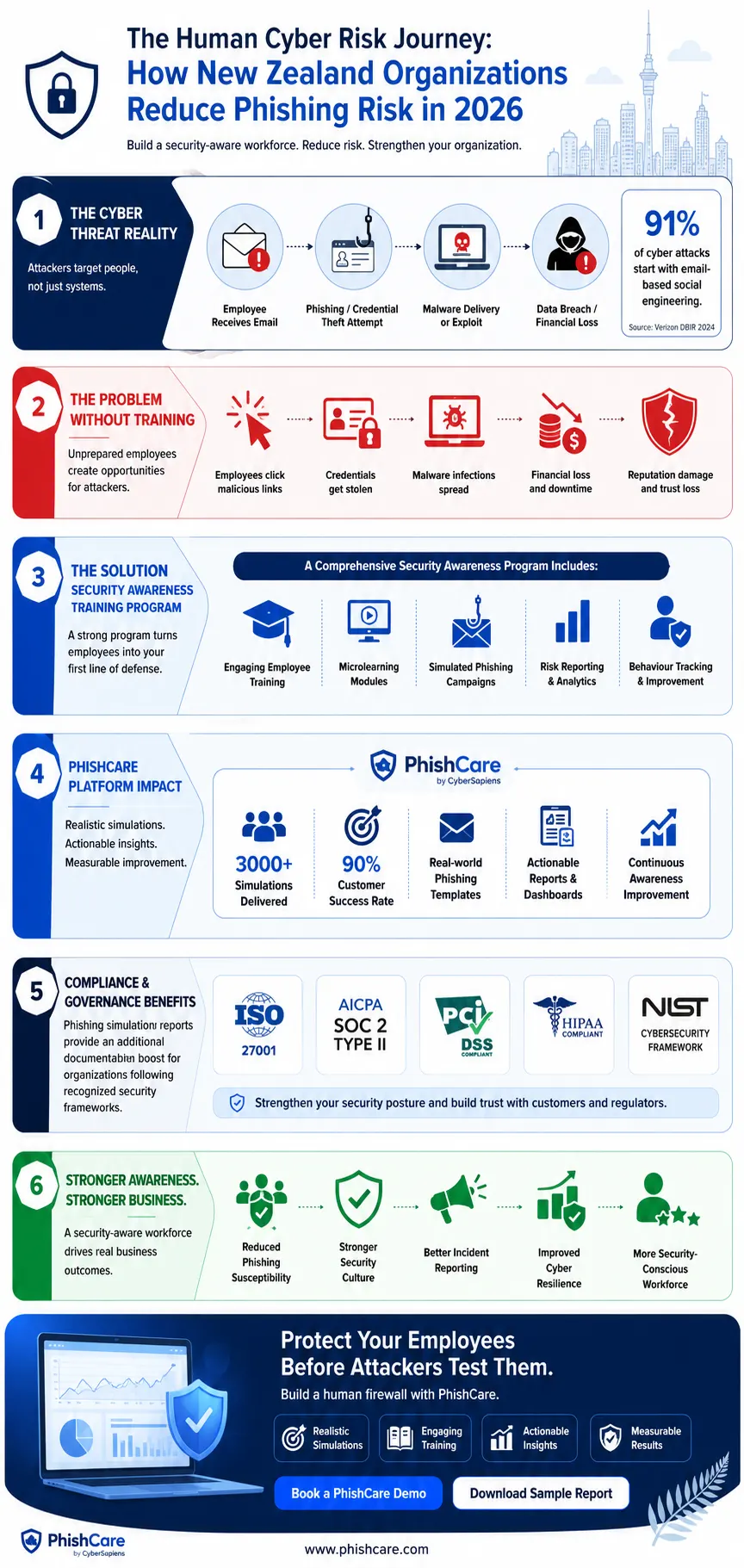
Phishing simulation reports can also provide an additional documentation boost for organizations working towards ISO 27001, SOC 2 Type II, PCI DSS, HIPAA, and NIST CSF, where ongoing security awareness training is recognized as a best practice.
The Human Cyber Risk Journey in New Zealand
The infographic below illustrates how security awareness training, phishing simulations, and employee education help organizations reduce cyber risk and build a stronger security culture.
How We Evaluated These Cyber Security Awareness Training Providers
Not all security awareness training providers deliver the same value. Some focus primarily on training content, while others combine phishing simulations, employee risk measurement, reporting analytics, compliance support, and continuous awareness programs. To create this list, we evaluated providers across several important criteria that organizations commonly consider when selecting a security awareness partner.
Phishing Simulation Capabilities
We assessed whether providers offer realistic phishing simulations, customizable templates, attack scenario variety, scheduling flexibility, and actionable reporting to measure employee susceptibility.
Training Quality
Training effectiveness depends on engagement. We reviewed content quality, learning formats, microlearning availability, training frequency options, and user experience.
Reporting & Analytics
Organizations need measurable outcomes. We considered dashboard visibility, campaign reporting, employee risk insights, trend tracking, and management reporting capabilities.
Compliance Support
Providers were evaluated based on their ability to support awareness initiatives that align with recognized frameworks such as ISO 27001, SOC 2 Type II, PCI DSS, HIPAA, and NIST CSF.
Scalability
We considered whether platforms can support growing organizations, multiple departments, remote teams, and enterprise-wide awareness initiatives.
Customer Experience
Ease of deployment, customer support, onboarding assistance, and long-term usability were considered because successful programs depend on adoption and engagement.
Key Evaluation Factors
Important Note About Rankings
Every organization has unique requirements based on industry, workforce size, security maturity, compliance objectives, and budget. The providers listed below are not ranked solely on company size or market presence. Instead, they were selected based on their ability to deliver meaningful security awareness outcomes, phishing simulation capabilities, employee engagement, and measurable cyber risk reduction.
Organizations That Have Used PhishCare
Organizations across finance, healthcare, IT, professional services, and enterprise environments have used PhishCare to strengthen employee security awareness and phishing resilience.









Key Features to Look for in a Security Awareness Training Provider
Selecting the right cyber security awareness training provider requires more than comparing training libraries. The most effective solutions combine education, behavioral reinforcement, phishing simulations, analytics, and continuous improvement strategies that help reduce real-world cyber risk.
Realistic Phishing Simulations
Effective phishing simulations help organizations understand employee risk levels using realistic attack scenarios that mirror current phishing techniques. Look for customizable campaigns, scheduling flexibility, and detailed reporting capabilities.
Engaging Training Content
Employees are more likely to retain information when training is interactive, concise, and relevant. Modern platforms typically offer videos, microlearning modules, quizzes, and role-based content.
Actionable Analytics
Reporting should go beyond completion rates. Look for platforms that provide employee risk insights, phishing click rates, reporting behavior trends, and measurable awareness improvements.
Automated Campaign Management
Automation helps security teams save time by scheduling recurring campaigns, training assignments, reminders, and awareness activities throughout the year.
Compliance-Friendly Reporting
Organizations often require documentation to demonstrate awareness initiatives. Reporting capabilities can provide useful evidence for broader governance, risk, and compliance programs.
Scalability & Support
Whether supporting a small business or a large enterprise, the platform should scale with organizational growth while offering reliable support and onboarding assistance.
Questions to Ask Before Choosing a Provider
Can the platform run realistic phishing simulations?
Does it provide measurable reporting and analytics?
Can training be customized for different employee groups?
Does the platform support continuous awareness programs?
Will it scale as the organization grows?
Is implementation simple and well-supported?
A Long-Term Security Investment
Security awareness training is most effective when treated as an ongoing program rather than a one-time event. Organizations that continuously educate employees, test awareness levels, and measure behavioral improvements are generally better positioned to reduce phishing susceptibility and strengthen their overall cyber resilience.
Phishing Simulation and Compliance Reporting Benefits
Many organizations invest in cyber security awareness training to reduce phishing risk, strengthen employee vigilance, and improve security culture. Phishing simulations add another valuable layer by helping organizations measure awareness levels and identify opportunities for continuous improvement.
How Phishing Simulations Improve Security Awareness
Measure Real Employee Behavior
Unlike theoretical assessments, phishing simulations evaluate how employees respond to realistic cyber attack scenarios in everyday work environments.
Identify High-Risk Areas
Campaign results help organizations identify departments, roles, or user groups that may require additional awareness training.
Reinforce Learning
Repeated simulations help employees apply training concepts in practical situations, improving long-term retention and awareness.
Improved Security Culture
Consistent awareness initiatives encourage employees to become active participants in organizational security. Over time, this helps create a culture where reporting suspicious activity becomes routine rather than reactive.
Data-Driven Decision Making
Reporting dashboards provide measurable insights into employee performance, helping security leaders prioritize awareness initiatives based on actual risk indicators.
Continuous Improvement
Organizations can compare campaign results over time to evaluate awareness progress and identify areas where additional education may be beneficial.
Supporting Broader Compliance Initiatives
Many organizations incorporate phishing simulations and security awareness training into broader governance, risk management, and cybersecurity programs. Documented awareness initiatives can help demonstrate ongoing efforts to educate employees about cyber threats and secure behaviors.
Phishing simulation reports provide an additional documentation boost for organizations working towards ISO 27001, SOC 2 Type II, PCI DSS, HIPAA, and NIST CSF, where ongoing security awareness training is recognized as a best practice by auditors and certification bodies.
What Strong Reporting Typically Includes
Top 10 Cyber Security Awareness Training Service Providers in New Zealand Compared
Choosing the right provider depends on your organization’s size, training objectives, phishing simulation requirements, reporting expectations, and security maturity. The comparison below provides a high-level overview of the leading cyber security awareness training providers featured in this guide.
| Provider | Phishing Simulation | Training Library | Reporting | Compliance Support | Best For |
|---|---|---|---|---|---|
| PhishCare | ✓ | ✓ | Advanced | ✓ | SMB & Enterprise |
| KnowBe4 | ✓ | ✓ | Advanced | ✓ | Enterprise |
| Proofpoint | ✓ | ✓ | Advanced | ✓ | Large Organizations |
| Mimecast | ✓ | ✓ | Advanced | ✓ | Enterprise |
| Cofense | ✓ | ✓ | Advanced | ✓ | Security Teams |
| Hoxhunt | ✓ | AI-Based | Advanced | ✓ | Mid-Market |
| Infosec IQ | ✓ | ✓ | Good | ✓ | SMB |
| Terranova Security | ✓ | ✓ | Good | ✓ | Compliance Programs |
| Curricula | ✓ | ✓ | Good | ✓ | Growing Teams |
| usecure | ✓ | ✓ | Good | ✓ | Small Businesses |
How to Use This Comparison
Every organization has unique requirements. Some prioritize phishing simulation sophistication, while others focus on employee engagement, compliance documentation, or ease of deployment.
This comparison should be used as a starting point for evaluating providers. Organizations should review individual capabilities, reporting features, training content, support models, and pricing structures before making a final decision.
Quick Takeaway
Organizations looking for a balanced combination of phishing simulations, employee awareness training, reporting visibility, and ongoing support should prioritize platforms that offer measurable risk reduction rather than one-time training alone. Continuous awareness programs generally produce stronger long-term security outcomes than annual training initiatives.
How to Select the Right Security Awareness Training Provider for Your Organization
Choosing a cyber security awareness training provider is a strategic decision that can influence your organization’s security culture, employee behavior, and overall cyber resilience. The best solution depends on your business objectives, workforce size, industry requirements, and cybersecurity maturity level.
5 Key Questions Every Organization Should Ask
1. What Are We Trying to Improve?
Identify whether your primary goal is phishing risk reduction, compliance support, employee education, security culture development, or a combination of these objectives.
2. How Large Is Our Workforce?
The provider should comfortably support your current employee count while remaining scalable as your organization grows.
3. Do We Need Phishing Simulations?
Organizations seeking measurable security outcomes often benefit from platforms that combine awareness training with realistic phishing simulation campaigns.
4. What Reporting Is Required?
Executives, auditors, compliance teams, and security managers often require different reporting views and performance metrics.
5. How Much Support Will We Need?
Consider onboarding assistance, campaign management support, training customization, and long-term customer success resources.
Small & Medium Businesses
SMBs typically benefit from platforms that are easy to deploy, cost-effective, and capable of delivering phishing simulations, employee training, and reporting without requiring dedicated security resources.
Growing Organizations
Growing companies often need scalable solutions that can accommodate expanding teams, multiple departments, and evolving security awareness requirements.
Enterprise Organizations
Large enterprises typically require advanced analytics, role-based training, extensive reporting capabilities, compliance-friendly documentation, and support for complex environments.
Common Mistakes to Avoid
Choosing based on content volume alone.
A large content library does not automatically result in better employee engagement or stronger security outcomes.
Ignoring reporting capabilities.
Without measurable insights, it becomes difficult to evaluate training effectiveness and identify high-risk users.
Treating awareness as a one-time project.
Continuous reinforcement generally delivers stronger long-term behavioral improvements.
Final Selection Advice
The most successful security awareness programs combine engaging employee education, realistic phishing simulations, actionable reporting, and continuous reinforcement. When evaluating providers, focus on measurable outcomes and long-term risk reduction rather than training content alone. A provider that helps improve employee behavior over time will typically deliver greater value than one that simply offers annual awareness courses.
Summary of the Top Cyber Security Awareness Training Providers in New Zealand
Security awareness training remains one of the most effective ways organizations can reduce human cyber risk. While technologies continue to evolve, employees remain a primary target for phishing attacks, credential theft attempts, and social engineering campaigns. Choosing the right awareness training provider can help organizations build a stronger security culture and improve cyber resilience over time.
Best Provider Categories at a Glance
Best Overall Choice
PhishCare
Balanced combination of phishing simulations, employee awareness training, reporting analytics, and ongoing support.
Best for Large Enterprises
Large organizations may benefit from enterprise-focused providers with extensive reporting and global deployment capabilities.
Best for Growing Businesses
Organizations seeking scalable awareness programs should prioritize flexibility, automation, and measurable outcomes.
Focus on Outcomes
The most effective awareness programs are those that demonstrate measurable improvements in employee behavior, phishing recognition, and security reporting habits.
Prioritize Continuous Learning
Cyber threats evolve continuously. Ongoing awareness programs generally provide stronger protection than annual or one-time training initiatives.
Measure and Improve
Organizations should regularly review phishing simulation results, employee engagement metrics, and awareness performance trends to support continuous improvement.
Why Many Organizations Consider PhishCare
PhishCare combines realistic phishing simulations, employee security awareness training, reporting analytics, and ongoing awareness initiatives within a single platform. Developed by CyberSapiens, the platform is designed to help organizations build stronger employee awareness while providing visibility into human cyber risk.
With more than 3,000 phishing simulations delivered and a 90% customer success rate, PhishCare has supported organizations across finance, banking, healthcare, and information technology sectors.
For organizations evaluating security awareness training providers in New Zealand, PhishCare offers a practical combination of phishing testing, employee education, analytics, and continuous security culture development.
Final Thoughts
The best cyber security awareness training provider is one that aligns with your organization’s goals, workforce requirements, and risk management strategy. Whether you are a small business building a security culture or a large enterprise seeking advanced reporting and phishing simulation capabilities, investing in employee awareness remains one of the most valuable cybersecurity initiatives for 2026 and beyond.
Frequently Asked Questions About Cyber Security Awareness Training
Below are answers to some of the most common questions organizations ask when evaluating cyber security awareness training providers and phishing simulation platforms in New Zealand.
What is cyber security awareness training?
Cyber security awareness training helps employees recognize, avoid, and report cyber threats such as phishing emails, social engineering attacks, malware, credential theft attempts, and other security risks. The goal is to improve employee behavior and reduce human cyber risk.
How often should employees complete security awareness training?
Most organizations benefit from continuous awareness programs rather than annual training alone. Regular microlearning sessions, phishing simulations, and ongoing awareness activities help reinforce secure behaviors throughout the year.
What is phishing simulation training?
Phishing simulation training involves sending controlled phishing emails to employees to assess how they respond to realistic cyber attack scenarios. These exercises help identify awareness gaps and provide opportunities for targeted education.
Why are phishing simulations important?
Phishing simulations help organizations measure employee awareness levels, identify high-risk groups, track improvements over time, and reinforce secure decision-making in a safe and controlled environment.
Can phishing simulation reports support compliance initiatives?
Yes. Phishing simulation reports can provide an additional documentation boost for organizations working towards ISO 27001, SOC 2 Type II, PCI DSS, HIPAA, and NIST CSF, where ongoing security awareness training is recognized as a best practice.
What should organizations look for in a security awareness training provider?
Organizations should evaluate phishing simulation capabilities, training quality, reporting analytics, scalability, ease of deployment, customer support, and the provider’s ability to deliver measurable improvements in employee awareness.
Which industries benefit most from security awareness training?
Virtually every industry can benefit from security awareness training. It is particularly valuable for organizations in finance, banking, healthcare, information technology, education, government, and professional services where sensitive data and business systems are frequently targeted.
Content Reviewed By

Mohammed Nawaz Sajjad is a practising security analyst specializing in phishing simulation campaigns, employee awareness assessments, red team exercises, and ethical hacking. He leads phishing simulation deployments at PhishCare, a platform developed by CyberSapiens, with hands-on experience evaluating and implementing phishing simulation programs across organizations in multiple industries and regions worldwide. His work focuses on helping organizations strengthen employee security awareness, reduce phishing susceptibility, and improve overall cyber resilience through practical, measurable security awareness initiatives.
View LinkedIn ProfileReady to Reduce Phishing Risk Across Your Organization?
PhishCare helps organizations identify employee risk, run realistic phishing simulations, deliver engaging security awareness training, and measure improvements through actionable reporting and analytics.
With more than 3,000+ phishing simulations delivered and a 90% customer success rate, PhishCare supports organizations across finance, banking, healthcare, and technology sectors in building stronger cyber resilience.