Employee Security Awareness & Phishing Simulation
Choosing the Right Phishing Simulation Tool Can Reduce Human Risk Significantly
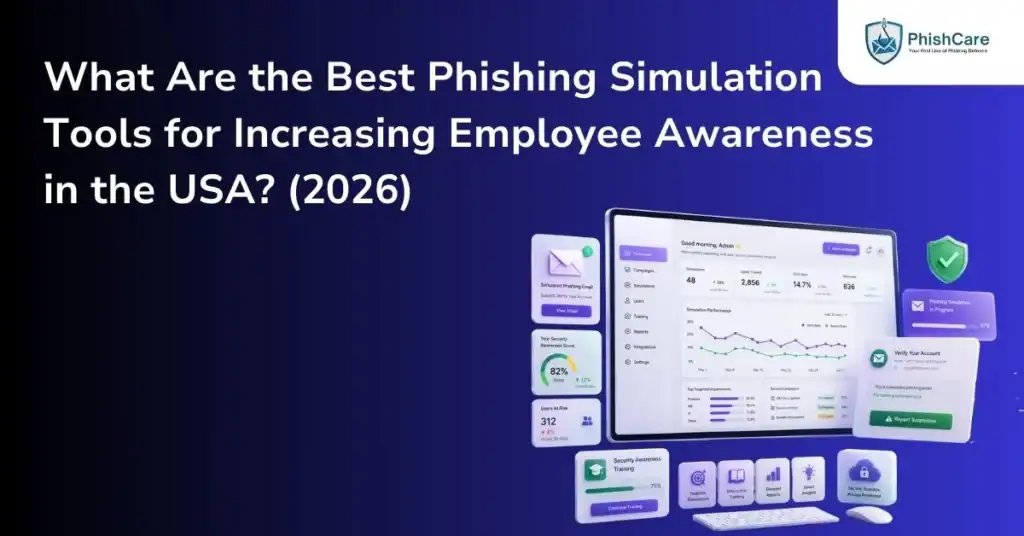
Organizations across the USA are increasingly investing in phishing simulation platforms to improve employee awareness, reduce phishing click rates, and strengthen overall cyber resilience. In this guide, we compare some of the leading phishing simulation tools used for employee security awareness training in 2026, including reporting capabilities, campaign realism, automation features, compliance-support benefits, and enterprise usability.
Organizations That Have Used PhishCare






Evaluation Methodology
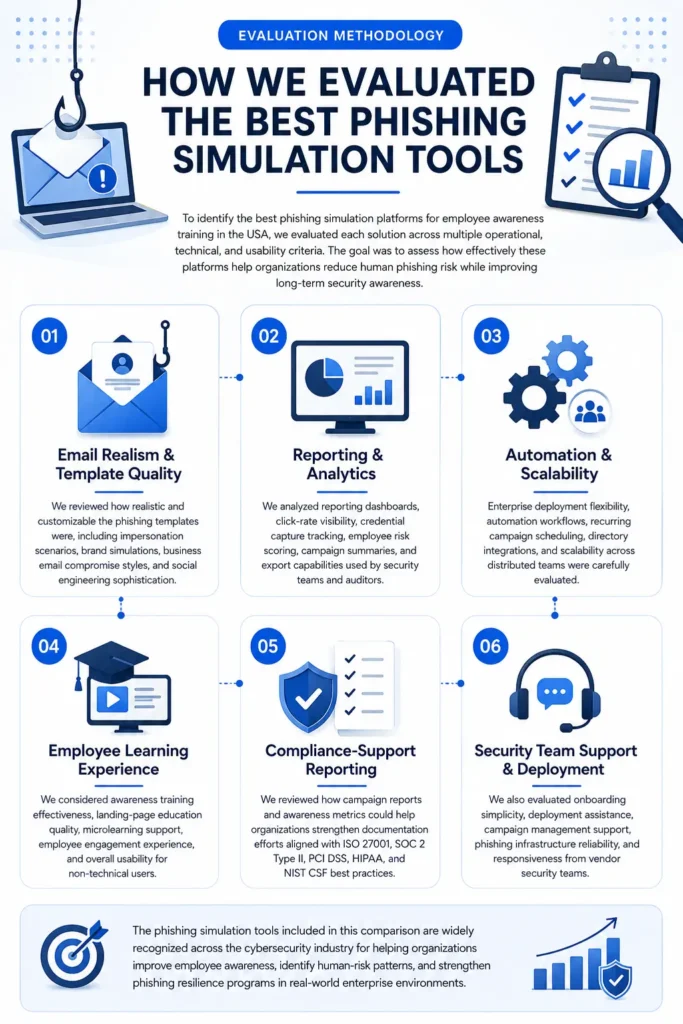
How We Evaluated the Best Phishing Simulation Tools
To identify the best phishing simulation platforms for employee awareness training in the USA, we evaluated each solution across multiple operational, technical, and usability criteria. The goal was to assess how effectively these platforms help organizations reduce human phishing risk while improving long-term security awareness.
Email Realism & Template Quality
We reviewed how realistic and customizable the phishing templates were, including impersonation scenarios, brand simulations, business email compromise styles, and social engineering sophistication.
Reporting & Analytics
We analyzed reporting dashboards, click-rate visibility, credential capture tracking, employee risk scoring, campaign summaries, and export capabilities used by security teams and auditors.
Automation & Scalability
Enterprise deployment flexibility, automation workflows, recurring campaign scheduling, directory integrations, and scalability across distributed teams were carefully evaluated.
Employee Learning Experience
We considered awareness training effectiveness, landing-page education quality, microlearning support, employee engagement experience, and overall usability for non-technical users.
Compliance-Support Reporting
We reviewed how campaign reports and awareness metrics could help organizations strengthen documentation efforts aligned with ISO 27001, SOC 2 Type II, PCI DSS, HIPAA, and NIST CSF best practices.
Security Team Support & Deployment
We also evaluated onboarding simplicity, deployment assistance, campaign management support, phishing infrastructure reliability, and responsiveness from vendor security teams.
The phishing simulation tools included in this comparison are widely recognized across the cybersecurity industry for helping organizations improve employee awareness, identify human-risk patterns, and strengthen phishing resilience programs in real-world enterprise environments.
Tool Comparison
Best Phishing Simulation Tools Compared
Compare leading phishing simulation platforms based on reporting, automation, awareness training capabilities, and enterprise deployment flexibility.
Phishing simulation reports and awareness metrics can provide an additional documentation boost for organizations working toward ISO 27001, SOC 2 Type II, PCI DSS, HIPAA, or NIST CSF programs, where continuous security awareness training is recognized as a cybersecurity best practice.
Why Organizations Choose PhishCare for Employee Phishing Awareness
PhishCare, developed by CyberSapiens, helps organizations run realistic phishing simulation campaigns that strengthen employee awareness and reduce human-risk exposure. Designed for both growing businesses and enterprise environments, the platform focuses on practical phishing readiness, awareness reporting, campaign automation, and scalable employee engagement.
Realistic Phishing Simulations
Launch highly realistic phishing campaigns that simulate modern social engineering techniques, credential harvesting attempts, impersonation attacks, and business email compromise scenarios.
Awareness Reporting & Insights
Measure employee awareness levels using phishing engagement analytics, click-rate visibility, reporting dashboards, and campaign-based risk insights for internal security teams.
Automated Campaign Management
Simplify recurring phishing assessments using automated campaign scheduling, scalable employee targeting, and centralized management workflows for distributed teams.
Compliance-Support Documentation
PhishCare campaign reports can provide an additional documentation boost for organizations aligning with ISO 27001, SOC 2 Type II, PCI DSS, HIPAA, and NIST CSF awareness best practices.
“We recently used PhishCare for a phishing simulation, and I’ve got to say, their email templates were top-notch. The realism and variety of the templates were impressive, really testing our team’s vigilance.”
Platform Breakdown
Leading Phishing Simulation Platforms in the USA
Below is a closer look at some of the most recognized phishing simulation tools used by organizations to improve employee awareness, reduce phishing susceptibility, and strengthen cybersecurity training programs.
PhishCare
PhishCare is designed to help organizations run realistic phishing simulations, measure employee awareness levels, and strengthen internal cybersecurity culture through scalable awareness programs.
- Realistic phishing email templates
- Awareness reporting dashboards
- Campaign automation support
- Compliance-support documentation
- Enterprise and SMB scalability
KnowBe4
KnowBe4 is widely recognized for its extensive security awareness training ecosystem and large phishing template library designed for enterprise-scale awareness initiatives.
- Large awareness content library
- Enterprise-level automation
- Detailed reporting dashboards
- Wide industry adoption
- Training management capabilities
Hoxhunt
Hoxhunt focuses heavily on behavioral cybersecurity awareness and adaptive employee learning experiences powered by AI-driven personalization.
- Adaptive awareness workflows
- Gamified employee engagement
- AI-driven phishing personalization
- Behavioral awareness analytics
- Modern learning experience
Cofense
Cofense combines phishing simulations with incident-response-focused workflows to help organizations improve employee phishing identification and reporting capabilities.
- Threat-centric awareness reporting
- Integrated phishing response workflows
- Security operations alignment
- Enterprise phishing analysis
- Incident-driven awareness strategy
Why Employee Phishing Awareness Matters More Than Ever in 2026
Phishing attacks continue to evolve rapidly, with attackers increasingly using AI-generated emails, impersonation tactics, deepfake communications, and advanced social engineering techniques. As threat sophistication increases, organizations across the USA are investing more heavily in phishing simulation and employee awareness training to reduce human-risk exposure.
Modern phishing attacks increasingly use AI-generated language that appears natural, context-aware, and highly convincing. This makes phishing emails harder for employees to identify using traditional awareness methods alone.
Attackers are now combining phishing with impersonation techniques, fake executive messages, and AI-generated voice or video content to manipulate employees into disclosing sensitive information.
Even with strong technical security controls, employee mistakes remain one of the most common causes of phishing-related incidents. Awareness training helps organizations strengthen the human layer of defense.
Organizations are moving away from once-a-year awareness sessions and toward continuous phishing simulations, ongoing training, and behavioral reinforcement strategies.
Employee Awareness Is Becoming a Core Cybersecurity Strategy
Phishing simulation programs are no longer viewed as optional awareness activities. Organizations increasingly see them as part of a broader cybersecurity resilience strategy designed to reduce phishing susceptibility, improve employee vigilance, and strengthen overall incident readiness across teams.
How Phishing Simulation Reporting Supports Compliance Programs
Security awareness training and phishing simulation reporting are increasingly recognized as cybersecurity best practices across modern compliance and risk management frameworks. Organizations use phishing awareness metrics to strengthen employee education initiatives, demonstrate ongoing awareness efforts, and improve internal cybersecurity maturity.
Ongoing phishing awareness initiatives and employee security education can support broader information security awareness objectives commonly associated with ISO 27001 programs.
Phishing simulation reports and awareness metrics can help organizations demonstrate continuous employee awareness activities within broader security and risk management programs.
Organizations handling payment data often use phishing awareness campaigns to strengthen employee vigilance against social engineering and credential theft attempts.
Healthcare organizations increasingly use phishing simulation exercises to improve employee awareness around email-based threats targeting sensitive healthcare information.
Awareness training and phishing simulations can contribute to broader cybersecurity maturity efforts aligned with employee awareness and organizational risk reduction practices.
Security teams also use phishing awareness metrics internally to identify high-risk behaviors, improve employee readiness, and track awareness improvements over time.
Awareness Reporting Provides Valuable Security Visibility
Modern phishing simulation platforms provide security teams with visibility into employee awareness trends, phishing susceptibility patterns, campaign engagement metrics, and behavioral improvement opportunities across departments and user groups.
Built to Improve Employee Awareness at Scale
Organizations across finance, healthcare, IT, and enterprise sectors use PhishCare to strengthen phishing awareness, identify human-risk patterns, and improve employee readiness against evolving social engineering attacks. The platform combines realistic phishing simulations, actionable reporting, and scalable campaign management to support modern cybersecurity awareness programs.
Deliver phishing simulations that closely resemble real-world phishing attacks, impersonation attempts, credential harvesting emails, and modern social engineering techniques.
Gain visibility into phishing click behavior, employee engagement metrics, awareness improvement trends, and campaign-level reporting insights.
Launch phishing awareness campaigns across departments, remote teams, and enterprise environments using streamlined deployment and campaign automation workflows.
Work with experienced cybersecurity professionals who support phishing campaign execution, reporting interpretation, awareness strategies, and deployment guidance.
Choosing the Right Phishing Simulation Platform for Your Organization
Best for Practical Awareness Programs
Suitable for organizations looking for realistic phishing simulations, actionable reporting, scalable deployment, and awareness-focused employee training programs.
Best for Large Awareness Libraries
Often selected by enterprises seeking extensive awareness content libraries and broad security awareness management capabilities.
Best for Behavioral Learning
A strong option for organizations prioritizing employee engagement, adaptive learning experiences, and long-term awareness behavior improvement.
Key Takeaways for Security Teams
Continuous Awareness Is Essential
Modern phishing threats evolve constantly, making recurring phishing simulations more effective than annual awareness sessions alone.
Reporting Visibility Matters
Awareness reporting helps security teams identify employee risk patterns and improve organizational phishing readiness over time.
Human Risk Requires Ongoing Attention
Employee awareness remains one of the most important layers of cybersecurity defense against phishing and social engineering attacks.
Frequently Asked Questions About Phishing Simulation Tools
Below are some of the most commonly searched questions about phishing simulation platforms, employee awareness training, phishing testing, and cybersecurity awareness programs in the USA.
What is a phishing simulation tool?
A phishing simulation tool helps organizations test employee awareness by sending simulated phishing emails that mimic real-world phishing attacks. These platforms help identify awareness gaps and improve cybersecurity readiness.
Why are phishing simulations important for employee awareness?
Phishing simulations help employees recognize suspicious emails, social engineering attempts, and credential theft tactics. Continuous awareness training can reduce phishing click rates and strengthen human-layer cybersecurity defenses.
What features should organizations look for in phishing simulation software?
Organizations typically evaluate phishing simulation tools based on email realism, reporting capabilities, campaign automation, awareness training support, scalability, employee engagement features, and deployment flexibility.
Can phishing simulation reports support compliance initiatives?
Phishing awareness reporting can provide an additional documentation boost for organizations working toward ISO 27001, SOC 2 Type II, PCI DSS, HIPAA, and NIST CSF programs where security awareness training is recognized as a cybersecurity best practice.
How often should organizations run phishing simulations?
Many organizations now run phishing simulations continuously or monthly instead of relying only on annual awareness training sessions. Regular simulations help reinforce employee awareness over time.
Which industries benefit most from phishing awareness training?
Industries commonly targeted by phishing attacks include finance, healthcare, IT services, banking, insurance, government, and enterprise organizations handling sensitive business or customer data.

Mohammed Nawaz Sajjad
Mohammed Nawaz Sajjad is a practicing cybersecurity analyst specializing in phishing simulation campaigns, employee awareness assessments, ethical hacking, and red team operations. He has hands-on experience deploying phishing awareness programs across finance, healthcare, IT, and enterprise environments through PhishCare, a phishing simulation platform developed by CyberSapiens.
Build a Stronger Human Layer of Cybersecurity Defense
PhishCare helps organizations improve employee awareness through realistic phishing simulations, actionable reporting, and scalable awareness programs designed for modern cybersecurity threats. Whether you are strengthening enterprise security awareness or improving phishing readiness across teams, our platform helps support long-term awareness improvement initiatives.