Most people picture malware as something foreign: a suspicious file, a strange process, a program that clearly does not belong. Living-off-the-land attacks break that picture entirely. They use tools already installed on the system, the same tools your own IT team uses every day, to carry out an attack that often produces no malware file at all. There is nothing foreign to spot, because nothing foreign was ever introduced.
This guide explains what living-off-the-land attacks are, how they actually work, why they have become the dominant approach for sophisticated attackers, and how they relate to techniques like ClickFix and device code phishing already covered on this site.
In Short: A living-off-the-land attack uses trusted, pre-installed system tools, such as PowerShell or Windows Management Instrumentation, to carry out malicious activity instead of introducing new malware. Because nothing new is installed, traditional antivirus tools that look for known malicious files often have nothing to detect.
How Living-Off-The-Land Attacks Work
Living-off-the-land, often abbreviated LOTL, describes attacks that exploit legitimate tools already present in a system’s environment rather than deploying custom malware. According to CrowdStrike’s overview of the technique, LOTL attacks are typically fileless, meaning the attacker does not need to install any code or scripts on the target system at all. Instead, they use tools already present, PowerShell, Windows Management Instrumentation, or credential tools like Mimikatz, to carry out the attack using the system’s own trusted infrastructure.
A typical LOTL sequence follows a general pattern:
- Initial access happens through a common vector, often phishing, a stolen credential, or an exploited vulnerability.
- The attacker pivots to native tools already on the system rather than downloading additional malware, using utilities like PowerShell, certutil, or WMI to explore the environment.
- Activity blends in with normal administrative work. A command that downloads a payload or moves laterally through a network looks structurally identical to a legitimate IT task performed with the same tool.
- The attacker escalates privileges, moves laterally, and often establishes long-term persistence, all while generating very little of the unusual activity signature-based security tools are built to catch.
The core problem this creates for defenders is straightforward: a tool like PowerShell is not malicious. It is essential to how modern IT environments function. Distinguishing a legitimate administrator running a script from an attacker doing the same thing requires context, not just a signature match.
Why LOTL Attacks Are So Hard to Detect
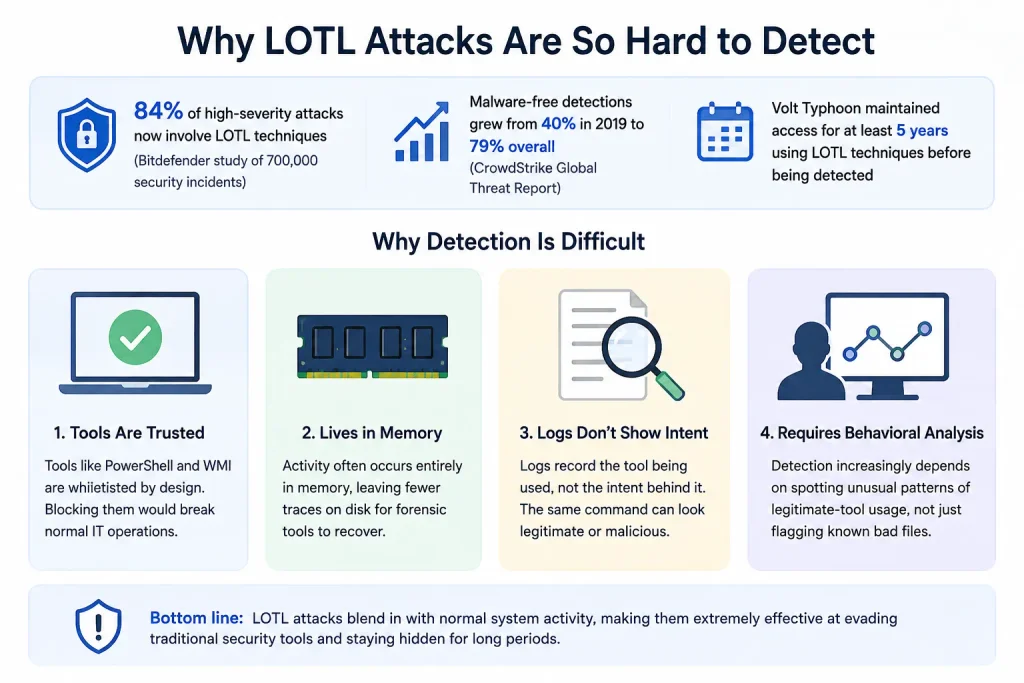
Traditional antivirus and signature-based security tools work by recognizing known malicious files or code patterns. Living-off-the-land attacks are specifically designed to avoid producing anything for those tools to recognize. According to Picus Security’s analysis, citing a Bitdefender study of 700,000 security incidents, 84 percent of high-severity attacks now involve LOTL techniques, and malware-free detections overall have grown from 40 percent in 2019 to 79 percent of all detections in CrowdStrike’s most recent Global Threat Report, a dramatic shift in how attacks are actually carried out.
The same analysis documented a striking real-world example: the state-sponsored threat group Volt Typhoon reportedly maintained access inside victim environments for at least five years using LOTL techniques before being detected, illustrating just how effectively this approach can evade conventional security monitoring over an extended period.
A few specific factors explain the detection difficulty:
- The tools involved are whitelisted by design. Security software is built to trust PowerShell, WMI, and similar utilities, since blocking them entirely would break normal IT operations.
- Activity often occurs entirely in memory, leaving fewer traces on disk for forensic tools to later recover.
- Logs record the tool being used, not the intent behind it. A logged PowerShell command looks the same whether an administrator or an attacker issued it.
- Detection increasingly requires behavioral analysis rather than signature matching. Security teams need to distinguish unusual patterns of legitimate-tool usage, not just flag known bad files, a fundamentally harder detection problem.
How This Relates to ClickFix, FileFix, and Device Code Phishing
Readers familiar with techniques already covered on this site, including ClickFix, its variant FileFix, ConsentFix, and device code phishing, will notice a shared theme: all four abuse legitimate tools or processes rather than deploying obvious malware. That overlap is not a coincidence, but it is worth clarifying the relationship rather than treating these as the same topic.
ClickFix, FileFix, ConsentFix, and device code phishing are specific initial-access techniques, focused narrowly on how an attacker first tricks a user into taking an action that grants access. Living-off-the-land is a much broader concept describing what happens after that initial foothold, and often independent of it entirely: how an attacker moves laterally, escalates privileges, and maintains long-term persistence using tools already present in the environment, regardless of how they first got in. A LOTL campaign might begin with a ClickFix-style lure, a stolen credential, or a completely different method, and then rely on PowerShell and native Windows tools for everything that happens afterward.
What This Means for Organizations
A few practical implications follow from how LOTL attacks work:
- Signature-based antivirus is not sufficient on its own. Since no new malicious file is typically introduced, tools built to scan for known threats have little to detect.
- Behavioral monitoring and logging become essential, focused on unusual patterns of legitimate-tool usage rather than known bad files.
- Application control and least-privilege access reduce the available attack surface, limiting which native tools are available for abuse in the first place, particularly for non-administrative users.
- Detection timelines can be long without the right monitoring. The Volt Typhoon case shows LOTL techniques can persist undetected for years when defenses rely primarily on traditional, signature-based tools.
Testing Awareness of the Broader Pattern
While LOTL techniques themselves are largely a technical detection challenge rather than something individual employees can be trained to spot directly, the initial-access methods that often lead into a LOTL campaign, including paste-and-run techniques and credential-based social engineering, remain squarely a training and awareness problem. Running realistic simulations through a phishing test for employees helps close the human side of this gap, even though the technical detection side requires separate security tooling and monitoring.
Final Thoughts
Living-off-the-land attacks succeed by refusing to look like an attack at all. There is no suspicious file to flag, no obviously foreign process, just the same tools an organization’s own IT team relies on every day, used with different intent. As this approach continues displacing traditional malware as the dominant method for sophisticated attackers, defenses built solely around recognizing known bad files are going to keep missing an increasing share of what actually happens inside a compromised environment.
FAQ
What is a living-off-the-land attack?
A living-off-the-land, or LOTL, attack uses legitimate tools already present in a system, such as PowerShell or Windows Management Instrumentation, to carry out malicious activity instead of deploying custom malware, making it significantly harder for traditional security tools to detect.
Why are LOTL attacks hard to detect?
Traditional antivirus tools work by recognizing known malicious files or code signatures. Since LOTL attacks use trusted, whitelisted system tools rather than introducing new malware, there is often nothing for signature-based detection to flag, requiring behavioral analysis instead.
How common are living-off-the-land attacks?
According to a Bitdefender analysis of 700,000 security incidents, 84 percent of high-severity attacks now involve LOTL techniques, and malware-free detections have grown from 40 percent in 2019 to 79 percent of all detections in recent industry reporting.
What tools do attackers typically abuse in LOTL attacks?
Commonly abused tools include PowerShell, Windows Management Instrumentation, certutil, and rundll32, all legitimate Windows utilities that IT administrators use for routine tasks. PowerShell alone appears in a majority of documented LOTL cases.
How is living-off-the-land different from attacks like ClickFix or device code phishing?
ClickFix, FileFix, ConsentFix, and device code phishing are specific techniques focused on how an attacker first gains access. Living-off-the-land describes the broader set of methods attackers use afterward, moving laterally and maintaining persistence using native tools, regardless of how the initial access was achieved.
Living-off-the-land attacks often begin with a moment of human trust, a phishing email, a paste-and-run trick, or a stolen credential. Strengthening that first line of defense starts with a free PhishCare demo account, no credit card required.
Content Reviewed By

Nawaz is a practising security analyst specializing in phishing simulation campaigns, employee awareness assessments, red team exercises, and ethical hacking.
He leads phishing simulation deployments at PhishCare, a product developed by CyberSapiens, with hands-on experience evaluating and deploying phishing simulation tools across organizations in multiple industries and regions globally.
View LinkedIn Profile