Most phishing simulation programs still test one thing: whether an employee clicks a fake link in an email. That leaves a growing hole. Attackers now pick up the phone. A vishing simulation platform closes that hole by testing how employees respond to a phone call, not just an email, using the same safe, controlled approach as email-based phishing simulation.
This guide explains what a vishing simulation platform actually is, how voice phishing training works in practice, why the attack is growing so quickly, and what to look for if your organization is evaluating one.
A vishing simulation platform places safe, simulated phone calls to employees to test how they respond to voice-based social engineering, then measures and trains based on the results, the same way email phishing simulation already does for inboxes.
What Is Vishing?
Vishing, short for voice phishing, is a social engineering attack carried out over a phone call rather than email. An attacker impersonates someone the target trusts, a bank, an executive, IT support, a vendor, and uses that trust to extract information, push a fraudulent payment, or gain remote access to a system.
What has changed the threat landscape recently is AI voice cloning. A convincing clone of someone’s voice can now be generated from just a few seconds of publicly available audio, such as a conference recording or a voicemail greeting. This means an attacker no longer needs to sound vaguely convincing. They can sound exactly like your CFO.
Voice-Based Attack
Vishing is carried out over a phone call instead of email, using social engineering to manipulate the target.
Trusted Impersonation
Attackers impersonate trusted individuals or organizations such as banks, executives, IT support, or vendors to gain trust.
AI Voice Cloning
AI voice cloning enables attackers to generate a convincing voice from just a few seconds of publicly available audio, allowing them to sound exactly like someone the victim trusts.
Why Vishing Is Growing Faster Than Email Phishing
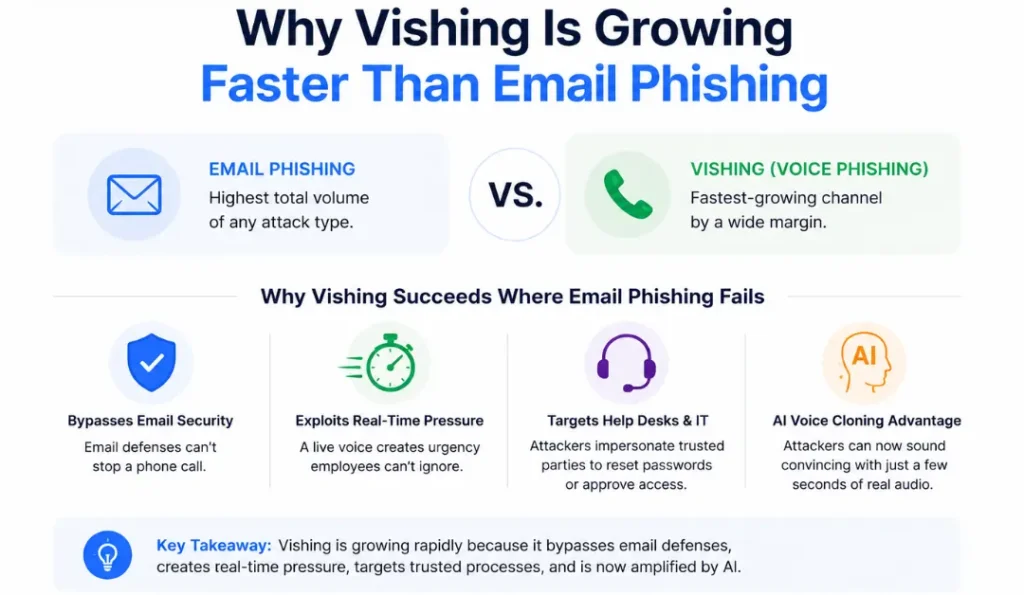
Email phishing still has the highest total volume of any attack type, but vishing is the fastest-growing channel by a wide margin. CrowdStrike’s 2025 Global Threat Report documented a 442 percent increase in voice phishing attacks between the first and second half of 2024, driven largely by threat actors using vishing, callback phishing, and help desk social engineering to gain an initial foothold inside target organizations.
There are a few reasons vishing succeeds where email phishing increasingly fails:
Increase in voice phishing attacks
CrowdStrike documented a 442 percent increase in voice phishing attacks between the first and second half of 2024.
It bypasses email security entirely. Spam filters, link scanning, and attachment sandboxing have nothing to inspect on a phone call.
It exploits real-time pressure. A live voice on the other end of a call creates urgency an email cannot replicate. Employees have seconds to decide, not minutes.
It often targets help desks and IT support directly, using social engineering to reset a password or approve an MFA request rather than trying to steal credentials at all.
AI voice cloning removes the biggest limiting factor attackers used to have: sounding convincing.
What Vishing Actually Looks Like
According to a public service announcement from the FBI’s Internet Crime Complaint Center, vishing is defined as the malicious targeting of individuals using voice messages, which may incorporate AI-generated audio, and it uses tactics similar to spear phishing: building rapport, establishing false trust, and pushing the target toward a secondary channel or urgent action.
A typical vishing attempt in a workplace setting follows a familiar shape:
The caller identifies themselves as IT support, a vendor, or an executive.
They reference something plausible: a ticket number, a recent email, a project name.
They ask for something small first: confirm your username, verify you received an email.
They escalate to the real ask: reset a password, approve an MFA push, transfer funds, or install remote access software.
None of this requires a link or an attachment. That is exactly why testing for it needs a different approach than email phishing simulation.
What Is a Vishing Simulation Platform?
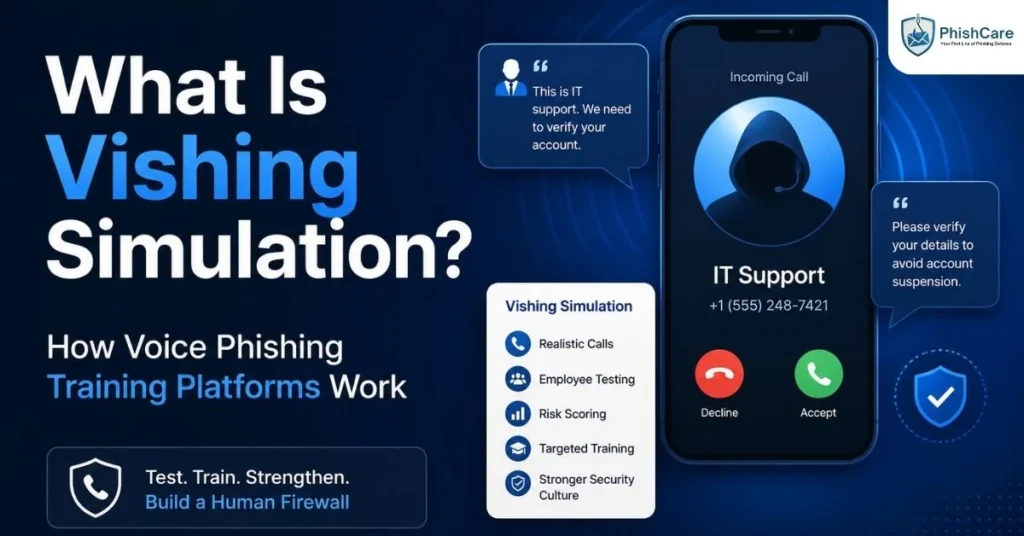
A vishing simulation platform is a controlled system that places safe, simulated phone calls to employees to test how they respond to voice-based social engineering, in the same spirit as PhishCare already does for email-based phishing and AI vishing. Instead of a fake email landing in an inbox, a scripted or AI-driven call reaches an employee’s phone, following a realistic pretext, and the platform records how the employee responded: did they comply, did they hesitate and verify, or did they refuse and report it.
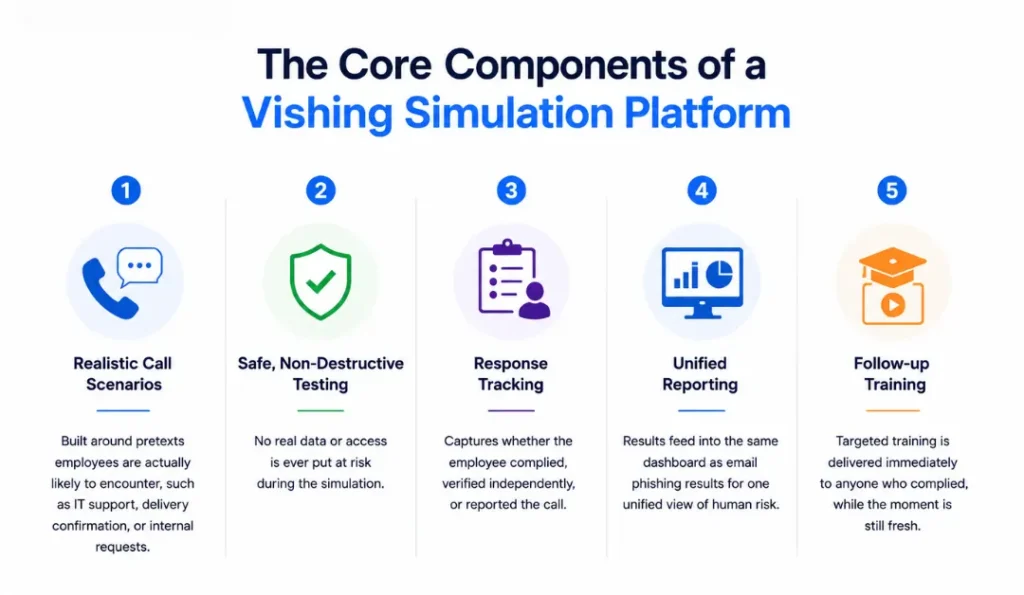
The core components of a real vishing simulation platform are:
Realistic Call Scenarios
Built around pretexts employees are actually likely to encounter, such as IT support, a delivery confirmation, or an internal request.
Safe, Non-Destructive Testing
No real data or access is ever actually put at risk during the simulation.
Response Tracking
Capturing whether the employee complied, verified independently, or reported the call.
Unified Reporting
Reporting that feeds into the same dashboard as email phishing results, so an organization sees one unified picture of human risk rather than two disconnected numbers.
Follow-up Training
Delivered immediately to anyone who complied with the simulated request while the moment is still fresh.
How Vishing Simulation Fits Into a Broader Awareness Program
Vishing simulation is not a replacement for email phishing testing. It is an addition to it. Organizations already running a phishing test for employees get the most value by extending the same program to cover voice-based attacks, because attackers increasingly combine channels: a text message to set up context, followed by a phone call that references it, followed by an email to complete the request.
The same behavioral data that powers an employee phishing risk score becomes more accurate once it includes voice-channel responses, not just email clicks. An employee who never clicks a phishing email but freely gives information to a caller claiming to be IT support has a real risk gap that email-only testing would never surface.
Extend Existing Programs
Organizations already running phishing tests get the most value by extending the same program to cover voice-based attacks, as attackers increasingly combine text messages, phone calls, and emails into a single attack chain.
Improve Risk Visibility
Including voice-channel responses creates a more accurate employee phishing risk score by identifying employees who resist phishing emails but may still trust a convincing caller claiming to be IT support.
Why It Matters
An employee who never clicks a phishing email but freely gives information to a caller claiming to be IT support has a real risk gap that email-only testing would never surface.
What to Look for When Evaluating a Vishing Simulation Platform
If your organization is comparing options, a few questions separate a genuinely useful platform from a superficial one:
Does it support realistic, role-specific pretexts, or only generic scripted calls?
Are results reported alongside email phishing data, or in a completely separate system?
Is follow-up training delivered automatically to anyone who fails a simulation?
Can campaigns be run on a recurring basis, not just as a one-time test?
Does the platform distinguish between an employee who complied immediately and one who hesitated and verified first? That distinction matters more than a simple pass or fail.
Final Thoughts
Vishing is not a niche threat anymore. It is one of the fastest-growing attack channels organizations face, and it succeeds precisely because most awareness programs were built to catch a suspicious email, not a convincing phone call. Whichever platform an organization chooses, closing that gap means testing real behavior under realistic conditions, on every channel attackers actually use, not just asking employees to sit through a slide deck once a year.
Key Takeaway
Closing the gap means testing real behavior under realistic conditions, on every channel attackers actually use, not just asking employees to sit through a slide deck once a year.
Frequently Asked Questions
What is a vishing simulation platform?
A vishing simulation platform is a system that places safe, controlled phone calls to employees to test how they respond to voice-based social engineering, then tracks the results and delivers follow-up training, similar to how email phishing simulation works for inbox-based attacks.
How is vishing different from phishing?
Phishing typically refers to email-based attacks, while vishing, short for voice phishing, happens over a phone call. Vishing often uses AI voice cloning to impersonate a trusted person and relies on real-time pressure that email cannot replicate.
Why has vishing increased so much recently?
AI voice cloning has made vishing far more convincing and far easier for attackers to scale, since a realistic clone of someone’s voice can now be generated from just a few seconds of audio. Industry threat reports have documented triple-digit percentage growth in vishing attacks over recent reporting periods.
Can vishing simulation be run alongside email phishing testing?
Yes. Most organizations get the most value by running vishing simulation as an extension of an existing phishing testing program, so voice-channel results feed into the same risk reporting as email results rather than existing as a separate, disconnected metric.
Should vishing simulation be part of your evaluation criteria when choosing a platform?
Yes, especially if your organization has already seen phishing move beyond email, such as SMS messages or phone calls referencing a prior email. Ask any vendor directly whether voice-channel testing is a native capability or a roadmap item, since the two are very different in practice.
Content Reviewed By

Nawaz is a practising security analyst specializing in phishing simulation campaigns, employee awareness assessments, red team exercises, and ethical hacking. He leads phishing simulation deployments at PhishCare, a product developed by CyberSapiens, with hands-on experience evaluating and deploying phishing simulation tools across organizations in multiple industries and regions globally.
View LinkedIn ProfileStart with Email Phishing Testing
Email is still the highest-volume phishing channel, and voice-based attacks frequently start with or reinforce an email lure. If your organization has not yet run a baseline phishing test on email, that is the place to start.
PhishCare offers a free demo account for companies to test employee response with real simulated phishing emails, no credit card required. For a full walkthrough of running your first test, see our guide on how to run a phishing test for employees .