Phishing attacks remain one of the most successful entry points for cybercriminals. Despite investments in security technologies, employees continue to be targeted through deceptive emails, fake login pages, malicious attachments, and social engineering campaigns.
For organizations across New Zealand, strengthening employee awareness is no longer just a cybersecurity initiative. It is an important part of reducing business risk, improving incident readiness, and supporting broader compliance efforts.
PhishCare, developed by CyberSapiens, combines realistic phishing simulations with practical security awareness training to help organizations build a stronger human firewall and better prepare employees to recognize and report phishing attempts.
What You’ll Learn in This Guide
This guide explores the top benefits of choosing PhishCare for phishing simulation and cyber security awareness training in New Zealand. You’ll learn how phishing simulations improve employee resilience, strengthen security awareness, provide actionable reporting, and support broader cybersecurity and compliance initiatives.
How We Evaluated Phishing Simulation and Security Awareness Platforms
Selecting a phishing simulation and security awareness training platform involves more than comparing features. Organizations need a solution that helps employees recognize real-world threats, delivers measurable improvements in security awareness, and provides actionable insights for management and compliance teams.
To evaluate platforms fairly, we focused on the capabilities that directly impact employee behavior, risk reduction, reporting visibility, and ease of deployment. The following criteria were used to assess effectiveness and business value.
Realistic Phishing Simulations
We assessed whether the platform can replicate modern phishing techniques, including credential harvesting, malicious links, attachment-based attacks, and social engineering tactics that employees encounter in real environments.
Awareness Training Quality
Effective platforms should complement phishing simulations with engaging awareness content that helps employees understand risks and develop safer security behaviors over time.
Reporting & Analytics
We evaluated how clearly each platform tracks employee engagement, click rates, credential submissions, reporting behaviour, and overall security awareness progress.
Deployment & Administration
A practical solution should be easy to deploy, manage, and scale while reducing administrative overhead for IT and security teams.
Why These Criteria Matter
Organizations do not reduce phishing risk by conducting a single awareness session each year. Sustainable improvement comes from continuous phishing simulations, measurable learning outcomes, targeted employee education, and ongoing visibility into user behavior. These evaluation criteria help identify solutions that drive long-term security awareness and meaningful risk reduction.
Traditional Security Awareness Training vs PhishCare’s Continuous Approach
Many organizations still rely on annual security awareness training sessions to educate employees about cyber threats. While these programs provide foundational knowledge, they often fail to measure whether employees can recognize and respond to real phishing attacks. Continuous phishing simulations combined with ongoing awareness training create a more practical and measurable approach to reducing human risk.
| Evaluation Area | Traditional Awareness Training | PhishCare Continuous Approach |
|---|---|---|
| Training Frequency | Usually annual or occasional sessions | Continuous simulations and recurring awareness activities |
| Real-World Testing | Limited practical assessment | Employees experience realistic phishing scenarios |
| Behavior Measurement | Difficult to measure effectiveness | Tracks clicks, reports, submissions, and risk trends |
| Targeted Learning | Generic training for all users | Focused education based on user behavior and risk |
| Management Visibility | Limited reporting | Detailed dashboards and actionable reporting |
| Compliance Support | Basic training records | Documented simulation results and awareness reporting that can support broader compliance initiatives |
Key Takeaway
The most effective security awareness programs combine education with real-world testing. PhishCare helps organizations move beyond one-time training by continuously measuring employee behavior, identifying risk patterns, and reinforcing security awareness through realistic phishing simulations and targeted learning experiences.
Benefit #1: Realistic Phishing Simulations That Reflect Modern Threats
Cybercriminals continuously refine their phishing techniques to bypass traditional defenses and exploit human behavior. Generic awareness training alone often fails to prepare employees for the increasingly sophisticated phishing emails they encounter in the workplace. One of the biggest advantages of PhishCare is its ability to simulate realistic phishing attacks that mirror current threat tactics.
Instead of relying on theoretical examples, employees experience simulated phishing campaigns designed to resemble real-world attacks. This practical exposure helps users recognize suspicious messages, evaluate risks more effectively, and develop safer decision-making habits when handling emails.
Credential Harvesting Simulations
Employees learn how attackers use fake login pages and impersonated services to steal usernames, passwords, and sensitive information.
Business Email Compromise Scenarios
Users gain experience identifying executive impersonation attempts, invoice fraud, payment redirection requests, and other common social engineering tactics.
Attachment and Link-Based Attacks
Simulations help employees understand how malicious attachments and deceptive links are commonly used to deliver malware and compromise systems.
Why Realistic Simulations Matter
Employees learn best through experience. By exposing users to realistic phishing scenarios in a safe and controlled environment, organizations can identify vulnerable areas, reinforce awareness training, and build stronger security habits before a real attack occurs. This practical approach transforms cybersecurity awareness from a compliance exercise into a measurable risk reduction strategy.
Benefit #2: Comprehensive Security Awareness Training for Employees
Technology alone cannot stop every phishing attack. Employees remain one of the most targeted attack vectors, making security awareness training an essential component of a strong cybersecurity strategy. PhishCare helps organizations strengthen employee knowledge through practical and engaging awareness programs that complement phishing simulation campaigns.
Rather than treating awareness training as a one-time activity, PhishCare encourages continuous learning. Employees receive ongoing exposure to security concepts that help them recognize threats, respond appropriately, and contribute to a stronger security culture across the organization.
Phishing Awareness
Employees learn how to identify suspicious emails, recognize social engineering techniques, and verify requests before taking action.
Password & Identity Security
Training reinforces best practices for password management, multi-factor authentication, account protection, and secure access management.
Safe Data Handling
Users gain awareness of data protection practices, confidential information handling, and common mistakes that can lead to data exposure.
Building a Security-First Culture
Organizations with strong security cultures are often better positioned to identify and respond to cyber threats. Employees become active participants in cybersecurity rather than passive recipients of training.
By combining awareness training with realistic phishing simulations, PhishCare helps reinforce learning through practical experience. This approach improves retention, encourages secure behaviors, and helps organizations create long-term improvements in employee cybersecurity awareness.
Benefit #3: Actionable Reporting and Employee Risk Insights
Running phishing simulations is only valuable when organizations can clearly understand the results and take meaningful action. One of PhishCare’s key strengths is its reporting and analytics capability, which transforms simulation data into practical insights for security teams, management, and compliance stakeholders.
Instead of simply showing who clicked on a phishing email, PhishCare helps organizations identify trends, measure awareness improvements, and prioritize areas that require additional training or risk mitigation. This data-driven approach enables security leaders to make informed decisions based on real employee behavior.
Employee Risk Visibility
Identify employees or groups that may require additional awareness training based on simulation outcomes and engagement patterns.
Campaign Performance Metrics
Track phishing email opens, link clicks, credential submissions, email reporting activity, and other key awareness indicators.
Trend Analysis
Measure awareness improvements over time and evaluate the effectiveness of training initiatives through historical reporting.
| Reporting Area | Business Value |
|---|---|
| Click Rate Tracking | Measures employee susceptibility to phishing attempts |
| Reporting Behaviour | Shows how actively employees identify and report threats |
| Department Analysis | Highlights higher-risk groups that may require targeted support |
| Historical Trends | Demonstrates awareness improvement across campaigns |
Supporting Security and Compliance Initiatives
PhishCare’s reporting capabilities provide valuable documentation that can support broader security governance and compliance initiatives. Simulation reports and awareness metrics offer additional evidence of ongoing employee security awareness efforts, which are recognized as a best practice within frameworks such as ISO 27001, SOC 2 Type II, PCI DSS, HIPAA, and NIST CSF.
Benefit #4: Easy Deployment and Scalable Campaign Management
Many organizations delay phishing simulation programs because they assume implementation will be complex, resource-intensive, or difficult to manage. In reality, successful security awareness initiatives depend on consistency and simplicity. PhishCare is designed to make phishing simulation campaigns easy to deploy, manage, and scale across organizations of different sizes.
Whether an organization is conducting its first phishing simulation exercise or running an ongoing security awareness program across multiple departments, PhishCare provides the flexibility needed to support evolving business requirements while reducing administrative overhead for security teams.
Quick Campaign Setup
Launch phishing simulation campaigns efficiently using configurable templates and campaign management features designed to streamline deployment.
Department-Based Targeting
Create campaigns for specific teams, departments, or user groups to deliver targeted awareness initiatives based on organizational needs.
Scalable Program Management
Support ongoing awareness programs across growing teams without significantly increasing management effort or operational complexity.
Why Scalability Matters
Cybersecurity awareness is not a one-time project. As organizations grow, employee onboarding increases, business units expand, and threat landscapes evolve. Security awareness programs must scale alongside these changes without creating unnecessary administrative burdens.
A scalable phishing simulation platform enables organizations to maintain consistent awareness efforts, track progress across teams, and continuously strengthen employee resilience against phishing threats.
Business Impact
By simplifying deployment and campaign management, PhishCare allows IT and security teams to spend less time managing awareness programs and more time acting on insights, reducing risk, and improving organizational cybersecurity maturity.
Benefit #5: Supports Security Awareness and Compliance Initiatives
Many cybersecurity frameworks emphasize the importance of employee security awareness as part of an organization’s overall security program. While compliance requirements vary across industries and standards, security awareness training and phishing simulations are widely recognized as effective methods for reducing human-related cyber risks.
PhishCare helps organizations demonstrate ongoing awareness efforts through phishing simulation campaigns, employee participation tracking, and detailed reporting. These activities can provide valuable documentation that supports broader governance, risk management, and compliance objectives.
| Framework | Security Awareness Focus | How PhishCare Helps |
|---|---|---|
| ISO 27001 | Security awareness and employee education | Provides awareness activities and documented simulation results |
| SOC 2 Type II | Security controls and employee awareness | Supports evidence of ongoing awareness efforts |
| PCI DSS | Security training and phishing awareness | Helps reinforce employee security practices |
| HIPAA | Workforce security awareness training | Supports ongoing awareness and reporting initiatives |
| NIST CSF | Awareness and workforce preparedness | Provides measurable awareness and phishing readiness data |
Documented Awareness Activities
Track employee participation, simulation engagement, and awareness progress through centralized reporting.
Evidence for Audits
Generate reports that demonstrate ongoing employee security awareness initiatives and continuous improvement efforts.
Important Compliance Note
PhishCare’s phishing simulation reports provide an additional documentation boost for organizations working towards ISO 27001, SOC 2 Type II, PCI DSS, HIPAA, or NIST CSF, where ongoing security awareness training is recognized as a best practice by auditors and certification bodies. However, phishing simulations are only one component of a broader compliance and cybersecurity program.
Benefits #6–#10: Additional Reasons Organizations Choose PhishCare
Beyond realistic phishing simulations, awareness training, reporting, deployment simplicity, and compliance support, organizations often select PhishCare because it helps create a sustainable security awareness program that continues to deliver value over time. These additional benefits contribute to stronger employee engagement and improved cybersecurity resilience.
Benefit #6: Continuous Improvement Through Measurable Results
Track employee progress across multiple campaigns and measure how awareness levels improve over time. This visibility helps organizations make informed decisions about future training priorities and risk reduction strategies.
Benefit #7: Encourages Active Threat Reporting
Employees become more confident in identifying suspicious emails and reporting potential threats. This creates an additional layer of defense by helping security teams respond more quickly to emerging risks.
Benefit #8: Supports Remote and Hybrid Workforces
As employees work from different locations and devices, phishing risks increase. PhishCare helps maintain awareness across distributed teams through consistent training and simulation activities.
Benefit #9: Reduces Human-Centric Cyber Risk
Human error remains one of the leading causes of security incidents. Regular phishing simulations help employees recognize threats before they become costly cybersecurity events.
Benefit #10: Developed with Practical Security Expertise
PhishCare is developed by CyberSapiens with a focus on practical cybersecurity outcomes. The platform is designed to help organizations build stronger security awareness programs while delivering actionable insights that support risk reduction efforts.
Why These Benefits Matter Together
The most successful cybersecurity awareness programs combine realistic simulations, continuous learning, measurable reporting, employee engagement, and long-term improvement. Together, these benefits help organizations build a stronger security culture and improve resilience against phishing attacks and social engineering threats.
Building Long-Term Cybersecurity Awareness with PhishCare
Cybersecurity awareness is not a one-time initiative. As phishing attacks continue to evolve, organizations need a structured and ongoing approach to employee education, behavioral reinforcement, and risk measurement. Security awareness programs are most effective when employees are regularly exposed to realistic scenarios that help them recognize and respond to threats confidently.
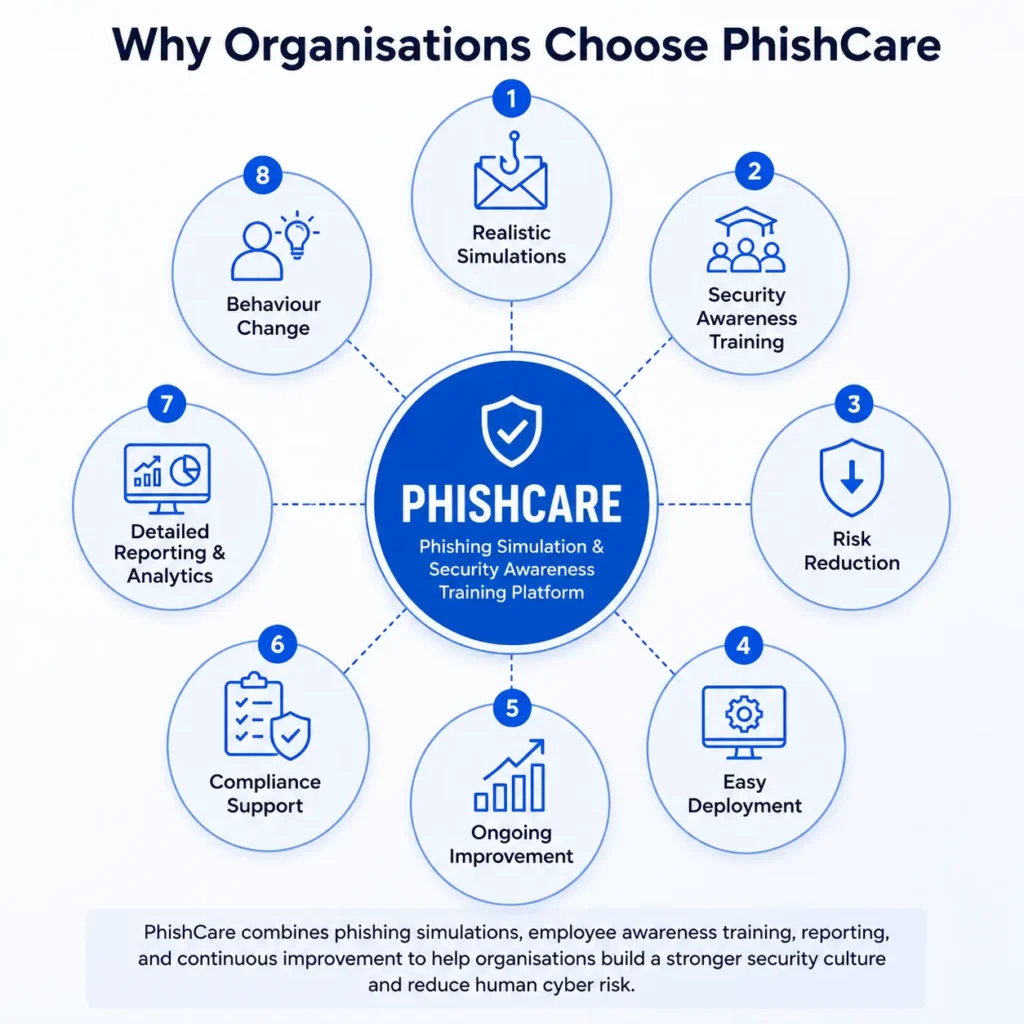
PhishCare, developed by CyberSapiens, combines phishing simulations, employee awareness training, actionable reporting, and continuous improvement strategies into a practical platform designed to strengthen an organization’s human firewall. By helping employees develop stronger security habits over time, organizations can reduce phishing-related risks and improve overall cyber resilience.
Beyond awareness training, PhishCare provides valuable visibility into employee behavior, allowing security teams to identify trends, measure progress, and focus awareness efforts where they can have the greatest impact. This data-driven approach supports more informed cybersecurity decision-making across the organization.
For organizations in New Zealand seeking a scalable and measurable approach to phishing simulation and cyber security awareness training, PhishCare offers a practical solution that helps transform security awareness from a periodic exercise into a long-term cybersecurity capability.
Frequently Asked Questions
What is phishing simulation training?
Phishing simulation training involves sending realistic but safe simulated phishing emails to employees to assess awareness levels, identify risky behaviours, and provide targeted cyber security education based on user responses.
Why is phishing simulation important for organisations?
Phishing remains one of the most common causes of cyber security incidents. Simulated phishing campaigns help organisations measure employee susceptibility, improve awareness, and reduce the likelihood of successful phishing attacks.
How often should organisations run phishing simulations?
Most organisations benefit from running phishing simulations on a regular basis throughout the year. Ongoing campaigns help reinforce awareness, measure behavioural improvements, and keep employees prepared for evolving phishing threats.
Can phishing simulations support ISO 27001 and SOC 2 initiatives?
PhishCare’s campaign reports provide an additional documentation boost for organisations working towards ISO 27001, SOC 2 Type II, PCI DSS, HIPAA, and NIST CSF, where ongoing security awareness training is recognised as a best practice.
What metrics should organisations track during phishing simulations?
Important metrics include click rates, reporting rates, behavioural improvement trends, department risk levels, and overall employee engagement with awareness initiatives.
Why choose PhishCare for phishing simulation and cyber security awareness training in New Zealand?
PhishCare combines realistic phishing simulations, employee awareness training, actionable reporting, compliance-supporting documentation, and continuous behavioural improvement to help organisations reduce human cyber risk and strengthen their security culture.
Content Reviewed By

Nawaz is a practising security analyst specializing in phishing simulation campaigns, employee awareness assessments, red team exercises, and ethical hacking. He leads phishing simulation deployments at PhishCare, a product developed by CyberSapiens, with hands-on experience evaluating and deploying phishing simulation platforms across organizations in multiple industries and regions globally.
View LinkedIn ProfileReady to Strengthen Your Human Firewall?
Discover how PhishCare can help your organization improve phishing resilience, strengthen employee cyber security awareness, and gain actionable insights through realistic phishing simulation campaigns.