Phishing Risks in Retail: Protecting Customer Payment Data
A single stolen employee login at a retailer can expose far more than one store’s inventory system. It can reach a payment processing platform, a customer database spanning millions of records, or an e-commerce admin panel that controls how every transaction on a website gets processed. Retail sits at a specific intersection that makes it unusually attractive to attackers: high transaction volume, valuable customer payment data, and, in many cases, a workforce that turns over faster than security training programs can keep up with.
This guide covers how common phishing attacks against retailers actually are, why the sector faces particular risk around seasonal staffing and payment systems, and what retailers can do to protect customer data without slowing down the business.
In Short: Phishing is now involved in roughly 65 percent of cyberattacks against retail businesses, and a large share of temporary holiday-season staff receive no phishing or social engineering training at all, creating a predictable, recurring gap attackers have learned to exploit.
How Common Is Phishing in Retail
Phishing has become the dominant entry point for attacks against retailers. According to Heimdal Security’s compilation of retail cybersecurity statistics, phishing is involved in roughly 65 percent of cyberattacks against retail businesses, and between 70 and 80 percent of retail businesses reported facing a cyberattack in a recent year. The same research found that only around a quarter of retail businesses feel highly prepared to respond to a cyberattack, despite the frequency with which they are targeted.
65%
Phishing is involved in roughly 65 percent of cyberattacks against retail businesses.
Stolen credentials obtained through phishing are commonly used to access e-commerce admin panels, modify payment settings, exfiltrate customer data, or deploy ransomware, turning a single successful phishing email into a much broader compromise across a retailer’s payment and customer systems.
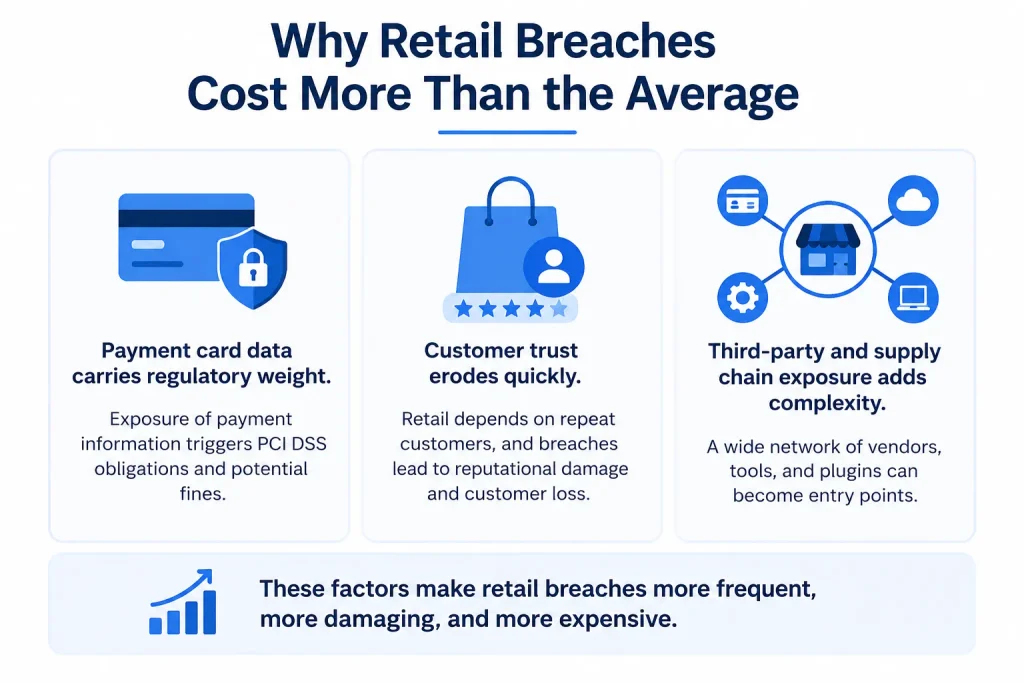
Why Retail Breaches Cost More Than the Average
Retail is one of the few sectors where breach costs have been rising rather than falling. According to Swif’s analysis, citing IBM’s 2025 Cost of a Data Breach Report, retail was among a small group of sectors that saw breach costs increase rather than decrease in the most recent reporting period. The same analysis notes that breaches involving ungoverned, unmanaged AI tooling added roughly $670,000 per incident on average, a growing concern for a sector that has adopted AI in customer service, search, and personalization faster than most.
A few structural factors explain why retail breaches tend to run expensive:
Payment card data carries regulatory weight.
Exposure of payment information triggers PCI DSS obligations and potential fines beyond the direct cost of the breach itself.
Customer trust erodes quickly after a breach.
Retail depends heavily on repeat customers, and a significant share of retailers report measurable reputational damage and customers turning to competitors following an incident.
Third-party and supply chain exposure adds complexity.
Modern retail relies on a wide network of payment processors, tag managers, and e-commerce plugins, any of which can become an entry point if compromised.
The Seasonal Staffing Gap
Retail faces a security challenge few other industries deal with at the same scale: a large, temporary workforce hired specifically for peak shopping periods, often with minimal onboarding time. Research into holiday-season hiring has found that a majority of temporary retail employees receive no social engineering or phishing training at all before starting work, alongside gaps in basic guidance around safe internet use.
This creates a predictable, recurring vulnerability. Attackers do not need to find a new way in every year. They can rely on the fact that a fresh wave of undertrained staff, handling real customer transactions during the highest-volume period of the year, will be onboarded with the same training gaps as the year before, unless retailers specifically address it.
Where Customer Payment Data Is Actually at Risk
Phishing rarely targets payment data directly. It targets the credentials and access that lead to it. Common paths from a successful phishing attempt to exposed payment data include:
Compromised admin credentials
Used to access e-commerce platforms and modify checkout code, a pattern behind the ongoing family of attacks known as Magecart, which skims payment card details directly from checkout pages.
Point-of-sale system access
Gained through a phished employee credential, allowing malware to be deployed that captures card data during in-store transactions.
Third-party vendor compromise
Where a phishing attack against a payment processor, tag manager, or other connected vendor cascades into the retailer’s own systems.
Fake delivery and account notifications
Increasingly delivered through smishing and QR code phishing, targeting both customers directly and staff who manage order fulfillment systems.
Reducing Phishing Risk in Retail
A few practical priorities matter more in retail than in many other sectors, given its specific staffing and payment realities:
Build phishing training into seasonal onboarding by default, not as an optional module skipped under time pressure, given how consistently temporary staff are left out of security training entirely.
Restrict and monitor access to payment and e-commerce admin systems separately from general staff accounts, so a single phished credential cannot reach checkout code or payment configuration.
Extend awareness beyond email specifically. Both staff and customers increasingly encounter phishing through text messages and QR codes referencing delivery, loyalty programs, or account issues, not just email.
Treat vendor and third-party access as part of the phishing risk surface, since a compromised third-party credential can reach retail systems just as easily as a directly phished employee account.
Building a Realistic Testing Program
Given how much of retail’s phishing risk concentrates around seasonal staff and payment-adjacent roles, generic annual training is unlikely to close the gap on its own. Running a phishing test for employees ahead of peak seasonal hiring, and again once new staff are onboarded, gives a realistic picture of readiness before the highest-risk period of the year begins rather than after an incident. Employees handling checkout systems or customer account management are natural candidates for closer attention, and reviewing how to spot a fake login page in 10 seconds is a practical, fast addition to onboarding for any staff with system access.
Tracking results over successive campaigns through an employee phishing risk score also helps retailers identify whether risk concentrates among seasonal staff specifically, information that directly informs where onboarding time is best spent next cycle.
Final Thoughts
Retail’s phishing risk is not evenly distributed. It concentrates around predictable moments: seasonal hiring surges, peak transaction volume, and systems connected to customer payment data. Attackers have learned to time their efforts around exactly these patterns. Retailers that build phishing awareness into seasonal onboarding as a default, rather than an afterthought, close the most predictable and recurring gap in an otherwise difficult-to-fully-secure environment.
FAQ
How common are phishing attacks against retailers?
Phishing is involved in roughly 65 percent of cyberattacks against retail businesses, and between 70 and 80 percent of retailers reported experiencing a cyberattack in a recent reporting period, making it one of the most consistently targeted sectors for this type of attack.
Why do retail breaches often cost more than average?
Retail breaches frequently involve regulated payment card data, triggering compliance obligations beyond direct remediation costs, alongside reputational damage that affects a sector heavily dependent on repeat customer trust. Retail was also among the few sectors where breach costs increased rather than decreased in recent reporting.
Why are seasonal and temporary retail staff a specific risk?
Research into holiday hiring has found that a majority of temporary retail employees receive no phishing or social engineering training before starting work, creating a predictable, recurring gap that coincides with the highest transaction volume of the year.
How does phishing lead to exposed customer payment data?
Phishing typically targets employee credentials rather than payment data directly. Compromised credentials can then be used to access e-commerce admin panels, modify checkout code, or gain point-of-sale system access, each of which can lead to exposed payment information.
What can retailers do to reduce phishing risk without slowing operations?
Building phishing awareness into seasonal onboarding by default, restricting payment-system access separately from general staff accounts, and testing employees before peak seasonal periods are practical steps that do not require slowing down day-to-day retail operations.
Content Reviewed By

Nawaz is a practising security analyst specializing in phishing simulation campaigns, employee awareness assessments, red team exercises, and ethical hacking.
He leads phishing simulation deployments at PhishCare, a product developed by CyberSapiens, with hands-on experience evaluating and deploying phishing simulation tools across organizations in multiple industries and regions globally.
View LinkedIn ProfileRetail’s biggest phishing risk often arrives with the seasonal staff who never got trained. See how realistic phishing simulation fits into onboarding with a free PhishCare demo account, no credit card required.