A text message claiming to be a delivery update, a bank fraud alert, or an unpaid toll notice. It looks routine. It is often anything but. Smishing, short for SMS phishing, has quietly become one of the highest-yield attack channels available to scammers, and most organizations still have no idea how their employees would respond to one.
This guide explains what smishing is, why it succeeds more often than email phishing, what real-world smishing attempts look like, and how organizations can start testing and training employees against it.
In Short
Smishing is phishing delivered by text message instead of email. It works because people trust texts more, read them faster, and rarely expect a company security filter to be checking their personal phone.
What Is Smishing?
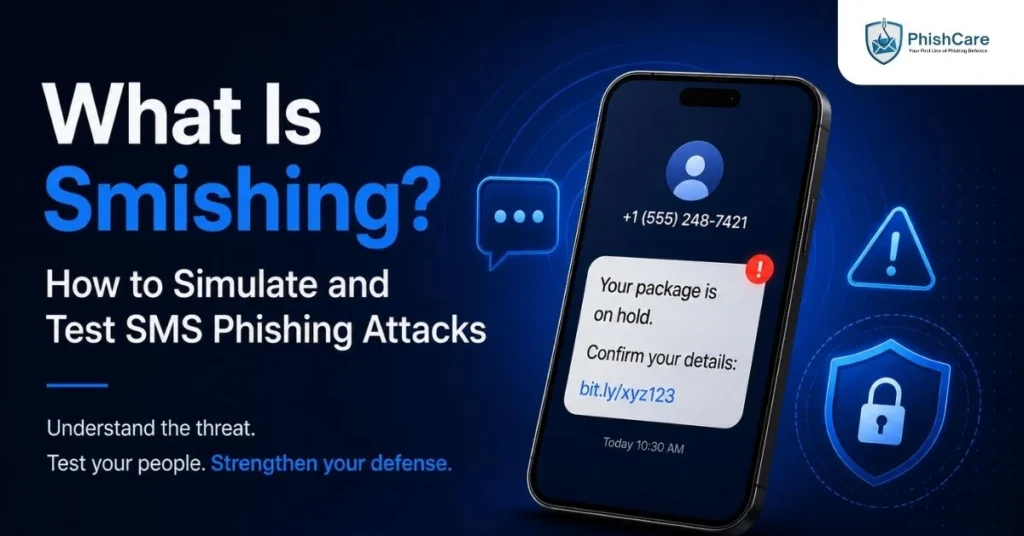
Smishing combines “SMS” and “phishing.” It is a social engineering attack delivered through a text message, designed to trick the recipient into clicking a malicious link, calling a fraudulent number, or handing over sensitive information such as login credentials or a one-time passcode.
Why It Is Different
Unlike email, SMS messages bypass almost every layer of enterprise security. There is no spam filter scanning a personal phone’s inbox, no link-sandboxing, no attachment analysis. The message lands directly, and it lands on a device people check constantly and trust instinctively.
Why Smishing Works Better Than Email Phishing
The numbers behind smishing are stark, and they explain why attackers have shifted so much effort toward it.
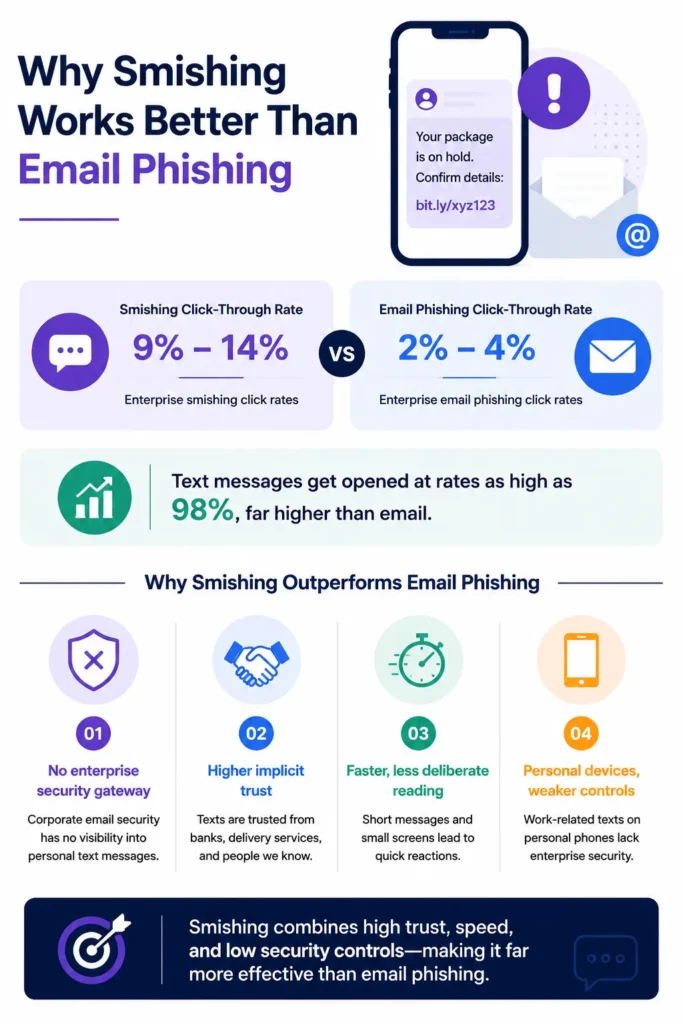
Enterprise smishing click-through rates have been measured between roughly 9 and 14 percent, compared with 2 to 4 percent for email phishing in the same organizational settings, a gap of several times over. Some consumer-facing studies put smishing click rates even higher. Part of the reason is simple behavior: the FTC has noted that text messages get opened at rates as high as 98 percent , far higher than email open rates, and people tend to read and react to a text within minutes of receiving it.
A few structural reasons smishing outperforms email phishing:
No Enterprise Security Gateway
Corporate email security has no visibility into personal text messages, even on a work phone.
Higher Implicit Trust
People associate text messages with banks, delivery services, and people they know, not marketing or spam.
Faster, Less Deliberate Reading
Small screens and short message formats push people toward a quick reaction rather than careful evaluation.
Personal Devices, Weaker Controls
Many employees read work-related texts on personal phones with none of the security tooling their laptop has.
What Smishing Actually Looks Like
According to the FTC’s guidance on recognizing phishing scams , the same core red flags that apply to email phishing apply to smishing: an unexpected message, a request to click a link or call a number, and pressure to act quickly. The delivery channel is different, but the psychology is not.
Common smishing pretexts include:
A fake delivery notification asking you to “confirm” an address or pay a small redelivery fee.
A fraud alert claiming to be from your bank, asking you to reply or click a link to “secure” your account.
A fake toll or parking violation notice with a link to “pay now.”
A one-time passcode message paired with a follow-up text asking the recipient to forward or read back the code.
A message claiming to be from HR or IT, referencing an internal system, asking the employee to click a link to verify credentials.
For Organizations
That last category is the one that matters most for organizations, since it targets employees directly rather than consumers in general.
Smishing vs Vishing vs Phishing
These three terms are often used loosely, but the distinction matters when building a testing program:
| Type | Description |
|---|---|
| Phishing | Typically refers to email-based attacks. |
| Smishing | The same category of attack delivered by SMS or text message. |
| Vishing | Covered in our guide on what a vishing simulation platform is , is the voice-call version, often now enhanced with AI voice cloning. |
Multi-Channel Attacks
Increasingly, attackers combine all three. A text message might establish initial contact, a phone call might follow up to add urgency and legitimacy, and an email might complete the request. Testing only one channel gives an incomplete picture of how prepared employees actually are.
How to Think About Testing and Training for Smishing
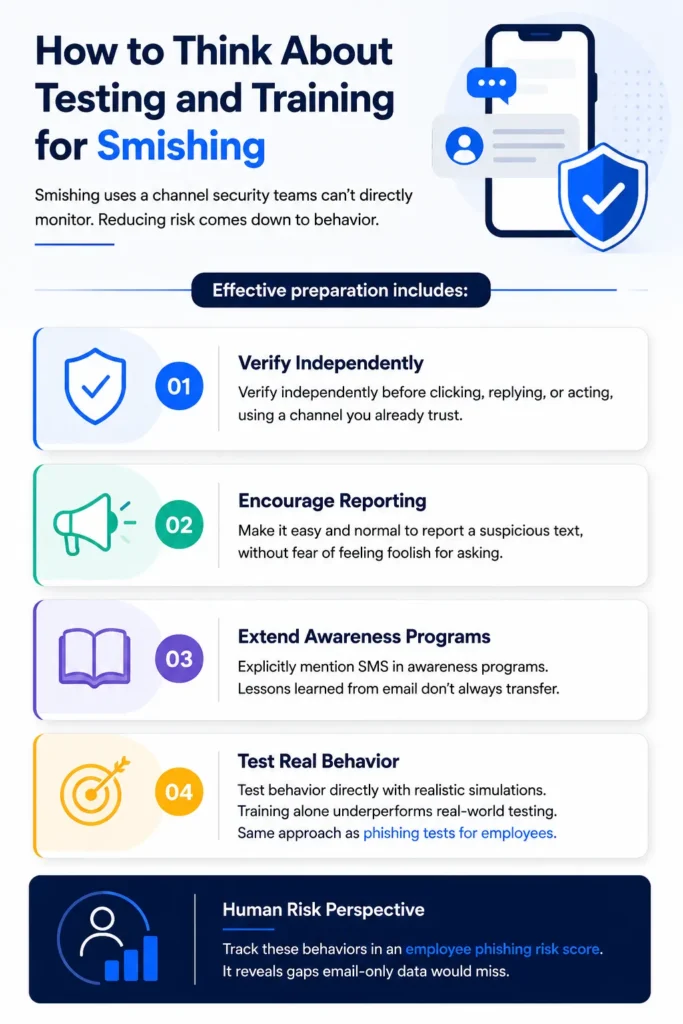
Because smishing exploits a channel most security teams cannot directly monitor, the most realistic path to reducing risk is behavioral: teaching employees to recognize the pattern regardless of which channel it arrives through, and building habits that hold up under time pressure.
Effective preparation generally includes:
Verify Independently
Teaching the same core verification habit across every channel. Whether it is an email, a text, or a phone call, the instruction should be the same: verify independently before clicking, replying, or acting, using a channel you already trust, not the one the message arrived on.
Encourage Reporting
Making it easy and normal to report a suspicious text, the same way employees are encouraged to report suspicious emails, without fear of feeling foolish for asking.
Extend Awareness Programs
Extending existing phishing awareness programs to explicitly mention SMS, rather than assuming lessons learned about email automatically transfer. They often do not, since the format, urgency, and trust level all differ.
Test Real Behavior
Testing behavior directly where possible, since awareness training alone has consistently been shown to underperform simulation-based testing that measures real responses under realistic conditions, the same principle behind running a phishing test for employees over email.
Human Risk Perspective
Organizations building out a broader human-risk program should also see how these behaviors roll up into an employee phishing risk score , since an employee who is careful with email but reflexively clicks text links represents a real, measurable gap that email-only data would miss entirely.
Final Thoughts
Smishing succeeds because it exploits exactly the behaviors that make text messaging useful in the first place: speed, trust, and constant attention. As attackers increasingly chain SMS, voice, and email together into a single coordinated attempt, organizations that only think about email phishing are defending against yesterday’s threat model. Awareness has to expand to match where the attacks actually are, not where they used to be.
Frequently Asked Questions
What is smishing?
Smishing is phishing carried out through SMS text messages instead of email. It uses the same manipulation tactics as email phishing, such as urgency and impersonation, but delivered through a channel with fewer built-in security defenses.
Why is smishing more effective than email phishing?
Text messages are opened at much higher rates than email, often within minutes, and personal phones typically lack the enterprise security filtering that scans corporate email. This combination of high trust and low friction makes smishing click rates significantly higher than email phishing in most measured data.
What does a typical smishing message look like?
Common examples include fake delivery notifications, fraudulent bank fraud alerts, fake toll or parking fine notices, and messages impersonating internal IT or HR asking an employee to click a link or confirm a code.
How is smishing different from vishing?
Smishing happens over text message, while vishing happens over a phone call, often now using AI-generated voice cloning. Both fall under the same umbrella of social engineering and are increasingly used together in a single coordinated attack.
Can organizations test employees against smishing the way they test against email phishing?
Yes, in principle, the same simulation-based approach used for email phishing, sending realistic, safe test messages and tracking responses, can be applied to SMS. The core requirement is realistic scenarios and fast, non-punitive follow-up training for anyone who responds to the simulated message.
Ready to Start Testing Employee Phishing Awareness?
Text-based attacks are growing fast, but email is still where most organizations can start testing today. PhishCare offers a free demo account for companies to run a real simulated phishing campaign and see how your team responds, no credit card required.
Content Reviewed By

Nawaz is a practising security analyst specializing in phishing simulation campaigns, employee awareness assessments, red team exercises, and ethical hacking.
View LinkedIn Profile