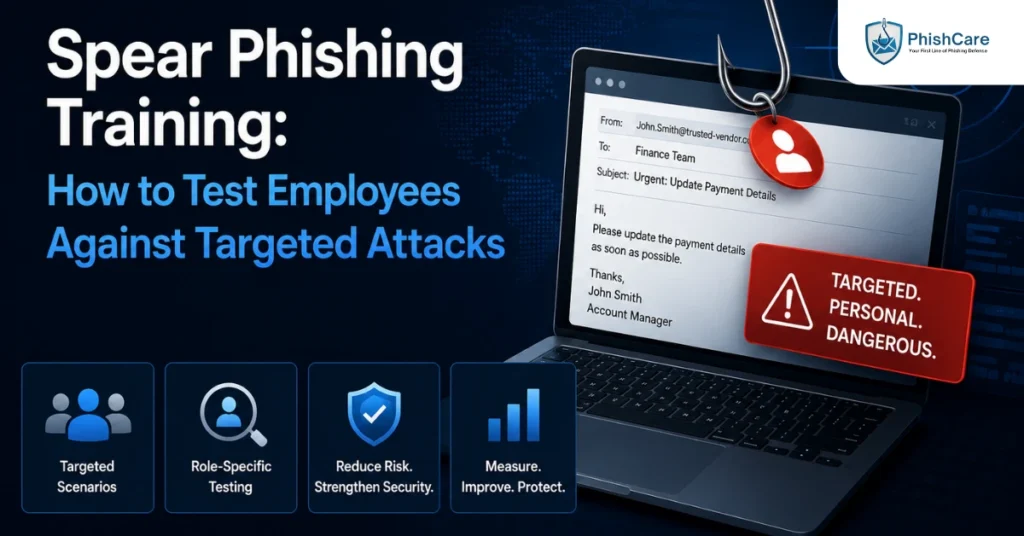
Most phishing emails go out by the thousand, hoping a small percentage of recipients click. Spear phishing works the opposite way. It targets one person, or a small group, using details specific enough to make the email feel real: a project name, a vendor relationship, a manager’s actual writing style. When the target is a senior executive with the authority to approve a wire transfer, that same technique has a name of its own: whaling.
Generic phishing awareness training was not built for this. This guide covers what spear phishing training actually needs to include, how it differs from standard phishing testing, and why whaling deserves a dedicated approach rather than being lumped into a general awareness program.
Spear phishing training tests employees against personalized, researched attacks aimed at them specifically, rather than generic phishing templates. Whaling training does the same thing for executives and the people who act on their authority, where a single successful attempt can be worth far more than an ordinary phishing click.
Spear Phishing vs Whaling vs Regular Phishing
These terms get used loosely, so it helps to separate them clearly:
Regular Phishing
Regular phishing casts a wide net. The same generic email goes to thousands of recipients, hoping a small percentage click.
Spear Phishing
Spear phishing targets a specific person or small group, using research about their role, projects, or relationships to make the email feel personally relevant.
Whaling
Whaling is spear phishing aimed specifically at senior executives, or the people authorized to act on their behalf, such as an executive assistant or a finance director. As Huntress explains in its comparison of the two techniques, whaling and spear phishing both rely on personalized social engineering, but whaling concentrates that effort on the highest-value targets in an organization.
The Common Thread
The common thread across spear phishing and whaling is research. Attackers study a target’s public footprint, LinkedIn activity, recent company announcements, and organizational structure before ever sending a message, which is exactly why a generic phishing test does not adequately prepare employees for one.
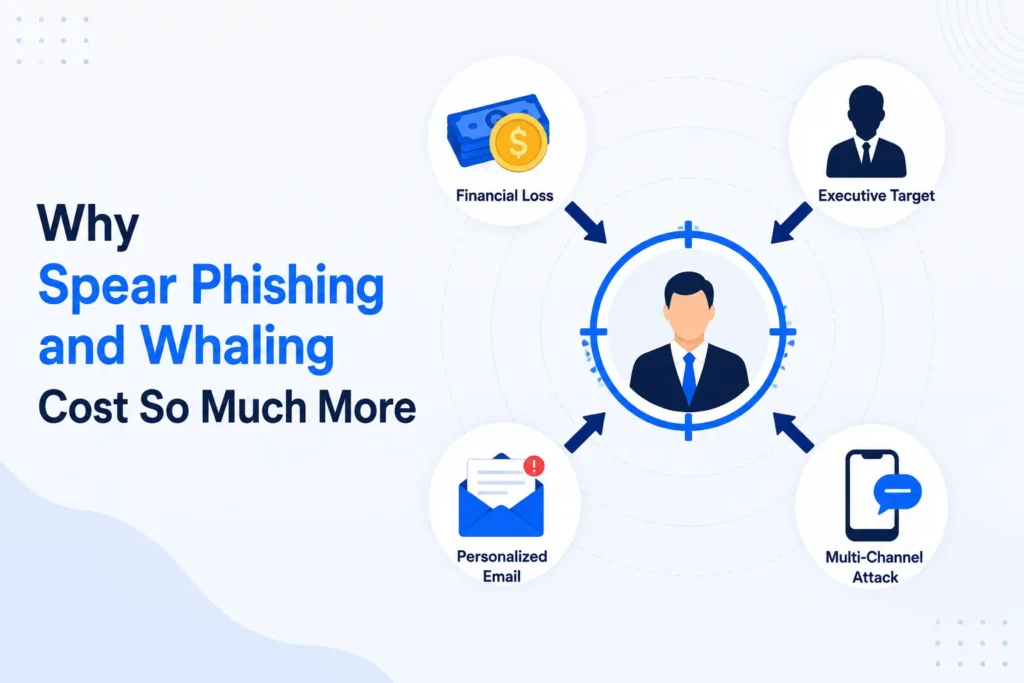
Why Spear Phishing and Whaling Cost So Much More
Regular phishing is a volume game for attackers. Spear phishing and whaling are precision plays, and the financial impact reflects that difference. According to the FBI’s 2025 Internet Crime Complaint Center Annual Report, business email compromise, a category of attack built almost entirely on spear phishing and whaling tactics, generated over 3 billion dollars in reported losses in a single year, making it one of the most financially damaging cybercrime categories the FBI tracks, behind only investment fraud.
A handful of factors explain why targeted attacks are so much more costly per incident than generic phishing:
The target usually has real authority.
A whaling victim can often approve a payment or access sensitive systems directly, with no additional approval needed.
The lure is timed deliberately.
Attackers wait for moments when verification is hardest: during travel, right before a board meeting, or late on a Friday when finance teams are rushing to close the week.
The message often contains no attachment or link.
A plain-text request that looks like normal business communication is far harder for technical filters to catch than a traditional phishing email.
Multi-channel follow-up adds credibility.
A convincing email is increasingly followed by a phone call, a text, or even a video call using voice or video cloning, reinforcing the request across channels the target already trusts.
What Real Spear Phishing Training Looks Like
Generic, once-a-year phishing awareness training does not hold up against attacks built specifically around an individual’s role and context. Effective spear phishing training needs a few things a broad program often lacks:
Role-based scenarios.
Finance, HR, and executive assistants face different lures than the average employee, and training should reflect the specific pretexts each group is likely to see, such as vendor payment changes for finance or urgent document requests for executive assistants.
Realistic context, not generic templates.
A spear phishing simulation is only useful if it mirrors the kind of research-driven email an attacker would actually send, referencing plausible internal details rather than an obviously generic lure.
Separate, dedicated testing for executives.
Whaling simulations should be treated as their own category, not folded into a standard company-wide campaign, since the pretexts, stakes, and appropriate follow-up are different.
Fast, blame-free follow-up.
Anyone who responds to a simulated spear phishing or whaling attempt should get immediate, specific feedback, not a generic module unrelated to what actually happened.
PhishCare Platform
PhishCare supports both spear phishing and whaling simulation directly inside the platform, alongside standard phishing campaigns, so organizations can run a baseline test with a general employee group and a separate, more targeted campaign for finance teams and executives, all from the same dashboard. Anyone starting from scratch can see the full first-campaign workflow in our guide on how to run a phishing test for employees, then apply the same principles with more targeted, role-specific templates for a spear phishing or whaling round.
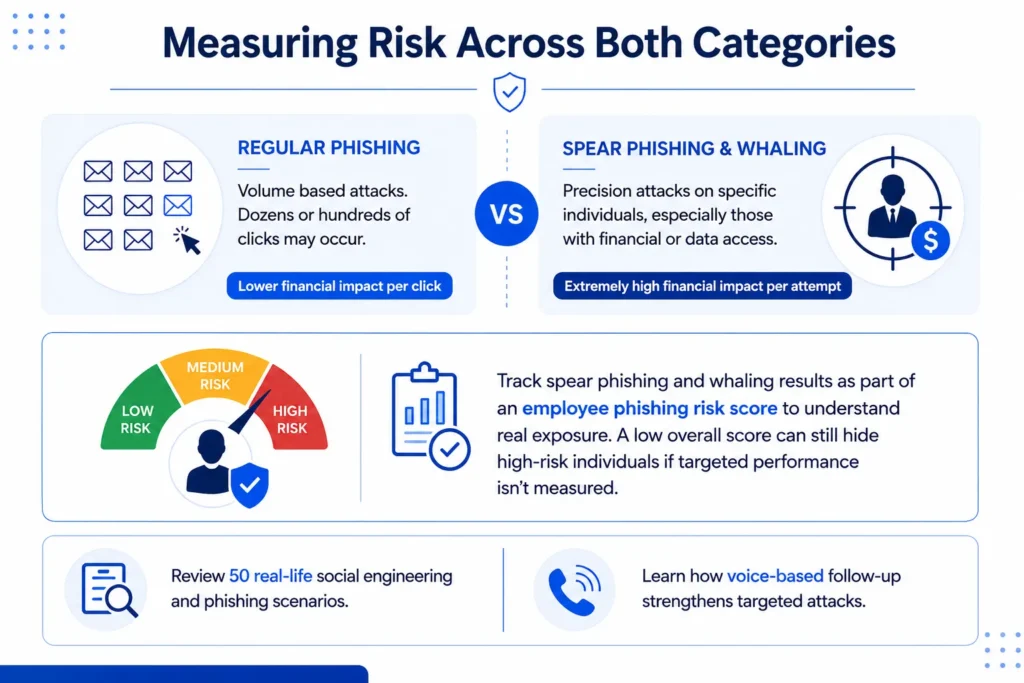
Measuring Risk Across Both Categories
Spear phishing and whaling results matter more than standard phishing click rates when it comes to actual financial exposure, since a single successful whaling attempt can cost far more than dozens of generic phishing clicks combined. Tracking these results as part of a broader employee phishing risk score gives a more complete picture than looking at company-wide click rates alone, since an executive or finance employee with a low overall score can still represent outsized risk if that score does not account for how they perform against realistic, targeted attempts specifically.
Organizations building a broader picture of social engineering risk may also find it useful to review 50 real-life social engineering and phishing scenarios for examples of the kind of pretexts that succeed against even experienced employees, and our guide on vishing simulation platforms for how voice-based follow-up increasingly reinforces a targeted email attempt.
Final Thoughts
Spear phishing and whaling do not fail against the same defenses that stop generic phishing. They are built specifically to get past them, using research, timing, and personal context that a broad awareness program was never designed to address. Testing employees, and especially executives and finance teams, against realistic, role-specific scenarios is the only way to know whether your organization’s actual weak points match where the training budget has gone.
Frequently Asked Questions
What is spear phishing training?
Spear phishing training tests and prepares employees against personalized, targeted phishing attempts built around specific research about their role, rather than generic phishing templates sent broadly across an organization.
What is the difference between spear phishing and whaling?
Spear phishing targets a specific individual or small group within an organization, while whaling is spear phishing aimed specifically at senior executives or the people authorized to act on their behalf, such as a CFO or executive assistant.
Why is whaling more dangerous than regular phishing?
Whaling targets people with real authority to approve payments, access sensitive systems, or make high-stakes decisions, so a single successful attempt can result in significantly larger financial or data loss than an average phishing click.
Can PhishCare simulate spear phishing and whaling attacks?
Yes. PhishCare supports both spear phishing and whaling simulation directly in the platform, alongside standard company-wide phishing campaigns, so organizations can run targeted tests for finance teams, executives, and other high-risk roles.
How often should organizations run spear phishing or whaling tests?
There is no universal number, but many organizations run standard phishing tests more frequently, such as monthly, while reserving spear phishing and whaling simulations for a smaller, higher-risk group on a quarterly basis or after a significant public announcement that could be used as a lure.
Ready to Test Your Organization Against Targeted Attacks?
Spear phishing and whaling attacks are built to bypass the defenses that stop everyday phishing. See how your finance team and executives would actually respond with a free PhishCare demo account, which includes spear phishing and whaling simulation alongside standard campaigns, no credit card required.

Mohammed Nawaz Sajjad
Sr. Security Analyst at CyberSapiens | Phishing Simulation | Ethical Hacker | Bug Hunter | Red Team
Nawaz is a practising security analyst specializing in phishing simulation campaigns, employee awareness assessments, red team exercises, and ethical hacking.
He leads phishing simulation deployments at PhishCare, a product developed by CyberSapiens, with hands-on experience evaluating and deploying phishing simulation tools across organizations in multiple industries and regions globally.
View LinkedIn Profile