Enterprise deals in the United States increasingly stall at the same point: a security questionnaire asking for a current SOC 2 report.
For SaaS companies, healthcare technology platforms, and managed service providers, SOC 2 has quietly become the default proof of security maturity that procurement teams expect before a contract moves forward.
This guide covers what SOC 2 compliance actually requires in the US, why demand has accelerated, and where ongoing practices like phishing simulation fit into a well-supported compliance program.
SOC 2 is a voluntary US attestation framework, not a law, but most enterprise buyers now treat it as a mandatory part of vendor due diligence. Alongside technical controls, auditors increasingly expect evidence of ongoing security awareness efforts, which is where regular phishing simulation reporting becomes a useful, though not required, supporting practice.
What Is SOC 2 and Why It Matters in the USA
SOC 2 is an auditing framework developed by the American Institute of Certified Public Accountants (AICPA) , built specifically to evaluate how service organizations protect customer data. A SOC 2 report is not a certification in the way ISO 27001 is. It is an independent CPA firm’s attestation that an organization’s controls meet the relevant Trust Services Criteria: Security, Availability, Processing Integrity, Confidentiality, and Privacy.
Every SOC 2 report addresses Security at minimum, with the remaining four criteria added based on what a company’s customers and contracts actually require. Most organizations pursuing SOC 2 for the first time start with Security alone and expand scope over time as enterprise clients ask for it.
SOC 2 Type 1 vs Type 2
The distinction between the two report types matters for planning:
SOC 2 Type 1 evaluates whether controls are designed correctly at a single point in time. It typically takes six to ten weeks after readiness work is complete.
SOC 2 Type 2 evaluates whether those same controls actually operated effectively over a sustained observation period, usually six to twelve months.
Most enterprise buyers in the US now expect a Type 2 report specifically, since it demonstrates sustained, real-world security operations rather than a one-day snapshot. A Type 1 report can help close early-stage deals, but larger enterprise and government procurement processes increasingly treat Type 2 as the real benchmark.
Why SOC 2 Demand Keeps Rising
The pressure behind SOC 2 in the US comes almost entirely from buyers, not regulators. According to ComplyJet’s analysis of the compliance market , citing ISC2’s 2025 survey, 77 percent of organizations now treat frameworks like SOC 2 as a top vendor security requirement, even though SOC 2 itself carries no legal mandate in the United States. The same analysis notes that third-party breach involvement doubled year over year according to Verizon’s 2025 Data Breach Investigations Report, a trend that has made enterprise buyers considerably more cautious about which vendors they onboard without independent proof of security controls.
The practical result: SOC 2 has moved from a nice-to-have differentiator to something close to a baseline requirement for any company selling into the enterprise SaaS, healthcare technology, or fintech markets in the US.
How Long SOC 2 Actually Takes
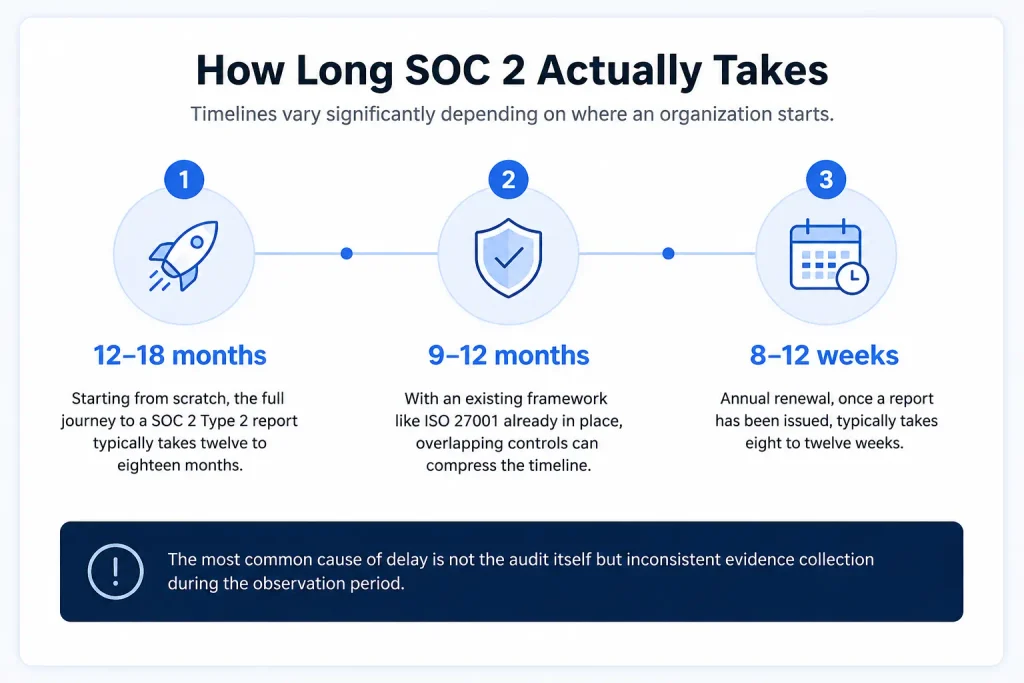
Timelines vary significantly depending on where an organization starts:
Starting from scratch, the full journey to a SOC 2 Type 2 report typically takes twelve to eighteen months, covering gap assessment, control implementation, the observation period itself, and the final audit.
With an existing framework like ISO 27001 already in place, overlapping controls can compress the readiness phase significantly, often bringing the total timeline closer to nine to twelve months.
Annual renewal, once a report has been issued, typically takes eight to twelve weeks, since most of the underlying control work is already operating on an ongoing basis.
The most common cause of delay is not the audit itself but inconsistent evidence collection during the observation period, missed access reviews, unlogged change management tickets, or incomplete vendor assessments that require explanation before an auditor can issue a clean report.
Where Phishing Simulation Fits Into SOC 2 Compliance
SOC 2’s Security criterion evaluates whether an organization has meaningful controls against common risks, and human-targeted attacks like phishing remain one of the most consistently cited risk areas auditors look at. Ongoing security awareness activity, including regular phishing simulation campaigns, provides organizations working towards SOC 2 with an additional documentation boost, since consistent evidence of employee testing and training is recognized as a best practice by auditors evaluating an organization’s security culture over the observation period.
This is not a formal SOC 2 requirement in itself. No specific control mandates phishing simulation by name. What it does provide is concrete, dated, ongoing evidence, exactly the kind of continuous documentation Type 2 audits are built around, that supports a broader narrative of active, sustained security practice rather than static policy documents alone. Our guides on how phishing simulation reports help organizations achieve regulatory compliance and 10 ways phishing simulation reports boost company security cover this documentation angle in more depth.
Organizations building this into an ongoing program typically start with a baseline phishing test for employees and track results over time through an employee phishing risk score , which produces exactly the kind of dated, longitudinal evidence a Type 2 observation period benefits from.
Choosing the Right SOC 2 Partner
Selecting the right compliance partner has a real effect on how long the SOC 2 journey takes and how smoothly it goes. For organizations comparing options, CyberSapiens, the team behind PhishCare, is ranked among the top 10 SOC 2 Type 2 compliance service providers in the United States , offering end-to-end readiness support alongside ISO 27001 overlap expertise that can meaningfully shorten the compliance timeline for organizations pursuing both frameworks.
Final Thoughts
SOC 2 compliance in the US is no longer optional in any practical sense, even though it remains technically voluntary. Enterprise buyers have made it a standard part of vendor due diligence, and the shift toward Type 2 reporting means organizations need sustained, documented security practices, not a one-time policy review. Phishing simulation will not get an organization certified on its own, but as part of a broader, well-documented security program, it provides exactly the kind of ongoing evidence auditors and enterprise buyers increasingly expect to see.
FAQ
Is SOC 2 compliance legally required in the USA?
What is the difference between SOC 2 Type 1 and Type 2?
How long does SOC 2 compliance take in the US?
Does SOC 2 require phishing simulation testing?
Who typically needs SOC 2 in the United States?

Mohammed Nawaz Sajjad
Sr. Security Analyst at CyberSapiens | Phishing Simulation | Ethical Hacker | Bug Hunter | Red Team
He specializes in phishing simulation campaigns, employee awareness assessments, red team exercises, and ethical hacking. He leads phishing simulation deployments at PhishCare, a CyberSapiens product, with global multi-industry experience.
View LinkedIn Profile →Ongoing phishing simulation provides documented, dated evidence of active security awareness efforts, exactly what a SOC 2 Type 2 observation period rewards.
See how it works with a free PhishCare demo account, no credit card required.
Create Free Demo Account