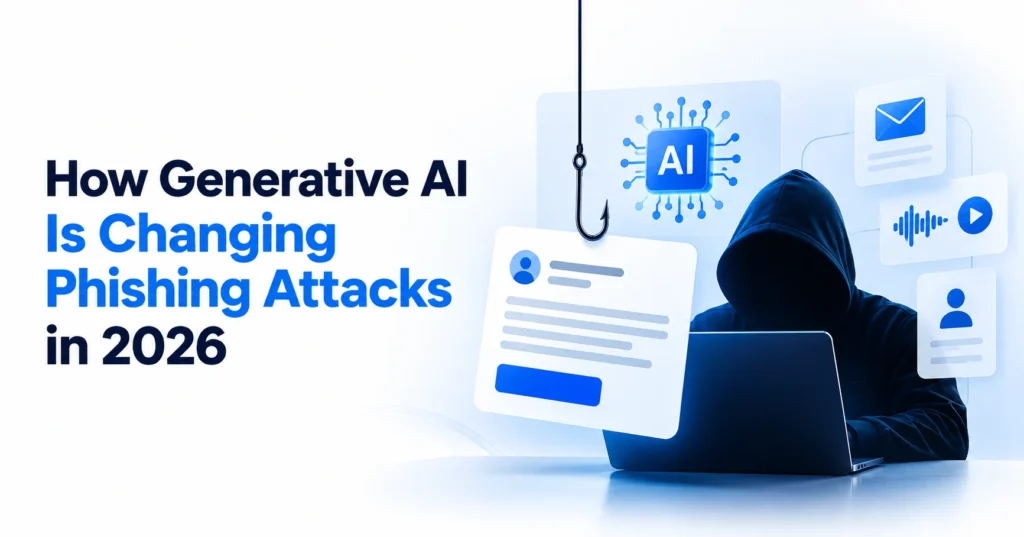
Phishing attacks have evolved significantly over the past decade, but the rise of generative artificial intelligence has accelerated this transformation at an unprecedented pace. In 2026, attackers are no longer limited to poorly written emails or generic scam messages. Instead, they are using advanced AI tools to create highly personalised, context-aware, and convincing phishing campaigns that are difficult to distinguish from legitimate communication.
Generative AI is changing phishing from a volume-based scam into a highly personalised social engineering threat. Employees can no longer rely on spelling mistakes, awkward wording, or generic messages as their primary warning signs.
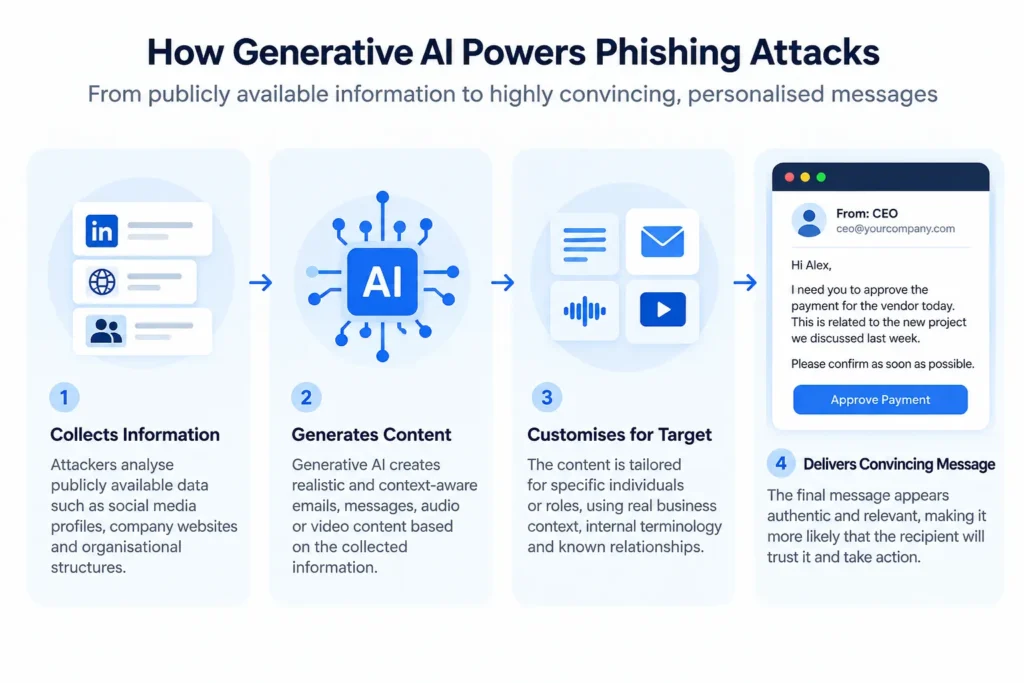
Generative AI enables attackers to produce realistic emails, messages, and even voice or video content in seconds. These tools can analyse publicly available data, social media profiles, and organisational structures to craft targeted phishing messages that align closely with real business interactions. As a result, traditional indicators such as grammatical errors or unusual phrasing are no longer reliable signals of a phishing attempt.
This shift presents a significant challenge for organisations. While technical security tools continue to improve, AI-generated phishing attacks are designed to bypass detection systems by mimicking legitimate communication patterns. The primary target is no longer just the system, but the individual employee making a decision.
Understanding how generative AI is changing phishing attacks is essential for organisations that want to stay ahead of evolving threats. As attackers adopt more sophisticated techniques, businesses need to strengthen both their technical defenses and their human layer of security.
What Is Generative AI in the Context of Phishing?
Generative AI refers to artificial intelligence systems capable of creating content such as text, images, audio, and video. In the context of phishing, attackers use these tools to generate convincing messages that appear authentic and relevant to the recipient.
From Generic Messages to Context-Aware Phishing
Unlike traditional phishing campaigns that rely on generic templates, AI-generated phishing messages can be customised for specific individuals or roles. For example, an attacker can generate an email that references a recent project, internal terminology, or known business relationships. This level of personalisation increases the likelihood that employees will trust the message and respond without suspicion.
This makes generative AI particularly useful for social engineering. Instead of sending the same message to hundreds of recipients, attackers can create communication that reflects the recipient’s role, responsibilities, and expected workflows. Employees therefore need to assess the context and legitimacy of a request rather than relying only on how professionally a message is written.
Increased Personalisation and Targeting
One of the most significant impacts of generative AI is the ability to create highly targeted phishing campaigns. Attackers can analyse publicly available information, including LinkedIn profiles, company websites, and social media activity, to understand organisational structures and employee roles.
How Attackers Build Context
Before launching a targeted campaign, attackers may collect information about an organisation, its employees, reporting structures, business relationships, and ongoing activities. This type of reconnaissance can help them create messages that appear to fit naturally into the recipient’s work environment. Learn more about how attackers research targets before a spear-phishing campaign .
Using this information, AI tools can generate messages tailored to specific individuals. For example, a finance employee may receive a phishing email that appears to come from a senior executive requesting urgent approval of a transaction. Because the message reflects real business context, it becomes more difficult for employees to identify it as malicious.
This level of personalisation can make phishing attempts feel familiar rather than suspicious. A message that references a genuine project, colleague, supplier, meeting, or business process may appear more credible to an employee, even when the underlying request is malicious.
Elimination of Traditional Phishing Indicators
Historically, phishing emails often contained spelling errors, unusual formatting, or inconsistent language. These indicators made it easier for employees to identify suspicious messages and question whether a communication was legitimate.
Why Spelling Errors Are No Longer Enough
Generative AI has largely eliminated many of these weaknesses. AI-generated emails can be grammatically correct, professionally written, and consistent in tone. Attackers can also adapt the language and style of a message to make it appear more natural for a particular employee, department, or business situation.
This means employees need to look beyond grammar and formatting when evaluating suspicious communication. A message can appear polished and professional while still directing the recipient toward a malicious link, fake login page, fraudulent payment request, or unauthorised information disclosure.
For example, attackers may use realistic branding and familiar-looking authentication pages to make a malicious request appear legitimate. Employees should therefore pay attention to the destination of links, unexpected authentication requests, unusual requests for sensitive information, and changes in normal business processes. Understanding how to spot a fake login page in 10 seconds can help employees recognise one of the common techniques used to capture credentials.
The New Question Employees Should Ask
Instead of asking only, “Does this email look suspicious?”, employees should consider whether the request is expected, whether the sender and request can be independently verified, and whether the action being requested is appropriate for the situation.
Rise of Deepfakes and Multi-Channel Attacks
Generative AI is not limited to text-based phishing. Attackers are increasingly using AI to create convincing audio and video content that can be used to impersonate trusted individuals. These techniques add another layer of deception to phishing and social engineering campaigns.
From Fake Emails to Fake Voices and Faces
Employees may receive voice messages or video calls that appear to come from senior executives, colleagues, suppliers, or other trusted contacts. These communications may request urgent action, such as approving payments, transferring funds, or sharing sensitive information.
Learn more about deepfake phishing scams and how AI-generated impersonation can be incorporated into phishing and social engineering campaigns.
Multi-channel attacks can make these scenarios even more convincing. Instead of relying on a single communication channel, attackers may combine email, messaging platforms, and voice communication to create a consistent story and reinforce a fraudulent request.
How a Multi-Channel Attack Can Work
An employee may first receive an email containing a request that appears to come from a senior executive. A follow-up message or phone call can then reinforce the request and create additional pressure to act quickly. Because the communications appear connected, the employee may be less likely to question the original request.
These coordinated attacks make it more difficult to verify authenticity and increase the likelihood that an employee will trust the communication. Organisations therefore need awareness training that prepares employees to verify unusual requests across multiple communication channels rather than trusting a message simply because it appears to come from a familiar person.
Video-based impersonation adds another challenge. Employees may be exposed to realistic-looking video calls that attempt to establish trust before requesting an action. Understanding how deepfake video call scams work can help organisations build more realistic awareness scenarios around identity verification and high-risk requests.
Automation and Scale of Phishing Campaigns
Generative AI allows attackers to scale phishing campaigns rapidly. Instead of manually crafting individual messages, attackers can generate large volumes of personalised emails and other communications in a short period of time.
More Messages, More Personalisation
Traditional phishing campaigns often depended on reusable templates and broad targeting. Generative AI can make it easier to create variations of a campaign for different employees, departments, roles, and business situations. Each message can be adapted to appear relevant while still supporting the same underlying phishing objective.
This automation increases both the volume and potential effectiveness of phishing campaigns. Organisations may face a higher frequency of targeted attempts, with messages designed around specific workflows or employee responsibilities.
AI-assisted campaigns can also make individual phishing attempts less predictable. Attackers can vary the wording, sender context, subject lines, and requested actions instead of repeatedly using the same message. This creates a broader range of scenarios for employees and security teams to identify.
Why Scale Changes the Phishing Risk
When attackers can automate both content creation and personalisation, organisations may encounter phishing attempts that are more varied and more closely aligned with legitimate business communication. This makes employee awareness and consistent verification practices increasingly important.
The changing nature of phishing also means that awareness training should cover more than traditional email scams. Employees need exposure to realistic scenarios that reflect the different ways attackers can use social engineering, impersonation, and context-aware communication to influence decisions.
Why Employees Are the Primary Target
Despite advances in security technology, generative AI phishing attacks continue to focus on human behaviour. Attackers rely on urgency, authority, familiarity, and trust to influence decision-making rather than depending only on technical vulnerabilities.
AI Makes Social Engineering More Convincing
Employees are often required to respond quickly to emails, approve requests, communicate with external contacts, and manage tasks under time pressure. AI-generated phishing messages can be designed to fit seamlessly into these workflows.
Techniques such as pretexting and social engineering can create a believable reason for an employee to take an action, making the request appear routine rather than suspicious.
This makes employee awareness a critical component of a cybersecurity strategy. Recognising suspicious patterns, verifying unusual requests, and reporting unexpected communication are essential skills in an AI-driven threat landscape.
What Employees Should Verify
Employees should pay particular attention to unexpected requests involving payments, credentials, sensitive information, account access, or changes to established processes. When a request creates unusual urgency or appears to bypass normal verification procedures, employees should independently confirm the request before taking action.
The goal is not to make employees suspicious of every communication. Instead, awareness should help employees recognise when a request falls outside normal patterns and provide them with clear steps for verification and reporting.
Adapting Awareness Programs for AI-Driven Threats
Traditional awareness programs must evolve to address the changing nature of phishing attacks. Training should focus on behavioural patterns rather than superficial indicators such as spelling mistakes, unusual formatting, or poor grammar.
Train Employees to Verify, Not Assume
Employees should be encouraged to verify requests, especially those involving financial transactions, credentials, account access, or sensitive data, even when the message appears legitimate. Verification should take place through a trusted communication channel rather than relying solely on the contact details provided in the suspicious message.
Awareness training should also teach employees how to recognise suspicious links, unexpected authentication requests, unusual changes to business processes, and pressure to act immediately. Resources such as Browser-in-the-Browser attacks demonstrate why employees need to look beyond the visual appearance of a login prompt when evaluating online requests.
Make Reporting Part of the Security Culture
Awareness programs should also emphasise the importance of reporting suspicious communication. Early reporting allows security teams to investigate unusual activity and respond before a phishing attempt develops into a larger security incident.
Employees should know exactly how and where to report a suspicious email, message, phone call, or other communication. A simple and well-understood reporting process can help organisations respond more quickly when new phishing campaigns emerge.
Continuous reinforcement is essential. As AI-driven phishing techniques evolve, employees need regular opportunities to practise identifying suspicious behaviour and responding appropriately. Phishing simulations can provide a controlled way to reinforce these behaviours and help organisations identify areas where additional awareness training may be useful.
Strengthening Awareness With PhishCare
To effectively address AI-driven phishing threats, organisations need realistic and continuously evolving awareness approaches. PhishCare , a phishing simulation and employee security awareness platform developed by CyberSapiens, supports organisations in testing and strengthening employee responses to phishing scenarios.
Simulate Realistic Phishing Scenarios
PhishCare simulations can reflect modern phishing patterns, including impersonation attempts, urgent business requests, and communications designed to resemble familiar organisational workflows. These controlled scenarios give employees an opportunity to practise identifying suspicious communication before encountering similar tactics in a real-world situation.
When employees interact incorrectly with simulated phishing emails, immediate feedback can reinforce the warning signs that were missed. This moment-based learning helps employees understand why a particular request was suspicious and encourages them to apply the same verification behaviour to future communications.
Measure Behaviour and Reinforce Learning
PhishCare provides behavioural insights that can help organisations understand how employees respond to phishing simulations over time. These insights can help security and awareness teams identify areas where additional training or reinforcement may be useful.
Continuous simulations can also help organisations adapt awareness programs as phishing techniques change. Instead of treating security awareness as a one-time training activity, organisations can use recurring exercises to reinforce safer decision-making and reporting behaviour.
PhishCare campaign reports can also provide an additional documentation boost for organisations working towards frameworks such as ISO 27001, SOC 2 Type II, PCI DSS, HIPAA, or NIST CSF, where ongoing security awareness training is recognised as a best practice. These reports can help organisations demonstrate that phishing awareness activities are being conducted and reviewed over time.
Build Continuous Phishing Awareness
AI-driven phishing continues to evolve, so employee awareness needs to evolve with it. Combining realistic phishing simulations, behavioural insights, immediate feedback, and continuous reinforcement can help organisations strengthen the human layer of their security strategy.
Content Reviewed By

Nawaz is a practising security analyst specializing in phishing simulation campaigns, employee awareness assessments, red team exercises, and ethical hacking.
He leads phishing simulation deployments at PhishCare, a product developed by CyberSapiens, with hands-on experience evaluating and deploying phishing simulation tools across organizations in multiple industries and regions globally.
View LinkedIn Profile