How Phishing Simulation Reports Support Audit Readiness and Compliance Programs
Many organizations invest in employee security awareness training, but during audits, training completion records alone are often not enough to demonstrate the effectiveness of awareness initiatives. Auditors, compliance teams, and security leaders increasingly look for evidence that employees are actively applying what they have learned in real-world scenarios.
Executive Summary
Phishing simulation reports provide measurable insights into employee behavior, awareness levels, and security improvement trends over time. While they are not mandatory for certification, they provide an additional documentation boost for organizations working towards ISO 27001, SOC 2 Type II, PCI DSS, HIPAA, and NIST CSF, where ongoing security awareness activities are widely recognized as a cybersecurity best practice.
Audit Evidence
Document employee participation, reporting behavior, and awareness improvements through measurable campaign results.
Compliance Visibility
Track awareness program effectiveness using phishing metrics, risk indicators, and historical reporting trends.
Continuous Improvement
Demonstrate how awareness initiatives evolve over time through recurring phishing simulations and reporting.
In this guide, we’ll explore how phishing simulation reports help organizations strengthen audit readiness, demonstrate security awareness program effectiveness, and support broader compliance objectives across leading regulatory and cybersecurity frameworks.
Why Compliance Teams Need More Than Security Awareness Training
Security awareness training is an important component of any cybersecurity program. However, auditors and compliance reviewers often want to see evidence that employees are not only completing training modules but also applying security knowledge in practical situations. This is where phishing simulations and reporting provide additional value.
The Challenge with Training Completion Records Alone
Many organizations rely on training attendance records, course completion certificates, and policy acknowledgements as evidence of security awareness efforts. While these records demonstrate participation, they may not provide visibility into whether employees can identify and respond appropriately to phishing attempts in real-world situations.
Training Shows Participation
Completion records confirm that employees attended awareness sessions or completed assigned security training modules.
Simulations Show Behavior
Phishing simulations provide measurable evidence of how employees react when presented with realistic phishing scenarios.
Reports Show Improvement
Historical reporting trends help demonstrate continuous awareness improvement and reduced phishing risk over time.
What Compliance Auditors Typically Look For
Documented Awareness Activities
Evidence that security awareness initiatives are actively conducted and maintained.
Measurement and Tracking
Metrics that help assess employee awareness and identify potential areas of risk.
Continuous Improvement
Evidence showing that awareness programs evolve based on findings and campaign outcomes.
Phishing simulation reports help bridge the gap between training participation and measurable employee behavior. They provide security teams with practical evidence that awareness initiatives are being tested, monitored, and improved over time, making them valuable supporting documentation for broader compliance and audit readiness efforts.
What Auditors Actually Want to See
A common misconception is that auditors simply verify whether security awareness training has been completed. In reality, most compliance assessments focus on evidence, consistency, accountability, and continuous improvement. Organizations that can demonstrate these elements are often better positioned during audits and security reviews.
Auditors Are Looking for Evidence, Not Assumptions
Security awareness initiatives become significantly more valuable when organizations can show documented proof of employee engagement, risk reduction efforts, and measurable program outcomes. Phishing simulation reports help transform awareness activities into evidence that can be reviewed, tracked, and referenced over time.
Documented Activities
Evidence that security awareness initiatives are being conducted regularly, including employee participation, phishing simulations, and awareness campaigns.
Measurable Results
Metrics that demonstrate how employees responded to simulated phishing attacks and how awareness levels changed over time.
Continuous Improvement
Evidence showing that findings from simulations are used to improve employee awareness and reduce organizational risk.
Examples of Evidence Commonly Reviewed During Audits
| Evidence Area | What Auditors Typically Review |
|---|---|
| Awareness Activities | Training schedules, awareness campaigns, and employee participation records. |
| Testing Programs | Phishing simulations and evidence that awareness effectiveness is being assessed. |
| Reporting Metrics | Click rates, reporting rates, risk trends, and employee engagement metrics. |
| Improvement Actions | Follow-up training, remediation activities, and evidence of ongoing program improvements. |
Phishing simulation reports help centralize much of this evidence into a single, structured format. By tracking employee interactions, reporting behavior, and awareness trends, organizations can demonstrate a more mature and measurable approach to cybersecurity awareness and compliance management.
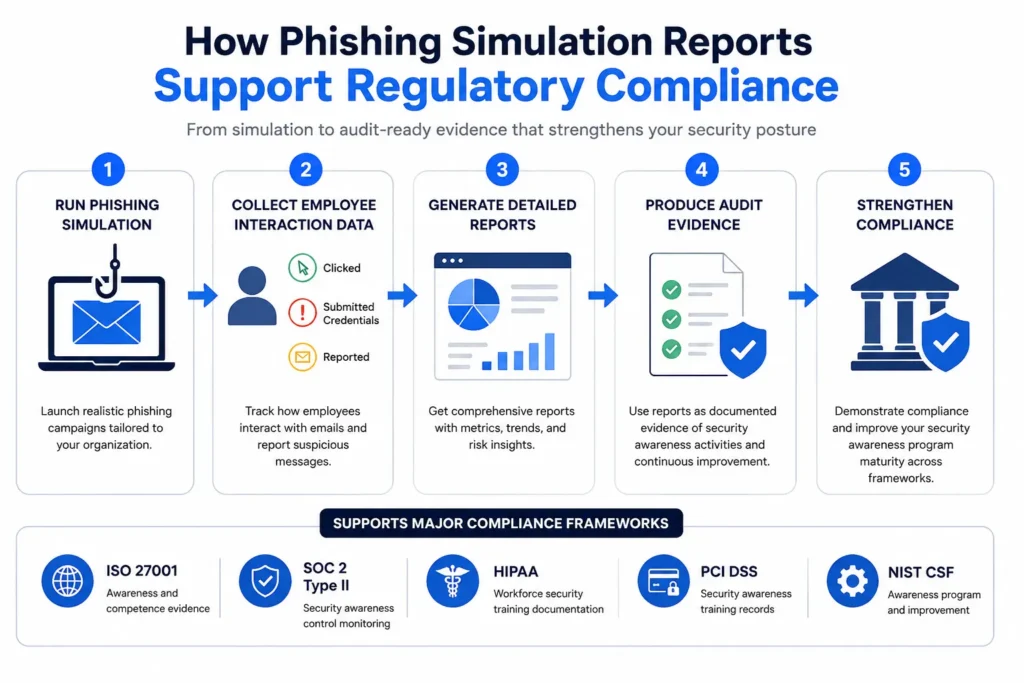
How Phishing Simulation Reports Become Audit Evidence
Running phishing simulations is only part of the process. The real value comes from the reporting generated after each campaign. Detailed phishing simulation reports help transform awareness activities into documented evidence that security teams can reference during audits, compliance reviews, and internal assessments.
From Awareness Activity to Compliance Documentation
A phishing simulation campaign creates measurable employee interaction data. When this data is organized into structured reports, organizations gain a documented record of awareness testing, employee engagement, risk indicators, and improvement trends that can support broader compliance initiatives.
Campaign Execution
Employees receive realistic phishing emails designed to assess awareness levels and response behavior in a controlled environment.
Behavior Measurement
The platform records employee actions such as email opens, link clicks, credential submissions, and phishing reports.
Report Generation
Results are consolidated into structured reports containing metrics, trends, department insights, and awareness indicators.
Audit Documentation
Security teams can retain reports as supporting documentation that demonstrates ongoing awareness activities and program oversight.
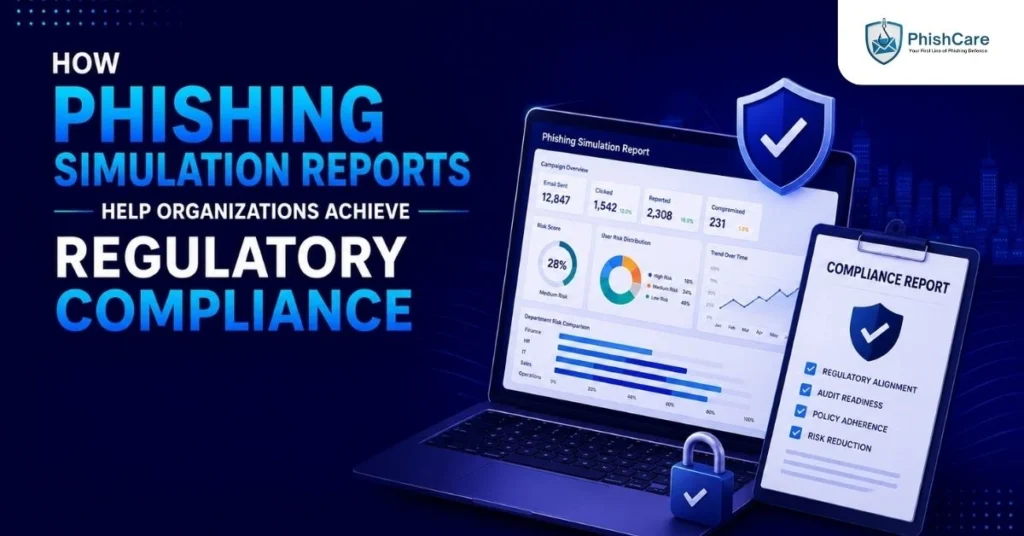
What Valuable Phishing Simulation Reports Typically Include
- Campaign participation rates
- Phishing click rates
- Credential submission metrics
- Email reporting rates
- Department-level insights
- Risk trend analysis
- Historical comparison data
- Repeat offender tracking
- Awareness improvement trends
- Management reporting summaries
Important Compliance Consideration
Phishing simulation reports are generally not mandatory for certifications or regulatory compliance frameworks. However, they provide an additional documentation boost for organizations working towards ISO 27001, SOC 2 Type II, PCI DSS, HIPAA, and NIST CSF programs, where ongoing security awareness activities are recognized as a cybersecurity best practice.
Key Reporting Metrics That Support Compliance Reviews
The effectiveness of a phishing simulation program is often measured through the quality of its reporting. Security teams, auditors, and compliance stakeholders benefit from metrics that demonstrate employee awareness levels, identify risk areas, and track improvement over time.
Why Metrics Matter
Compliance reviews often focus on whether awareness initiatives are being monitored and improved. Reporting metrics provide measurable evidence that organizations are actively assessing employee behavior, identifying vulnerabilities, and refining awareness programs based on real-world results.
Phishing Click Rate
Measures the percentage of employees who clicked on phishing links. This metric helps organizations understand overall susceptibility levels and monitor improvements across campaigns.
Credential Submission Rate
Tracks how many employees attempted to enter credentials into simulated phishing pages. It helps identify higher-risk behaviors that may require targeted awareness initiatives.
Phishing Reporting Rate
Measures how many employees correctly identify and report suspicious emails. Increasing reporting rates often indicate stronger security awareness maturity.
Department Risk Trends
Comparing results across departments helps organizations identify groups that may benefit from additional awareness support or focused training efforts.
Repeat Failure Tracking
Monitoring repeated phishing failures can help security teams prioritize remediation efforts and measure behavioral improvement over time.
Historical Improvement Metrics
Long-term reporting trends help demonstrate continuous improvement, making it easier to showcase awareness program progress during reviews and audits.
Metrics Become More Valuable When Tracked Over Time
A single phishing simulation provides a snapshot of employee awareness. Multiple campaigns conducted throughout the year provide trend data that can help demonstrate program maturity, risk reduction efforts, and continuous awareness improvement. This longitudinal view is often more meaningful to compliance stakeholders than isolated campaign results.
The most effective phishing simulation reports do more than display statistics. They help security leaders identify trends, prioritize awareness initiatives, and demonstrate that cybersecurity awareness is being actively measured and improved across the organization.
How Phishing Simulation Reports Support Major Compliance Frameworks
Many cybersecurity and regulatory frameworks emphasize security awareness, employee training, and ongoing risk management. While phishing simulation reports are generally not mandatory requirements, they can provide valuable supporting evidence that demonstrates awareness program effectiveness and continuous improvement efforts.
Why Framework Alignment Matters
Security awareness initiatives are most effective when they can be measured and documented. Phishing simulation reports help organizations create a record of employee awareness activities, behavioral assessments, and program improvements that may support broader governance, risk, and compliance objectives.
| Framework | Awareness Focus | How Phishing Reports Can Help |
|---|---|---|
| ISO 27001 | Security awareness and employee competence | Provides additional evidence of awareness activities, employee engagement, and continuous improvement initiatives. |
| SOC 2 Type II | Security controls and workforce awareness | Helps demonstrate that employees are regularly assessed and security awareness efforts are actively monitored. |
| HIPAA | Workforce security awareness and training | Supports documentation of awareness initiatives designed to reduce human-related security risks. |
| PCI DSS | Security awareness for personnel handling cardholder data | Provides measurable reporting that can complement awareness training records and program reviews. |
| NIST CSF | Awareness, governance, and risk management | Helps organizations monitor workforce behavior, measure awareness maturity, and support continuous improvement efforts. |
Documented Awareness Activities
Reports provide a structured record of phishing awareness campaigns, participation levels, and employee engagement.
Measurable Security Outcomes
Security teams can demonstrate awareness effectiveness through metrics such as reporting rates, click rates, and improvement trends.
Continuous Improvement Evidence
Historical reporting helps show how awareness programs evolve over time and how organizations address identified risks.
Compliance Best Practice Note
PhishCare’s phishing simulation reports provide an additional documentation boost for organizations working towards ISO 27001, SOC 2 Type II, PCI DSS, HIPAA, or NIST CSF, where ongoing security awareness training and employee risk assessment are recognized cybersecurity best practices. Reports should be used to complement broader compliance and security awareness programs rather than replace them.
What a Compliance-Friendly Phishing Simulation Report Looks Like
Not all phishing simulation reports provide the same level of value. For compliance teams, security managers, and auditors, the most useful reports go beyond basic click statistics and provide meaningful insights into employee behavior, awareness effectiveness, and organizational risk trends.
Characteristics of a Strong Compliance-Oriented Report
A well-structured phishing simulation report should help security teams demonstrate that awareness initiatives are being measured, monitored, and continuously improved. Reports should provide enough context to support internal reviews, management reporting, and compliance assessments.
- Campaign overview and objectives
- Participation statistics
- Click and interaction rates
- Credential submission metrics
- Email reporting activity
- Department-level insights
- Historical comparison trends
- Risk analysis summaries
- Awareness improvement indicators
- Executive reporting dashboards
Why Historical Reporting Matters
A single phishing simulation campaign provides a snapshot of employee awareness. However, compliance stakeholders are often more interested in trends over time.
Historical reporting helps demonstrate whether awareness programs are improving employee behavior, reducing phishing susceptibility, and increasing reporting rates. This long-term perspective provides stronger evidence of program maturity than isolated campaign results.
Download a Sample Phishing Simulation Report
See how a professionally structured phishing simulation report presents employee awareness metrics, campaign insights, reporting trends, and executive-level summaries that security teams can use for internal reviews and compliance discussions.
The most effective phishing simulation reports do not simply record employee mistakes. They provide actionable insights that help organizations strengthen awareness programs, reduce human risk, and demonstrate ongoing commitment to cybersecurity improvement.
How PhishCare Helps Security Teams Demonstrate Continuous Improvement
Compliance programs are most effective when organizations can demonstrate measurable progress over time. PhishCare, developed by CyberSapiens, helps security teams move beyond one-time awareness activities by providing recurring phishing simulations, actionable reporting, and long-term visibility into employee security behavior.
Turning Security Awareness Into Measurable Outcomes
Rather than relying solely on annual awareness training, organizations can use recurring phishing simulations to assess employee readiness, identify high-risk behaviors, and measure improvement across departments and business units. Detailed reporting allows security leaders to track progress and demonstrate the effectiveness of awareness initiatives.
Simulations Conducted
Extensive experience running phishing simulation campaigns across multiple industries and regions.
Campaign Success Rate
Helping organizations improve awareness levels through realistic phishing assessments and reporting.
Industry Reach
Supporting organizations across finance, banking, healthcare, technology, and professional services sectors.
How PhishCare Supports Continuous Improvement
- Recurring phishing simulation campaigns
- Realistic phishing email templates
- Department-level risk visibility
- Historical performance tracking
- Executive-ready reporting
- Employee risk identification
- Awareness improvement measurement
- Audit-friendly documentation
Why Continuous Measurement Matters
Security awareness is not a one-time activity. Employee behavior, threat tactics, and organizational risks evolve continuously. By measuring awareness performance through regular phishing simulations and reporting, organizations gain valuable insights that help strengthen security culture, support risk management objectives, and provide evidence of ongoing improvement efforts.
Trusted by Organizations Across Industries
Organizations across finance, banking, healthcare, information technology, and professional services sectors use PhishCare to assess employee awareness, strengthen cybersecurity culture, and support ongoing security improvement initiatives.
Phishing Simulations Run
Campaign Success Rate
Customer Deployments
Industry Experience
Organizations That Have Used PhishCare









Industries Served
PhishCare has been used by organizations operating in industries where employee awareness and cybersecurity resilience play an important role in risk management and compliance initiatives.
What Security Teams Say About PhishCare
Real-world feedback provides valuable insight into how phishing simulations contribute to employee awareness, cybersecurity readiness, and organizational risk reduction efforts.
We recently used PhishCare for a phishing simulation, and I’ve got to say, their email templates were top-notch. The realism and variety of the templates were impressive, really testing our team’s vigilance.
The level of detail they put into crafting these emails was evident, making the simulation both challenging and effective. It’s clear they know their stuff when it comes to cybersecurity. Highly recommend them.
Realistic Phishing Scenarios
Effective phishing simulations should closely resemble the types of attacks employees may encounter in their daily work environment. Realistic campaigns help produce more meaningful awareness insights.
Actionable Reporting
Security teams benefit from reports that go beyond statistics and provide insights that can support awareness improvements, risk management, and compliance initiatives.
Measurable Awareness Outcomes
Organizations can track employee behavior, identify high-risk trends, and monitor awareness improvements through recurring phishing simulation campaigns.
Building Confidence Through Continuous Testing
Organizations that regularly assess employee awareness are often better positioned to identify emerging risks, reinforce security best practices, and demonstrate a proactive approach to cybersecurity. Consistent phishing simulations and reporting help transform awareness programs from one-time activities into measurable security initiatives.
Why Compliance Auditors Appreciate Consistent Reporting
Compliance reviews are rarely based on a single document or training record. Auditors often evaluate whether security awareness activities are consistently performed, documented, monitored, and improved over time. This is where recurring phishing simulation reports can provide valuable supporting evidence.
Consistency
Regular phishing simulations demonstrate that awareness initiatives are ongoing rather than isolated annual activities.
Documentation
Structured reports provide documented evidence that can be retained and reviewed during audits or internal assessments.
Improvement Tracking
Trend reporting helps demonstrate that awareness programs evolve based on measurable employee outcomes.
Examples of Audit-Friendly Evidence
- Phishing campaign schedules
- Awareness participation records
- Campaign performance summaries
- Executive reporting dashboards
- Risk trend documentation
- Employee reporting statistics
- Department-level risk analysis
- Remediation tracking records
- Historical improvement reports
- Awareness program reviews
The Value of Historical Evidence
One of the strongest indicators of a mature awareness program is the ability to show progress over time. Historical phishing simulation reports help demonstrate that awareness activities are not only being conducted, but are producing measurable outcomes that can support broader risk management and compliance objectives.
For many organizations, phishing simulation reports become part of a larger evidence collection strategy that includes training records, policies, risk assessments, and security reviews. Together, these materials help create a more complete picture of cybersecurity awareness and governance maturity.
Key Takeaways: How Phishing Simulation Reports Support Compliance Initiatives
Phishing simulation reports provide far more than awareness metrics. They help organizations document security awareness activities, monitor employee behavior, demonstrate continuous improvement, and support broader audit readiness and compliance objectives.
Awareness Becomes Measurable
Phishing simulations provide practical insights into how employees respond to realistic cyber threats and help quantify awareness effectiveness.
Reporting Creates Evidence
Structured reporting helps transform awareness activities into documented evidence that can support audits and internal reviews.
Continuous Improvement Matters
Historical campaign reporting helps demonstrate awareness maturity, employee progress, and ongoing risk reduction efforts.
Key Points Covered in This Guide
- Why awareness training alone may not provide sufficient visibility into employee security behavior.
- How phishing simulation reports help create measurable awareness evidence.
- The reporting metrics commonly reviewed by security leaders and compliance teams.
- How reporting can support broader initiatives aligned with ISO 27001, SOC 2 Type II, HIPAA, PCI DSS, and NIST CSF.
- The importance of historical reporting and continuous improvement tracking.
- How PhishCare helps organizations assess employee awareness through recurring phishing simulations and reporting.
Final Thought
Organizations seeking to strengthen cybersecurity awareness programs often benefit from measurable, repeatable, and well-documented activities. Phishing simulation reports provide valuable visibility into employee behavior while helping security teams demonstrate ongoing awareness efforts, continuous improvement, and stronger audit readiness across the organization.
Frequently Asked Questions
Answers to common questions about phishing simulation reports, audit readiness, security awareness measurement, and compliance support.
Are phishing simulation reports required for ISO 27001 certification?
No. Phishing simulation reports are generally not required for ISO 27001 certification. However, they can provide additional evidence of security awareness activities, employee engagement, and continuous improvement efforts that support broader information security objectives.
How do phishing simulation reports help with SOC 2 audits?
Phishing simulation reports help organizations demonstrate that security awareness initiatives are actively monitored and measured. Reports can provide supporting documentation showing employee participation, awareness trends, and ongoing security improvement efforts.
What metrics should be included in a phishing simulation report?
Useful phishing simulation reports typically include click rates, credential submission rates, phishing reporting rates, department-level insights, repeat failure trends, participation metrics, and historical performance comparisons.
How often should organizations run phishing simulations?
The appropriate frequency depends on organizational risk, industry requirements, and security objectives. Many organizations run phishing simulations regularly throughout the year to maintain awareness and track employee behavior over time.
Can phishing simulation reports be used as audit evidence?
Yes. Organizations often retain phishing simulation reports as supporting documentation alongside training records, policies, and risk assessments. Reports can help demonstrate awareness activities, employee engagement, and continuous improvement initiatives.
What should auditors look for in phishing simulation reporting?
Auditors typically look for evidence of ongoing awareness activities, measurable employee participation, trend reporting, risk reduction efforts, and documentation showing that awareness initiatives are regularly reviewed and improved.
Content Reviewed By

Mohammed Nawaz Sajjad
Sr. Security Analyst at CyberSapiens | Phishing Simulation Specialist | Ethical Hacker | Bug Hunter | Red Team Professional
Mohammed Nawaz Sajjad is a practicing cybersecurity professional with hands-on experience in phishing simulation campaigns, security awareness assessments, ethical hacking, red team exercises, and employee cyber risk evaluation. He works closely with organizations across finance, banking, healthcare, and technology sectors to help strengthen security awareness programs through realistic phishing simulations, employee behavior analysis, and risk-focused reporting initiatives.
View LinkedIn ProfileSee How PhishCare Helps Measure and Improve Employee Security Awareness
Whether you’re improving security awareness, preparing for audits, or building a stronger cybersecurity culture, PhishCare helps organizations assess employee phishing readiness through realistic simulations, actionable reporting, and measurable improvement tracking.