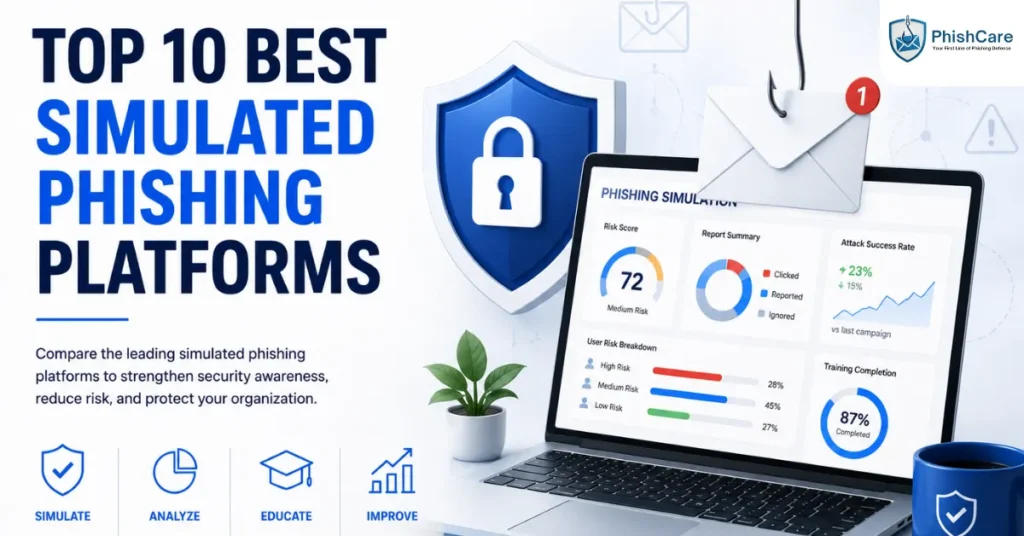
Top 10 Best Simulated Phishing Platforms for Security Awareness and Employee Risk Reduction
Phishing remains one of the most successful attack methods used by cybercriminals. While email security tools help block many threats, organizations still face risks when employees interact with sophisticated phishing emails, credential harvesting pages, and social engineering campaigns. This is why phishing simulation platforms have become a critical component of modern security awareness programs.
The best simulated phishing platforms do more than send test emails. They help organizations measure employee susceptibility, identify high-risk departments, deliver targeted security awareness training, and track improvements over time through detailed reporting and analytics.
However, not every phishing simulation solution offers the same capabilities. Some focus heavily on automation and reporting, while others emphasize training content, customization, compliance support, or enterprise-scale deployment. Selecting the right platform requires understanding how each solution aligns with your organization’s security maturity, workforce size, and training objectives.
In this guide, we compare the Top 10 Best Simulated Phishing Platforms available in 2026. We evaluate each platform based on phishing simulation capabilities, training effectiveness, reporting depth, ease of administration, scalability, and overall value to help security leaders, IT teams, and compliance professionals make an informed decision.
How We Evaluated the Top Simulated Phishing Platforms
Choosing a phishing simulation platform is not simply about finding a tool that sends phishing emails. Modern security awareness programs require accurate risk measurement, employee behavior tracking, training effectiveness, campaign automation, and actionable reporting. To ensure a fair comparison, we evaluated each platform across the factors that matter most to security teams, compliance leaders, and IT administrators.
Phishing Simulation Quality
We assessed the realism of phishing templates, campaign customization options, landing pages, credential capture simulations, and support for current phishing attack techniques.
Security Awareness Training
We reviewed training libraries, micro-learning content, video quality, multilingual support, and the ability to deliver targeted remediation after simulation failures.
Reporting & Analytics
We evaluated dashboards, user risk scoring, click-rate analysis, credential submission tracking, executive reporting, and long-term behavior measurement capabilities.
Automation & Ease of Use
We considered campaign scheduling, automated training assignments, directory integrations, user management, and overall administrative efficiency.
Scalability & Deployment
Platforms were reviewed based on their ability to support small businesses, mid-sized organizations, and enterprise environments with distributed workforces.
Compliance & Audit Support
We looked at reporting and documentation features that support organizations working toward frameworks such as ISO 27001, SOC 2 Type II, PCI DSS, HIPAA, and NIST CSF where ongoing security awareness training is recognized as a best practice.
What Makes a Strong Phishing Simulation Platform?
The most effective platforms combine realistic phishing simulations, engaging awareness training, automated remediation workflows, and actionable reporting. The goal is not simply to test employees, but to continuously improve security behavior, reduce human risk, and strengthen organizational resilience against phishing attacks.
Comparison of the Top 10 Best Simulated Phishing Platforms
Every phishing simulation platform offers a different balance of phishing testing, employee awareness training, automation, analytics, and compliance reporting. The table below provides a high-level comparison to help security teams shortlist the most suitable solution before evaluating individual platforms in detail.
| Platform | Best For | Awareness Training | Reporting | Enterprise Ready |
|---|---|---|---|---|
| PhishCare | Organizations seeking phishing simulation and awareness training | Comprehensive | Advanced | Yes |
| KnowBe4 | Large training content libraries | Extensive | Advanced | Yes |
| Proofpoint | Enterprise security programs | Strong | Advanced | Yes |
| Hoxhunt | Behavior-driven learning | Strong | Good | Yes |
| Cofense PhishMe | Mature phishing programs | Good | Advanced | Yes |
| Microsoft Attack Simulation Training | Microsoft 365 environments | Moderate | Good | Yes |
| Terranova Security | Compliance-focused organizations | Strong | Good | Yes |
| Mimecast Awareness Training | Email security customers | Good | Good | Yes |
| Infosec IQ | Awareness-driven programs | Strong | Good | Yes |
| Hook Security | Small and mid-sized businesses | Good | Good | Moderate |
Important Note
The best platform depends on your organization’s security maturity, employee count, compliance objectives, and available resources. Some organizations prioritize realistic phishing simulations and reporting, while others focus on awareness content, automated remediation, or large-scale enterprise deployment capabilities.
1. PhishCare
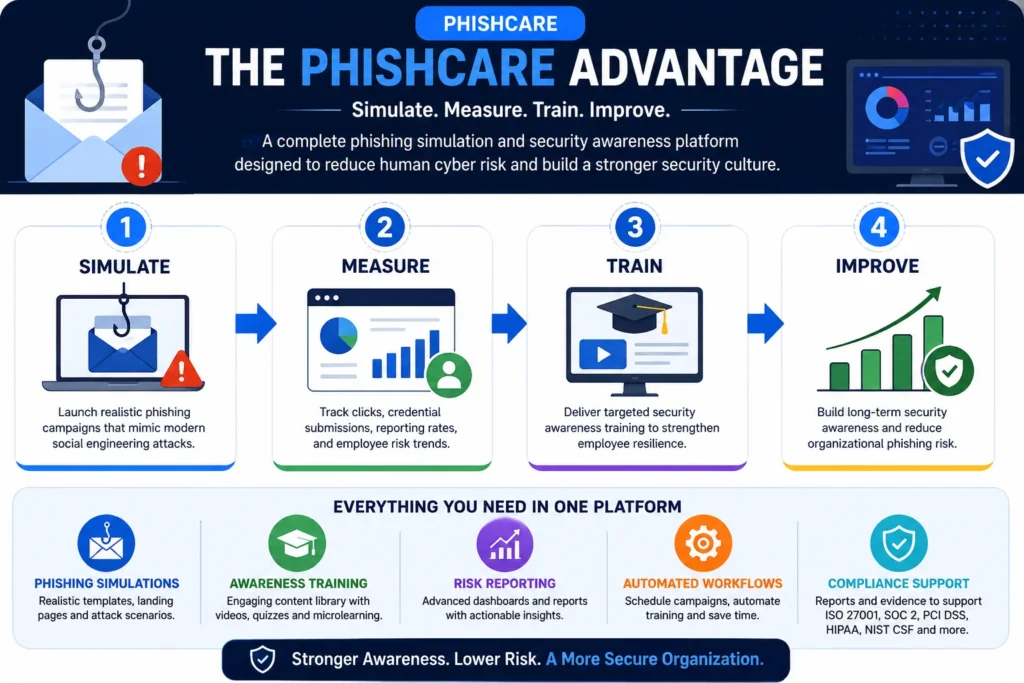
PhishCare, developed by CyberSapiens, is a phishing simulation and security awareness training platform designed to help organizations measure human cyber risk, improve employee awareness, and build a stronger security culture through continuous learning and realistic phishing exercises.
Unlike traditional awareness programs that rely solely on annual training sessions, PhishCare combines phishing simulations, targeted remediation, employee risk insights, and awareness training into a single platform that enables organizations to continuously evaluate and improve user behavior.
Key Features
Realistic Phishing Simulations
Launch customizable phishing campaigns that replicate modern phishing tactics and social engineering techniques commonly used by attackers.
Security Awareness Training
Deliver engaging awareness content that helps employees recognize phishing attempts, social engineering attacks, and common cybersecurity threats.
Detailed Reporting
Track clicks, credential submissions, reporting rates, department-level performance, and overall employee risk trends.
Automated Campaign Management
Schedule recurring simulations and automate awareness workflows to reduce administrative effort for IT and security teams.
Best For
Organizations looking for a practical phishing simulation and awareness training platform that helps reduce human risk while providing measurable security improvement over time.
Compliance Support
PhishCare’s campaign reports provide an additional documentation boost for organizations working towards ISO 27001, SOC 2 Type II, PCI DSS, HIPAA, or NIST CSF, where ongoing security awareness training is recognized as a best practice by auditors and certification bodies.
Why PhishCare Stands Out
Many organizations struggle to move beyond checkbox security awareness programs. PhishCare focuses on continuous improvement by combining phishing simulations, employee education, measurable risk indicators, and actionable reporting. This helps security teams identify vulnerable users, improve awareness levels, and create a stronger security culture across the organization.
2. KnowBe4
KnowBe4 is one of the most widely recognized names in the security awareness training market. The platform combines phishing simulations, awareness training content, user risk scoring, and automated campaign management to help organizations strengthen employee security behavior.
Many organizations choose KnowBe4 because of its extensive training library, broad template selection, and mature ecosystem that supports security awareness initiatives across organizations of varying sizes.
Strengths
- Large awareness training content library
- Extensive phishing template collection
- Automated campaign scheduling
- User risk scoring and reporting
- Suitable for global deployments
Considerations
- Feature-rich platform may require initial onboarding
- Organizations should evaluate content licensing requirements
- Pricing can vary depending on modules and user volume
- Feature availability differs across subscription tiers
Best For
Large organizations and enterprises looking for a mature phishing simulation and security awareness platform with extensive training resources, detailed reporting capabilities, and broad deployment flexibility.
3. Proofpoint Security Awareness Training
Proofpoint is a well-established cybersecurity company that offers a comprehensive security awareness training and phishing simulation solution. Its platform is designed to help organizations identify vulnerable users, reduce human risk, and improve employee resilience against phishing and social engineering attacks.
A key differentiator for Proofpoint is its focus on human-centric security. The platform combines phishing simulations, awareness training, threat intelligence insights, and behavioral analytics to help organizations understand and address user-related security risks.
Key Features
- Realistic phishing simulation campaigns
- Risk-based user targeting
- Behavioral analytics and reporting
- Awareness training content library
- Enterprise-scale deployment capabilities
Potential Limitations
- May offer more functionality than smaller organizations require
- Enterprise-focused deployment model
- Organizations should evaluate licensing options carefully
- Implementation complexity can vary based on requirements
Why Organizations Consider Proofpoint
Organizations already invested in broader email security and threat protection initiatives often evaluate Proofpoint because of its ability to combine phishing simulations with human risk insights. Security teams can use the platform to identify high-risk users, tailor awareness initiatives, and measure improvements through detailed reporting and analytics.
Best For
Enterprises and large organizations seeking a human-centric security approach that combines phishing simulations, employee awareness training, behavioral analytics, and broader cybersecurity risk management capabilities.
4. Hoxhunt
Hoxhunt takes a behavior-driven approach to phishing awareness by combining phishing simulations with personalized learning experiences. Rather than relying solely on periodic testing, the platform focuses on continuous employee engagement and habit formation through adaptive training.
The platform uses gamification, user-specific learning paths, and behavioral insights to encourage employees to recognize and report phishing attempts. This approach helps organizations build a stronger security culture while improving long-term awareness outcomes.
Key Features
- AI-driven phishing simulations
- Adaptive awareness learning paths
- Gamified employee engagement
- Phishing reporting training
- Behavioral analytics and insights
Potential Limitations
- Behavior-focused approach may not suit every training strategy
- Organizations should evaluate content depth against requirements
- Feature availability can vary by subscription level
- May be more aligned with mature awareness programs
What Makes Hoxhunt Different?
Unlike traditional awareness platforms that focus heavily on periodic training modules, Hoxhunt emphasizes continuous behavioral improvement. Employees receive personalized challenges and learning experiences designed to reinforce secure decision-making over time. This can help organizations move beyond simple compliance-driven training toward long-term behavior change.
Best For
Organizations looking to strengthen security culture through ongoing employee engagement, adaptive learning, and behavior-focused phishing awareness initiatives rather than relying solely on traditional training programs.
5. Cofense PhishMe
Cofense PhishMe is a well-known phishing simulation platform designed to help organizations assess employee susceptibility to phishing attacks and strengthen their overall human security posture. The platform has long been used by enterprises seeking realistic phishing simulations and detailed employee risk analysis.
One of Cofense PhishMe’s core strengths is its focus on real-world phishing scenarios. Organizations can run highly targeted phishing campaigns that mirror current attacker techniques while measuring how employees respond to suspicious emails and social engineering attempts.
Key Features
- Realistic phishing attack simulations
- Extensive phishing scenario library
- Employee risk assessment reporting
- Campaign customization capabilities
- Enterprise-scale phishing awareness programs
Potential Limitations
- May be best suited for larger security programs
- Organizations should review training content requirements separately
- Advanced functionality may require additional configuration
- Pricing structure varies based on deployment scope
Why Security Teams Consider Cofense PhishMe
Security teams often evaluate Cofense PhishMe because of its long-standing focus on phishing defense and employee risk reduction. The platform enables organizations to test workforce readiness against realistic phishing attacks while generating actionable insights that can be used to improve awareness initiatives and reduce susceptibility rates over time.
Quick Snapshot
Best For
Enterprises and mature security teams looking for realistic phishing simulations, detailed employee risk insights, and a platform focused on strengthening organizational defenses against phishing attacks.
6. Microsoft Attack Simulation Training
Microsoft Attack Simulation Training is part of the Microsoft Defender ecosystem and is designed to help organizations assess employee readiness against phishing attacks and other social engineering techniques. It enables security teams to launch simulated phishing campaigns directly within Microsoft 365 environments.
Because the platform is tightly integrated with Microsoft technologies, organizations already using Microsoft Defender and Microsoft 365 often find it a convenient option for running phishing assessments without deploying a separate awareness platform.
Key Features
- Native Microsoft 365 integration
- Phishing credential harvest simulations
- Automated attack simulation templates
- Built-in user targeting capabilities
- Reporting through Microsoft security tools
Potential Limitations
- Best suited for Microsoft-centric environments
- Training content depth may vary compared to dedicated awareness platforms
- Advanced awareness features may require additional Microsoft services
- Organizations should evaluate reporting requirements against their needs
Why Organizations Consider Microsoft Attack Simulation Training
Organizations that have standardized on Microsoft 365 often evaluate Microsoft Attack Simulation Training because it allows them to conduct phishing assessments within their existing security ecosystem. The platform provides a streamlined approach to testing employee awareness while leveraging Microsoft’s security management capabilities.
Quick Snapshot
Best For
Organizations already invested in Microsoft 365 and Microsoft Defender that want a native phishing simulation capability integrated into their existing security and productivity environment.
Other Simulated Phishing Platforms Worth Considering
While the platforms above are frequently shortlisted by security teams, several other phishing simulation and security awareness solutions offer capabilities that may align well with specific organizational requirements, compliance goals, or deployment preferences.
Terranova Security
Terranova Security is known for combining phishing simulations with compliance-oriented security awareness programs. The platform is commonly evaluated by organizations that place a strong emphasis on awareness education and risk reduction initiatives.
Best For:Organizations seeking awareness-driven programs with a strong training focus.
Mimecast Awareness Training
Mimecast extends its email security ecosystem with awareness training and phishing simulation capabilities. Organizations already using Mimecast email security solutions often evaluate it as part of a broader human risk management strategy.
Best For:Existing Mimecast customers looking for integrated phishing awareness capabilities.
Infosec IQ
Infosec IQ combines phishing simulations, awareness training, assessments, and employee risk management features. Its content-focused approach makes it attractive to organizations prioritizing workforce education.
Best For:Organizations seeking a training-centric awareness platform with phishing testing capabilities.
Hook Security
Hook Security focuses on delivering phishing simulations and security awareness training for small and mid-sized organizations. The platform emphasizes ease of deployment and simplified administration.
Best For:Small and growing businesses that want a straightforward phishing awareness solution.
Choosing the Right Simulated Phishing Platform
The ideal platform depends on your organization’s goals. Some solutions prioritize enterprise-scale reporting and analytics, while others focus on awareness training, behavioral change, compliance support, or ease of deployment. Security teams should evaluate phishing realism, reporting depth, training quality, integration capabilities, and long-term scalability before making a final decision.
Why Organizations Choose PhishCare
Many phishing simulation platforms focus primarily on sending test emails and measuring click rates. While those metrics are valuable, modern security teams increasingly need a broader approach that combines phishing simulations, employee education, risk visibility, and continuous improvement.
PhishCare, developed by CyberSapiens, is designed to help organizations move beyond one-time awareness exercises by creating an ongoing security awareness program that strengthens employee behavior over time.
Realistic Simulations
Test employees with phishing campaigns designed to reflect modern attack techniques and social engineering tactics commonly used by threat actors.
Continuous Awareness
Reinforce learning through ongoing awareness initiatives that help employees recognize phishing attempts before they become incidents.
Actionable Reporting
Gain visibility into employee behavior, campaign performance, risk trends, and awareness progress through detailed reporting dashboards.
Easy Administration
Automate phishing campaigns and awareness activities to reduce administrative overhead for IT and security teams.
PhishCare at a Glance
| Capability | PhishCare |
|---|---|
| Phishing Simulations | ✓ |
| Security Awareness Training | ✓ |
| Employee Risk Insights | ✓ |
| Campaign Reporting | ✓ |
| Automated Campaigns | ✓ |
| Compliance Documentation Support | ✓ |
Organizations working toward ISO 27001, SOC 2 Type II, PCI DSS, HIPAA, and NIST CSF often use phishing simulations and employee awareness programs as part of broader cybersecurity governance initiatives. PhishCare’s campaign reports can provide an additional documentation boost where ongoing awareness activities are considered a recognized best practice.
Final Thoughts: How to Choose the Right Simulated Phishing Platform
Phishing attacks continue to evolve, making employee awareness one of the most important layers of organizational defense. Even with advanced email security technologies in place, a single successful phishing attack can lead to credential theft, business email compromise, ransomware incidents, or data breaches.
The most effective phishing simulation platforms help organizations identify human risk, strengthen security awareness, measure behavioral improvements, and create a culture where employees actively recognize and report suspicious activity.
Key Evaluation Criteria
Look for realistic phishing templates, credential harvesting simulations, and modern attack scenarios.
Evaluate the depth, relevance, and engagement level of awareness training content.
Choose platforms that provide actionable insights rather than basic click-rate metrics.
Ensure the solution can support future growth and evolving security requirements.
Our Recommendation
The right platform depends on your organization’s size, security maturity, compliance objectives, and awareness training strategy. Large enterprises may prioritize advanced analytics and enterprise integrations, while smaller organizations often seek simplicity, affordability, and ease of deployment.
For organizations looking to combine realistic phishing simulations, security awareness training, employee risk visibility, and actionable reporting within a single platform, PhishCare offers a balanced approach designed to help security teams continuously improve human cyber resilience.
Ready to Evaluate PhishCare?
Explore phishing simulations, awareness training, campaign reporting, and employee risk insights designed to strengthen your organization’s security posture.
Frequently Asked Questions About Simulated Phishing Platforms
What is a simulated phishing platform?
A simulated phishing platform allows organizations to send realistic phishing emails to employees in a controlled environment. The goal is to measure user awareness, identify risky behaviors, and provide training that helps employees recognize and avoid real phishing attacks.
Why should organizations run phishing simulations?
Phishing simulations help organizations evaluate employee readiness against phishing attacks, identify vulnerable users, reinforce awareness training, and reduce human-related cybersecurity risks through continuous education and assessment.
How often should phishing simulations be conducted?
Most security professionals recommend running phishing simulations regularly throughout the year rather than relying on annual testing. Frequent campaigns help reinforce learning, track progress, and keep employees alert to evolving phishing tactics.
What features should I look for in a phishing simulation platform?
Important features include realistic phishing templates, automated campaign scheduling, awareness training content, reporting dashboards, employee risk scoring, compliance reporting support, and integration with existing security systems.
Can phishing simulations help with compliance initiatives?
Yes. Phishing simulation reports can provide an additional documentation boost for organizations working toward ISO 27001, SOC 2 Type II, PCI DSS, HIPAA, and NIST CSF, where ongoing security awareness training is recognized as a best practice.
How is PhishCare different from other phishing simulation platforms?
PhishCare combines phishing simulations, employee awareness training, campaign reporting, and risk visibility in a single platform. It is designed to help organizations continuously improve employee security behavior rather than simply measure phishing click rates.
Content Reviewed By

Mohammed Nawaz Sajjad is a practising security analyst specializing in phishing simulation campaigns, employee security awareness assessments, red team exercises, and ethical hacking. He works closely with organizations across industries to evaluate human cyber risk and strengthen security culture through measurable awareness initiatives.
At CyberSapiens, Nawaz leads phishing simulation and awareness training initiatives through PhishCare, helping organizations assess employee susceptibility to phishing attacks, improve reporting behavior, and build long-term cyber resilience using practical, data-driven security awareness programs.
View LinkedIn ProfileReady to Reduce Phishing Risk Across Your Organization?
Discover how PhishCare helps organizations measure employee cyber risk, run realistic phishing simulations, deliver awareness training, and improve security behavior through actionable reporting and continuous learning.
Trusted by organizations looking to strengthen phishing awareness, reduce human cyber risk, and build a stronger security culture through continuous employee education.