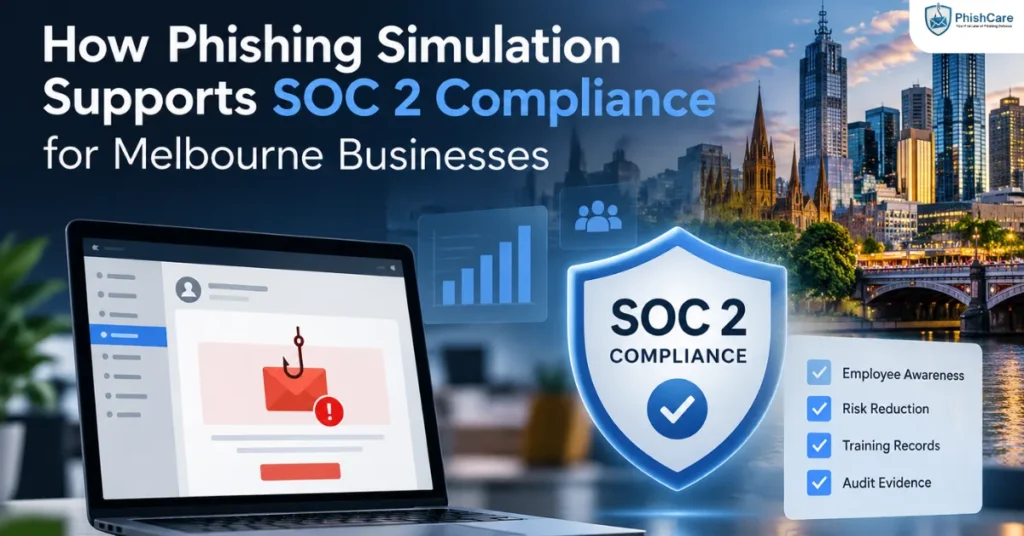
When Melbourne businesses start their SOC 2 compliance journey, one area that frequently comes into focus is employee security awareness training. Phishing simulation can help organisations test how employees respond to realistic social engineering attempts and create measurable evidence of security awareness activities.
SOC 2 focuses on controls designed to protect systems and information against risks such as unauthorised access. While phishing simulation is not itself a SOC 2 requirement, documented phishing awareness activities can provide useful supporting evidence of an organisation’s broader security awareness program.
Why Phishing Simulation Matters for SOC 2
Security awareness is more meaningful when organisations can demonstrate how employees respond to real-world threats. Phishing simulations provide measurable campaign data, such as participation, reporting behaviour, and failure rates, which can help security teams identify areas for improvement and document ongoing awareness efforts.
For Melbourne organisations, this is particularly relevant when employees regularly handle sensitive customer information, financial data, cloud applications, or business-critical systems. A practical awareness program can combine employee education with controlled testing so security teams can identify where additional training is needed.
Employees may encounter increasingly convincing threats, including fake authentication pages and other social engineering techniques. Understanding how to spot a fake login page can be one useful part of broader phishing awareness training.
What SOC 2 Says About Security Awareness Training
SOC 2 Type I and Type II assessments examine whether an organisation has designed and implemented appropriate controls to protect systems and information. Within the Security Trust Services Criteria, employee awareness and understanding of security responsibilities can form an important part of an organisation’s overall control environment.
For businesses preparing for a SOC 2 assessment, security awareness activities should therefore be documented and measurable. Instead of relying only on records showing that employees completed training, organisations can use controlled phishing simulations to assess how employees respond to realistic attempts and identify areas where additional awareness is needed.
What Security Teams Should Be Able to Demonstrate
Awareness Activities
Documented evidence that employees receive security awareness education and understand relevant security responsibilities.
Phishing Awareness
Evidence of activities designed to help employees recognise and respond appropriately to phishing and social engineering attempts.
Measurable Results
Metrics that help security teams evaluate employee behaviour and identify whether awareness activities are improving over time.
Training Records
Records showing participation, completion, assessment activity, and follow-up training where appropriate.
The Role of Phishing Simulation
Phishing simulation should be viewed as a practical way to test and measure employee awareness within a broader security program. Its reports can provide additional documentation that supports an organisation’s SOC 2 evidence package, while helping security teams identify human-risk areas that require further training.
How Phishing Simulation Provides SOC 2 Audit Evidence
During a SOC 2 assessment, organisations need to demonstrate that their security controls are operating as intended. For employee awareness, simply stating that training was completed may provide limited insight into whether employees can recognise and respond to real-world phishing attempts.
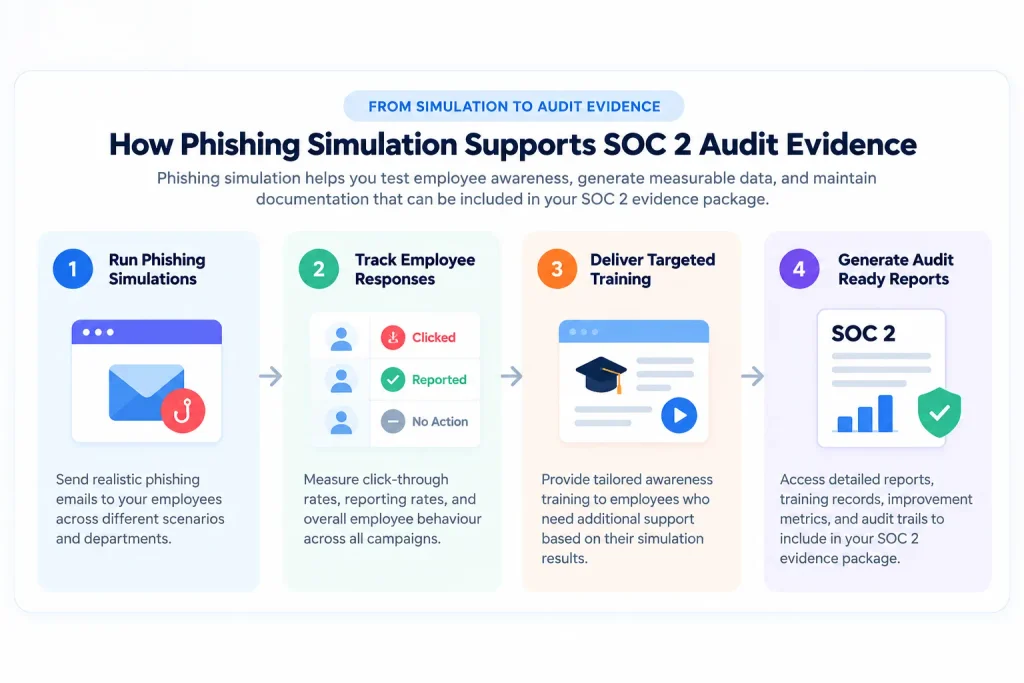
Phishing simulation adds a practical testing layer to security awareness programs. A platform such as PhishCare can help organisations conduct controlled simulations and generate campaign data that security teams can retain as supporting documentation for their broader SOC 2 compliance program.
Campaign Details
Campaign dates, scope, and simulation activity can help document when awareness testing took place and which groups were included.
Employee Metrics
Click-through, failure, reporting, and related campaign metrics can help security teams measure employee responses to simulated threats.
Training Records
Training completion and follow-up records can show how the organisation responds when simulations identify employees who need additional awareness support.
Improvement Tracking
Comparing results across campaigns can help demonstrate whether employee behaviour is improving and where additional awareness activities may be appropriate.
Turning Simulation Results Into Useful Documentation
The value of phishing simulation is not simply the number of employees who clicked a simulated link. The broader value comes from using campaign results to identify human-risk patterns, provide targeted awareness training, repeat testing, and maintain a documented record of the organisation’s ongoing security awareness efforts.
This approach can be particularly useful when employees encounter sophisticated social engineering techniques. For example, understanding how pretexting exploits the human element of social engineering can help security teams build more relevant awareness scenarios around the threats their employees may encounter.
The 3 SOC 2 Controls Phishing Simulation Can Support
Phishing simulation does not automatically satisfy a SOC 2 control or guarantee compliance. Instead, it can provide useful supporting evidence within an organisation’s broader security program. For Melbourne businesses preparing for a SOC 2 assessment, simulation results can help demonstrate how employee awareness is tested, measured, and improved over time.
The following three areas show where phishing simulation can contribute to the broader control environment and evidence collection process.
Security Awareness
Regular phishing simulations can help organisations evaluate whether employees recognise common phishing techniques and understand how to respond to suspicious emails, links, login pages, and requests for sensitive information.
Human Risk Monitoring
Simulation results can reveal patterns in employee behaviour, such as link clicks, credential submissions, or phishing reports. These insights can help security teams identify areas where additional awareness training or remediation may be appropriate.
Monitoring & Improvement
Repeated simulations allow organisations to track awareness activity and measure changes in employee behaviour over time. Campaign results, training records, and remediation activities can contribute to the documentation maintained for the broader SOC 2 evidence process.
What This Evidence Can Show
A consistent phishing simulation program can create a documented trail of awareness activities, employee responses, training actions, and improvement efforts. These records can serve as additional documentation when an organisation is preparing its broader SOC 2 evidence package.
For Melbourne businesses, this approach can help connect employee awareness activities with a broader security and compliance strategy, rather than treating phishing simulation as a standalone compliance exercise.
How Melbourne Businesses Are Using PhishCare for SOC 2
For Melbourne businesses working towards SOC 2, phishing simulation can become part of a structured employee security awareness program. Rather than treating awareness as a one-time training activity, organisations can use recurring simulations to test employee responses, identify human-risk patterns, and provide targeted follow-up training.
With PhishCare, security teams can organise controlled phishing campaigns and use the resulting data to understand employee behaviour. This can help create a consistent record of awareness testing and improvement activities that may be retained as supporting documentation for the broader SOC 2 compliance program.
Plan the Campaign
Define the employees, departments, scenarios, and objectives that will be included in the phishing awareness exercise.
Run Controlled Simulations
Send realistic but controlled phishing scenarios to evaluate how employees respond to common social engineering techniques.
Analyse Employee Responses
Review campaign metrics to identify patterns in clicks, reporting behaviour, and other responses that may indicate areas of human risk.
Train & Improve
Use the results to guide targeted awareness training, repeat testing, and continuous improvement of employee security practices.
Building a Repeatable Awareness Program
A repeatable cycle of simulation, measurement, training, and retesting can help Melbourne organisations build a more measurable security awareness program. The resulting campaign records and improvement metrics can provide additional documentation to support the broader SOC 2 evidence collection process.
Start Your SOC 2 Compliance Journey in Melbourne
Preparing for SOC 2 requires more than completing individual security activities. Melbourne businesses need to understand their control environment, identify gaps, document relevant processes, and maintain evidence that demonstrates how controls operate over time.
Phishing simulation can form one part of this broader approach by helping organisations test employee awareness, measure responses, and maintain records of security awareness activities. When combined with appropriate policies, training, technical controls, monitoring, and other security measures, these activities can contribute to a more structured SOC 2 readiness program.
Assess Your Current Controls
Review existing security policies, employee awareness activities, technical safeguards, and monitoring processes to understand where improvements may be required.
Strengthen Employee Awareness
Combine security awareness training with controlled phishing simulations to help employees recognise and respond appropriately to evolving social engineering threats.
Maintain Supporting Evidence
Keep relevant policies, training records, simulation reports, campaign history, remediation activities, and other documentation organised for the broader SOC 2 evidence collection process.
Improve Continuously
Use assessment findings and security awareness results to identify recurring weaknesses, improve employee training, and strengthen the organisation’s overall security program.
Build a More Measurable Security Program
For organisations preparing for SOC 2 in Melbourne, combining security awareness, phishing simulation, technical controls, documentation, and continuous improvement can create a stronger foundation for the assessment process.
Explore SOC 2 Compliance in MelbourneStrengthening SOC 2 Readiness with Phishing Simulation
For Melbourne businesses preparing for SOC 2, employee security awareness should be treated as an ongoing part of the broader security program. Training can help employees understand security responsibilities, while controlled phishing simulations can provide a practical way to evaluate how people respond to realistic social engineering scenarios.
Phishing simulation does not automatically satisfy SOC 2 controls or guarantee a successful assessment. However, when combined with documented policies, security awareness training, access controls, monitoring, and other appropriate safeguards, simulation results can provide additional documentation for the organisation’s overall evidence collection and continuous improvement efforts.
A Practical Approach to SOC 2 Readiness
The goal is not simply to run a phishing campaign. The stronger approach is to use simulation results to understand employee risk, deliver targeted awareness training, document improvements, and maintain a repeatable security awareness process that supports the organisation’s wider SOC 2 readiness efforts.
Turn Employee Awareness Into Measurable Progress
Melbourne businesses can strengthen their SOC 2 readiness by combining security awareness training, controlled phishing simulations, measurable results, and documented improvement activities as part of a broader cybersecurity program.
Frequently Asked Questions
1. Is phishing simulation required for SOC 2 compliance?
Phishing simulation is not automatically required for SOC 2 compliance. Organisations should determine the controls and evidence appropriate to their environment. Phishing simulations can support a broader security awareness program and provide additional documentation for evidence collection.
2. How can phishing simulation support SOC 2 readiness?
Controlled phishing simulations can help organisations evaluate employee responses, identify awareness gaps, provide targeted training, track improvement, and maintain records that may contribute to their broader SOC 2 evidence collection.
3. What phishing simulation metrics can businesses track?
Businesses can track metrics such as campaign participation, employee responses, reporting behaviour, repeat failures, training completion, and changes in results across campaigns. These metrics can help security teams measure awareness and identify areas for improvement.
4. Can phishing simulation reports be used as SOC 2 audit evidence?
Phishing simulation reports can provide supporting documentation as part of an organisation’s broader evidence package. The usefulness of the evidence depends on the organisation’s controls, policies, procedures, and the specific requirements of its SOC 2 assessment.
5. How often should Melbourne businesses run phishing simulations?
The appropriate frequency depends on the organisation’s risk profile, security awareness program, workforce, and internal policies. A repeatable schedule can help organisations measure changes in employee behaviour and use campaign results to guide ongoing awareness activities.
Is Your Organisation Ready for SOC 2?
A measurable security awareness program can complement the wider controls and processes involved in SOC 2 readiness. Phishing simulation can be one practical component for testing employee awareness and documenting improvement over time.
About the Author

Mohammed Nawaz Sajjad
Sr. Security Analyst at CyberSapiens
Mohammed Nawaz Sajjad specialises in Phishing Simulation, Ethical Hacking, Bug Hunting, and Red Teaming, with a focus on helping organisations understand and strengthen their cybersecurity posture.
Connect on LinkedInStrengthen Your SOC 2 Readiness in Melbourne
Build a measurable security awareness program with phishing simulations, employee risk insights, and supporting documentation that can contribute to your broader SOC 2 readiness efforts.
Talk to Our Team