If you are budgeting for ISO 27001 certification in Australia, the price range is wide mainly because most published figures quote only the certification body’s audit fee, not the full first-year program. Below is a fast, all-in view of what Australian organisations are paying in 2026, plus where security awareness training and phishing simulation reporting fit inside that budget as supporting evidence for your Information Security Management System (ISMS).
Quick Answer
At Australian market rates, ISO 27001 certification typically costs AUD $15,000–$35,000 for small businesses, $35,000–$80,000 for mid-market organisations, and $80,000–$150,000+ for large or complex organisations, all-in for the first year. Through a combined consultancy and certification-partner model, the same outcome commonly costs AUD $8,000–$30,000. Certification also runs on a 3-year cycle, so budget for lighter surveillance audits in years 1–2 and a full recertification audit in year 3.
PhishCare is part of CyberSapiens. For the full consultancy pricing breakdown behind these figures, see CyberSapiens’ ISO 27001 certification cost guide. ISO 27001 certification, PhishCare phishing simulation, and VAPT testing are also available together as a combined security compliance package, with pricing tailored to your organisation’s scope.
What You’re Actually Paying For
A quote that only covers “the certificate” almost always means the final audit alone. A realistic budget has five components.
1. Gap Analysis & Scoping
Measuring your current state against the standard and defining the ISMS boundary. Rushing this step is the most common reason projects run over budget and over time.
2. ISMS Build & Documentation
Risk assessment, the Statement of Applicability across Annex A controls, and the policy set. Most of the consultancy effort sits here.
3. Implementation & Evidence
Putting controls into practice and collecting the evidence an auditor will expect to see, including records from awareness and training activity.
4. Certification Body Audit Fees
Stage 1 and Stage 2 audits, paid directly to the accredited certification body, separate from consultancy fees. Often only 30–50% of true first-year spend.
5. Internal Staff Time
Policy reviews, evidence gathering and interviews pull real hours from your team across the engagement. Frequently underestimated in early budgeting.
ISO 27001 Cost by Company Size in Australia
Total first-year program cost, including certification body fees, gap analysis, ISMS build, documentation and internal audit, scales with headcount, number of sites, and how much of the organisation sits inside the certification scope.
| Organisation Profile | Market All-In (Year 1) | CyberSapiens Price | Typical Timeline |
|---|---|---|---|
| Small Business 1–50 staff | AUD $15,000–$35,000 | AUD $8,000–$20,000 | 4–6 months |
| Mid-Market 50–250 staff | AUD $35,000–$80,000 | AUD $12,000–$30,000 | 6–9 months |
| Large / Complex 250+ staff, multi-site | AUD $80,000–$150,000+ | AUD $30,000+ | 9–18 months |
Small-business figures assume a focused, single-site scope. Cost rises with the number of locations, systems, staff and regulatory overlays involved.
ISO 27001 Runs on a 3-Year Cycle, Not a One-Off Purchase
This is the most commonly underestimated cost in ISO 27001 budgeting. A certificate is valid for three years, but it only stays valid if the ISMS keeps operating and passes annual checks.
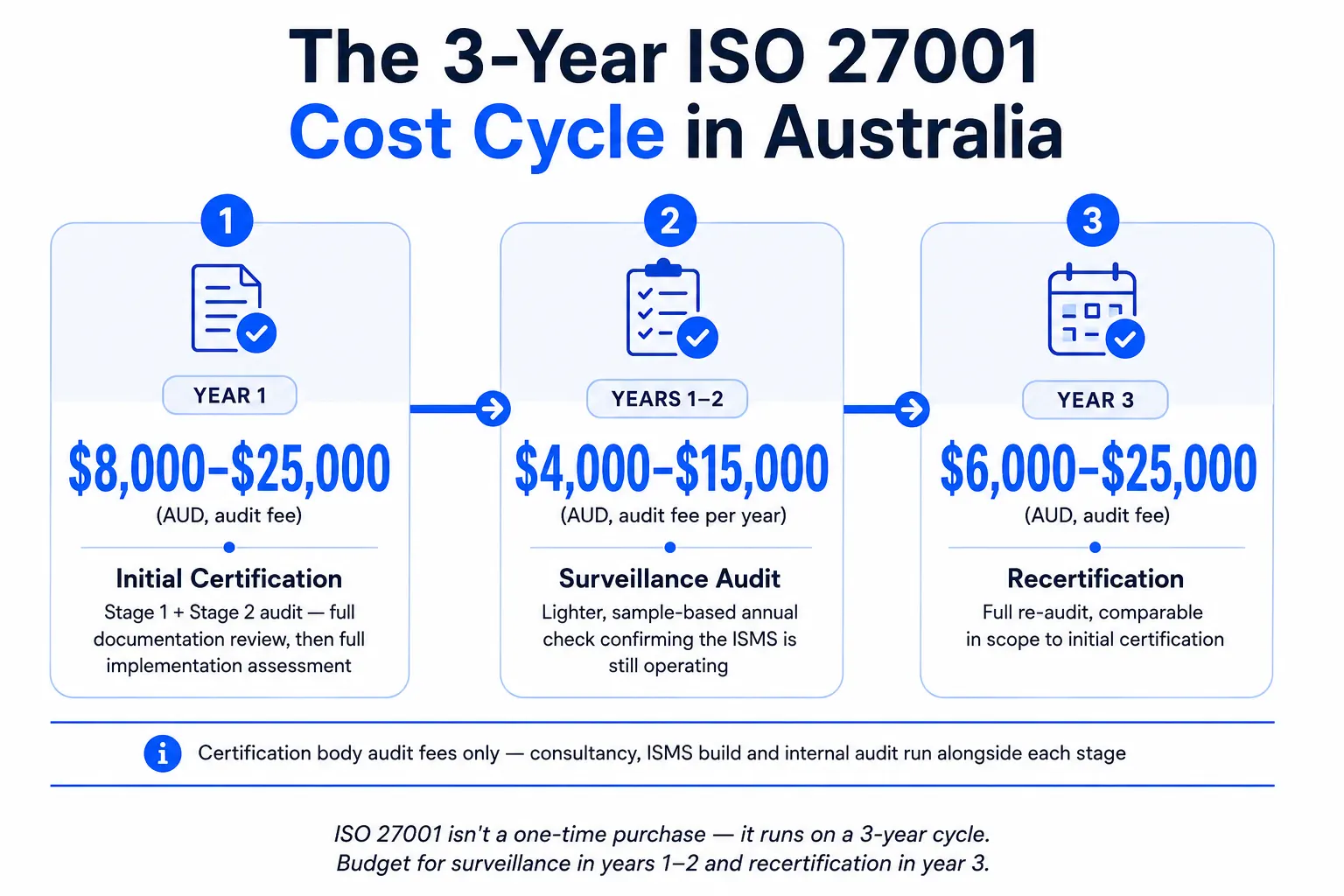
ISO 27001 isn’t a one-time purchase. Budget for surveillance audits in years 1–2 and recertification in year 3.
| Stage | Audit Fee (AUD) | Scope | When |
|---|---|---|---|
| Initial Certification | $8,000–$25,000 | Full documentation review, then full implementation assessment | Year 1 |
| Surveillance Audit | $4,000–$15,000 / yr | Lighter, sample-based review confirming the ISMS is still operating | Years 1–2 |
| Recertification | $6,000–$25,000 | Comparable in scope to the initial certification audit | Year 3 |
Six Things That Move Your ISO 27001 Price
Same standard, very different price tags. These factors explain most of the spread between quotes.
Scope size
A tighter certification boundary means less to build, document and audit.
Existing security maturity
Documented processes and established controls, including a running Essential Eight programme, mean less to build from scratch.
Number of locations
Certification body auditors typically bill per site visited or reviewed.
Certification body chosen
Accredited bodies vary in day rate and travel cost. All accredited bodies deliver a recognised certificate.
Existing frameworks
SOC 2 or Essential Eight overlap cuts real work since evidenced controls do not need rebuilding.
Internal resourcing
A dedicated internal point of contact, even part-time, is the single biggest lever on timeline, and timeline drives cost.
Where Security Awareness Training Fits Your ISO 27001 Budget
Phishing remains one of the most common ways organisations are compromised, and human error consistently shows up as a leading cause of security incidents in independent industry research such as IBM’s Cost of a Data Breach report. That is why ongoing security awareness training and phishing simulation sit inside most ISMS programmes, not outside them.
PhishCare’s campaign reports provide an additional documentation boost for organisations working towards ISO 27001, SOC 2 Type II, PCI DSS, HIPAA, or NIST CSF, where ongoing security awareness training is recognised as a best practice by auditors and certification bodies. Recurring phishing simulation campaigns give your ISMS documented, dated evidence of employee awareness activity, alongside click-rate and reporting-rate trends your internal auditor can reference during the implementation and evidence stage of certification.
Five Ways to Bring Your ISO 27001 Cost Down
None of these compromise the certificate’s credibility. They simply remove spend that does not need to happen.
1. Scope tightly
Certify only the systems and services your key customers actually care about. Scope can expand later.
2. Fix easy gaps before the audit
Gaps closed during gap analysis cost less than gaps found during audit fieldwork, where the auditor’s clock is running.
3. Reuse existing frameworks
If you already hold SOC 2 or have completed Essential Eight uplift, those controls map directly across.
4. Choose a fixed-price, all-inclusive provider
Avoid quotes covering the audit only, with extras billed later. One agreed number is the only fair way to compare providers.
5. Assign a dedicated internal owner
Even part-time, a single point of contact who chases evidence and makes decisions is the biggest lever on timeline and cost.
Summary: What to Budget For
- Year 1 all-in cost ranges from AUD $15,000–$150,000+ depending on organisation size, or AUD $8,000–$30,000+ through a consultancy-plus-certification-partner model.
- Certification body audit fees are usually only 30–50% of true first-year spend.
- ISO 27001 runs on a 3-year cycle: surveillance audits in years 1–2, recertification in year 3.
- Existing frameworks such as SOC 2 or Essential Eight can meaningfully cut cost and timeline.
- Ongoing phishing simulation and awareness training reporting supports your ISMS evidence base as a recognised best practice, not a certification requirement.
ISO 27001 Cost in Australia: Your Questions Answered
How much does ISO 27001 cost in Australia?
Market rates run AUD $15,000–$35,000 for small businesses, $35,000–$80,000 for mid-market, and $80,000–$150,000+ for large or complex organisations, all-in for year one. Through a consultancy-plus-certification-partner model, the typical range is AUD $8,000–$30,000.
How much is the ISO 27001 audit fee alone?
The certification body’s Stage 1 plus Stage 2 fee typically runs AUD $8,000–$25,000, separate from consultancy costs, and is often only 30–50% of total first-year spend.
What does ISO 27001 cost per year to maintain?
Surveillance audits run AUD $4,000–$15,000 per year in years 1–2, with recertification at AUD $6,000–$25,000 in year 3, plus ongoing internal maintenance time.
Why are some ISO 27001 quotes so much cheaper than others?
Low quotes usually cover the final audit only, excluding gap analysis, ISMS build, documentation and internal audit, so the real cost surfaces later. Fixed-price, all-inclusive quotes avoid this.
Does phishing simulation or awareness training count as ISO 27001 evidence?
Regular phishing simulation and awareness training generate documented, dated evidence that supports your ISMS and is widely recognised by auditors as a best practice. It is a supporting element, not a mandatory certification requirement.
How long does ISO 27001 certification take?
Typically 4–6 months for a focused, single-site scope, and 6–18 months for larger or multi-site environments, depending on existing security maturity and internal resourcing.
Keep reading: ISO 27001 certification in Australia, the full consultancy guide ·
Content Reviewed By

Ketki specialises in Governance, Risk and Compliance with extensive experience supporting cybersecurity consulting for organisations across Australia and beyond. She has worked across ISO 27001, PCI DSS, NIST CSF, Essential Eight, and broader GRC frameworks, and reviewed this cost guide for accuracy against current Australian market practice.
View LinkedIn ProfileGet Your Exact ISO 27001 Cost, and See Where Phishing Simulation Fits
Talk to CyberSapiens about your ISO 27001 scope, and to PhishCare about building recurring phishing simulation reporting into your ISMS evidence base.