A donor record at a typical nonprofit contains a full name, home address, email, phone number, and often a credit card or bank account number, the same category of sensitive financial data a bank protects with a dedicated security team and a real budget. Most nonprofits protect it with neither. Attackers understand this gap well, and nonprofits have become a consistent, deliberate target precisely because of it.
This guide covers why nonprofits face a real phishing risk despite limited resources, what the honest budget reality looks like across the sector, and which defenses actually matter most when spending is close to zero.
In Short: Phishing remains the most common way nonprofit data breaches start, and most organizations spend little to nothing on dedicated cybersecurity. The good news is that several of the most effective defenses, email authentication and staff awareness, cost little or nothing to implement.
The Nonprofit Budget Reality
Most conversations about cybersecurity assume a budget nonprofits simply do not have. According to Petronella Cybersecurity News’s analysis of nonprofit security spending, the typical nonprofit allocates only 1 to 3 percent of its operating budget to technology overall, covering email, CRM, accounting software, and website hosting, with dedicated cybersecurity spending often at zero.
Attackers know this. Recent industry surveys found phishing was the most common breach or attack type reported by charities, and separate research puts the figure at 84 percent of organizations experiencing at least one successful phishing attack in the prior year. Nonprofit data breaches have already cost the sector more than 49.5 million dollars in settlements in a single recent year alone, a figure that continues growing through ongoing state-level penalties.
Why Nonprofits Are a Consistent Target
A few characteristics make nonprofits an attractive target despite typically holding less overall wealth than a comparable-sized business.
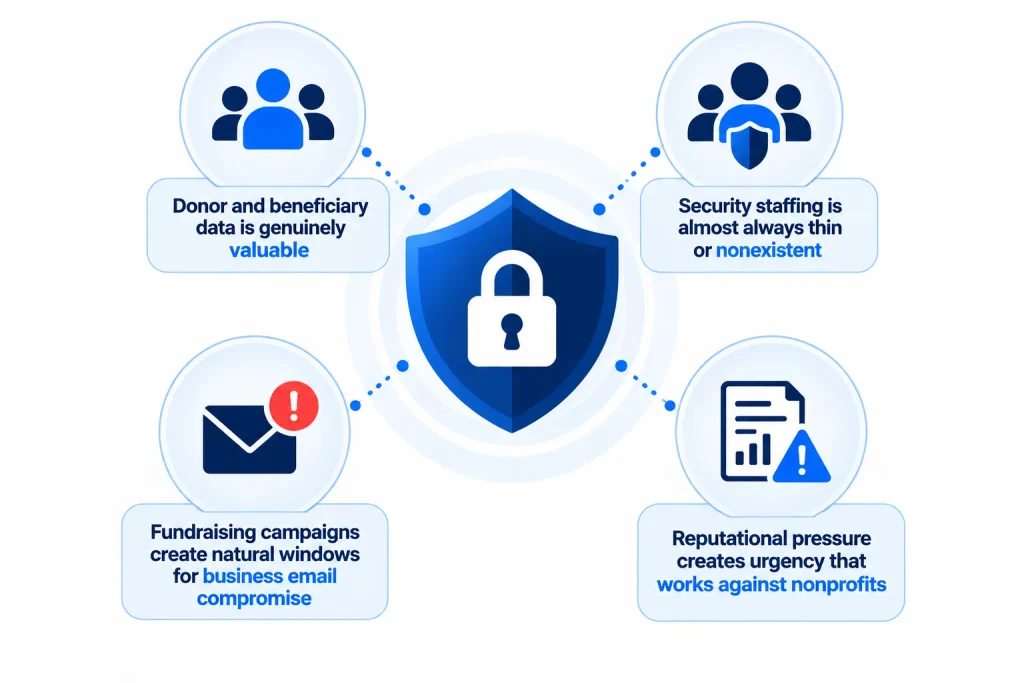
Donor and beneficiary data is genuinely valuable. Names, addresses, payment details, and in some cases sensitive information about the populations a nonprofit serves are all data attackers can monetize.
Security staffing is almost always thin or nonexistent. Attackers specifically look for organizations running outdated systems without dedicated IT security staff, and nonprofits fit that profile more consistently than most other sectors.
Fundraising campaigns create natural windows for business email compromise. Attackers monitor communications during active fundraising periods, then impersonate an executive or vendor to redirect donations or payments to a fraudulent account, timing the request around the urgency of a live campaign.
Reputational pressure creates urgency that works against nonprofits. The reputational damage from a public breach or ransomware incident creates pressure that can push an organization toward paying quickly rather than responding carefully.
How AI Is Raising the Stakes for Nonprofits
Nonprofits are not immune to the same AI-driven escalation affecting every other sector. According to KLR’s analysis of AI-driven fraud targeting nonprofits, generative AI is making phishing, business email compromise, and impersonation scams significantly more convincing, and deepfake audio and video are increasingly capable of impersonating nonprofit leaders to authorize fraudulent transactions.
This matters more for nonprofits than it might first appear, since trust is the entire basis of how a nonprofit operates. A convincing fraudulent request appearing to come from an executive director or board chair exploits exactly the kind of implicit trust that makes fundraising and donor relationships work in the first place. Our guides on pretexting and vishing simulation platforms cover this broader shift toward convincing, real-time impersonation in more depth.
Free and Low-Cost Defenses That Actually Matter
Several of the most effective defenses against phishing cost nothing beyond a small amount of technical time, which matters enormously for organizations with no dedicated security budget.
Configure SPF, DKIM, and DMARC records for your email domain. These free, DNS-based authentication protocols prevent attackers from spoofing your organization’s own domain to send phishing emails to donors, partners, and staff. Configuration is free and typically takes a technically capable person about an hour, with guides available directly from Microsoft 365 and Google Workspace.
Require independent verification for any payment or account change request, especially during active fundraising campaigns, regardless of how legitimate the request appears or who it claims to come from.
Include volunteers and board members in awareness efforts, not just paid staff. Nonprofits often rely heavily on volunteer labor and board oversight for exactly the kind of financial decisions attackers target, making this group a meaningful gap if left out of training entirely.
Build a simple data inventory. A documented map of every system, database, and cloud application holding donor or constituent information makes it far easier to know what actually needs protecting, at no cost beyond staff time.
Consider affordable cyber insurance. Policies for nonprofits with basic security controls in place and budgets under 10 million dollars are frequently available in the 1,000 to 5,000 dollar annual range, a modest cost relative to the exposure a single breach can create. Our guide on phishing simulation and cyber insurance covers how documented training data increasingly factors into these policies.
Building Awareness Without a Training Budget
Awareness training does not require an expensive enterprise platform to be effective. A free PhishCare demo account lets a nonprofit run a real, simulated phishing test on a pilot group at no cost, which is often enough to establish a genuine baseline understanding of where staff, volunteer, or board awareness actually stands, before deciding whether a larger, ongoing program is worth the investment. Our guide on how to run a phishing test for employees walks through the process step by step.
Final Thoughts
Nonprofits face the same phishing threats as any other organization holding valuable personal and financial data, without the budget most businesses of comparable exposure would have available. The gap that creates is real, but it is not unbridgeable. Free email authentication, independent verification habits, and a genuinely free way to test staff and volunteer awareness cover a meaningful share of the risk, without requiring a dedicated security budget most nonprofits simply do not have.
FAQ
Why are nonprofits targeted by phishing attacks?
Nonprofits hold valuable donor and beneficiary data, including payment information, while typically operating with thin or nonexistent dedicated security staff and outdated systems, conditions that attackers specifically look for regardless of the organization’s overall size or wealth.
How much do nonprofits typically spend on cybersecurity?
Most nonprofits allocate only 1 to 3 percent of their total operating budget to technology overall, covering email, CRM, and basic infrastructure, with dedicated cybersecurity spending frequently at zero.
What is the cheapest way to reduce phishing risk at a nonprofit?
Configuring SPF, DKIM, and DMARC email authentication records is free and typically takes about an hour, and it directly prevents attackers from spoofing your organization’s own email domain to target donors, staff, and partners.
Should nonprofit board members and volunteers be included in phishing training?
Yes. Nonprofits rely heavily on volunteers and board oversight for many of the exact financial decisions attackers target, and excluding this group from awareness efforts leaves a meaningful, often overlooked gap.
Can a nonprofit test employee phishing awareness without a training budget?
Yes. A free phishing simulation demo account allows a nonprofit to run a real test on a small pilot group at no cost, providing a genuine baseline before committing to a larger, ongoing awareness program.
Content Reviewed By

Nawaz is a practising security analyst specializing in phishing simulation campaigns, employee awareness assessments, red team exercises, and ethical hacking.
He leads phishing simulation deployments at PhishCare, a product developed by CyberSapiens, with hands-on experience evaluating and deploying phishing simulation tools across organizations in multiple industries and regions globally.
View LinkedIn ProfileProtecting donor data does not require an enterprise security budget.
Test your organization’s real phishing awareness with a free PhishCare demo account, no credit card required.