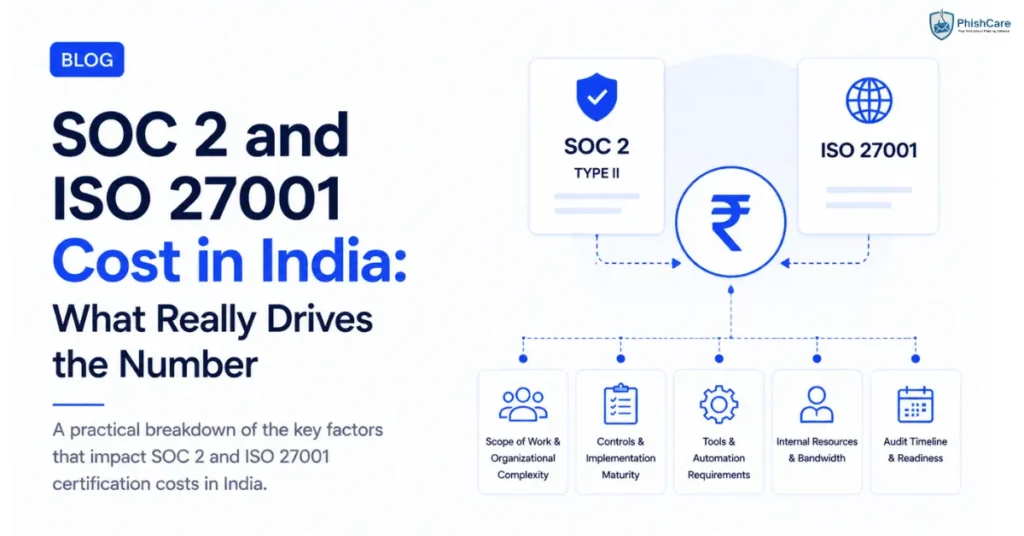
Ask three vendors what it costs to get SOC 2 and ISO 27001 in India and you will get three very different numbers, usually with no explanation of what sits behind them. That uncertainty is exactly why so many founders delay, and delay is expensive when a deal is waiting on a certificate.
This guide gives you the honest version. There is no single fixed price for SOC 2 and ISO 27001, because the cost depends entirely on your scope. What we can do is show you every component that goes into the price, explain what pushes the number up or down, and help you understand which path actually fits your business. The headline you should remember is simple. Doing both does not cost twice as much.
Because the two frameworks share most of their controls, running them together is incremental, not double. The savings come from collecting evidence once and auditing on one coordinated schedule.
Key takeaway: SOC 2 and ISO 27001 share roughly 70 to 80 percent of their controls, so doing both together usually costs around 1.3 to 1.5 times a single framework, not two times. There is no one-size price. The real number depends on your scope, headcount, and cloud footprint, which is why a scoped assessment matters far more than a generic quote.
Note: this article explains cost drivers, not fixed rates. It is general information, not financial advice.
What you are actually paying for
A compliance quote is not one fee. It is a stack of separate costs, and understanding the stack is the only way to compare vendors fairly. There are five main components.
- Consulting and readiness. Designing your Information Security Management System, writing policies, implementing controls, and getting you audit-ready. Usually the largest controllable line item.
- Independent audit and certification. For ISO 27001, an accredited registrar audits your ISMS and issues the certificate. For SOC 2, a licensed CPA firm audits your controls and issues the report. These fees go to the audit body, not the consultant.
- VAPT. Vulnerability assessment and penetration testing validates the systems behind your controls and provides evidence both frameworks expect.
- Evidence tooling. Compliance automation platforms can speed up evidence collection, especially for SOC 2, but they add a recurring subscription cost. Helpful, not compulsory.
- Internal effort. The time your own team spends gathering evidence, answering the auditor, and maintaining controls. It does not appear on an invoice, but it is real, often hundreds of hours across a first certification.
For a fuller picture of each path on its own, see our SOC 2 compliance in India overview and our ISO 27001 implementation guide.
Timeline: parallel or sequential
Cost and time are linked, so the schedule matters. ISO 27001 is usually the faster of the two, often achievable in 3 to 6 months because certification is a point-in-time assessment of your ISMS. SOC 2 Type II takes longer, typically 6 to 12 months, because it observes your controls operating across a defined period rather than at a single moment.
If you have the budget and a deal is waiting, running both in parallel is usually the most efficient route. You build one ISMS, collect evidence once, and time the audits to overlap. If budget is tight in year one, a common Indian approach is to start with ISO 27001 as the backbone, since it is faster, then add SOC 2 the following year while reusing most of the work.
What quietly drives the cost up
Two projects with identical scope can cost very differently depending on how they are run. The biggest cost drivers are rarely the audit fees. They are these.
- Scope creep. A vague scope means new systems, teams, and data flows keep getting added, and each addition expands the work. A tightly defined scope is the single biggest cost control you have.
- Fragmented vendors. Separate consultants for ISO and SOC 2 mean duplicate evidence requests, conflicting advice, and a schedule you have to referee. The duplication shows up as both higher fees and more of your own time.
- Rework. Controls built for one framework without the other in mind often get rebuilt later. Designing once for both avoids paying twice.
- Underestimated internal effort. When a team treats compliance as a side task squeezed into spare hours, the project drags, and a longer project costs more in every sense.
A coordinated program is designed to remove these drivers, which is where the real savings come from.
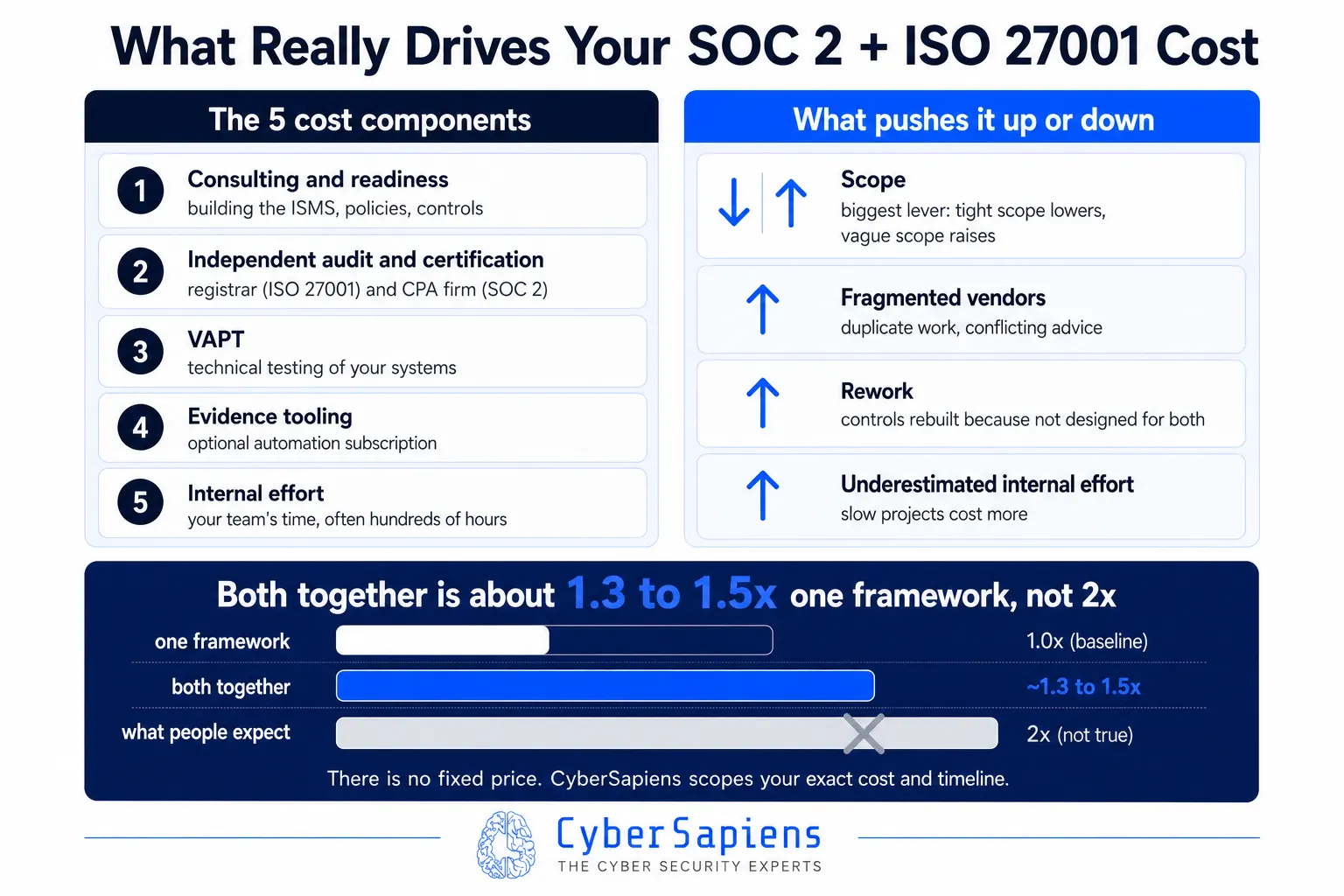
The cost is built from five components and moved mainly by scope. Doing both together runs about 1.3 to 1.5 times a single framework, not double.
Not sure whether you need SOC 2, ISO 27001, or both?
Here is the honest truth that most pricing pages skip. Most companies do not actually know what they need when they start. A buyer sends a security questionnaire, an investor mentions compliance, and suddenly you are trying to decide between SOC 2, ISO 27001, or both, with no clear way to tell which one your situation calls for.
That is normal, and it is exactly where CyberSapiens helps first. Before talking about price, CyberSapiens works with you to understand your actual requirements: who your buyers are, which markets you sell into, what data you handle, and where you are headed next. From there you get a clear recommendation on the right path, a realistic cost and timeline for your specific scope, and a plan that accounts for what you will likely need in the future, not just today.
You can do a quick self-check first with the SOC 2 compliance checklist and the ISO 27001 compliance checklist. When you are ready for a clear, scoped answer, schedule a meeting and CyberSapiens will tell you what you need, what it costs, and how long it takes.
How one partner reduces the number
The fastest way to lower the all-in cost is to stop paying for the same work twice. When a single partner runs both frameworks, the consulting, VAPT, evidence collection, and internal coordination are shared across them instead of repeated.
CyberSapiens is built around this model. The team is itself ISO 27001:2022 certified, with more than 40 cybersecurity specialists and over 500 organisations served across India, Australia, Canada, and the United States. For the audit and certification chain, CyberSapiens coordinates Accorp Partners, a globally recognised audit firm for SOC 2 and ISO 27001, and Gabriel Registrar, an accredited certification registrar, so the independent audit and certification happen on one schedule. The commercial model is flat pricing with a clearly defined scope, which directly attacks the scope creep that inflates so many compliance projects. If you want to see how the wider market is priced and positioned, our roundups of the top SOC 2 compliance vendors in India and the top ISO 27001 certification companies in India are useful references.
It is worth keeping the spend in perspective. The cost of compliance is small next to the cost of a breach. According to the IBM Cost of a Data Breach Report, breach costs run into significant sums, and that is before counting lost deals and reputation. Viewed that way, a coordinated compliance program is risk reduction, not just a sales checkbox.
Where VAPT, PhishCare, and vCISO fit the budget
Three line items often sit outside the headline certification cost but belong in any realistic budget, because they address the risks that certificates alone do not.
VAPT is the technical validation layer. It is usually a defined, scoped cost rather than an open-ended one, and the VAPT checklist for startups and SaaS companies helps you scope it sensibly.
PhishCare, the phishing simulation and security awareness training tool developed by CyberSapiens, covers the human layer. Most breaches still start with a person, a point the Verizon Data Breach Investigations Report makes year after year, so awareness training is a low-cost line item with an outsized effect on risk. You can review options on the PhishCare pricing page.
A vCISO is the optional leadership layer. Rather than hiring a full-time security executive, you bring in part-time governance to keep the program on track during certification and after. For many growing Indian companies, this is far more cost-effective than a permanent senior hire.
Bundled into one program, these layers are scoped together rather than bought piecemeal, which keeps the total predictable.
Frequently asked questions
How much do SOC 2 and ISO 27001 cost together in India?
There is no fixed rate. The cost depends on your scope, headcount, cloud footprint, and the audit firm you use, so a generic number can be misleading. What is consistent is the ratio: doing both together is far less than double a single framework. CyberSapiens scopes your specific situation and gives you a clear cost and timeline before any commitment.
Is it cheaper to do both at the same time?
Yes, usually. Because the two frameworks share 70 to 80 percent of their controls, doing both together typically costs around 1.3 to 1.5 times a single framework rather than double, since most of the evidence and readiness work is shared.
How long does it take to get both?
Run in parallel, both are commonly achievable in 6 to 12 months. ISO 27001 on its own is often faster at 3 to 6 months, while SOC 2 Type II takes longer because it observes controls operating over a period.
Should we do SOC 2 Type I or Type II first?
Type I is a point-in-time snapshot and can unblock a deal quickly, while Type II observes controls over a period and is what most enterprise buyers ultimately want. Many companies do Type I first, then Type II.
What if we are not sure which one we need?
That is the most common situation. CyberSapiens helps you understand your requirements based on your buyers, markets, and data, then recommends the right path with a clear cost and timeline. The fastest way to get clarity is to schedule a meeting.
Content Reviewed By

Ketki specialises in Governance, Risk and Compliance with extensive experience providing cybersecurity consulting to public, private, and government clients across Australia. She has managed GRC projects across ISO 27001, PCI DSS, NIST CSF, Essential Eight, APRA CPS 234, VPDSS, and ISM frameworks.
Connect on LinkedInGet a clear, scoped answer on cost and timeline
The cheapest compliance mistake is running SOC 2 and ISO 27001 as two separate projects and paying for the overlap twice. Talk to CyberSapiens to learn what you actually need, what it would cost, and how long it takes, with flat pricing and no surprises.