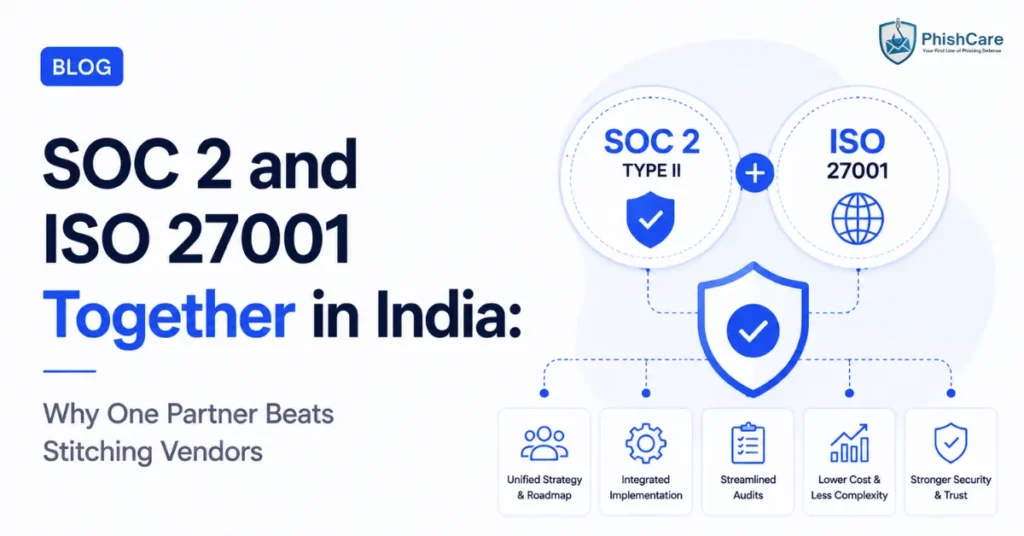
You run an Indian SaaS, fintech, or IT services company, and two security questions keep landing in your inbox. A US prospect wants your SOC 2 report. A European or large-enterprise buyer wants your ISO 27001 certificate. Suddenly you are facing two compliance projects at once, two sets of consultants, two audits, and a budget that looks like it just doubled.
It does not have to double. SOC 2 and ISO 27001 share most of their underlying controls, which means most of the work is done once and reused across both. The real decision is not which framework to choose. It is whether you run them as two disconnected projects or as one coordinated program under a single partner.
This guide breaks down where the two frameworks overlap, what a genuine one-partner engagement looks like end to end, and how to avoid the rework and finger-pointing that fragmented vendors create.
Key takeaway: SOC 2 and ISO 27001 overlap by roughly 70 to 80 percent. Running both together under one partner usually costs around 1.3 to 1.5 times a single framework, not two times. The savings come from a shared Information Security Management System, reused evidence, and one coordinated audit cycle.
Why Indian companies now need both
A few years ago, most Indian companies chased a single certification. That has changed. If you sell across borders, you are likely being asked for both, and for different reasons.
US enterprise buyers treat SOC 2 as the default. For many B2B SaaS deals, no SOC 2 report means the security questionnaire stalls and the deal slows or stops. ISO 27001, by contrast, is the language of Indian enterprises, European procurement, and government tenders. If your customers sit on both sides, you cannot pick one and ignore the other.
There is also a domestic driver. India’s Digital Personal Data Protection Act, 2023 has raised the bar on data security for every organisation that handles personal data. ISO 27001 is not mandatory under the DPDP Act, but a working Information Security Management System maps closely to the security safeguards the Act expects, which is why many Indian companies now treat ISO 27001 as the backbone and add SOC 2 for global buyers.
The result is a buyer who wants both, often at the same time. That is exactly where running them together pays off.
Where SOC 2 and ISO 27001 overlap
The reason a combined program works is simple. Both frameworks ask you to prove the same core security disciplines, just in different formats. When you build the control once, you satisfy both. The shared ground usually includes:
- Risk assessment and risk treatment
- Access control and least-privilege management
- Incident detection, response, and reporting
- Vendor and third-party risk management
- Change management and secure development
- Logging, monitoring, and review
- Security awareness training for employees
Build a single Information Security Management System that covers these areas, collect the evidence once, and you are most of the way to both an ISO/IEC 27001 certificate and a SOC 2 report. What differs is mainly the output and who signs off on it.
ISO 27001 vs SOC 2 Type II at a glance
| Aspect | ISO 27001 | SOC 2 Type II |
|---|---|---|
| What it is | A certifiable standard for an Information Security Management System | An attestation report on how well your controls operated over a period |
| Who issues it | An accredited certification registrar (for CyberSapiens clients, Gabriel Registrar) | A licensed CPA firm (for CyberSapiens clients, Accorp Partners) |
| Output | A certificate plus a Statement of Applicability | A detailed report covering a defined period |
| Validity | Three years, with annual surveillance audits | Typically covers a 6 to 12 month period and is refreshed each year |
| Best recognised for | Indian enterprises, European and UK buyers, government tenders | US enterprise and SaaS buyers |
| What buyers ask for | The certificate and supporting documents | The full attestation report |
One important point for Indian companies. A SOC 2 report can only be issued by a licensed CPA firm, in line with the AICPA Trust Services Criteria. A report signed off by a Chartered Accountant is not the same thing and can create problems with enterprise customers later. If you are weighing the formats, our guide on SOC 2 Type 1 vs Type 2 in India explains which one buyers usually expect.
What a genuine one-partner engagement looks like
A single partner does not mean one person doing everything. It means one team owning the program and coordinating every moving part so you are not managing five vendors yourself. End to end, that looks like this:
- Scoping and gap assessment. Define what is in scope for both frameworks and find the gaps against each.
- ISMS design and control implementation. Build one management system that satisfies both ISO 27001 and SOC 2 requirements.
- Technical validation through VAPT. Run vulnerability assessment and penetration testing on the systems that handle your data, which supports both frameworks and surfaces real risk.
- Employee awareness and phishing simulation. Train staff and test them with realistic phishing campaigns, since people remain a leading cause of incidents.
- Evidence collection and internal audit. Gather proof once, map it to both frameworks, and run an internal audit before anyone external arrives.
- Coordinated external audit and certification. Bring in the independent audit firm and the certification registrar, on one schedule, with one point of contact.
When all of this sits under one roof, evidence is collected once and reused, advice does not contradict itself, and there is no gap where one vendor assumes another is handling something.
Where fragmented vendors quietly cost you
Stitching together separate vendors looks cheaper on paper. In practice it tends to add cost in ways that do not show up until you are deep in the project:
- Duplicate evidence. Each vendor asks for the same screenshots, logs, and policies in their own format.
- Conflicting advice. Your ISO consultant and your SOC 2 consultant recommend different control wording, and you become the referee.
- Scheduling friction. The auditor is ready before the consultant has finished, or the registrar’s calendar does not line up.
- Finger-pointing. When something slips, no single party owns the outcome.
- Rework. Controls built for one framework get rebuilt because they were not designed with the other in mind.
A coordinated program removes these by design. That is the entire point of doing both together rather than back to back with different teams.
How CyberSapiens runs SOC 2 and ISO 27001 together
CyberSapiens is built for exactly this buyer: the company that needs more than one outcome and does not want to manage the seams between vendors. CyberSapiens is itself ISO 27001:2022 certified, so the team has been through the process it runs for clients.
For the audit and certification chain, CyberSapiens works with accredited partners. Accorp Partners, a globally recognised audit firm specialising in SOC 2 Type I and II and ISO 27001, conducts the independent audit and issues the SOC 2 report. Gabriel Registrar, an internationally accredited certification registrar for ISO 27001, SOC 2, and PCI DSS, handles the ISO 27001 certification. CyberSapiens coordinates both alongside your internal team throughout, so you get the consulting, the readiness work, the independent audit, and the certificate without managing three relationships yourself.
The technical and human layers come from the same partner too. VAPT validates the systems behind your controls. For the awareness layer, PhishCare, a phishing simulation and security awareness training tool developed by CyberSapiens, runs realistic campaigns and tracks how employees respond over time. Ongoing security awareness training is recognised by auditors and certification bodies as a best practice that strengthens both ISO 27001 and SOC 2 programs, and the campaign reports give you clean documentation of that effort. For teams without a full-time security leader, a vCISO engagement provides the governance and direction to keep the program on track after certification.
The commercial model matches the delivery model: flat pricing, clear scope, and no surprise charges once the engagement begins. You can also compare the wider market through our roundups of the top SOC 2 compliance vendors in India and the top ISO 27001 certification companies in India.
One program, two outputs
The visual below shows why a combined engagement is efficient. A single Information Security Management System sits at the core, fed by VAPT and security awareness training, and produces both an ISO 27001 certificate and a SOC 2 Type II report.
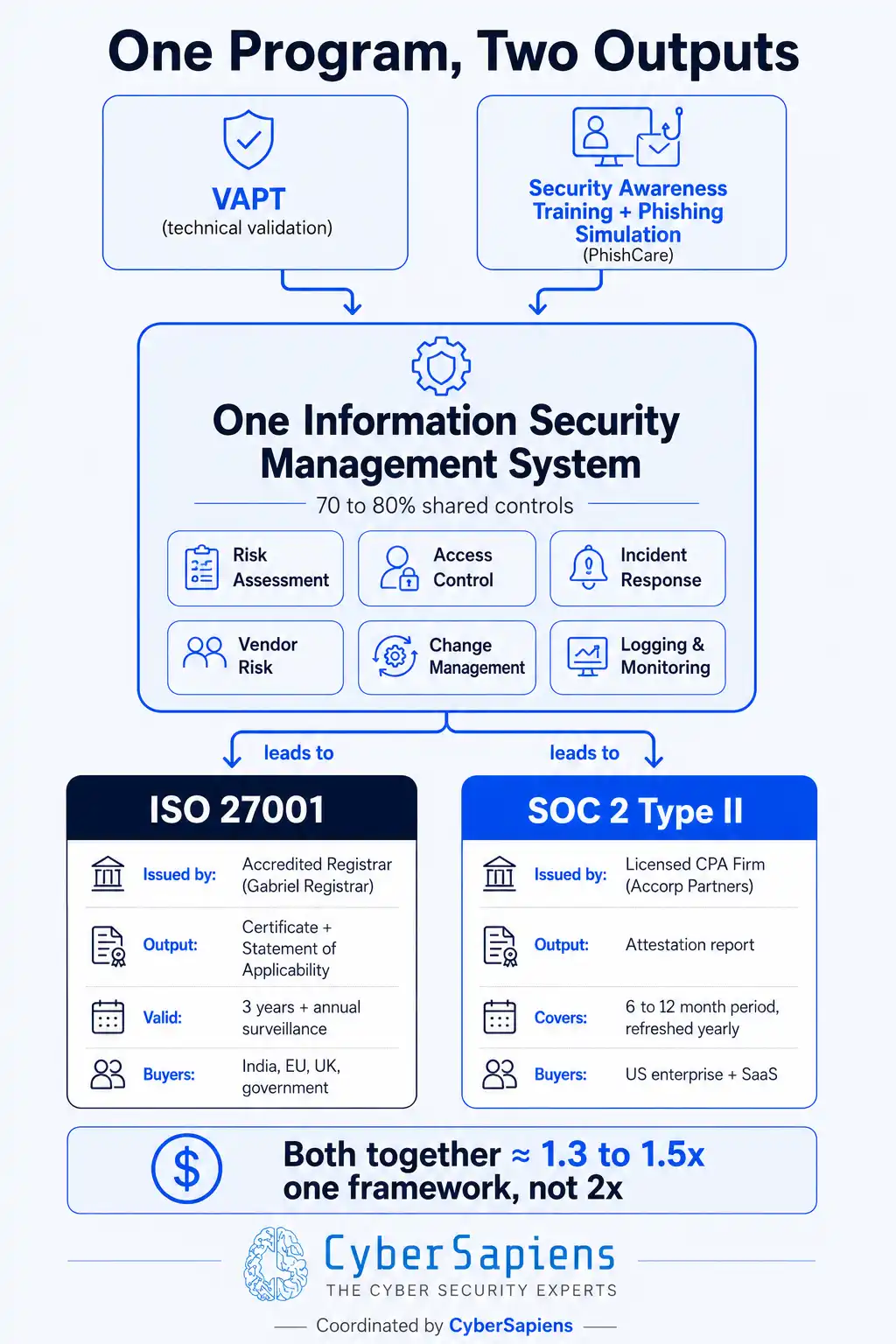
One shared ISMS produces both an ISO 27001 certificate and a SOC 2 Type II report, which is why running them together costs far less than two separate projects.
Frequently asked questions
Can one vendor handle both SOC 2 and ISO 27001?
Yes. A single partner can design one Information Security Management System that satisfies both, then coordinate the independent audit firm and the certification registrar. CyberSapiens runs the consulting and readiness work and coordinates Accorp Partners for the SOC 2 audit and Gabriel Registrar for ISO 27001 certification.
Can a SOC 2 report replace ISO 27001, or the other way around?
No. They produce different outputs for different audiences. A SOC 2 report is an attestation on how your controls operated over a period, while ISO 27001 is a certificate confirming a working ISMS. A SOC 2 report can support an ISO 27001 effort because of the shared controls, but it does not substitute for the certificate.
How much overlap is there between the two?
Roughly 70 to 80 percent of the underlying controls are shared. That is why doing both together usually costs around 1.3 to 1.5 times a single framework rather than double, since most evidence is collected once and reused.
Who actually issues each one?
A SOC 2 report can only be issued by a licensed CPA firm. An ISO 27001 certificate can only be issued by an accredited certification registrar. The consultant prepares you for both but does not issue either, which is why a coordinated partner that manages those relationships saves you time.
Should an Indian SaaS do them in parallel or one after the other?
If you are selling to both US and Indian or European buyers and have the budget, parallel is usually more efficient because of the shared controls. If budget is tight in year one, many Indian companies start with ISO 27001 as the backbone and add SOC 2 next, reusing most of the work.
Content Reviewed By

Ketki specialises in Governance, Risk and Compliance with extensive experience providing cybersecurity consulting to public, private, and government clients across Australia. She has managed GRC projects across ISO 27001, PCI DSS, NIST CSF, Essential Eight, APRA CPS 234, VPDSS, and ISM frameworks.
Connect on LinkedInRun SOC 2 and ISO 27001 as one program, not two projects
If your roadmap now includes both, the cheapest mistake to avoid is running them separately. Talk to CyberSapiens about a single coordinated plan covering your ISMS, the independent audit, certification, VAPT, and employee awareness training.