Most Indian companies approaching SOC 2 for the first time ask the wrong question. They ask: “How do we get SOC 2 certified?” when the more important question is: “Which SOC 2 report does our client, investor, or procurement team actually need, and by when?”
Getting this wrong has real consequences. Indian companies that go straight for SOC 2 Type 2 when they need to close a deal in 60 days miss the window entirely. Companies that settle for Type 1 when an enterprise client’s contract renewal requires Type 2 find themselves back in a lengthy compliance process 12 months later. Companies that misunderstand the observation period start collecting evidence too late and delay their audit by months.
This guide is built specifically for Indian SaaS companies, IT services firms, BPOs, and fintech businesses facing the Type 1 vs Type 2 decision. It explains not just what each type means, but when each one is the right answer, what your auditor is actually examining in each scenario, and how to plan the journey so you do not lose time or deals to a decision made without full information.
What This Guide Covers
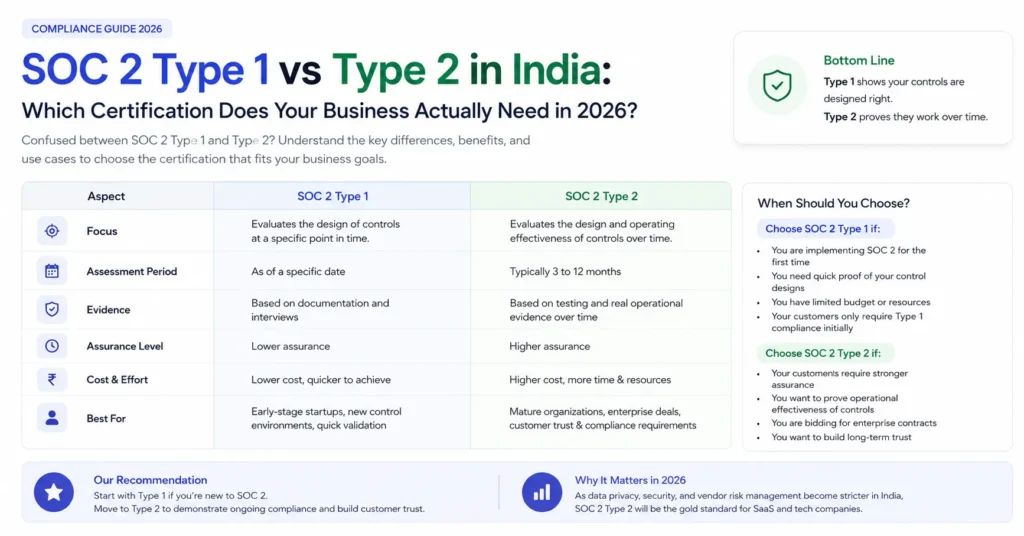
SOC 2 Type 1 evaluates whether your security controls are properly designed at a single point in time. SOC 2 Type 2 evaluates whether those controls operated effectively over 6 to 12 months.
Most Indian businesses need Type 1 first to close a deal, then Type 2 for long-term enterprise relationships. Both can be run as a single connected engagement with the right partner.
Choosing wrong costs Indian companies between 3 and 9 months depending on where in the process they realise the mistake.
CyberSapiens provides a free SOC 2 scope assessment and helps Indian businesses choose the right type, timeline, and criteria before spending anything.
What SOC 2 Type 1 Actually Gives You (And What It Does Not)
A SOC 2 Type 1 report is a point-in-time assessment. Your AICPA-licensed auditor examines your security controls on a specific date and answers one question: are these controls properly designed to meet the Trust Services Criteria your organisation has committed to?
If the answer is yes, a formal SOC 2 Type 1 report is issued. The report carries the independent CPA firm’s attestation and is accepted by enterprise procurement teams, legal departments, and investors as valid proof of your security posture at that moment.
What Type 1 Gives You
A Type 1 report gives you a credible, independently verified document that tells global clients and investors your security controls exist, are properly structured, and meet the AICPA’s Trust Services Criteria. For most Indian SaaS and IT services companies, this is enough to close an initial enterprise contract, pass vendor security onboarding, or satisfy a Series A investor’s due diligence checklist.
It also gives you a foundation. Once Type 1 is issued, the observation period for Type 2 begins. The two are not separate processes — they are stages of the same journey.
What Type 1 Does Not Give You
A Type 1 report does not prove your controls worked consistently over time. Enterprise clients who have been burned by vendors with good policies but poor execution have learned to distinguish between Type 1 and Type 2. For long-term contracts, annual renewals, and recurring enterprise relationships, clients increasingly ask for Type 2. US enterprise procurement teams at larger organisations, and virtually all Series B investors, expect Type 2.
A Type 1 report also becomes dated quickly. Most enterprise clients consider a Type 1 report older than 12 months to be stale and will ask for a refreshed report or a Type 2 to replace it.
What SOC 2 Type 2 Actually Gives You (And What It Costs)
A SOC 2 Type 2 report is an operating effectiveness assessment. Your auditor examines whether your security controls not only existed at a point in time but actually ran as intended throughout a defined observation period, typically 6 to 12 months.
This is a fundamentally different level of assurance. Type 1 says your controls are designed correctly. Type 2 says your controls worked consistently for months under real operating conditions, including during busy periods, staff changes, product releases, and incidents.
What Type 2 Gives You
Type 2 is the gold standard credential for Indian businesses competing for long-term US enterprise relationships. Enterprise clients in the US, UK, Canada, and Australia treat a current Type 2 report as the most trusted proof of security posture available from a vendor. It renews each year as long as you maintain the observation programme.
For Indian startups, Type 2 is the credential that satisfies Series B and later investor due diligence. It signals operational maturity beyond policies and paper controls, which is exactly what institutional investors want to see before committing to a larger round.
Type 2 also significantly reduces the security questionnaire burden on Indian IT services firms and BPOs. A current Type 2 report replaces dozens of individual client security questionnaires every year, saving time and reducing friction in sales cycles.
What Type 2 Costs
The cost difference between Type 1 and Type 2 is real. The observation period extends the audit scope, increases the evidence burden, and requires more ongoing support across the 6 to 12 month window. The auditor must sample events across the full period, not just examine a single date’s controls. CyberSapiens provides a fixed-price, all-inclusive quote for both Type 1 and Type 2 within 24 hours of the free gap assessment, so there are no surprises mid-engagement.
SOC 2 Type 1 vs Type 2: The Key Differences Every Indian Business Should Understand
The table below covers the differences that matter most for Indian businesses making the Type 1 vs Type 2 decision. Each row has direct implications for your deal timeline, investor readiness, and annual compliance cost.
| Factor | SOC 2 Type 1 | SOC 2 Type 2 |
|---|---|---|
| Core Question | Are controls properly designed? | Did controls operate effectively over time? |
| Audit Type | Point-in-time snapshot | 6 to 12 month observation period |
| Timeline (CyberSapiens) | 6 to 8 weeks | 9 to 14 months total |
| Evidence Required | Controls exist at audit date | Controls ran consistently throughout the observation period |
| Auditor Sampling | Examines controls at one specific date | Tests samples of events across the full observation window |
| Cost | Lower due to shorter audit scope | Higher due to extended testing and evidence review |
| Enterprise Acceptance | Initial onboarding and first deal closure | Long-term contracts and annual renewals |
| Investor Acceptance | Satisfies Series A due diligence | Expected for Series B and institutional investors |
| Report Validity | No expiry but stale after 12 months | Renewed annually through ongoing observation |
| DPDP Act Alignment | Privacy controls documented at point in time | Ongoing Privacy control operation evidenced |
| Best Suited For | Urgent deal closure, first certification, early-stage startups | Enterprise growth, recurring contracts, mature operations |
The most important point in this comparison is the transition path. Type 1 and Type 2 are not mutually exclusive choices. For most Indian organisations, Type 1 is the starting point that enables a fast deal close while the Type 2 observation period runs in the background. CyberSapiens manages this as a single connected engagement, which means no duplication of work and no gap between certifications. For a full deep dive into SOC 2 Type 1 vs Type 2 in India, the complete guide from CyberSapiens covers every aspect of the decision.
When SOC 2 Type 1 Is the Right Choice for Your Indian Business
These are the five situations where SOC 2 Type 1 is the correct starting point for Indian organisations.
Situation 1
You have an active enterprise deal that requires SOC 2 within 60 to 90 days
US and global enterprise procurement teams sometimes issue security requirements with tight vendor onboarding windows. If a contract is conditional on a current SOC 2 report and the timeline is measured in weeks, not months, Type 1 is the only realistic path. With CyberSapiens, Type 1 is achievable in 6 to 8 weeks for organisations with reasonable security maturity.
Situation 2
You are pursuing your first SOC 2 certification with no prior audit history
Organisations with no previous SOC 2 history do not have an evidence base that would satisfy a Type 2 observation period. Starting with Type 1 allows you to get certified quickly, close the deal, and then build the observation period evidence from a position of having already passed your first audit.
Situation 3
You are raising a Series A round and investors have asked for SOC 2
Series A investors in the US and globally typically require SOC 2 as part of due diligence, but they generally accept Type 1 at this stage. Getting Type 1 certified quickly removes the compliance blocker and keeps the fundraise moving without committing to the full Type 2 timeline.
Situation 4
You need to respond to a vendor security questionnaire from a large client
Large US enterprise clients frequently send security questionnaires to Indian IT suppliers before onboarding. A current SOC 2 Type 1 report answers most of these questionnaires in a single document, dramatically reducing the back-and-forth that slows contract execution.
Situation 5
You want to begin the SOC 2 journey without committing to the full Type 2 timeline upfront
Some Indian businesses want to understand the compliance process and build internal security maturity before committing to a 12-month observation period. Type 1 is a practical first step that delivers a real, internationally recognised certification while the organisation prepares for Type 2.
When SOC 2 Type 2 Is the Right Choice for Your Indian Business
These are the five situations where SOC 2 Type 2 is what your clients or investors actually need, and where Type 1 alone will not be sufficient.
Situation 1
Your US enterprise client is renewing a contract and requires Type 2 this cycle
Many US enterprise clients accept Type 1 for initial vendor onboarding but require Type 2 for contract renewals. This is a known pattern in US enterprise procurement. If your Indian business is approaching a renewal and the client has flagged Type 2 as a requirement, starting the process immediately is the only viable path given the 9 to 14 month total timeline.
Situation 2
You are raising Series B or later funding from US investors
Institutional investors and Series B-stage US venture capital firms increasingly require Type 2 to verify that security controls actually ran through a full observation period, not just on audit day. Indian startups planning a Series B round should begin the Type 2 process 12 to 15 months before the target close date.
Situation 3
You are signing multi-year enterprise contracts
A single large enterprise contract worth significant annual recurring revenue typically carries contract terms that reference ongoing SOC 2 compliance. Multi-year contracts in the US market almost always require annual Type 2 renewal, not just an initial Type 1 snapshot.
Situation 4
Your competitive landscape requires Type 2 to win deals
In certain segments of the Indian IT export market, particularly mid-market and enterprise SaaS targeting financial services or healthcare clients in the US, Type 2 has become the standard credential among leading competitors. If your sales team is consistently losing to competitors who hold Type 2 reports, the difference is not price or product. It is the security credential.
Situation 5
You handle personal data under the DPDP Act 2023 and need ongoing Privacy evidence
India’s DPDP Act 2023 requires ongoing compliance, not just a point-in-time commitment. SOC 2 Type 2 with the Privacy criterion included provides a 6 to 12 month evidence record of how your privacy controls operated, which is significantly stronger evidence of DPDP Act alignment than a Type 1 snapshot.
The Two-Step SOC 2 Approach CyberSapiens Recommends for Most Indian Businesses
After working with 50+ Indian organisations through the SOC 2 process with a 100% audit pass rate, CyberSapiens has a consistent recommendation for most Indian businesses facing the Type 1 vs Type 2 decision: do not choose one or the other. Plan both from day one, run them as a single connected engagement, and let Type 1 close your immediate deal while Type 2 builds in the background.
Why This Works
The evidence and controls you build for Type 1 are the same evidence and controls that carry forward into the Type 2 observation period. There is no duplication. Type 1 does not need to be finished and closed before Type 2 starts. The observation period begins the moment your controls are live and running, which in most CyberSapiens engagements happens before the Type 1 audit is completed.
How the Timeline Works in Practice
Weeks 1 to 2
Free Gap Assessment
CyberSapiens evaluates your current security posture, defines scope, and provides a fixed-price quote for both Type 1 and Type 2 within 24 hours. No commitment required.
Weeks 2 to 6
Remediation and Control Implementation
Policies, technical controls, access management, logging, incident response, backup procedures, and vendor management are put in place. Type 2 observation period begins accumulating evidence from this point.
Weeks 6 to 8
Type 1 Audit by Accorp Partners
The independent AICPA-licensed CPA firm examines your controls and issues the official SOC 2 Type 1 report. Ready to share with enterprise clients and investors immediately.
Month 2 through Month 8 to 14
Type 2 Observation Period Runs
CyberSapiens manages evidence collection continuously so that your audit evidence file builds automatically throughout the observation window, not retroactively at the end.
Month 9 to 14
Type 2 Audit and Report Issued
The same CPA firm examines your full observation period evidence and issues the official SOC 2 Type 2 report, accepted by US enterprise clients, long-term contract partners, and institutional investors.
What Auditors Actually Look For in SOC 2 Type 1 vs Type 2 Audits
Understanding what your AICPA-licensed auditor is examining in each type is the most effective way to prepare your Indian organisation for the audit without wasting time on evidence that does not matter for that specific report type.
Type 1 Audit
What Auditors Examine
The Type 1 auditor is asking one question about each control: is it properly designed to achieve its stated objective?
They examine your policy documentation to verify it is written, approved, communicated, and reviewed. They check your technical controls to verify they are configured and active on the audit date. They review your control descriptions to verify they accurately reflect how the system actually works.
Common findings: policies written but never formally approved by leadership, technical controls configured but not documented in the system description, and control descriptions that describe an ideal state rather than the actual environment on audit day.
Type 2 Audit
What Auditors Examine
The Type 2 auditor is asking two questions: is each control properly designed, and did it operate effectively throughout the observation period?
Auditors select samples of events across the full observation window. For access reviews with quarterly cadence, they look for evidence of reviews in each quarter. For vulnerability scanning, they pull sample reports across multiple months and check remediation timelines.
What auditors are really evaluating: whether your organisation is genuinely running its security programme or performing compliance theatre. Controls that run consistently because they are embedded in operations look very different in the evidence record from controls activated two weeks before the audit.
Common Mistakes Indian Companies Make When Choosing Between Type 1 and Type 2
These are the decisions that cost Indian businesses time and deals in the SOC 2 process.
Starting with Type 2 when you need a deal in 90 days
The most common and most expensive mistake. An Indian SaaS company gets a request from a US enterprise client that mentions SOC 2 in the vendor security questionnaire. Without understanding the difference between Type 1 and Type 2, they start the full Type 2 process. Six months later they still do not have a report and the deal has moved to a certified competitor. Type 1 would have closed the deal in 8 weeks.
Getting Type 1 and not planning for Type 2
An Indian company gets Type 1 certified, closes the deal, and considers the compliance requirement complete. Twelve months later, the client renewal requires Type 2. The company has to start a new engagement, run a full observation period, and tells the client they will have the Type 2 report in 9 to 14 months. A connected Type 1 to Type 2 engagement planned from day one would have had the Type 2 report ready at renewal time.
Choosing the wrong Trust Services Criteria for the business model
Indian companies sometimes include criteria that are not relevant to their client requirements and exclude criteria that are. A BPO handling legal documents that skips Confidentiality, or a SaaS company with SLA commitments that skips Availability, creates a gap that clients notice when they read the report. CyberSapiens determines the optimal criteria selection during the free gap assessment, not after the audit has already started.
Treating a Type 1 report as a permanent credential
Some Indian companies treat a SOC 2 Type 1 report as a permanent credential. Enterprise clients in the US generally consider a Type 1 report older than 12 months to be outdated and will ask for a fresh report or a Type 2 before renewing contracts. Planning for annual compliance from the outset avoids this problem entirely.
How CyberSapiens Helps Indian Businesses Choose and Execute the Right SOC 2 Path
CyberSapiens has guided 50+ Indian organisations through SOC 2 with a 100% audit pass rate, including organisations that came with an urgent deal deadline and needed Type 1 in 6 to 8 weeks, and organisations that needed a complete Type 1 to Type 2 journey managed as a single engagement.
The starting point for every engagement is a free gap assessment. CyberSapiens evaluates your current security posture, clarifies which certification your specific client or investor situation requires, defines the tightest scope to minimise cost and timeline, and delivers a fixed-price quote within 24 hours. No hidden costs and no scope creep mid-engagement.
Every Indian engagement includes DPDP Act 2023 mapping, RBI and SEBI alignment where applicable, and full audit support with Accorp Partners, a globally recognised AICPA-licensed CPA firm whose reports are accepted by US enterprise clients and global investors. CyberSapiens is an ISO 27001:2022 certified company, which means its own internal security operations are independently verified to the same standard it helps Indian clients achieve.
Indian organisations in Bangalore, Mumbai, Hyderabad, and Pune can access the full CyberSapiens SOC 2 programme remotely with no travel required and no disruption to operations. To see how CyberSapiens compares with other leading SOC 2 compliance vendors in India, the full evaluation guide is available on the CyberSapiens website.
Why Employee Security Awareness Matters During the SOC 2 Type 2 Observation Period
One area where Indian companies frequently find unexpected audit findings during the Type 2 observation period is employee security awareness training. Trust Services Criteria CC1.4 and CC2.2 reference an organisation’s commitment to security competence and communication, which auditors treat as an expectation of documented, ongoing awareness activity across the observation window.
An annual security training session completed in January and not repeated until December the following year creates a gap in the evidence record for a 6-month observation period. Auditors look for awareness activity that runs throughout the observation window, not a single annual event.
Organisations that run phishing simulation campaigns as part of their ongoing employee awareness programme build a stronger, more continuous evidence record during the Type 2 observation period. Simulation reports show month-by-month awareness activity, track employee behaviour over time, and demonstrate that the security awareness programme is operational rather than a once-a-year exercise. PhishCare, developed by CyberSapiens, gives Indian organisations a straightforward way to run these campaigns and generate the documentation that feeds directly into SOC 2 evidence collection.
This is not a mandatory element of SOC 2 Type 2 certification. It is an additional layer of awareness evidence that gives auditors greater confidence in the operating effectiveness of awareness controls and provides an additional documentation boost for organisations working toward a clean Type 2 observation period.
Frequently Asked Questions: SOC 2 Type 1 vs Type 2 India
Can a US enterprise client require SOC 2 Type 2 if I only have Type 1?
Yes. Many US enterprise clients accept Type 1 for initial vendor onboarding but specify Type 2 for contract renewals or for higher-tier supplier relationships. This is particularly common with clients in financial services, healthcare technology, and large enterprise SaaS. If your client contract references an annual SOC 2 requirement, clarify whether they require Type 1 or Type 2 before starting the process.
Does SOC 2 Type 1 expire?
A SOC 2 Type 1 report does not have a formal expiry date. However, enterprise procurement teams generally treat a Type 1 report older than 12 months as stale and will ask for a refreshed report or a Type 2 before proceeding. Planning the Type 1 to Type 2 transition from the start avoids being in a position where your certification is considered outdated at a critical contract or fundraise moment.
Can I start the SOC 2 Type 2 observation period before my Type 1 audit is complete?
Yes. The Type 2 observation period begins when your controls are live and operating, which in a CyberSapiens engagement typically happens before the Type 1 audit date. This means the observation period is already accumulating evidence while the Type 1 audit is underway, which reduces the total time to Type 2 certification.
What is the minimum observation period for SOC 2 Type 2 in India?
The AICPA does not set a mandatory minimum, but standard practice is a minimum of 6 months. Most first-time Type 2 audits use a 6-month observation period. Subsequent annual renewals typically use a 12-month period. CyberSapiens recommends a 6-month observation period for Indian companies pursuing their first Type 2 certification to balance speed with audit credibility.
Does choosing SOC 2 Type 1 first delay my overall SOC 2 journey?
No, when the engagement is planned correctly. CyberSapiens runs the Type 1 audit and Type 2 observation period as a single connected engagement, so Type 1 does not add time to the overall Type 2 journey. The total time from starting the process to holding a Type 2 report is the same whether or not you pause at Type 1, provided the observation period begins immediately after controls are implemented.
How does SOC 2 Type 2 support DPDP Act 2023 compliance for Indian businesses?
SOC 2 Type 2 with the Privacy criterion included provides a 6 to 12 month evidence record of how your privacy controls operated across the observation period. This is substantially stronger evidence of ongoing DPDP Act 2023 compliance than a Type 1 snapshot, which only shows your privacy controls existed on a specific date. CyberSapiens maps DPDP Act obligations explicitly against your SOC 2 Privacy controls as part of every Indian engagement.

About the Author
Ketki Tidke
Ketki specialises in Governance, Risk and Compliance with extensive experience providing cybersecurity consulting to public, private, and government clients across Australia. She has managed GRC projects across ISO 27001, PCI DSS, NIST CSF, Essential Eight, APRA CPS 234, VPDSS, and ISM frameworks.
Connect on LinkedInNot Sure Whether You Need Type 1 or Type 2? CyberSapiens Will Tell You in 24 Hours.
CyberSapiens provides a free SOC 2 gap assessment for Indian businesses that includes a clear recommendation on whether Type 1 or Type 2 is right for your situation, a fixed-price quote, and a confirmed timeline. 50+ Indian organisations certified. 100% audit pass rate. Zero failed audits.