Phishing remains one of the most successful attack methods targeting Australian organisations. Despite investments in email security, endpoint protection, and monitoring technologies, attackers continue to exploit human behaviour through convincing phishing emails, credential harvesting pages, business email compromise attempts, and social engineering campaigns.
For security operations teams, reducing phishing risk requires more than annual awareness training. It requires continuous testing, measurable employee education, realistic simulations, and actionable reporting that helps identify vulnerabilities before attackers do. This is where PhishCare, developed by CyberSapiens, helps organisations strengthen their human firewall through phishing simulations and security awareness training programs designed for modern workplaces.
Why Security Teams Are Prioritising Phishing Simulations
Modern phishing simulation platforms allow organisations to safely replicate real-world phishing attacks, evaluate employee responses, identify high-risk users, deliver targeted awareness training, and continuously improve security culture. For organisations working toward ISO 27001, SOC 2 Type II, PCI DSS, HIPAA, or NIST CSF objectives, phishing simulation reporting provides valuable evidence of ongoing security awareness efforts and employee engagement.
Top 7 Reasons Why PhishCare Stands Out in Australia
In this guide, we examine seven reasons why Australian security operations teams, IT managers, compliance professionals, and business leaders are choosing PhishCare to improve phishing resilience, strengthen employee awareness, and reduce organisational cyber risk.
How We Evaluated Phishing Simulation Platforms
Security teams today have access to dozens of phishing simulation and security awareness platforms. However, not every solution delivers the level of realism, reporting accuracy, automation, and user engagement required to drive meaningful behavioural change. For this evaluation, we focused on the factors that matter most to security operations teams and compliance-driven organisations.
Realistic Simulation Quality
The effectiveness of a phishing platform depends on how closely campaigns mirror real-world attack techniques used by cybercriminals.
Awareness Training Capabilities
We assessed how effectively each platform reinforces learning through training modules, micro-learning, and behaviour-focused education.
Reporting & Analytics
Detailed reporting is essential for measuring employee risk, campaign performance, and security awareness improvements over time.
Automation & Scalability
Modern security teams need platforms that automate campaign scheduling, user management, and follow-up training activities.
Compliance Support
We considered how phishing simulation reporting can support broader security governance and compliance initiatives.
User Experience
A platform should be simple for administrators to manage and engaging enough for employees to participate consistently.
What Security Teams Actually Need
The most effective phishing simulation platforms do more than send test emails. They help organisations identify human risk, strengthen employee decision-making, improve reporting visibility, and create measurable improvements in security culture. The seven reasons below explain why PhishCare continues to be a preferred choice for security operations teams across Australia.
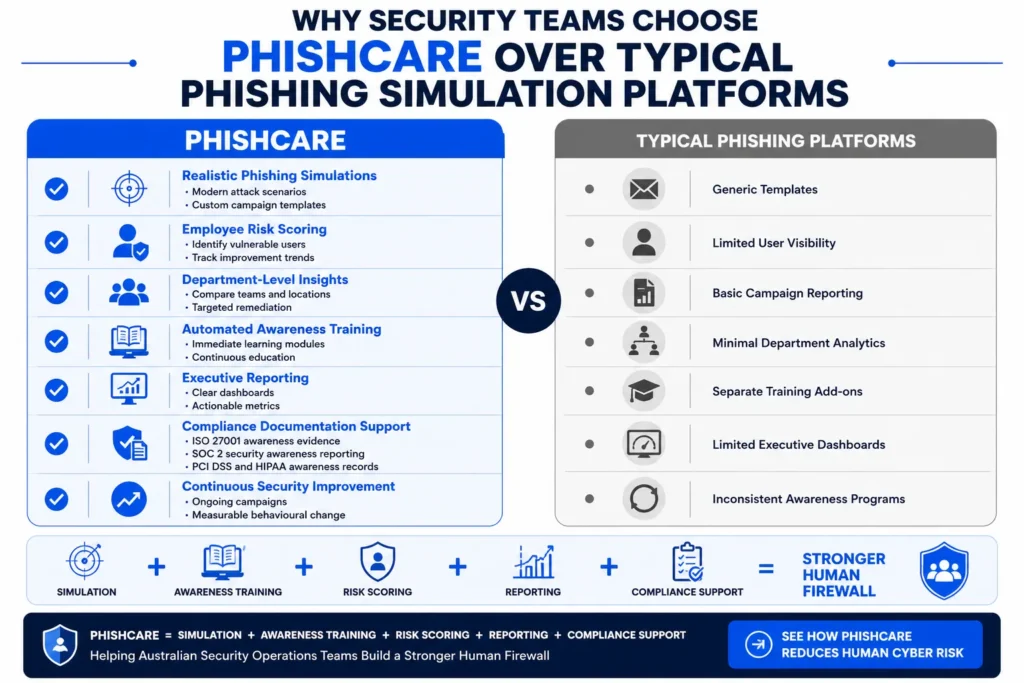
PhishCare vs Typical Phishing Simulation Platforms
Many phishing simulation tools offer basic campaign delivery and awareness testing. However, modern security operations teams need deeper visibility into employee risk, stronger automation, actionable reporting, and continuous awareness programs. The comparison below highlights where PhishCare provides additional value for Australian organisations.
| Evaluation Criteria | PhishCare | Typical Platforms |
|---|---|---|
| Customisable Phishing Campaigns | ✓ | Limited |
| Department-Wise Risk Analysis | ✓ | Basic |
| Employee Risk Scoring | ✓ | Not Always Available |
| Automated Awareness Training | ✓ | Varies |
| Detailed Executive Reporting | ✓ | Limited |
| Compliance-Friendly Documentation | ✓ | Partial |
| Continuous Security Awareness Programs | ✓ | Often Separate Add-On |
A Platform Built for Measurable Security Outcomes
Rather than focusing solely on phishing email delivery, PhishCare combines phishing simulations, employee awareness training, risk scoring, campaign analytics, and management reporting into a single platform. This allows security teams to move beyond testing and create continuous improvements in employee cyber resilience across the organisation.
Realistic Phishing Simulations That Reflect Modern Threats
The effectiveness of any phishing simulation platform depends on one critical factor: realism. Employees can only develop stronger phishing detection skills when they are exposed to scenarios that closely resemble the attacks they encounter in their daily work environment. Generic test emails often fail to measure real-world behaviour because employees quickly recognize them as training exercises.
PhishCare helps security teams create realistic phishing simulations based on current attack techniques, business communication patterns, and evolving social engineering tactics. This allows organisations to evaluate employee responses under conditions that more accurately reflect genuine cyber threats.
Real-World Attack Scenarios
Simulate credential harvesting attacks, invoice fraud attempts, executive impersonation campaigns, cloud application phishing, and other common threat techniques.
Custom Campaign Design
Tailor campaigns to departments, user groups, locations, or specific organisational risk profiles for more meaningful assessments.
Continuous Threat Relevance
Campaigns can be updated regularly to reflect new phishing techniques, seasonal scams, and emerging cybercriminal tactics.
Why This Matters for Security Operations Teams
Realistic simulations generate more accurate behavioural data. Security teams gain clearer visibility into which employees are susceptible to phishing attacks, which departments require additional training, and where remediation efforts should be prioritised. The result is a more resilient workforce and a stronger first line of defence against cyber threats.
Security Awareness Training That Drives Behaviour Change
Many organisations conduct annual cybersecurity awareness sessions to satisfy internal policies or compliance expectations. While these programs provide foundational knowledge, employees often forget what they learned within weeks. Security awareness becomes effective only when it is continuous, engaging, and directly connected to real-world risks.
PhishCare combines phishing simulations with integrated security awareness training, helping employees understand why they clicked, what warning signs they missed, and how to respond more effectively in the future. This creates long-term behavioural improvements rather than short-term awareness spikes.
Micro-Learning Modules
Short, focused learning sessions help employees absorb key security concepts without disrupting productivity or overwhelming users with excessive information.
Targeted Remediation
Employees who interact with phishing simulations can receive additional training content tailored to the specific risks they demonstrated.
Continuous Reinforcement
Regular awareness activities help transform cybersecurity knowledge into everyday workplace habits and decision-making behaviours.
Building a Stronger Human Firewall
Technology alone cannot stop every phishing attack. Employees remain one of the most targeted entry points for cybercriminals. By combining realistic phishing simulations with continuous awareness education, organisations can reduce risky behaviour, improve reporting rates, and strengthen their overall security culture.
Why This Matters for Compliance and Risk Management
Employee awareness remains a recognised security best practice across frameworks such as ISO 27001, SOC 2 Type II, PCI DSS, HIPAA, and NIST CSF. PhishCare’s awareness training and simulation reporting can provide valuable documentation that demonstrates ongoing employee education and security awareness initiatives.
Powerful Reporting and Actionable Insights
Running phishing simulations is only valuable when organisations can clearly understand the results. Security leaders need more than click-rate statistics. They need visibility into employee risk levels, behavioural trends, departmental weaknesses, training effectiveness, and overall organisational resilience.
PhishCare provides detailed reporting dashboards that transform phishing simulation results into meaningful intelligence. Instead of manually analysing spreadsheets or disconnected reports, security teams can quickly identify high-risk users, track awareness improvements, and make data-driven decisions that strengthen organisational security.
User Risk Analysis
Identify employees who repeatedly interact with phishing simulations and may require additional awareness training or remediation support.
Department-Level Visibility
Compare phishing susceptibility across departments, business units, locations, or teams to prioritise awareness efforts effectively.
Campaign Performance Metrics
Measure click rates, credential submissions, email opens, reporting behaviour, and overall employee engagement.
Trend Tracking
Monitor awareness progress over time and evaluate whether security training initiatives are reducing organisational risk.
From Data to Security Decisions
Reporting should not simply document what happened. It should help organisations understand why employees are vulnerable and what actions can reduce future risk. PhishCare’s reporting framework enables security teams to focus resources where they will have the greatest impact, improving both efficiency and security outcomes.
Why Security Leaders Value Reporting
Executives, auditors, compliance managers, and security teams all require evidence that awareness programs are working. PhishCare’s reporting capabilities provide clear visibility into security awareness performance while supporting broader governance, risk management, and compliance initiatives across the organisation.
Automation That Saves Time for Security Teams
Security operations teams already manage a growing list of responsibilities, including threat monitoring, incident response, vulnerability management, compliance activities, and security awareness initiatives. Managing phishing simulations manually can quickly become time-consuming, especially for organisations with large or distributed workforces.
PhishCare simplifies phishing program management through automation. From campaign scheduling to user management and training assignments, the platform helps security teams reduce administrative overhead while maintaining consistent employee engagement throughout the year.
Automated Campaign Scheduling
Plan phishing simulations in advance and run recurring campaigns automatically without requiring constant manual intervention.
Automatic Training Assignment
Employees who interact with phishing simulations can automatically receive relevant awareness training based on their behaviour.
Scalable User Management
Efficiently manage awareness programs across multiple departments, business units, and geographic locations from a single platform.
Consistent Awareness Programs
Ensure security awareness initiatives continue throughout the year without relying on manual campaign execution.
Reducing Administrative Burden
Automation allows security professionals to spend less time coordinating campaigns and more time focusing on strategic initiatives. Rather than manually managing every stage of the awareness lifecycle, teams can rely on automated workflows that deliver consistent and measurable outcomes.
Why Automation Matters in Modern Security Operations
As cyber threats continue to increase, security teams are expected to accomplish more with limited resources. Automated phishing simulation and awareness workflows help organisations maintain continuous security education while reducing operational workload, improving efficiency, and supporting long-term cybersecurity maturity.
Supports Compliance and Risk Management Initiatives
For many organisations, phishing simulations are not just about awareness training. They also play an important role in demonstrating that security awareness programs are active, measurable, and continuously improving. Security leaders, auditors, and compliance teams increasingly expect evidence that employees receive ongoing cybersecurity education and are regularly tested against social engineering threats.
PhishCare helps organisations strengthen their risk management programs by providing structured phishing simulations, awareness training records, employee participation metrics, and detailed reporting that can support broader governance and compliance objectives.
ISO 27001 Awareness Support
Maintain evidence of ongoing employee awareness activities and phishing simulations as part of a broader information security management program.
SOC 2 Type II Readiness
Provide documentation that demonstrates ongoing security awareness efforts and employee engagement throughout the audit observation period.
Risk-Based Security Programs
Identify high-risk users and departments, helping organisations focus awareness resources where they are needed most.
Audit-Friendly Reporting
Generate reports that clearly demonstrate awareness activities, participation levels, and phishing simulation outcomes.
How Phishing Simulations Contribute to Compliance Efforts
- Demonstrate continuous employee awareness activities.
- Create measurable records of phishing testing and participation.
- Support internal risk assessments and security reviews.
- Provide documented evidence for audit preparation activities.
- Help identify human-related security risks before they lead to incidents.
- Strengthen overall governance, risk, and compliance initiatives.
A Practical Approach to Reducing Human Risk
While phishing simulations alone do not guarantee compliance, they provide valuable evidence that an organisation is actively investing in employee awareness and risk reduction. PhishCare’s reporting and awareness capabilities offer an additional documentation boost for organisations working toward ISO 27001, SOC 2 Type II, PCI DSS, HIPAA, and NIST CSF objectives where ongoing security awareness is widely recognised as a security best practice.
Department-Wise Risk Visibility and Employee Risk Scoring
Not all employees face the same level of phishing risk. Finance teams may be targeted with invoice fraud, HR departments frequently receive recruitment-related phishing attempts, while executives are often targeted through impersonation and business email compromise campaigns. Treating every employee group the same can lead to inefficient security awareness programs and missed risk reduction opportunities.
PhishCare provides department-level visibility and employee risk scoring capabilities that help security teams understand exactly where vulnerabilities exist. Instead of relying on organisation-wide averages, administrators can identify specific users, departments, and business units that require additional support.
Individual Risk Scoring
Track employee behaviour across phishing simulations and identify users who may require additional awareness training or coaching.
Department-Level Analysis
Compare phishing susceptibility between departments to identify areas where security awareness efforts can deliver the greatest impact.
Targeted Awareness Programs
Deliver department-specific simulations and training content that reflect the threats employees are most likely to encounter.
Risk-Based Decision Making
Allocate awareness resources more effectively by focusing on the users and teams that present the highest organisational risk.
Why Risk Visibility Matters
A single phishing click by a high-privilege user can have far greater consequences than multiple clicks from low-risk accounts. By combining employee risk scoring with department-level analytics, security teams gain the context needed to prioritise awareness activities, strengthen controls, and reduce the likelihood of successful phishing attacks.
Turning Security Awareness Into Measurable Risk Reduction
The goal of phishing simulations is not simply to measure who clicks. The real objective is to reduce organisational risk over time. PhishCare’s risk scoring and visibility features help organisations move from awareness metrics to meaningful risk management outcomes, creating a more resilient workforce and a stronger security posture.
Designed for Australian Organisations and Security Teams
Australian organisations face a rapidly evolving cyber threat landscape. From ransomware groups targeting critical infrastructure to phishing campaigns aimed at healthcare providers, educational institutions, financial services firms, and government agencies, human error continues to be one of the most exploited attack vectors.
PhishCare has been developed to help Australian organisations strengthen employee awareness, improve phishing resilience, and build sustainable security awareness programs. The platform combines phishing simulations, awareness training, risk scoring, automation, and reporting capabilities in a single solution that aligns with the operational realities of modern security teams.
Built for Local Security Needs
Designed to support organisations operating within Australia’s evolving cybersecurity and regulatory environment.
Suitable Across Industries
Supports awareness programs for healthcare, education, finance, professional services, government, technology, and other sectors.
Scales With Growth
Whether supporting a small business or a large enterprise, awareness programs can scale alongside organisational requirements.
Backed by CyberSapiens
Developed by CyberSapiens, a cybersecurity company supporting organisations with security services, awareness initiatives, compliance programs, and cyber risk management.
Why Organisations Continue Choosing PhishCare
The most successful phishing simulation programs are those that become part of an organisation’s long-term security strategy. By combining realistic simulations, awareness training, automation, risk analytics, and reporting capabilities, PhishCare helps organisations move beyond one-time testing and create lasting improvements in employee cybersecurity behaviour.
The Verdict
When evaluating phishing simulation platforms, security teams should look beyond email testing alone. The ability to deliver realistic phishing scenarios, continuous awareness training, risk-based reporting, automation, and measurable security improvements is what ultimately determines long-term success. These capabilities are the reason PhishCare continues to stand out as a preferred phishing simulation platform for security operations teams across Australia.
Key Takeaways: Why PhishCare Stands Out
Selecting the right phishing simulation platform is not simply about running phishing tests. Security teams need a solution that helps reduce human risk, improve employee awareness, provide meaningful reporting, and support long-term security objectives. PhishCare brings these capabilities together in a single platform designed to help organisations build a stronger security culture.
1. Realistic Simulations
Create phishing scenarios that closely reflect modern cyber threats and employee attack surfaces.
2. Continuous Awareness Training
Reinforce security knowledge through ongoing education and targeted learning experiences.
3. Actionable Reporting
Gain visibility into employee behaviour, risk trends, and awareness program effectiveness.
4. Automation
Reduce manual effort through automated campaigns, user management, and training workflows.
5. Compliance Support
Provide valuable awareness documentation that supports governance and compliance initiatives.
6. Risk Visibility
Identify vulnerable users and departments using risk scoring and detailed analytics.
A Smarter Approach to Phishing Resilience
PhishCare helps organisations move beyond basic phishing testing by combining simulations, awareness training, reporting, automation, and risk analytics into a unified platform. This holistic approach enables security operations teams to continuously strengthen employee resilience against phishing attacks while building a stronger overall security posture.
Frequently Asked Questions
Here are answers to some of the most common questions security leaders, IT managers, compliance professionals, and business owners ask when evaluating phishing simulation platforms.
What is a phishing simulation tool?
A phishing simulation tool helps organisations test employee awareness by sending realistic but safe phishing emails. These simulations allow security teams to identify vulnerabilities, measure employee responses, and deliver targeted awareness training.
Why are phishing simulations important for Australian organisations?
Phishing remains one of the most common cyberattack methods targeting Australian businesses. Regular phishing simulations help employees recognize suspicious emails, reduce risky behaviour, and strengthen overall organisational resilience against social engineering attacks.
How does PhishCare help improve employee awareness?
PhishCare combines phishing simulations with awareness training, employee risk scoring, automated remediation, and reporting. This helps organisations create continuous learning opportunities that improve employee decision-making over time.
Can phishing simulation reports support compliance initiatives?
Yes. PhishCare’s reporting can provide an additional documentation boost for organisations working toward ISO 27001, SOC 2 Type II, PCI DSS, HIPAA, and NIST CSF objectives where ongoing security awareness is recognised as a security best practice.
What industries can benefit from phishing simulations?
Phishing simulations are valuable across industries including healthcare, education, financial services, technology, government, manufacturing, retail, and professional services. Any organisation that relies on email communication can benefit from regular awareness testing.
How often should organisations run phishing simulations?
Most organisations achieve better results through ongoing monthly or quarterly phishing simulations combined with continuous awareness training. Regular testing helps reinforce learning and provides measurable improvements in employee resilience over time.
Content Reviewed By

Mohammed Nawaz Sajjad
Sr. Security Analyst at CyberSapiens | Phishing Simulation Specialist | Ethical Hacker | Bug Hunter | Red Team Professional
Mohammed Nawaz Sajjad is a practising security analyst specialising in phishing simulation campaigns, employee security awareness assessments, red team engagements, and ethical hacking. He works closely with organisations to evaluate phishing risks, strengthen employee cyber resilience, and improve organisational security awareness programs through practical, measurable security initiatives.
As part of CyberSapiens, he has supported phishing simulation deployments and awareness programs across multiple industries, helping organisations reduce human cyber risk and build stronger security cultures through continuous employee education.
View LinkedIn ProfileReady to Strengthen Your Human Firewall?
Phishing attacks continue to evolve, but employee awareness remains one of the strongest defenses available. PhishCare helps organisations reduce human cyber risk through realistic phishing simulations, security awareness training, employee risk scoring, automation, and actionable reporting.