Phishing Simulation & Security Awareness
Why Security Operations Teams in Canada Are Prioritizing Phishing Simulation in 2026
Security operations teams across Canada are facing a growing challenge. While organizations continue investing in firewalls, endpoint protection, cloud security, and threat detection technologies, attackers increasingly target employees through phishing campaigns. A single click on a malicious email can bypass technical controls and expose sensitive systems, customer data, and business operations.
As phishing attacks become more sophisticated, security leaders are moving beyond annual awareness sessions and adopting continuous phishing simulation programs that measure user behavior, identify high-risk employees, and reinforce security awareness through practical learning experiences.
This is where PhishCare, developed by CyberSapiens, has gained attention among security operations teams. Built to help organizations run realistic phishing simulations, deliver targeted awareness training, and generate actionable reporting, the platform helps security teams reduce human risk while building a stronger security culture across the organization.
What You’ll Learn in This Guide
1. The key factors security teams evaluate before choosing a phishing simulation platform.
2. The seven reasons PhishCare stands out for Canadian organizations.
3. How phishing simulations support security awareness and compliance initiatives.
How We Evaluated Phishing Simulation Tools for Security Operations Teams in Canada
Not all phishing simulation platforms are designed for the same audience. Some focus primarily on awareness training, while others prioritize campaign automation, reporting, integrations, and enterprise-scale deployments. For security operations teams, the evaluation criteria go beyond simply sending simulated phishing emails.
To identify the factors that matter most to Canadian organizations, we focused on the operational requirements commonly considered by security teams, compliance stakeholders, IT managers, and security leaders responsible for reducing human cyber risk.
1. Realistic Phishing Simulations
We assessed how effectively each platform can replicate modern phishing attacks, including credential harvesting campaigns, business email compromise scenarios, attachment-based threats, and social engineering techniques commonly used by attackers.
2. Automation & Ease of Management
Security teams often manage multiple responsibilities. We evaluated how easily administrators can launch campaigns, schedule recurring simulations, manage users, and automate reporting without creating additional workload.
3. Reporting & Risk Visibility
Detailed reporting helps security teams measure employee risk levels, identify vulnerable departments, track awareness improvements, and communicate results to leadership through meaningful metrics.
4. Awareness Training Capabilities
A phishing simulation is most effective when combined with continuous learning. We reviewed how platforms reinforce secure behavior through awareness modules, educational content, and targeted remediation programs.
5. Compliance Support
Organizations working toward ISO 27001, SOC 2 Type II, PCI DSS, HIPAA, or NIST CSF often look for evidence of ongoing security awareness efforts. We evaluated how reporting and documentation support these initiatives.
6. Scalability & Enterprise Readiness
Whether supporting a growing business or a large enterprise, the platform should be capable of handling multiple departments, locations, user groups, and long-term security awareness programs efficiently.
Using these evaluation criteria, PhishCare consistently stood out as a strong option for Canadian security operations teams seeking measurable phishing risk reduction, streamlined campaign management, and practical security awareness outcomes.
Comparing Leading Phishing Simulation Platforms for Security Operations Teams in Canada
Security teams evaluate phishing simulation platforms based on multiple operational requirements, including campaign automation, reporting depth, awareness training capabilities, scalability, and compliance support. The table below provides a high-level comparison of widely recognized phishing simulation solutions used by organizations worldwide.
| Platform | Phishing Simulation | Awareness Training | Automation | Reporting | Compliance Support |
|---|---|---|---|---|---|
| PhishCare | Comprehensive | Included | Advanced | Detailed Analytics | Strong Documentation |
| KnowBe4 | Comprehensive | Extensive Library | Advanced | Detailed | Awareness Reporting |
| Proofpoint | Comprehensive | Included | Advanced | Detailed | Security Metrics |
| Cofense | Strong | Available | Moderate | Good Visibility | Audit Support |
| Hoxhunt | AI-Based | Gamified | Advanced | Behavior Focused | Awareness Metrics |
While several platforms provide phishing simulation capabilities, organizations often prioritize solutions that combine realistic phishing scenarios, awareness training, automation, and reporting within a single platform. The next section explores the first reason many Canadian security operations teams choose PhishCare for ongoing phishing risk management.
Reason #1
Realistic Phishing Simulations Designed for Modern Threats
One of the biggest reasons Canadian security operations teams choose PhishCare is its ability to simulate phishing attacks that closely resemble the tactics used by real-world threat actors. Employees are no longer targeted only with poorly written emails. Modern phishing campaigns frequently imitate trusted brands, internal business communications, cloud service notifications, HR messages, invoice requests, and executive communications.
PhishCare helps organizations test employee readiness against these evolving attack methods through realistic phishing scenarios that challenge users in a safe and controlled environment. By exposing employees to simulated attacks that mirror current threats, organizations gain a clearer understanding of how their workforce might respond during an actual phishing incident.
Rather than relying solely on theoretical awareness training, security teams can identify behavioral weaknesses, measure susceptibility to phishing attacks, and provide targeted education where it is needed most.
Credential Harvesting Scenarios
Simulate phishing emails that direct users to realistic login pages, helping organizations evaluate how employees respond to credential theft attempts.
Business Email Impersonation
Test user responses to executive requests, internal communications, invoice approvals, and other social engineering techniques commonly used by attackers.
Attachment-Based Threat Simulations
Assess how employees interact with suspicious attachments and malicious file delivery techniques frequently observed in phishing campaigns.
Why This Matters for Security Operations Teams
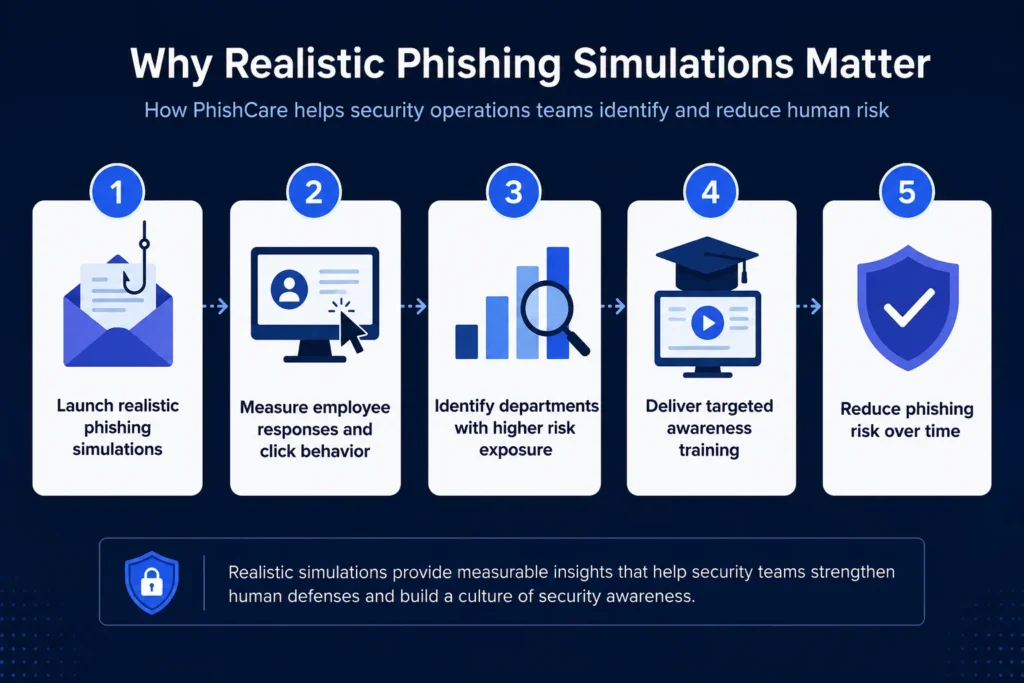
Security operations teams need visibility into human risk, not just technical vulnerabilities. Realistic phishing simulations provide measurable data on employee behavior, helping teams prioritize awareness initiatives, strengthen incident response readiness, and reduce the likelihood of successful phishing attacks across the organization.
Reason #2
Automated Campaign Management That Saves Security Teams Valuable Time
Managing phishing simulations manually can quickly become overwhelming, especially for organizations running recurring awareness programs across multiple departments, business units, or locations. Security operations teams need a solution that minimizes administrative effort while maintaining consistent testing and reporting.
PhishCare simplifies campaign execution through automation features that help security teams deploy phishing simulations at scale. Administrators can schedule campaigns in advance, automate recurring assessments, assign users to groups, and receive reporting without manually managing every campaign cycle.
This automation enables security professionals to spend less time on campaign administration and more time analyzing risks, improving awareness strategies, and strengthening overall security posture.
Automated Scheduling
Create phishing campaigns weeks or months in advance and automatically deliver simulations without manual intervention.
Department-Based Targeting
Run customized simulations for finance, HR, executives, IT teams, and other departments based on their unique risk profiles.
Recurring Awareness Programs
Maintain continuous testing throughout the year instead of relying on one-time security awareness initiatives.
Operational Benefits for Security Operations Teams
For many organizations, security teams operate with limited resources while managing a growing list of cybersecurity responsibilities. Automated phishing simulations help reduce administrative overhead, ensure testing consistency, and provide ongoing visibility into employee risk trends throughout the year.
Reason #3
Comprehensive Reporting and Actionable Security Insights
Running phishing simulations is only valuable when organizations can clearly understand the results and take meaningful action. Security operations teams require more than basic click-rate statistics. They need detailed visibility into employee behavior, organizational risk levels, recurring weaknesses, and long-term awareness improvements.
PhishCare provides reporting dashboards designed to help security teams transform simulation data into practical security decisions. Instead of reviewing isolated campaign outcomes, administrators can identify trends, measure risk reduction over time, and determine where additional awareness efforts are required.
This level of visibility allows organizations to move from reactive awareness initiatives to data-driven security programs that continuously improve employee resilience against phishing attacks.
Employee Risk Scoring
Identify individuals who repeatedly interact with phishing simulations and may require additional awareness training or targeted coaching.
Department-Level Insights
Compare risk exposure across departments, business units, and teams to understand where phishing awareness improvements are most needed.
Trend Analysis
Track awareness performance across multiple campaigns and measure how employee behavior improves over time.
Executive Reporting
Present security awareness performance and phishing risk metrics to leadership through clear, easy-to-understand reporting dashboards.
What Security Teams Can Measure with PhishCare Reporting
✓ Phishing email open rates
✓ Click-through rates
✓ Credential submission attempts
✓ Department risk trends
✓ High-risk employee groups
✓ Long-term awareness improvements
Why Reporting Matters
Security leaders increasingly need measurable evidence that awareness programs are reducing organizational risk. Detailed reporting helps demonstrate progress, justify security investments, support audit discussions, and guide future awareness initiatives based on real employee behavior rather than assumptions.
Reason #4
Built to Support Security Awareness and Compliance Initiatives
For many Canadian organizations, phishing simulations are not just about testing employees. They are also part of a broader strategy to improve security awareness, reduce human risk, and demonstrate ongoing security improvement efforts across the organization.
Security leaders increasingly need evidence that awareness programs are active, measurable, and continuously improving. PhishCare helps organizations establish repeatable phishing simulation and awareness initiatives that generate meaningful reporting and measurable outcomes.
The platform’s reporting capabilities provide an additional documentation boost for organizations working toward ISO 27001, SOC 2 Type II, PCI DSS, HIPAA, and NIST CSF, where ongoing security awareness activities are widely recognized as a cybersecurity best practice.
ISO 27001 Awareness Support
Regular phishing simulations and employee awareness activities help organizations demonstrate a proactive approach to information security awareness initiatives.
SOC 2 Type II Readiness
Awareness reporting can help organizations show evidence of ongoing employee security education and risk reduction efforts.
PCI DSS Security Awareness
Organizations handling payment information can use phishing simulations to strengthen workforce awareness against social engineering attacks.
HIPAA & Privacy Programs
Healthcare and privacy-focused organizations can reinforce secure employee behavior through ongoing phishing awareness campaigns.
How PhishCare Supports Security Awareness Programs
✓ Recurring phishing simulations
✓ Employee awareness reinforcement
✓ Risk-based user identification
✓ Long-term behavior tracking
✓ Audit-friendly reporting
✓ Security culture improvement
Why This Matters
Modern compliance programs increasingly emphasize employee awareness and risk reduction. Organizations that continuously educate employees and measure awareness effectiveness are often better positioned to strengthen their overall cybersecurity posture while supporting broader governance and compliance objectives.
Reason #5
Scalable for Small Businesses, Mid-Market Organizations, and Large Enterprises
Security awareness challenges exist across organizations of every size. Small businesses often operate with limited security resources, while larger enterprises must manage thousands of employees across multiple departments, business units, and geographic locations. A phishing simulation platform must be flexible enough to support both scenarios effectively.
PhishCare is designed to scale alongside organizational growth. Whether a company is launching its first phishing awareness program or managing an enterprise-wide security awareness initiative, the platform provides the flexibility required to support evolving security objectives.
This scalability allows security teams to maintain consistent awareness testing and reporting without introducing unnecessary complexity as the organization expands.
Ideal for Growing Businesses
Organizations beginning their security awareness journey can quickly deploy phishing simulations without requiring extensive resources or complex configurations.
Supports Multiple Departments
Run department-specific phishing campaigns and awareness initiatives tailored to different risk profiles across the organization.
Enterprise-Wide Deployments
Large organizations can manage awareness programs across thousands of users while maintaining centralized reporting and visibility.
How PhishCare Scales with Organizational Growth
Small Teams
Growing Businesses
Enterprise Users
Distributed Teams
Why Scalability Matters
Many organizations outgrow security awareness platforms that were initially selected for short-term needs. A scalable phishing simulation platform helps maintain consistency, supports business growth, and ensures that security awareness initiatives remain effective as employee numbers and organizational complexity increase.
Reason #6
Continuous Security Awareness Training Beyond Phishing Simulations
Phishing simulations are most effective when they are part of a broader security awareness strategy. While simulated attacks help identify risky behaviors, organizations also need a structured way to educate employees and reinforce secure decision-making throughout the year.
PhishCare combines phishing simulations with continuous awareness learning, helping organizations move beyond simple testing and toward lasting behavior change. Employees receive practical guidance that helps them recognize suspicious emails, social engineering tactics, credential theft attempts, and other common cyber threats they may encounter during their daily work.
This combination of testing, learning, and reinforcement helps create a stronger security culture where employees become an active layer of defense rather than a potential security weakness.
Targeted Learning Modules
Provide employees with focused training that addresses specific phishing risks and security awareness gaps identified during simulations.
Behavior Reinforcement
Regular awareness activities help employees retain security knowledge and apply it when encountering real-world phishing attempts.
Ongoing Education
Maintain security awareness throughout the year instead of relying solely on annual cybersecurity training sessions.
Building a Stronger Security Culture
✓ Better phishing recognition skills
✓ Increased employee confidence
✓ Improved threat reporting habits
✓ Reduced human-related risk
✓ Consistent awareness engagement
✓ Long-term security behavior improvement
Why Continuous Awareness Matters
Cyber threats evolve constantly, and employee awareness can fade over time if not reinforced. Continuous security awareness training helps organizations keep cybersecurity top of mind, improve phishing detection capabilities, and build a workforce that is better prepared to recognize and respond to modern social engineering attacks.
Reason #7
Dedicated Support and Practical Deployment Assistance
Even the most feature-rich phishing simulation platform can fall short if organizations struggle with deployment, campaign planning, or long-term program management. Security operations teams often need practical guidance to ensure phishing simulations deliver meaningful results rather than becoming another underutilized security tool.
One of the reasons organizations choose PhishCare is the combination of technology and expert support. Developed by CyberSapiens, the platform is backed by cybersecurity professionals with experience in phishing simulations, security awareness programs, compliance initiatives, and risk management projects across multiple industries.
This helps organizations launch phishing awareness programs faster, align simulations with business objectives, and continuously improve security awareness outcomes over time.
Deployment Guidance
Receive assistance with initial setup, campaign planning, user onboarding, and phishing simulation deployment strategies.
Security Awareness Expertise
Benefit from practical insights gained through real-world phishing simulation programs and employee awareness initiatives.
Long-Term Program Support
Continuously refine phishing campaigns, reporting strategies, and awareness programs as organizational requirements evolve.
What Organizations Often Need Beyond Technology
✓ Campaign planning assistance
✓ User segmentation guidance
✓ Awareness strategy recommendations
✓ Reporting interpretation support
✓ Security culture improvement planning
✓ Continuous program optimization
Why This Makes a Difference
Many phishing simulation programs fail because organizations focus only on technology and not on adoption, engagement, and continuous improvement. Combining a phishing simulation platform with practical cybersecurity expertise helps security teams maximize value, improve participation, and achieve stronger long-term awareness outcomes.
Why Canadian Security Operations Teams Continue to Choose PhishCare
Reducing phishing risk requires more than awareness presentations and annual training sessions. Organizations need a practical way to measure employee risk, improve awareness continuously, and strengthen security culture through data-driven decision-making.
Throughout this guide, we’ve explored the seven key reasons why many Canadian security operations teams select PhishCare as their phishing simulation platform. The platform combines realistic phishing simulations, automation, reporting, awareness training, scalability, and expert support within a single solution designed to help organizations reduce human cyber risk.
As phishing attacks continue evolving, organizations that regularly test employees, reinforce secure behavior, and measure awareness effectiveness are often better positioned to detect threats earlier and improve organizational resilience over time.
1. Realistic Simulations
Test employees using phishing scenarios that closely resemble modern attack techniques.
2. Campaign Automation
Reduce administrative workload through automated scheduling and recurring campaigns.
3. Actionable Reporting
Transform simulation results into meaningful security insights and measurable improvements.
4. Awareness & Compliance Support
Strengthen awareness programs while supporting broader governance and compliance initiatives.
5. Enterprise Scalability
Support growing businesses and enterprise environments from a single platform.
6. Continuous Learning
Reinforce employee awareness through ongoing education and behavioral improvement.
7. Expert Deployment Assistance
Benefit from practical cybersecurity expertise that helps maximize the effectiveness of phishing awareness programs.
Key Takeaway
Organizations cannot completely eliminate phishing attacks, but they can significantly reduce the likelihood of successful compromises through continuous testing, employee education, and measurable awareness programs. PhishCare provides security operations teams with the tools and insights needed to build stronger human defenses against phishing threats.
Frequently Asked Questions
Common questions security leaders, IT managers, and compliance teams ask when evaluating phishing simulation platforms.
What is a phishing simulation tool?
A phishing simulation tool allows organizations to send controlled phishing emails to employees in order to measure awareness levels, identify risky behaviors, and improve employee resilience against real phishing attacks through ongoing education and testing.
Why do Canadian organizations use phishing simulations?
Canadian organizations use phishing simulations to understand employee risk levels, strengthen cybersecurity awareness, reduce successful phishing attempts, and support broader security awareness initiatives across the organization.
How often should phishing simulations be conducted?
Many organizations run phishing simulations monthly or quarterly to maintain awareness, track employee behavior trends, and reinforce cybersecurity best practices throughout the year.
Can phishing simulations support ISO 27001 and SOC 2 initiatives?
Yes. Phishing simulation reports can provide an additional documentation boost for organizations working toward ISO 27001, SOC 2 Type II, PCI DSS, HIPAA, and NIST CSF, where ongoing security awareness activities are considered a cybersecurity best practice.
What features should security teams look for in a phishing simulation platform?
Key features include realistic phishing scenarios, automated campaign management, employee risk scoring, awareness training modules, reporting dashboards, compliance-friendly documentation, and scalability for organizational growth.
Why is PhishCare a popular choice for security operations teams?
PhishCare combines phishing simulations, awareness training, reporting, automation, and expert deployment support in a single platform, helping organizations reduce human cyber risk and strengthen security awareness programs.
Content Reviewed By

Mohammed Nawaz Sajjad is a practising security analyst specializing in phishing simulation campaigns, employee security awareness assessments, red team exercises, and ethical hacking. He leads phishing simulation deployments at PhishCare, a platform developed by CyberSapiens, helping organizations strengthen employee awareness, reduce phishing risk, and build measurable security awareness programs across multiple industries.
View LinkedIn ProfileReduce Human Cyber Risk
Ready to Strengthen Your Phishing Defense Program?
See how PhishCare helps Canadian organizations run realistic phishing simulations, automate awareness campaigns, identify high-risk users, and measure security awareness improvements through actionable reporting.
Request a Demo
Book a personalized walkthrough and see how PhishCare can help your security team reduce phishing risk and improve employee awareness.
sales@phishcare.com
Phone
1300 507 668