Cyber attacks no longer target only technology systems. They increasingly target employees through phishing emails, social engineering tactics, credential theft attempts, malicious links, and AI-generated scams. Even organizations with strong security controls can become vulnerable when employees are not equipped to recognize and respond to cyber threats.
Cyber security awareness training helps employees understand modern cyber risks, recognize suspicious activity, and make safer security decisions in their day-to-day work. When combined with phishing simulations and ongoing education, awareness programs can significantly reduce human-related security incidents while strengthening an organization’s overall security culture.
In this guide, we explain what cyber security awareness training is, why it matters, how to conduct an effective program, common mistakes organizations make, and how phishing simulation exercises can help reinforce learning outcomes over time.
Cyber Security Awareness Training at a Glance
Organizations increasingly view employee awareness as a critical layer of defense. Security awareness training, reinforced through realistic phishing simulations, helps employees identify threats earlier and respond more confidently when suspicious activity occurs.
What Is Cyber Security Awareness Training?
Cyber security awareness training is an educational program designed to help employees recognize, avoid, and respond appropriately to cyber threats. Its primary purpose is to reduce human-related security risks by teaching employees how cybercriminals operate and what actions they can take to protect organizational data, systems, and customer information.
Unlike technical security controls such as firewalls, endpoint protection, or intrusion detection systems, awareness training focuses on human behavior. It equips employees with the knowledge and confidence needed to identify suspicious emails, verify unusual requests, report security incidents, create strong passwords, and safely use company resources.
Simple Definition
Cyber security awareness training teaches employees how to identify cyber threats, avoid risky behavior, and make security-conscious decisions that help protect the organization from attacks such as phishing, ransomware, social engineering, and credential theft.
Modern awareness programs go beyond annual compliance presentations. Effective organizations now combine interactive learning modules, phishing simulations, role-based training, security newsletters, microlearning sessions, and continuous reinforcement activities to build a stronger security culture throughout the year.
Key Objectives of Cyber Security Awareness Training
Help employees identify phishing emails, scams, malware, and social engineering attempts.
Minimize accidental actions that could expose systems, credentials, or sensitive information.
Encourage employees to quickly report suspicious activity before incidents escalate.
Create a workplace where cyber security becomes part of everyday decision-making.
Awareness Training vs Security Training
Security awareness training focuses on educating all employees about cyber risks and safe behavior. Security training is typically more technical and designed for IT teams, security professionals, administrators, and specialists responsible for implementing and managing security controls. Most organizations need both to build a mature security posture.
Why Cyber Security Awareness Training Matters More Than Ever
Cyber threats have evolved significantly over the last few years. Attackers no longer focus exclusively on exploiting software vulnerabilities. Instead, they increasingly target employees because human behavior remains one of the most accessible attack vectors in any organization.
Modern phishing emails, business email compromise attacks, AI-generated scams, deepfake voice messages, and social engineering campaigns are becoming more convincing and harder to detect. As a result, organizations must ensure that employees can identify suspicious activity before it turns into a security incident.
The Modern Cyber Threat Landscape
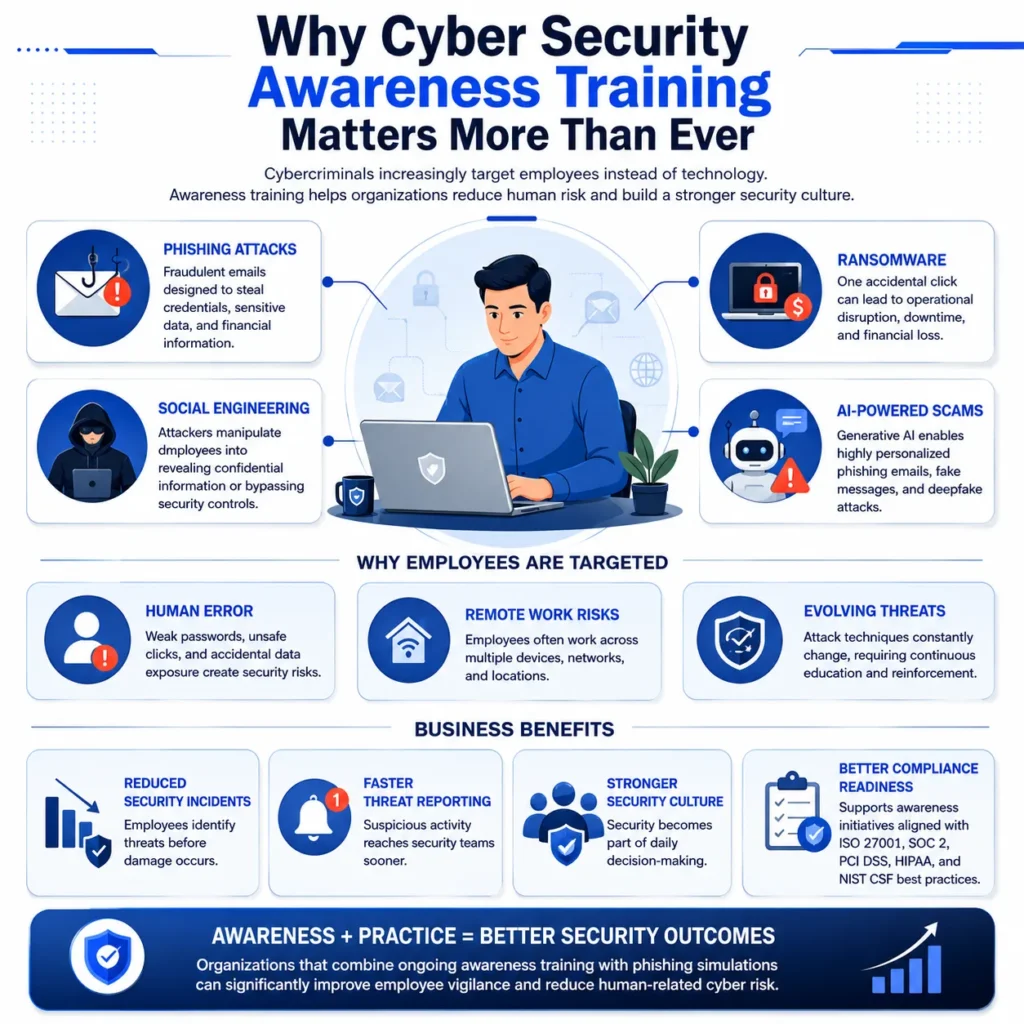
Employees face a growing number of cyber threats every day. Security awareness training helps organizations reduce the likelihood of successful attacks by improving employee decision-making and threat recognition.
Phishing Attacks
Fraudulent emails designed to steal credentials, financial information, or gain unauthorized access.
Social Engineering
Attackers manipulate employees into revealing sensitive information or bypassing security procedures.
Ransomware
A single click on a malicious link or attachment can lead to major operational disruption.
AI-Powered Scams
Generative AI enables attackers to create highly personalized and convincing phishing campaigns.
Why Employees Remain the Primary Target
Organizations invest heavily in security technologies, yet attackers often bypass technical defenses by targeting employees directly. Cybercriminals understand that convincing one employee to click a malicious link can be easier than compromising a well-secured network.
Human Error Risks
Weak passwords, accidental data sharing, clicking suspicious links, and ignoring security policies can create security gaps.
Remote Work Challenges
Distributed workforces increase exposure to phishing emails, unsecured networks, and device-related risks.
Rapidly Changing Threats
Cyber threats evolve constantly, requiring ongoing awareness rather than one-time annual training sessions.
Business Benefits of Security Awareness Training
1. Reduced Security Incidents
Employees become better equipped to identify and avoid cyber threats.
2. Faster Threat Reporting
Suspicious activity is reported earlier, helping security teams respond faster.
3. Stronger Security Culture
Security awareness becomes part of everyday business operations.
4. Better Compliance Readiness
Awareness programs support security best practices often associated with frameworks such as ISO 27001, SOC 2, PCI DSS, HIPAA, and NIST CSF.
The Cost of Untrained Employees
Many organizations invest heavily in firewalls, endpoint security, cloud security, and threat monitoring solutions. However, even the most advanced security technologies can be undermined if employees are unable to recognize cyber threats or respond appropriately when suspicious activity occurs.
Cybercriminals understand that human error remains one of the easiest ways to gain access to systems, credentials, and sensitive information. A single click on a malicious email, attachment, or fraudulent request can trigger a costly security incident with long-term operational and reputational consequences.
What Can Happen Without Security Awareness Training?
Untrained employees may unintentionally expose organizations to cyber risks that impact business continuity, customer trust, financial performance, and regulatory obligations.
Credential Theft
Employees may unknowingly enter usernames and passwords into phishing websites that appear legitimate.
Data Breaches
Sensitive customer, financial, or business data may be exposed through avoidable employee actions.
Ransomware Infections
Malicious links or attachments can introduce ransomware that disrupts daily operations.
Business Email Compromise
Attackers impersonate executives, suppliers, or partners to manipulate employees into taking action.
The Hidden Business Impact
The consequences of cyber incidents extend beyond technical recovery efforts. Organizations often experience operational disruption, lost productivity, reputational damage, customer trust issues, and increased security remediation costs after preventable attacks.
Operational Downtime
Business processes can be disrupted when systems become unavailable due to cyber incidents.
Financial Losses
Organizations may incur recovery costs, incident response expenses, and lost business opportunities.
Reputational Damage
Customer confidence can decline when cyber incidents become public or affect service delivery.
Why Proactive Awareness Is More Cost-Effective
Preventing cyber incidents is often significantly less expensive than responding to them. Awareness training helps employees identify threats before they become security events, reducing the likelihood of costly remediation efforts and operational disruptions.
Organizations that combine awareness education with phishing simulations, continuous reinforcement, and measurable reporting create stronger human defenses and improve their overall cyber resilience over time.
Common Cyber Threats Employees Face
Cybercriminals rarely attack organizations through a single method. Instead, they use a combination of phishing, social engineering, credential theft, malware, and emerging AI-powered techniques to exploit human behavior. Understanding these threats helps employees make safer decisions and reduce the likelihood of successful attacks.
A well-designed cyber security awareness training program teaches employees how to identify these attack methods, recognize warning signs, and respond appropriately when suspicious activity occurs.
The Most Common Employee-Targeted Cyber Threats
Most successful cyber attacks begin with a human interaction. These are the threats employees encounter most frequently across modern workplaces.
Phishing Emails
Fraudulent emails designed to trick employees into revealing credentials, downloading malware, or making unauthorized payments.
Business Email Compromise
Attackers impersonate executives, vendors, or partners to manipulate employees into transferring money or sharing sensitive data.
Credential Theft
Fake login pages and malicious websites are used to steal usernames, passwords, and authentication details.
Ransomware
Malware encrypts files and systems, causing downtime and operational disruption until recovery procedures are completed.
Social Engineering
Attackers exploit trust, urgency, fear, or curiosity to persuade employees to take risky actions.
AI-Powered Scams
Generative AI enables highly convincing phishing emails, fake messages, voice impersonation, and deepfake attacks.
Warning Signs Employees Should Watch For
Unexpected Requests
Requests involving passwords, payments, or sensitive information should always be verified.
Urgent Language
Messages creating pressure or demanding immediate action are common social engineering tactics.
Suspicious Links
Employees should carefully inspect links and verify website destinations before clicking.
Unknown Attachments
Unexpected attachments may contain malware, ransomware, or malicious code.
Awareness Is the First Line of Defense
While security technologies help detect and block many threats, employees remain a critical layer of defense. Regular cyber security awareness training ensures staff can identify suspicious activity, avoid common attack techniques, and report potential threats before they become security incidents.
Core Components of an Effective Cyber Security Awareness Program
Successful cyber security awareness programs do more than deliver annual training sessions. They create ongoing learning experiences that help employees recognize evolving threats, reinforce secure behavior, and actively participate in protecting organizational assets.
Organizations that achieve the best outcomes typically combine education, practical exercises, continuous reinforcement, and measurable reporting into a structured awareness strategy.
The Building Blocks of an Effective Awareness Program
A mature awareness program combines multiple learning methods to keep employees engaged and improve long-term retention.
Awareness Training Modules
Structured learning sessions covering phishing, social engineering, password security, ransomware, data protection, and emerging cyber threats.
Phishing Simulations
Realistic phishing exercises help employees apply their knowledge in practical scenarios and identify areas for improvement.
Regular Reinforcement
Short awareness reminders, newsletters, videos, and microlearning sessions help maintain engagement throughout the year.
Incident Reporting Education
Employees should know how and when to report suspicious emails, unusual requests, and potential security incidents.
Role-Based Training
Different departments face different risks. Finance, HR, executives, and IT teams often require specialized awareness content.
Measurement & Reporting
Tracking participation, phishing simulation results, reporting rates, and risk trends helps demonstrate program effectiveness.
Characteristics of High-Performing Awareness Programs
Continuous Learning
Training is delivered throughout the year rather than relying on a single annual session.
Real-World Relevance
Examples and scenarios reflect actual threats employees are likely to encounter.
Measurable Outcomes
Organizations use reporting and metrics to evaluate behavioral improvements and risk reduction.
Why Phishing Simulations Are an Important Component
Training helps employees understand cyber threats, but simulations help determine whether that knowledge translates into real-world decision-making. Phishing simulations provide practical experience, reinforce learning, and help identify users who may need additional support.
Organizations frequently use simulation reporting as an additional documentation boost when working toward security frameworks such as ISO 27001, SOC 2 Type II, PCI DSS, HIPAA, and NIST CSF, where ongoing security awareness is widely recognized as a security best practice.
How to Conduct Cyber Security Awareness Training Step-by-Step
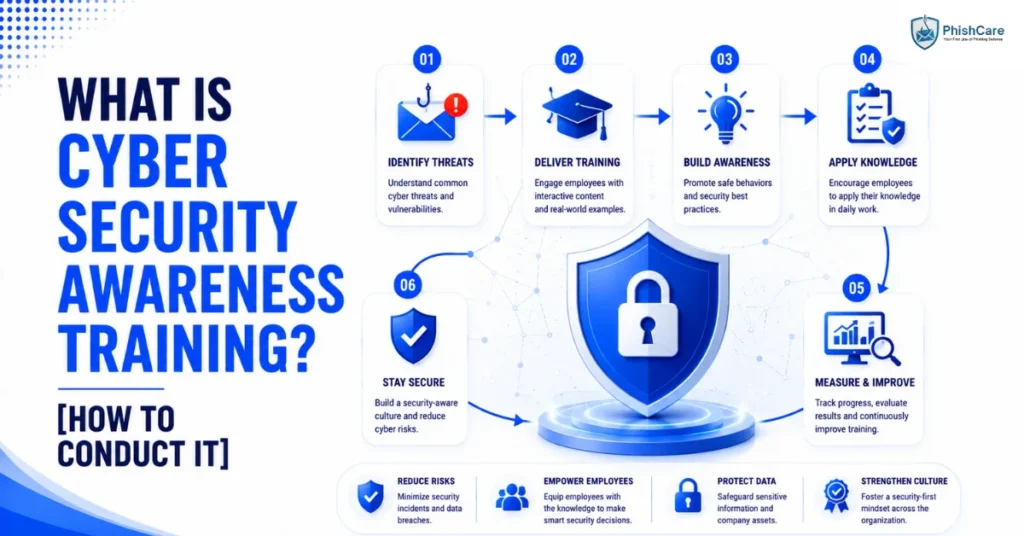
Many organizations understand the importance of security awareness training but struggle to implement a program that delivers measurable results. Effective awareness initiatives require more than simply distributing training material. They need a structured approach that combines education, assessment, reinforcement, and continuous improvement.
The following framework can help organizations build a sustainable cyber security awareness program that improves employee vigilance and reduces human-related cyber risks over time.
6-Step Awareness Training Framework
High-performing security awareness programs typically follow a continuous improvement cycle rather than treating awareness as a one-time event.
Assess Organizational Risk
Identify common threats, employee risk areas, business processes, and departments that may be most vulnerable to cyber attacks.
Develop Relevant Training Content
Create practical content focused on phishing, social engineering, password security, data protection, remote work security, and emerging threats.
Deliver Employee Training
Use engaging formats such as videos, interactive modules, workshops, webinars, and microlearning sessions to improve participation.
Run Phishing Simulations
Test employee awareness using realistic phishing scenarios that reflect current attack techniques and organizational risks.
Measure Performance
Track participation rates, phishing simulation results, reporting behavior, and knowledge assessments to evaluate effectiveness.
Continuously Improve
Use reporting insights and employee feedback to refine training content and address emerging threats.
Best Practices for Better Awareness Outcomes
Make Training Ongoing
Continuous learning is more effective than annual awareness sessions that employees quickly forget.
Use Realistic Scenarios
Training content should reflect actual threats employees encounter in their daily work environments.
Focus on Behavior Change
The goal is not simply knowledge retention but improving security-related decision-making.
What Successful Organizations Do Differently
Organizations that achieve stronger awareness outcomes typically combine employee education with regular phishing simulations, executive support, department-specific training, and measurable reporting. This approach transforms awareness training from a compliance activity into an ongoing security improvement initiative.
Over time, employees become more confident identifying suspicious activity, reporting threats quickly, and contributing to a stronger security culture across the organization.
Why Phishing Simulations Improve Awareness Outcomes
Training helps employees understand cyber threats, but knowledge alone does not always translate into secure behavior. Employees often perform well during training sessions yet struggle to identify real-world phishing attempts when faced with urgency, distractions, or sophisticated social engineering tactics.
This is where phishing simulations become valuable. By safely replicating realistic phishing attacks, organizations can evaluate employee readiness, reinforce learning, and identify areas that require additional awareness efforts.
How Phishing Simulations Work
Phishing simulations recreate the tactics commonly used by cybercriminals while providing organizations with a safe environment to measure employee responses and improve security awareness.
Simulated Email Campaign
Employees receive realistic phishing emails that mimic common attack techniques used by cybercriminals.
Employee Interaction
The system records actions such as email opens, link clicks, attachment interactions, and reporting behavior.
Awareness Reinforcement
Employees receive educational guidance and learning opportunities based on simulation outcomes.
Performance Reporting
Organizations gain visibility into risk levels, awareness trends, and areas requiring improvement.
Key Benefits of Phishing Simulations
Measures Real Behavior
Simulations assess how employees respond to realistic phishing scenarios rather than relying solely on knowledge assessments.
Identifies High-Risk Users
Organizations can identify departments or individuals who may require additional training and support.
Improves Threat Recognition
Repeated exposure to realistic phishing attempts helps employees develop stronger threat detection skills.
Provides Actionable Metrics
Reporting helps organizations track progress, benchmark results, and demonstrate awareness program effectiveness.
Beyond Training Completion Rates
Many organizations measure awareness success based solely on training completion percentages. While participation is important, it does not always indicate whether employees can identify phishing attacks in real situations.
Phishing simulations provide a practical way to evaluate behavioral change, helping organizations understand whether awareness initiatives are reducing actual cyber risk.
Awareness Training + Phishing Simulations = Stronger Human Defense
Organizations that combine awareness training with recurring phishing simulations often gain deeper visibility into employee risk, reinforce secure behaviors more effectively, and create measurable improvements in their overall security posture. Simulation reports can also provide an additional documentation boost for organizations working toward ISO 27001, SOC 2 Type II, PCI DSS, HIPAA, and NIST CSF, where ongoing security awareness is recognized as a security best practice.
How PhishCare Supports Employee Cyber Security Awareness
Building an effective security awareness program requires more than training content alone. Organizations need a practical way to measure employee readiness, identify high-risk behaviors, reinforce learning, and demonstrate ongoing improvements over time. This is where phishing simulations become a valuable part of a broader awareness strategy.
PhishCare, developed by CyberSapiens, helps organizations strengthen employee cyber awareness through realistic phishing simulations, awareness campaigns, risk-based reporting, and actionable insights that support continuous security improvement.
Awareness Programs Backed by Real-World Experience
Organizations across multiple industries use phishing simulations to assess employee readiness and reinforce cyber security awareness in a controlled environment.
Phishing simulations delivered across industries
Campaign success rate achieved through structured awareness initiatives
Key sectors served including banking, finance, healthcare, and IT
Key PhishCare Capabilities
Realistic Phishing Simulations
Launch phishing campaigns using realistic templates that replicate modern attack techniques and employee-targeted scams.
Risk-Based Reporting
Track click rates, reporting rates, employee risk scores, and campaign outcomes through centralized dashboards.
Awareness Learning Modules
Reinforce security knowledge with educational content designed to improve long-term awareness and threat recognition.
Department-Level Insights
Identify high-risk departments and target awareness initiatives where they will have the greatest impact.
What Security Teams Value Most
“We recently used PhishCare for a phishing simulation, and I’ve got to say, their email templates were top-notch. The realism and variety of the templates were impressive, really testing our team’s vigilance. The level of detail they put into crafting these emails was evident, making the simulation both challenging and effective. It’s clear they know their stuff when it comes to cybersecurity. Highly recommend them!”
Lachlan Glen
Operations and Plan Management Team Leader – LDS
Supporting Long-Term Security Awareness
Awareness programs are most effective when they combine education, practice, and measurement. PhishCare helps organizations continuously evaluate employee cyber readiness through recurring phishing simulations and reporting insights that support informed security decisions.
PhishCare campaign reports can also provide an additional documentation boost for organizations working toward ISO 27001, SOC 2 Type II, PCI DSS, HIPAA, and NIST CSF, where ongoing security awareness training is recognized as a security best practice.
Industries That Benefit Most from Cyber Security Awareness Training
Every organization faces cyber threats, but certain industries are particularly attractive targets due to the volume of sensitive data they handle, regulatory requirements they must meet, and the financial impact of successful attacks. For these sectors, employee awareness often plays a critical role in reducing cyber risk and strengthening organizational resilience.
While security technologies remain essential, employees frequently serve as the first line of defense against phishing, social engineering, credential theft, and business email compromise attacks.
Industries Where Awareness Training Delivers Significant Value
Organizations in high-risk sectors often prioritize awareness programs to help employees identify and respond to increasingly sophisticated cyber threats.
🏦 Banking & Financial Services
Financial institutions frequently face phishing attacks, account takeover attempts, payment fraud, and business email compromise campaigns targeting employees.
🏥 Healthcare
Healthcare organizations handle sensitive patient information and are often targeted by ransomware groups and credential theft campaigns.
💻 Information Technology
Technology companies manage valuable intellectual property, cloud infrastructure, and customer data that attract cybercriminals.
🎓 Education
Universities and educational institutions often have large user populations and decentralized environments that increase phishing exposure.
🏛 Government & Public Sector
Government agencies are frequently targeted by espionage campaigns, phishing attacks, and social engineering attempts.
🏭 Manufacturing
Manufacturing organizations increasingly rely on digital systems and connected environments that attackers seek to disrupt.
Common Awareness Priorities by Industry
| Industry | Common Threats | Training Focus |
|---|---|---|
| Banking | BEC, fraud, phishing | Verification procedures |
| Healthcare | Ransomware, credential theft | Patient data protection |
| IT | Account compromise | Access security awareness |
| Education | Phishing campaigns | User awareness at scale |
| Manufacturing | Social engineering | Operational security awareness |
One Awareness Program Does Not Fit Every Industry
While core cyber security principles remain consistent, the threats faced by healthcare professionals, finance teams, educators, and technology companies can vary significantly. Awareness programs are most effective when training content reflects the risks employees encounter in their specific industry and job role.
Industry-specific examples, realistic phishing scenarios, and targeted learning materials can improve engagement and help employees better recognize relevant threats.
Organizations Across Multiple Sectors Use Awareness Training
PhishCare has supported awareness initiatives across finance, banking, healthcare, and IT environments through phishing simulations and employee awareness programs designed to strengthen human defenses against modern cyber threats.
Client Success & Industry Experience
The effectiveness of a cyber security awareness program is best measured through real-world results. Over time, organizations across multiple industries have adopted phishing simulations and awareness initiatives to strengthen employee vigilance, reduce human-related cyber risks, and build a more resilient security culture.
PhishCare, developed by CyberSapiens, has supported organizations across finance, banking, healthcare, information technology, education, and professional services through realistic phishing simulations and ongoing awareness programs.
Awareness Programs Supported by Measurable Experience
Organizations use phishing simulations not only to educate employees but also to gain visibility into human risk and continuously improve awareness outcomes.
Phishing simulations delivered
Campaign success rate
Industries served globally
Organizations That Have Used PhishCare









What Customers Say
“We recently used PhishCare for a phishing simulation, and I’ve got to say, their email templates were top-notch. The realism and variety of the templates were impressive, really testing our team’s vigilance. The level of detail they put into crafting these emails was evident, making the simulation both challenging and effective. It’s clear they know their stuff when it comes to cybersecurity. Highly recommend them!”
Lachlan Glen
Operations and Plan Management Team Leader – LDS
Industries Served
Common Mistakes Organizations Make With Security Awareness Training
Many organizations invest in cyber security awareness training with the right intentions but fail to achieve meaningful improvements in employee behavior. In most cases, the issue is not the lack of training. The problem is how the program is designed, delivered, and measured over time.
Effective awareness programs focus on long-term behavioral change rather than simply completing a training requirement. Avoiding the following mistakes can significantly improve awareness outcomes and reduce human-related cyber risk.
The Most Common Awareness Training Mistakes
Organizations often focus on training completion while overlooking the factors that actually influence employee behavior and security outcomes.
Treating Awareness as a Once-a-Year Activity
Annual training alone is rarely enough. Employees need ongoing reinforcement to keep pace with evolving cyber threats.
Using Generic Training Content
Employees engage more effectively when training reflects real-world threats relevant to their roles and industry.
Failing to Test Awareness
Without phishing simulations or practical exercises, organizations cannot accurately assess employee readiness.
Ignoring High-Risk Groups
Finance teams, HR departments, executives, and administrators often require additional awareness attention.
Not Measuring Results
Completion rates alone do not demonstrate awareness effectiveness or behavioral improvement.
Creating a Culture of Blame
Employees should feel comfortable reporting mistakes and suspicious activity without fear of punishment.
What Effective Programs Do Instead
Continuous Reinforcement
Successful programs provide ongoing awareness activities throughout the year rather than relying on annual training.
Role-Based Learning
Training is tailored to the responsibilities and risk exposure of different employee groups.
Data-Driven Improvements
Awareness initiatives evolve based on phishing simulation results, reporting trends, and employee feedback.
Awareness Training Is About Behavior Change
The most successful awareness programs focus on changing employee behavior rather than simply transferring knowledge. Employees should understand how threats appear in their daily work environment and feel confident responding appropriately when they encounter suspicious activity.
When awareness initiatives combine education, phishing simulations, reinforcement, and reporting, organizations are more likely to see measurable improvements in employee cyber readiness.
The Goal Is Continuous Improvement, Not Perfect Scores
Cyber threats constantly evolve, and no awareness program can eliminate risk entirely. The objective is to continuously improve employee awareness, increase reporting behavior, reduce risky actions, and strengthen the organization’s overall security culture over time.
Measuring the Effectiveness of Cyber Security Awareness Training
A common challenge for organizations is determining whether awareness training is actually improving employee security behavior. While training completion rates provide some visibility into participation, they do not necessarily indicate whether employees can recognize and respond to cyber threats in real-world situations.
Effective measurement focuses on behavioral indicators, reporting activity, phishing simulation performance, and overall risk reduction. By tracking meaningful metrics, organizations can continuously improve their awareness programs and demonstrate tangible security outcomes.
Key Metrics Security Teams Should Track
High-performing awareness programs rely on measurable indicators that reveal employee behavior trends and potential areas of risk.
Training Completion Rate
Measures how many employees completed assigned awareness activities within the required timeframe.
Phishing Click Rate
Tracks how many employees interact with simulated phishing emails and helps identify awareness gaps.
Reporting Rate
Measures how often employees report suspicious emails, links, or security concerns to internal teams.
Repeat Failure Rate
Identifies employees or groups that repeatedly fall for phishing simulations and may require additional support.
Risk Score Trends
Provides visibility into how employee cyber risk changes over time across departments and teams.
Awareness Improvement
Compares awareness performance across campaigns to measure long-term behavioral improvement.
What Successful Awareness Programs Look For
Lower Click Rates
Employees become less likely to interact with suspicious emails as awareness improves.
Higher Reporting Rates
Employees proactively report suspicious messages instead of ignoring them.
Reduced Human Risk
Organizations see measurable improvements in security behavior across departments.
| Metric | What It Measures | Desired Trend |
|---|---|---|
| Completion Rate | Training participation | Increase |
| Phishing Click Rate | Risky behavior | Decrease |
| Reporting Rate | Threat recognition | Increase |
| Repeat Failures | High-risk users | Decrease |
| Risk Score | Overall employee risk | Decrease |
Using Metrics to Drive Continuous Improvement
Awareness measurement should not be viewed as a reporting exercise alone. Security teams can use campaign data and employee behavior trends to identify knowledge gaps, customize future training, and provide targeted support where needed.
The most effective programs continuously adapt based on evidence rather than assumptions, helping organizations improve awareness outcomes year after year.
If You Can’t Measure It, You Can’t Improve It
Organizations that track awareness metrics consistently gain better visibility into employee cyber risk, make more informed security decisions, and build stronger long-term security cultures through continuous improvement.
The Future of Cyber Security Awareness Training
Cyber security awareness training continues to evolve alongside the threat landscape. Traditional phishing emails remain a significant concern, but organizations are now facing increasingly sophisticated attacks powered by artificial intelligence, deepfake technology, social engineering automation, and highly personalized scams.
As cybercriminals adopt new technologies, awareness programs must also adapt. Future-ready organizations are moving beyond static training content and implementing continuous awareness strategies that prepare employees for emerging threats before they become widespread.
Emerging Threats Employees Need to Understand
The next generation of cyber attacks will increasingly focus on trust, identity, and human psychology rather than technical vulnerabilities alone.
AI-Generated Phishing
Attackers increasingly use generative AI to create highly convincing phishing emails with personalized language and fewer grammatical mistakes.
Deepfake Voice Attacks
Synthetic voice technology can imitate executives, managers, or business partners to manipulate employees into taking action.
Deepfake Video Impersonation
Video manipulation technologies are making it easier for attackers to create believable impersonation attempts.
AI-Powered Social Engineering
Large-scale data analysis allows attackers to create highly targeted scams tailored to specific individuals and organizations.
How Awareness Training Is Evolving
Continuous Learning
Organizations are replacing annual awareness programs with year-round learning and reinforcement activities.
Adaptive Training
Training content increasingly adapts based on employee behavior, risk scores, and phishing simulation outcomes.
Role-Specific Awareness
Organizations are delivering targeted content based on employee responsibilities and threat exposure.
Data-Driven Decisions
Awareness programs increasingly rely on analytics, simulation reporting, and risk-based metrics.
The Human Element Will Remain Critical
Even as organizations invest in artificial intelligence, automation, and advanced security technologies, employees will continue to play a vital role in cyber defense. Human judgment, critical thinking, and the ability to identify suspicious activity remain essential capabilities that technology alone cannot replace.
The organizations that succeed in the future will be those that combine strong security technologies with well-informed employees who understand how modern cyber threats operate.
Future-Ready Security Awareness Starts Today
Cyber threats will continue to evolve, but organizations that invest in continuous awareness training, phishing simulations, and employee education will be better positioned to adapt, reduce risk, and build a stronger security culture for the years ahead.
Building a Stronger Cyber Security Culture Through Awareness
Cyber threats continue to evolve, but one fact remains constant: employees are often the first line of defense against phishing attacks, social engineering attempts, credential theft, ransomware, and other cyber risks. While technology plays an essential role in protecting organizations, security awareness ultimately depends on people making informed decisions every day.
An effective cyber security awareness training program goes beyond annual compliance exercises. It combines continuous education, practical phishing simulations, measurable reporting, and ongoing reinforcement to help employees recognize threats and respond appropriately when suspicious activity occurs.
Organizations that invest in awareness initiatives often experience stronger security cultures, improved threat reporting, reduced human-related risks, and greater visibility into employee cyber readiness. The goal is not to eliminate risk entirely but to continuously improve awareness and build resilience against emerging threats.
Whether you are building a new awareness program or strengthening an existing one, combining employee education with realistic phishing simulations can help create lasting behavioral change, improve threat recognition, and support long-term cyber security objectives.
Key Takeaways
1. Cyber security awareness training helps employees identify and respond to modern cyber threats.
2. Continuous awareness programs are more effective than annual training sessions.
3. Phishing simulations help measure real-world employee behavior and reinforce learning.
4. Reporting metrics and awareness analytics support continuous improvement.
5. Awareness initiatives help strengthen security culture across the organization.
6. Future-ready organizations continuously adapt awareness programs to address emerging threats.
Frequently Asked Questions About Cyber Security Awareness Training
Below are answers to some of the most common questions organizations ask when building or improving their cyber security awareness training programs.
What is cyber security awareness training?
Cyber security awareness training is an educational program that teaches employees how to recognize cyber threats, avoid risky behavior, protect sensitive information, and respond appropriately to phishing attacks, social engineering attempts, ransomware threats, and other cyber risks.
How often should employees receive cyber security awareness training?
Organizations should view awareness as an ongoing process rather than a once-a-year activity. Continuous learning through training modules, phishing simulations, newsletters, and awareness campaigns generally delivers stronger long-term results than annual training alone.
Why is cyber security awareness training important?
Employees are frequently targeted by phishing attacks, credential theft campaigns, business email compromise scams, and social engineering tactics. Awareness training helps reduce human-related cyber risks by improving threat recognition and encouraging safer security practices.
What is the difference between awareness training and phishing simulations?
Awareness training focuses on educating employees about cyber threats and security best practices. Phishing simulations provide practical exercises that test employee responses to realistic phishing scenarios and help measure awareness effectiveness.
How can organizations measure awareness training effectiveness?
Common metrics include training completion rates, phishing simulation click rates, employee reporting rates, repeat failure rates, risk scores, and overall awareness improvements across multiple campaigns.
Can phishing simulations support compliance initiatives?
Phishing simulation reporting can provide an additional documentation boost for organizations working toward ISO 27001, SOC 2 Type II, PCI DSS, HIPAA, and NIST CSF, where ongoing security awareness is recognized as a security best practice.
Content Reviewed By

Mohammed Nawaz Sajjad is a practicing security analyst with hands-on experience in phishing simulations, employee cyber security awareness programs, red team exercises, vulnerability assessments, and ethical hacking initiatives.
He works closely with organizations across finance, banking, healthcare, information technology, education, and professional services sectors to assess human cyber risk and strengthen security awareness through realistic phishing simulations and employee-focused security initiatives.
Through his work with PhishCare, a phishing simulation platform developed by CyberSapiens, Nawaz has contributed to awareness programs that help organizations improve threat recognition, reporting behavior, and overall cyber resilience.
View LinkedIn ProfileStrengthen Employee Cyber Awareness With PhishCare
Help employees recognize phishing attacks, improve reporting behavior, and build a stronger security culture through realistic phishing simulations, awareness training, and actionable reporting insights.
PhishCare phishing simulation reports can provide an additional documentation boost for organizations working toward ISO 27001, SOC 2 Type II, PCI DSS, HIPAA, and NIST CSF, where ongoing security awareness is recognized as a security best practice.