Phishing remains one of the most common causes of cybersecurity incidents worldwide. Attackers continue to target employees through deceptive emails, fake login pages, malicious links, and social engineering tactics designed to steal credentials, financial information, or sensitive business data. Even organizations with strong technical controls can become vulnerable when employees are not equipped to identify modern phishing attempts.
This is where phishing awareness training plays a critical role. Effective training helps employees recognize suspicious messages, verify requests before taking action, and develop security-conscious habits that reduce organizational risk. When combined with phishing simulation exercises, organizations can measure employee readiness and continuously improve security awareness across departments.
What Is Phishing Awareness Training?
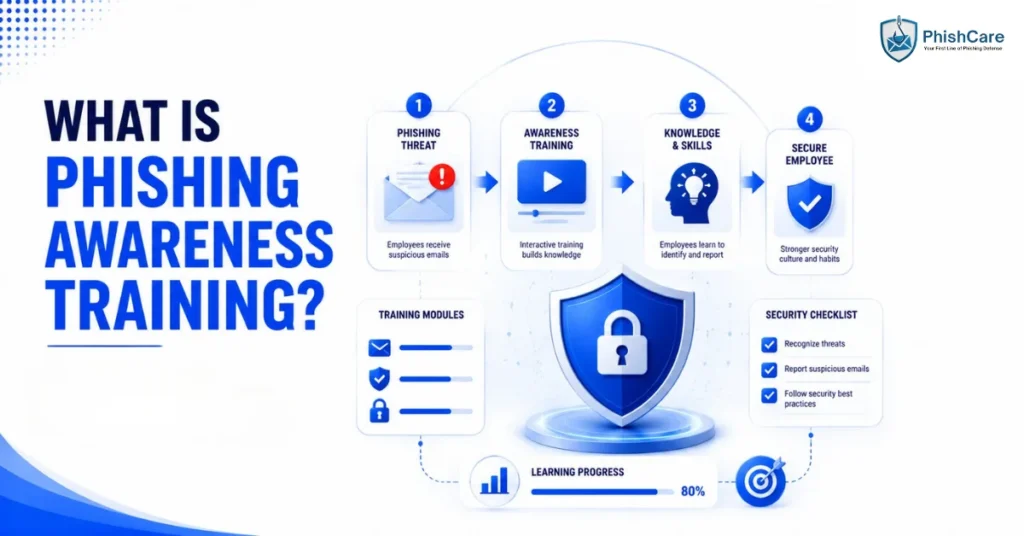
Phishing awareness training is a structured cybersecurity education program designed to teach employees how to identify, avoid, and report phishing attacks. The training typically covers phishing emails, spear phishing, business email compromise (BEC), malicious attachments, credential theft attempts, social engineering tactics, and safe email handling practices. The objective is to reduce human risk by transforming employees into an active layer of defense against cyber threats.
In this guide, we’ll explain how phishing awareness training works, why it matters for modern organizations, and how to conduct an effective phishing awareness program that drives measurable improvements in employee security behavior.
Why Phishing Awareness Training Is Important for Organizations
Cybersecurity technologies such as email security gateways, endpoint protection, and multi-factor authentication help reduce risk, but attackers continue to target employees because human error remains one of the easiest paths into an organization. A single click on a malicious link or attachment can lead to credential theft, ransomware infections, financial fraud, or unauthorized access to sensitive systems.
Phishing awareness training helps organizations reduce this risk by educating employees about modern phishing techniques and reinforcing secure decision-making in everyday work situations. Rather than relying solely on technology, organizations can build a stronger security culture where employees actively contribute to threat detection and prevention.
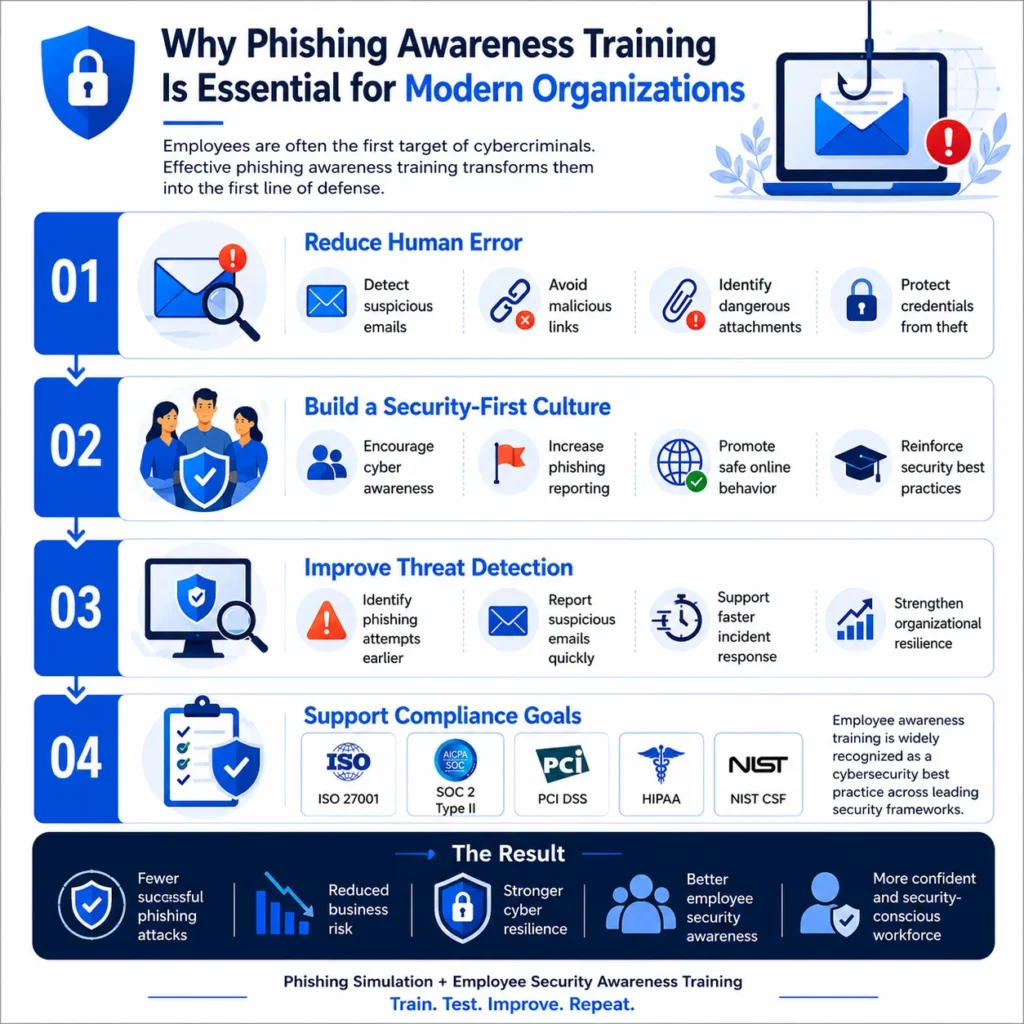
1. Reduces Human Error
Employees learn how to identify suspicious emails, fake login pages, urgent requests, and social engineering tactics before they result in a security incident.
2. Strengthens Security Culture
Ongoing awareness programs encourage employees to think critically about cyber risks and report suspicious activities more confidently.
3. Improves Incident Detection
Trained employees become an additional layer of defense by identifying and reporting phishing attempts before they spread across the organization.
4. Supports Compliance Objectives
Security awareness programs are widely recognized as a best practice within frameworks such as ISO 27001, SOC 2 Type II, PCI DSS, HIPAA, and NIST CSF.
The Cost of Ignoring Employee Awareness
Organizations often invest heavily in cybersecurity tools while overlooking employee education. However, attackers specifically design phishing campaigns to bypass technical controls by exploiting trust, urgency, and human behavior. Regular phishing awareness training helps reduce this exposure by ensuring employees can recognize and respond appropriately to evolving phishing threats.
Common Types of Phishing Attacks Employees Should Know
Modern phishing attacks are no longer limited to poorly written emails. Cybercriminals now use highly personalized messages, fake websites, social media platforms, text messages, and even voice calls to deceive employees. Understanding the most common phishing techniques helps employees recognize threats before they result in data breaches, credential theft, or financial losses.
1. Email Phishing
The most common form of phishing where attackers send fraudulent emails designed to trick recipients into clicking malicious links, opening infected attachments, or sharing sensitive information.
2. Spear Phishing
A targeted attack that uses personal or organizational information to make phishing messages appear more convincing and relevant to the victim.
3. Business Email Compromise (BEC)
Attackers impersonate executives, finance teams, or trusted vendors to request payments, sensitive data, or urgent account changes.
4. Smishing
SMS-based phishing attacks that use text messages containing malicious links or fake requests to steal credentials or financial information.
5. Vishing
Voice phishing attacks where cybercriminals use phone calls to impersonate trusted individuals, technical support teams, or financial institutions.
6. Clone Phishing
Attackers replicate legitimate emails and replace links or attachments with malicious versions, making the message appear authentic.
Why Employees Must Understand Multiple Attack Types
Cybercriminals constantly adapt their tactics to bypass traditional defenses and exploit human trust. Effective phishing awareness training should expose employees to multiple attack scenarios so they can confidently identify threats across email, messaging platforms, phone calls, collaboration tools, and cloud applications.
How to Conduct Effective Phishing Awareness Training
Successful phishing awareness training is not a one-time event. Organizations that achieve measurable improvements in employee security behavior typically combine structured education, realistic phishing simulations, continuous reinforcement, and ongoing performance measurement. The goal is to create lasting behavioral change rather than simply completing a compliance exercise.
A Practical 6-Step Phishing Awareness Training Framework
The most effective security awareness programs follow a continuous cycle of assessment, education, testing, measurement, and improvement. This ensures employees stay prepared for evolving phishing threats throughout the year.
Step 1: Assess Current Employee Awareness
Establish a baseline by evaluating existing employee knowledge and identifying departments, teams, or roles that may be more vulnerable to phishing attacks.
Step 2: Deliver Practical Security Training
Educate employees on phishing techniques, social engineering tactics, suspicious email indicators, password security, and safe online behavior using engaging learning content.
Step 3: Run Realistic Phishing Simulations
Conduct controlled phishing campaigns that mimic real-world attack scenarios to measure employee responses and identify areas requiring additional attention.
Step 4: Provide Immediate Learning Opportunities
When employees interact with a simulated phishing email, provide instant educational feedback that explains warning signs they may have missed.
Step 5: Measure and Report Results
Track key metrics such as click rates, credential submission rates, reporting rates, department performance, and awareness improvement over time.
Step 6: Repeat Regularly
Cyber threats constantly evolve. Ongoing quarterly or monthly awareness campaigns help maintain vigilance and continuously strengthen employee readiness.
Best Practice Recommendation
Organizations that combine phishing simulations with employee awareness training generally achieve better long-term outcomes than organizations that rely solely on annual training sessions. Regular testing helps reinforce learning, identify high-risk users, and create measurable improvements in security awareness across the workforce.
Key Components of a Successful Phishing Awareness Program
Not all phishing awareness programs deliver the same results. Organizations that consistently reduce phishing risk focus on building an ongoing security awareness culture rather than treating training as a one-time activity. A successful program combines education, practical testing, reporting mechanisms, and continuous improvement to create measurable behavioral change across the workforce.
1. Continuous Learning
Security awareness should be delivered throughout the year using short, engaging training modules that help employees stay informed about evolving phishing tactics.
2. Realistic Phishing Simulations
Simulated phishing campaigns provide hands-on experience and allow organizations to evaluate how employees respond to realistic attack scenarios.
3. Easy Reporting Mechanisms
Employees should have a simple way to report suspicious emails and potential phishing attempts without disrupting their daily workflow.
4. Performance Measurement
Tracking click rates, reporting rates, repeat offenders, and departmental performance helps identify areas that need additional training.
5. Executive Participation
Security awareness programs are more effective when leadership actively participates and reinforces the importance of cybersecurity across the organization.
6. Continuous Improvement
Awareness programs should evolve based on simulation results, emerging threat trends, employee feedback, and changing organizational risks.
What High-Performing Organizations Do Differently
Organizations that consistently achieve lower phishing click rates typically focus on ongoing awareness rather than annual compliance-based training.
They combine targeted phishing simulations, role-based learning, executive engagement, employee reporting programs, and regular performance reviews to create a proactive security culture that adapts to new threats over time.
Common Mistakes Organizations Make with Phishing Awareness Training
Many organizations invest in employee awareness initiatives but fail to achieve meaningful reductions in phishing risk. In most cases, the issue is not the lack of training but how the program is designed, delivered, and measured. Avoiding common mistakes can significantly improve employee engagement and long-term security outcomes.
Mistake #1: Treating Training as a One-Time Event
Employees quickly forget security lessons when awareness programs are conducted only once a year. Ongoing reinforcement is essential to maintain vigilance against evolving phishing tactics.
Mistake #2: Using Generic Training Content
Generic awareness content often lacks relevance. Employees are more likely to engage with examples and scenarios that reflect the phishing threats they encounter in their daily roles.
Mistake #3: Not Measuring Results
Without tracking performance metrics such as click rates, reporting rates, and risk trends, organizations cannot determine whether their awareness efforts are effective.
Mistake #4: Ignoring High-Risk Users
Some employees repeatedly fall for phishing simulations. These users often require additional coaching and targeted awareness interventions rather than generic retraining.
Mistake #5: Focusing Only on Email Threats
Modern attackers use SMS messages, voice calls, collaboration platforms, QR codes, and social media. Awareness programs should cover multiple attack channels.
Mistake #6: Creating a Fear-Based Culture
Employees should feel comfortable reporting mistakes and suspicious messages. Fear-based programs often reduce reporting and discourage participation.
Building a More Effective Awareness Program
Successful phishing awareness programs focus on continuous improvement rather than employee punishment. Organizations should use training results to identify knowledge gaps, tailor future campaigns, and strengthen security awareness across all departments.
By combining realistic phishing simulations, ongoing education, clear reporting channels, and measurable performance metrics, organizations can create a sustainable program that reduces human risk and improves overall cybersecurity resilience.
How Phishing Simulations Improve Employee Awareness Training
Traditional security awareness training teaches employees how phishing attacks work, but phishing simulations provide an opportunity to apply that knowledge in a realistic environment. By exposing employees to controlled phishing scenarios, organizations can measure real-world behavior, identify knowledge gaps, and continuously improve security awareness across the workforce.
When combined with employee education, phishing simulations transform awareness programs from passive learning exercises into measurable cybersecurity initiatives that help organizations reduce human risk over time.
1. Measures Real Employee Behavior
Simulations reveal how employees respond to phishing emails in practice, providing more accurate insights than quizzes or theoretical assessments alone.
2. Identifies High-Risk Users
Organizations can identify employees who repeatedly interact with simulated phishing emails and provide targeted coaching to improve awareness.
3. Reinforces Learning Through Experience
Employees learn more effectively when they encounter realistic phishing scenarios and receive immediate educational feedback after an interaction.
4. Tracks Awareness Improvements Over Time
Regular simulations allow organizations to monitor awareness trends, measure risk reduction, and evaluate training effectiveness across departments.
Why Organizations Use Phishing Simulation Platforms
Realistic Attack Scenarios
Simulate modern phishing campaigns using realistic templates and attack techniques.
Automated Campaigns
Schedule recurring phishing assessments without increasing administrative workload.
Reporting & Analytics
Track click rates, reporting rates, risk scores, and awareness performance metrics.
Continuous Awareness
Maintain employee vigilance through ongoing testing and security awareness reinforcement.
PhishCare and Continuous Security Awareness
Platforms such as PhishCare help organizations deliver phishing simulations, awareness training, employee risk scoring, and reporting dashboards from a single platform. This allows security teams to continuously evaluate employee readiness and strengthen organizational resilience against phishing attacks through measurable, data-driven awareness programs.
How to Measure the Success of Phishing Awareness Training
One of the biggest advantages of modern phishing awareness programs is the ability to measure employee behavior and track security improvements over time. Rather than relying on course completion rates alone, organizations should focus on metrics that demonstrate whether employees are becoming more effective at identifying and reporting phishing attempts.
By monitoring key performance indicators (KPIs), security teams can identify risk trends, evaluate training effectiveness, and make data-driven decisions to strengthen their awareness programs.
1. Phishing Click Rate
Measures how many employees clicked links within simulated phishing emails. A declining click rate generally indicates improved phishing awareness.
2. Reporting Rate
Tracks how many employees correctly report suspicious emails. Higher reporting rates often indicate stronger security engagement.
3. Credential Submission Rate
Evaluates how many employees entered credentials into simulated phishing pages. This metric helps identify users who may require additional training.
4. Repeat Offender Trends
Identifying employees who repeatedly fail phishing simulations allows organizations to provide focused coaching and risk reduction support.
5. Department Risk Scores
Comparing awareness performance across departments helps security teams identify areas that may require additional education or testing.
6. Awareness Improvement Over Time
Long-term measurement helps organizations understand whether employee awareness is improving and whether training investments are delivering results.
Metrics That Matter Most
Many organizations focus only on phishing click rates. However, a mature awareness program evaluates multiple indicators to gain a complete picture of employee behavior.
A combination of lower click rates, higher reporting rates, reduced credential submissions, and improved department risk scores provides stronger evidence that phishing awareness training is successfully reducing organizational risk.
Reporting for Security and Compliance Teams
Detailed phishing simulation reports can help security teams demonstrate ongoing awareness initiatives and employee engagement efforts. PhishCare’s reporting capabilities provide an additional documentation boost for organizations working towards ISO 27001, SOC 2 Type II, PCI DSS, HIPAA, or NIST CSF, where ongoing security awareness training is recognized as a cybersecurity best practice.
Benefits of Phishing Awareness Training for Organizations
Phishing awareness training delivers value far beyond helping employees identify suspicious emails. When implemented consistently, it strengthens organizational resilience, improves security culture, reduces human-related cyber risk, and helps businesses respond more effectively to evolving cyber threats.
Organizations that invest in ongoing employee awareness programs often experience measurable improvements in phishing detection, incident reporting, and overall cybersecurity maturity.
Reduced Risk of Successful Phishing Attacks
Employees become better equipped to identify suspicious communications, reducing the likelihood of phishing emails leading to compromised accounts or malware infections.
Stronger Security Culture
Regular awareness initiatives encourage employees to view cybersecurity as a shared responsibility rather than solely an IT or security function.
Faster Threat Reporting
Awareness-trained employees are more likely to report suspicious emails quickly, helping security teams investigate and contain potential threats sooner.
Improved Incident Response Readiness
Employees who understand phishing indicators can respond appropriately when incidents occur, reducing confusion and supporting faster response efforts.
Better Visibility into Human Risk
Training and simulation results provide valuable insights into employee behavior, helping organizations identify risk trends and prioritize awareness efforts.
Support for Security Governance Initiatives
Ongoing awareness programs help demonstrate an organization’s commitment to employee education and security best practices as part of broader cybersecurity governance efforts.
Business Impact Beyond Cybersecurity
The benefits of phishing awareness training extend beyond reducing cyber incidents. Security-conscious employees help protect customer trust, support operational continuity, and contribute to a more resilient organization.
As phishing attacks continue to evolve, organizations that prioritize employee awareness are often better positioned to identify threats early, minimize potential disruption, and maintain confidence among customers, partners, and stakeholders.
Awareness Training Works Best as an Ongoing Program
Organizations that achieve the greatest success with phishing awareness training treat it as a continuous process rather than a periodic exercise. Regular training, phishing simulations, performance measurement, and employee engagement initiatives help create sustainable improvements in cybersecurity awareness across the workforce.
Why Organizations Use PhishCare for Phishing Awareness Training
Building an effective phishing awareness program requires more than occasional training sessions. Organizations need a practical way to educate employees, measure risk, run realistic phishing simulations, and continuously improve awareness levels across the workforce. This is where phishing simulation and awareness platforms play an important role.
PhishCare, developed by CyberSapiens, helps organizations combine phishing awareness training with ongoing phishing simulations, employee risk measurement, and reporting capabilities from a centralized platform.
Realistic Phishing Simulations
Run controlled phishing campaigns that replicate modern attack techniques to evaluate employee readiness and identify awareness gaps.
Built-In Awareness Training
Deliver employee education modules that help users recognize phishing attacks, social engineering tactics, and suspicious communications.
Employee Risk Scoring
Understand employee risk levels through measurable awareness metrics, simulation outcomes, and behavioral trends.
Detailed Reporting Dashboards
Access actionable reporting that helps security teams track awareness progress, reporting rates, click rates, and training effectiveness.
Department-Level Insights
Identify departments or teams that may require additional training and awareness support through targeted reporting.
Ongoing Awareness Improvement
Support continuous awareness programs through recurring simulations, training campaigns, and measurable performance tracking.
Beyond Training: Creating a Security-Aware Workforce
The goal of phishing awareness training is not simply to complete a learning module. It is to create employees who can recognize threats, report suspicious activity, and contribute to a stronger security culture.
By combining phishing simulations, employee awareness training, risk measurement, and reporting, organizations can move from reactive security awareness efforts to a more proactive and measurable approach to reducing phishing risk.
Compliance and Awareness Reporting
PhishCare’s campaign reports provide an additional documentation boost for organizations working towards ISO 27001, SOC 2 Type II, PCI DSS, HIPAA, or NIST CSF, where ongoing security awareness training is recognized as a cybersecurity best practice by auditors and certification bodies.
Phishing Awareness Training Checklist for Organizations
Whether you are launching your first phishing awareness initiative or improving an existing program, having a structured checklist helps ensure your efforts are consistent, measurable, and aligned with organizational security objectives.
Use the following checklist to evaluate your current phishing awareness program and identify opportunities for improvement.
Essential Phishing Awareness Program Checklist
Signs of a Mature Phishing Awareness Program
Mature organizations do more than deliver awareness training. They actively measure employee behavior, improve awareness through continuous simulations, and use reporting insights to strengthen security decision-making.
As phishing threats continue to evolve, organizations that regularly assess, train, test, and improve employee awareness are generally better positioned to reduce human-related cyber risk and strengthen overall cyber resilience.
Quick Self-Assessment Question
If a realistic phishing email reached your employees today, would they recognize it, report it, and avoid interacting with it? If the answer is uncertain, your organization may benefit from more frequent phishing simulations and employee awareness training.
Frequently Asked Questions About Phishing Awareness Training
What is phishing awareness training?
Phishing awareness training is a cybersecurity education program designed to help employees identify, avoid, and report phishing attacks. It teaches users how to recognize suspicious emails, malicious links, fake login pages, social engineering tactics, and other common cyber threats.
Why is phishing awareness training important?
Employees are frequently targeted by phishing attacks because human error can bypass technical security controls. Awareness training helps reduce this risk by improving employees’ ability to identify and respond appropriately to suspicious communications.
How often should phishing awareness training be conducted?
Most organizations benefit from ongoing awareness programs that include regular training sessions and recurring phishing simulations. Monthly or quarterly activities help reinforce learning and keep employees prepared for evolving phishing tactics.
What is the difference between phishing awareness training and phishing simulations?
Awareness training focuses on educating employees about phishing threats, while phishing simulations test how employees respond to realistic phishing scenarios. Together, they help organizations educate, assess, and improve employee security behavior.
How can organizations measure the effectiveness of phishing awareness training?
Organizations typically measure click rates, reporting rates, credential submission rates, department risk scores, and overall awareness improvements over time. These metrics provide valuable insights into employee behavior and program effectiveness.
Can phishing awareness training support compliance initiatives?
Yes. Security awareness programs are widely recognized as a cybersecurity best practice across frameworks such as ISO 27001, SOC 2 Type II, PCI DSS, HIPAA, and NIST CSF. Awareness reporting can help demonstrate ongoing employee education efforts.
Content Reviewed By

Mohammed Nawaz Sajjad is a practising security analyst specializing in phishing simulations, employee awareness assessments, ethical hacking, and red team exercises. He works closely with organizations to evaluate human cyber risk, improve phishing resilience, and strengthen security awareness programs through practical, measurable security initiatives.
As part of CyberSapiens, he contributes to phishing simulation deployments, employee awareness training strategies, and cybersecurity risk reduction programs across multiple industries and regions.
View LinkedIn ProfileTurn Employees Into Your Strongest Defense Against Phishing
Phishing attacks continue to evolve, but employee awareness remains one of the most effective ways to reduce cyber risk. With realistic phishing simulations, awareness training, employee risk scoring, and detailed reporting, PhishCare helps organizations build a stronger security culture and improve resilience against modern phishing threats.