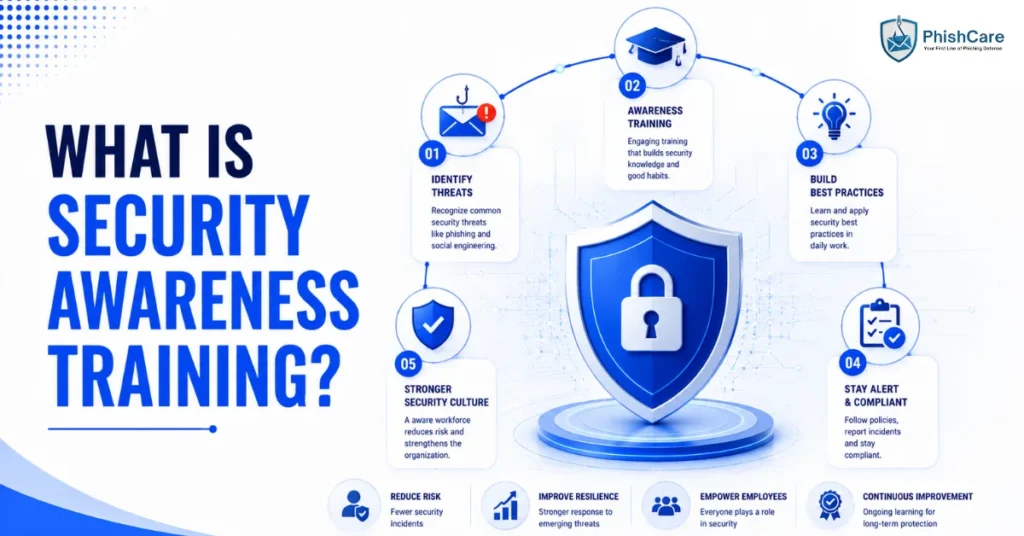
What Is Security Awareness Training?
Security Awareness Training is a structured program designed to help employees recognize, avoid, and report cyber threats before they cause harm to an organization. It focuses on building secure behaviors through education, practical exercises, phishing simulations, and continuous reinforcement. As cybercriminals increasingly target employees through phishing emails, social engineering tactics, credential theft, and AI-generated scams, organizations can no longer rely solely on technical security controls.
Human error remains one of the leading causes of cybersecurity incidents worldwide. Even organizations with advanced security technologies can become vulnerable when employees unknowingly click malicious links, share sensitive information, or fall victim to sophisticated phishing attacks. Security awareness training helps bridge this gap by turning employees into an active line of defense against cyber threats.
Effective security awareness programs go beyond annual compliance sessions. Modern organizations are adopting continuous training models that combine short learning modules, real-world attack scenarios, phishing simulations, and measurable performance tracking. This approach helps employees develop practical skills that can be applied immediately when suspicious activity occurs.
In this guide, we explain what security awareness training is, why it matters, how to conduct it effectively, common mistakes to avoid, and how organizations can measure employee cyber risk using phishing simulations and ongoing awareness initiatives.
Why Security Awareness Training Matters
Cybersecurity is no longer just an IT responsibility. Every employee who uses email, accesses cloud applications, handles customer data, or works remotely plays a role in protecting the organization. While businesses continue investing in firewalls, endpoint protection, and advanced threat detection systems, attackers increasingly focus on the easiest target: people.
Modern phishing campaigns are designed to appear legitimate and often bypass traditional technical defenses. Employees may receive emails that imitate executives, trusted vendors, banks, government agencies, or well-known software providers. Without proper awareness, even experienced professionals can mistakenly click malicious links, download infected attachments, or disclose sensitive information.
Security Awareness Training Helps Organizations:
Reduce Phishing Risks
Employees learn how to identify suspicious emails, fake login pages, and social engineering tactics before attackers gain access.
Strengthen Security Culture
Continuous awareness programs encourage employees to take ownership of cybersecurity and report suspicious activity.
Reduce Human Error
Training helps employees make safer decisions when handling emails, passwords, customer information, and business systems.
Support Compliance Initiatives
Ongoing awareness activities and phishing simulation reports can provide additional evidence for organizations working toward ISO 27001, SOC 2 Type II, PCI DSS, HIPAA, and NIST CSF programs.
The financial impact of a successful phishing attack can be significant. Cybercriminals often use phishing emails to steal credentials, deploy ransomware, initiate fraudulent payments, or gain access to sensitive business information. Beyond financial losses, organizations may face operational disruption, reputational damage, regulatory scrutiny, and loss of customer trust.
Security awareness training provides a proactive way to reduce these risks. Instead of reacting after an incident occurs, organizations can continuously educate employees, test real-world readiness, and identify areas where additional coaching or training may be needed.
Organizations that combine employee awareness training with regular phishing simulations often gain deeper visibility into human risk, allowing security teams to measure improvements and focus training efforts where they are needed most.
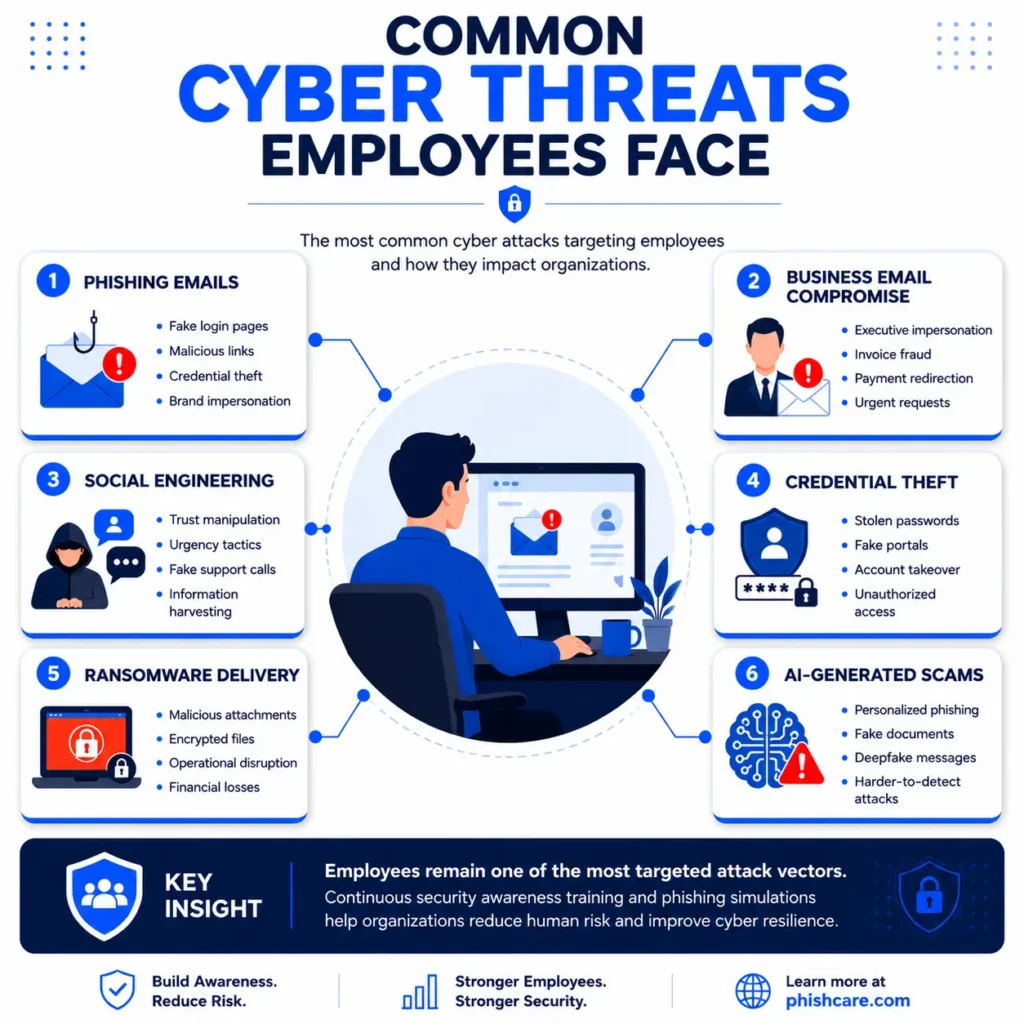
Common Cyber Threats Employees Face
Employees are frequently targeted because attackers know that human behavior can often be easier to exploit than technical vulnerabilities. Modern cyberattacks are designed to appear legitimate, making it increasingly difficult for employees to distinguish genuine communications from malicious ones. Understanding the most common threats is a critical component of any effective security awareness training program.
1. Phishing Emails
Phishing remains one of the most successful attack methods. Cybercriminals send convincing emails that impersonate trusted organizations, executives, vendors, or colleagues to steal credentials, financial information, or sensitive data.
2. Business Email Compromise (BEC)
BEC attacks target employees with authority over payments, payroll, or sensitive information. Attackers often impersonate executives and request urgent wire transfers, invoice payments, or confidential business data.
3. Social Engineering
Social engineering attacks manipulate individuals into revealing information or performing actions that benefit attackers. These attacks often exploit trust, urgency, fear, or curiosity rather than technical weaknesses.
4. Credential Theft
Fake login pages, malicious links, and compromised websites are commonly used to steal usernames and passwords. Once attackers gain access, they can move laterally across systems and access sensitive information.
5. Ransomware Delivery
Many ransomware incidents begin with a phishing email or malicious attachment. A single employee interaction can provide attackers with the initial access needed to encrypt systems and disrupt operations.
6. AI-Generated Scams
Attackers increasingly use artificial intelligence to create highly personalized phishing emails, fake documents, and convincing communications that appear legitimate and are harder to detect.
Why Employees Remain a Primary Target
Cybercriminals continuously adapt their techniques to bypass security controls and exploit human behavior. Employees handle emails, cloud applications, customer information, financial transactions, and remote access systems daily. Without ongoing security awareness training, even a single mistake can create an entry point for attackers. Educating employees about evolving threats helps organizations build a stronger human layer of defense and reduce overall cyber risk.
The challenge is not simply understanding these threats but ensuring employees can recognize them in real-world situations. This is why effective security awareness programs combine education with practical exercises such as phishing simulations, scenario-based learning, and continuous reinforcement to improve long-term security behavior.
Key Components of an Effective Security Awareness Training Program
Successful security awareness training is not a one-time presentation or annual compliance exercise. The most effective programs create continuous learning opportunities that help employees recognize threats, develop secure habits, and respond appropriately when suspicious activity occurs. A modern security awareness program combines education, practical testing, measurement, and ongoing improvement.
Employee Security Education
Employees should understand common cyber threats, organizational policies, password security, data protection requirements, and safe online behavior.
Phishing Simulations
Simulated phishing campaigns help organizations evaluate employee readiness in realistic scenarios and identify individuals or departments that may need additional training.
Role-Based Training
Different departments face different risks. Finance teams, executives, HR professionals, and IT staff often require tailored training relevant to their responsibilities.
Continuous Reinforcement
Short awareness reminders, newsletters, security alerts, and micro-learning sessions help reinforce good security practices throughout the year.
Reporting Mechanisms
Employees should know how to report suspicious emails, unusual activity, or potential incidents quickly so security teams can investigate and respond effectively.
Measurement and Analytics
Organizations should track participation rates, phishing click rates, reporting behavior, and employee risk trends to continuously improve training effectiveness.
Building a Security-First Culture
Technology alone cannot eliminate cyber risk. Organizations that successfully reduce phishing incidents and security breaches typically foster a culture where employees actively participate in cybersecurity efforts. Security awareness training works best when leadership supports the initiative, employees receive ongoing education, and progress is measured over time through realistic assessments and simulations.
The strongest security awareness programs combine education, phishing simulations, behavioral measurement, and continuous reinforcement to create lasting improvements in employee cyber resilience.
How to Conduct Security Awareness Training: Step-by-Step Process
A successful security awareness training program requires more than simply delivering educational content. Organizations need a structured approach that identifies employee risk, delivers relevant training, measures effectiveness, and continuously improves security behavior. The following framework can help organizations build a sustainable and measurable awareness program.
Step 1: Assess Current Employee Risk
Begin by understanding your organization’s current level of cyber awareness. Review past incidents, phishing reports, audit findings, and employee security behaviors to identify areas that require improvement.
Step 2: Establish a Baseline Phishing Assessment
Conduct a phishing simulation before training begins. This provides valuable insight into employee susceptibility to phishing attacks and helps establish measurable benchmarks for future improvement.
Step 3: Deliver Targeted Training Content
Focus on practical topics such as phishing detection, password security, social engineering, ransomware awareness, safe browsing practices, data protection, and secure remote work habits. Customize content where possible for specific roles and departments.
Step 4: Reinforce Learning Through Simulations
Regular phishing simulations help employees apply what they have learned in realistic scenarios. Simulations also provide measurable data that can be used to identify trends and training gaps.
Step 5: Measure Employee Performance
Track key metrics such as phishing click rates, credential submission attempts, email reporting rates, training completion rates, and department-specific risk scores to understand program effectiveness.
Step 6: Continuously Improve the Program
Cyber threats evolve constantly. Review results regularly, update training content, introduce new attack scenarios, and provide additional coaching to higher-risk groups to maintain awareness effectiveness.
Security Awareness Training Lifecycle
Effective security awareness programs follow a continuous improvement cycle:
Organizations that regularly assess employee risk, reinforce learning through phishing simulations, and measure behavioral improvements often achieve stronger security outcomes than those relying solely on annual awareness sessions.
Security Awareness Training Metrics That Matter
Security awareness training should deliver measurable improvements, not just course completion certificates. Organizations that track meaningful security metrics gain better visibility into employee behavior, identify higher-risk groups, and continuously improve their awareness programs. Measuring performance also helps demonstrate the value of security awareness initiatives to leadership and stakeholders.
Why Metrics Matter
Without measurement, organizations cannot determine whether employee behavior is improving or whether training efforts are reducing risk. Security metrics transform awareness programs from educational activities into strategic risk management initiatives.
1. Phishing Click Rate
Measures the percentage of employees who clicked links within simulated phishing emails. A declining click rate typically indicates improved awareness and stronger decision-making.
2. Credential Submission Rate
Tracks how many employees attempted to enter usernames or passwords into simulated phishing pages. This metric provides deeper insight into organizational risk exposure.
3. Phishing Reporting Rate
Measures how many employees actively report suspicious emails. Higher reporting rates often indicate a stronger security culture and increased vigilance.
4. Training Completion Rate
Tracks employee participation in awareness modules and educational activities. Consistent completion supports broader awareness objectives.
5. Department Risk Scores
Comparing performance across departments helps identify areas requiring additional training, coaching, or targeted awareness campaigns.
6. Repeat Failure Trends
Monitoring recurring phishing failures helps security teams identify employees who may benefit from additional awareness support.
| Metric | What It Measures | Why It Matters |
|---|---|---|
| Click Rate | Employee susceptibility | Indicates phishing awareness levels |
| Credential Submission | Credential-sharing behavior | Highlights high-risk actions |
| Reporting Rate | Employee vigilance | Supports faster threat detection |
| Completion Rate | Training participation | Measures engagement levels |
| Risk Scores | Department performance | Enables targeted training |
Phishing simulations combined with employee awareness metrics provide valuable insight into human risk trends. These reports can also provide additional documentation support for organizations working toward ISO 27001, SOC 2 Type II, PCI DSS, HIPAA, and NIST CSF initiatives where ongoing security awareness is considered a best practice.
Common Security Awareness Training Mistakes to Avoid
Many organizations invest in security awareness training but fail to achieve meaningful improvements in employee behavior. In most cases, the problem is not the training itself but how it is designed, delivered, and measured. Avoiding common mistakes can significantly improve employee engagement, reduce human risk, and strengthen overall cybersecurity resilience.
Treating Training as an Annual Exercise
Cyber threats evolve continuously. Conducting awareness training only once a year often leaves employees unprepared for emerging phishing techniques, social engineering attacks, and AI-generated scams.
Ignoring Phishing Simulations
Awareness training without practical testing makes it difficult to measure whether employees can apply their knowledge in real-world situations. Simulations provide valuable behavioral insights.
Using Generic Content for Everyone
Different departments face different threats. Finance teams, executives, HR personnel, and IT staff often require role-specific awareness training to address their unique risks.
Focusing Only on Compliance
Awareness programs should aim to improve employee behavior and reduce risk, not simply satisfy compliance requirements or audit checklists.
Failing to Measure Results
Organizations that do not track phishing click rates, reporting rates, and employee risk scores often struggle to determine whether training is effective.
Lack of Executive Participation
Security culture starts at the top. When leadership actively participates in awareness initiatives, employees are more likely to engage and take cybersecurity seriously.
What Successful Organizations Do Differently
High-performing security awareness programs focus on continuous improvement rather than one-time training events. They combine education, testing, measurement, and leadership support to create lasting behavioral change.
The most effective security awareness programs treat employee education as an ongoing risk reduction initiative rather than a compliance checkbox. Continuous learning and realistic simulations often produce the strongest long-term results.
Why Annual Security Awareness Training Is No Longer Enough
For many years, organizations relied on annual cybersecurity awareness training to satisfy compliance requirements and educate employees about basic security practices. While annual training can provide foundational knowledge, today’s threat landscape changes far too quickly for a once-a-year approach to remain effective.
Cybercriminals continuously evolve their tactics, creating more convincing phishing campaigns, AI-generated scams, business email compromise attacks, and social engineering techniques. Employees who receive training only once per year may struggle to recognize these emerging threats when they encounter them months later.
The Problem With Annual-Only Training
Knowledge Fades Over Time
Employees naturally forget information when it is not reinforced regularly through practical application and reminders.
Threats Change Rapidly
New phishing techniques, AI-generated attacks, and social engineering tactics emerge throughout the year.
Limited Behavioral Change
One-time training often increases awareness temporarily but rarely produces lasting security habits.
No Ongoing Measurement
Organizations struggle to determine whether employees are becoming more resilient without regular testing.
The Shift Toward Continuous Security Awareness
Leading organizations now adopt continuous security awareness programs that provide employees with ongoing education throughout the year. Rather than relying on a single annual session, they deliver regular micro-learning content, phishing simulations, awareness campaigns, and security reminders that keep cybersecurity top of mind.
Monthly Awareness Content
Regular awareness sessions help reinforce key cybersecurity concepts and introduce emerging threat trends.
Recurring Phishing Simulations
Simulations provide realistic practice opportunities and help organizations measure behavioral improvements over time.
Threat-Specific Updates
Employees receive guidance on newly emerging threats rather than waiting until the next annual training cycle.
Continuous Risk Monitoring
Security teams gain visibility into employee risk trends and can provide targeted support where needed.
The goal of modern security awareness training is not simply to educate employees once per year. It is to create lasting security behaviors through continuous learning, realistic simulations, and measurable improvement over time.
How Phishing Simulations Improve Security Awareness Training
Security awareness training provides employees with the knowledge needed to recognize cyber threats, but knowledge alone does not always translate into secure behavior. Employees may understand phishing concepts during training sessions yet still fall victim to realistic phishing emails in their daily work environment. This is where phishing simulations become an essential part of a modern security awareness program.
Phishing simulations allow organizations to safely test employee responses using realistic attack scenarios. These controlled exercises help security teams identify vulnerabilities, measure awareness levels, and reinforce learning through practical experience without exposing the organization to actual cyber threats.
Why Simulations Are More Effective Than Theory Alone
Real-World Practice
Employees experience realistic phishing scenarios similar to those used by actual attackers.
Behavioral Measurement
Security teams can measure employee actions rather than relying solely on training completion rates.
Immediate Learning
Employees receive timely feedback when they interact with simulated phishing emails.
Risk Visibility
Organizations gain insight into department-level and employee-level risk trends.
Key Benefits of Phishing Simulations
Identify High-Risk Users
Simulations help identify employees who may require additional awareness training or targeted coaching.
Measure Awareness Progress
Organizations can compare results across campaigns to determine whether employee behavior is improving.
Improve Reporting Culture
Employees become more confident identifying and reporting suspicious emails to security teams.
Strengthen Security Culture
Frequent simulations reinforce awareness and help create a security-first mindset across the organization.
Typical Phishing Simulation Metrics
- Phishing email open rate
- Link click rate
- Credential submission attempts
- Email reporting rate
- Repeat phishing failures
- Department risk scores
Phishing simulations transform security awareness training from a passive learning activity into a measurable risk reduction program. Campaign reports can also provide an additional documentation boost for organizations working toward ISO 27001, SOC 2 Type II, PCI DSS, HIPAA, or NIST CSF, where ongoing security awareness training is recognized as a best practice by auditors and certification bodies.
How PhishCare Helps Organizations Measure Human Risk
One of the biggest challenges organizations face is understanding how vulnerable employees are to phishing attacks and social engineering threats. Traditional awareness training often focuses on course completion rates, but completion alone does not indicate whether employees can recognize and respond to real-world attacks. Organizations need measurable insights into employee behavior, risk exposure, and awareness effectiveness.
PhishCare, developed by CyberSapiens, helps organizations assess, measure, and improve employee cybersecurity awareness through phishing simulations, training modules, and detailed reporting. By combining education with behavioral measurement, organizations can gain a clearer understanding of human risk and make data-driven decisions to strengthen their security posture.
Key Capabilities of PhishCare
Phishing Simulations
Run realistic phishing campaigns to evaluate employee readiness and identify potential vulnerabilities before attackers do.
Employee Risk Scoring
Measure employee behavior across campaigns and gain visibility into individuals, teams, and departments that may require additional support.
Awareness Learning Modules
Deliver engaging awareness content covering phishing, ransomware, password security, social engineering, and other critical cybersecurity topics.
Reporting and Analytics
Access dashboards and reports that track click rates, reporting behavior, risk trends, and overall awareness program performance.
From Awareness to Measurable Improvement
Effective security awareness programs require continuous measurement. PhishCare helps organizations establish a baseline, track improvements over time, and identify areas where additional awareness initiatives may be needed. This enables security teams to move beyond assumptions and make informed decisions based on employee behavior and campaign results.
Establish a Baseline
Understand current employee susceptibility to phishing and social engineering attacks.
Deliver Targeted Awareness
Provide employees with practical cybersecurity education tailored to emerging threats.
Track Behavioral Changes
Monitor improvements in click rates, reporting behavior, and overall security awareness.
Continuously Reduce Risk
Use campaign insights and employee risk data to strengthen organizational cyber resilience.
Additional Benefits for Compliance Programs
PhishCare campaign reports can provide an additional documentation boost for organizations working toward ISO 27001, SOC 2 Type II, PCI DSS, HIPAA, and NIST CSF initiatives. Ongoing awareness activities, employee training records, and phishing simulation results demonstrate a proactive approach to reducing human-related cybersecurity risks and supporting security best practices.
Explore Your Human Risk Exposure
Identify employee phishing risks, measure awareness effectiveness, and build a stronger security culture with continuous phishing simulations and awareness training.
Key Takeaways on Security Awareness Training
Security awareness training has evolved from a compliance-driven activity into a critical component of modern cybersecurity strategy. As phishing attacks, social engineering campaigns, ransomware incidents, and AI-generated scams continue to increase, organizations must ensure employees are equipped to recognize and respond to cyber threats effectively.
Employees Are a Critical Line of Defense
Cybersecurity is not solely a technology challenge. Educated employees play a vital role in identifying and reporting suspicious activity before it becomes a security incident.
Continuous Training Outperforms Annual Training
Ongoing awareness programs, micro-learning, and recurring simulations help create lasting behavioral change and stronger cyber resilience.
Phishing Simulations Provide Measurable Insights
Simulations help organizations evaluate employee readiness, identify high-risk users, and measure improvements over time.
Metrics Drive Better Decisions
Tracking click rates, reporting behavior, credential submissions, and risk scores helps security teams improve awareness effectiveness.
Security Awareness Training Checklist
Organizations that combine employee education, phishing simulations, continuous reinforcement, and behavioral measurement are often better positioned to reduce human-related cyber risks and strengthen their overall cybersecurity posture.
Frequently Asked Questions About Security Awareness Training
What is Security Awareness Training?
Security awareness training is a structured program that educates employees about cyber threats, safe security practices, phishing attacks, social engineering, password security, and data protection. Its goal is to reduce human-related cybersecurity risks by improving employee behavior and decision-making.
Why is security awareness training important?
Employees are frequently targeted by phishing campaigns, credential theft attempts, and social engineering attacks. Security awareness training helps employees recognize suspicious activity, avoid common attack methods, and report potential threats before they impact the organization.
How often should employees receive security awareness training?
While annual training provides a baseline, many organizations now adopt continuous awareness programs that include monthly awareness content, micro-learning modules, security reminders, and recurring phishing simulations throughout the year.
Does security awareness training reduce phishing attacks?
Security awareness training can significantly improve employees’ ability to identify and report phishing attempts. When combined with phishing simulations and continuous reinforcement, organizations often see improvements in phishing resilience and reporting behavior.
What topics should be included in security awareness training?
Effective programs typically cover phishing awareness, social engineering, ransomware threats, password security, multi-factor authentication, remote work security, data protection, safe internet usage, and incident reporting procedures.
How do phishing simulations support security awareness training?
Phishing simulations provide employees with realistic attack scenarios in a controlled environment. They help organizations measure awareness effectiveness, identify higher-risk users, reinforce training lessons, and track improvements over time.
Content Reviewed By

Mohammed Nawaz Sajjad
Mohammed Nawaz Sajjad is a practising cybersecurity professional with hands-on experience in phishing simulations, security awareness programs, ethical hacking, vulnerability assessments, and red team operations. He works closely with organizations to assess employee cyber risk, improve security awareness, and strengthen resilience against phishing and social engineering attacks.
Through his work with PhishCare, a phishing simulation platform developed by CyberSapiens, Nawaz has helped organizations evaluate employee readiness, measure awareness effectiveness, and build stronger security cultures through practical security education and phishing simulation campaigns.
View LinkedIn ProfileTurn Security Awareness Into Measurable Risk Reduction
Security awareness training is most effective when employees can apply what they learn in real-world situations. PhishCare helps organizations assess employee readiness, run phishing simulations, measure human risk, and strengthen security culture through continuous awareness initiatives.
Gain visibility into phishing susceptibility, reporting behavior, and employee risk trends with realistic phishing simulations and awareness reporting.