Phishing attacks are no longer limited to emails. In 2026, cybercriminals are increasingly using artificial intelligence to launch more sophisticated and convincing attacks, including AI voice cloning. These attacks represent a new evolution of CEO fraud, where attackers impersonate senior executives using realistic voice replication to manipulate employees into taking immediate action.
Traditionally, CEO fraud relied on phishing emails that appeared to come from executives requesting urgent payments or sensitive information. While these attacks remain common, employees have become more aware of email-based threats. In response, attackers have shifted toward more direct and persuasive methods, including voice-based communication.
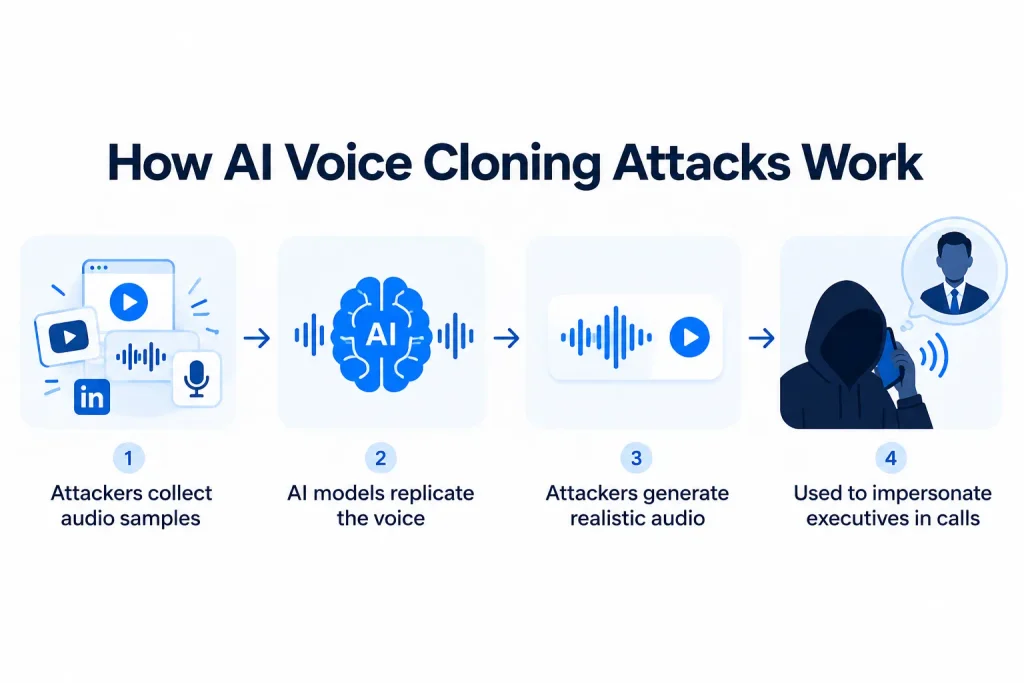
AI voice cloning allows attackers to replicate a person’s voice using small samples of audio, often collected from public sources such as interviews, webinars, or social media content. Once a voice model is created, attackers can generate realistic audio messages or conduct live calls that sound like the targeted individual.
This level of realism makes AI voice cloning attacks particularly dangerous. Employees may trust a familiar voice and act quickly, especially when the message conveys urgency or authority. As a result, these attacks can bypass both technical controls and traditional awareness measures. Understanding how AI voice cloning attacks work and how they enable advanced CEO fraud is essential for organisations seeking to protect themselves from this emerging threat.
What Are AI Voice Cloning Attacks?
AI voice cloning attacks use machine learning models to replicate a person’s voice with high accuracy. Attackers gather audio samples from publicly available sources and train AI systems to mimic tone, accent, and speech patterns.
Once the voice model is created, attackers can generate audio messages or interact with employees in real time. These messages may be delivered through phone calls, voice notes, or integrated communication platforms. In many cases, the cloned voice is used to impersonate senior executives, finance leaders, or trusted contacts within the organisation. The goal is to create a sense of familiarity and authority that encourages immediate action. These techniques are also discussed in more detail in our guide to deepfake scams and AI voice cloning .
How AI Voice Cloning Enables CEO Fraud
CEO fraud typically involves impersonating a senior executive to request urgent financial transactions or sensitive information. AI voice cloning enhances this tactic by adding a layer of realism that email-based phishing cannot achieve.
An employee may receive a call that appears to come from a senior leader, instructing them to process a payment or share confidential information. Because the voice sounds authentic, the employee may not question the request.
These attacks often rely on urgency. The caller may claim that the request is time-sensitive or confidential, discouraging the employee from verifying the instruction. In some cases, attackers combine voice cloning with email phishing. An employee may first receive an email and then a follow-up call reinforcing the request, creating a multi-channel attack that increases credibility.
Why These Attacks Are Difficult to Detect
AI voice cloning attacks are difficult to detect because they exploit trust rather than technical vulnerabilities. Traditional security tools are designed to identify malicious emails, links, or attachments, but they are less effective against voice-based communication.
Employees are trained to recognise phishing emails, but fewer are prepared to question voice instructions, especially when they appear to come from known individuals.
The realism of AI-generated voices further complicates detection. Subtle cues that might indicate a fraudulent call are often absent, making it challenging to distinguish between legitimate and malicious communication. Because these attacks rely on human behaviour, awareness and verification processes become critical defenses.
Real-World Impact of Voice-Based CEO Fraud
AI voice cloning attacks can lead to significant financial and operational consequences. Fraudulent payment requests may result in direct financial loss, particularly when funds are transferred quickly without verification.
These attacks can also compromise sensitive information if employees share credentials or confidential data in response to voice instructions.
Beyond financial impact, such incidents can damage trust within the organisation. Employees may become uncertain about how to verify requests, and leadership may face challenges in maintaining secure communication practices. As these attacks become more common, organisations must adapt their security strategies to address voice-based threats.
Preventing AI Voice Cloning Attacks
Preventing voice-based CEO fraud requires a combination of awareness, process, and technology. Employees should be trained to verify all sensitive requests, regardless of how they are received. This includes financial approvals, credential sharing, and access requests.
Organisations should implement clear verification protocols. For example, employees can confirm requests through a secondary communication channel, such as email or messaging platforms, before taking action. This approach is particularly important as organisations address voice phishing and vishing as part of their security awareness efforts.
Limiting publicly available audio content of senior executives may also reduce the risk of voice cloning, although this is not always practical. Multi-factor authentication and approval workflows add additional layers of protection, reducing reliance on a single communication method.
Preparing for the Next Phase of Social Engineering
AI voice cloning represents a significant shift in how cybercriminals approach social engineering. As attackers continue to adopt advanced technologies, organisations must evolve their security strategies accordingly.
Awareness training must expand beyond email phishing to include voice and multi-channel attacks. Organisations can strengthen their approach through employee awareness training that encourages employees to question unusual requests, even when they appear to come from trusted sources.
Verification processes and clear communication protocols play a critical role in preventing these attacks from succeeding. In the evolving landscape of cyber threats, the ability to recognise manipulation and verify authenticity is more important than ever.
Frequently Asked Questions
1. What are AI voice cloning attacks?
AI voice cloning attacks use artificial intelligence to replicate a person’s voice and impersonate them in phone calls or audio messages.
2. How do these attacks relate to CEO fraud?
Attackers use cloned voices of executives to request urgent payments or sensitive information, making the fraud more convincing.
3. Are voice phishing attacks common in 2026?
Yes. Voice phishing, or vishing, is increasing as attackers adopt AI tools to create more realistic and persuasive scams.
4. How can employees verify voice-based requests?
Employees should confirm requests through a secondary communication channel, such as email or messaging, before taking action.
5. Can technology detect AI voice cloning attacks?
Detection is challenging because these attacks rely on human trust. Awareness and verification processes are the most effective defenses.
Content Reviewed By

Nawaz is a practising security analyst specializing in phishing simulation campaigns, employee awareness assessments, red team exercises, and ethical hacking.
He leads phishing simulation deployments at PhishCare, a product developed by CyberSapiens, with hands-on experience evaluating and deploying phishing simulation tools across organizations in multiple industries and regions globally.
View LinkedIn ProfileStrengthen Your Employee Awareness
Train your workforce to recognise phishing, voice-based threats, and social engineering attacks.