Businesses today face an increasingly complex cyber threat landscape. From phishing attacks and credential theft to ransomware and business email compromise schemes, organisations across every industry are being targeted by cybercriminals. As a result, cyber security has become a critical priority for leadership teams seeking to protect sensitive data, financial assets, and operational continuity.
Despite this growing risk, many organisations still hesitate to invest in cybersecurity training programs for employees. Security awareness initiatives are sometimes viewed as optional or secondary compared to technical defenses such as firewalls, endpoint protection systems, and monitoring tools. However, a large percentage of cyber incidents begin with human interaction, particularly through phishing emails and social engineering tactics .
When evaluating cyber security investments, businesses often overlook an important comparison: the cost of implementing employee cybersecurity training versus the potential financial consequences of a data breach. While awareness programs require time and resources, their cost is minimal when compared to the direct and indirect expenses associated with a breach.
Understanding this comparison is essential for organisations that want to make informed decisions about security investment.
The Real Cost of a Data Breach
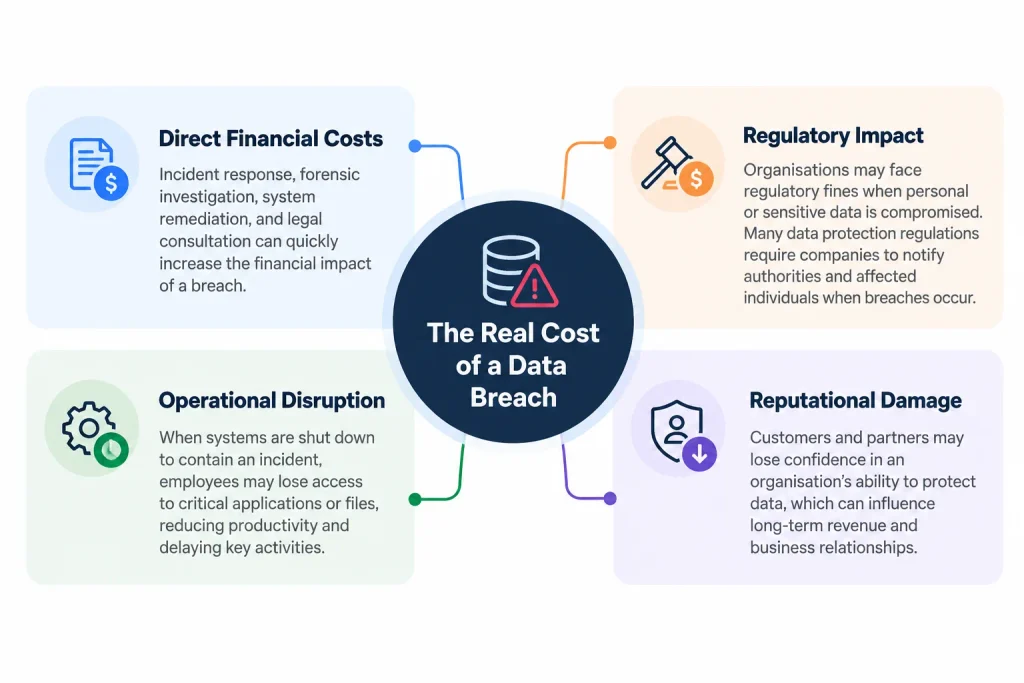
A data breach can create immediate and long-term financial consequences for businesses. The most visible costs often include incident response activities such as forensic investigation, system remediation, and legal consultation. Security teams must determine how the breach occurred, what systems were affected, and what data may have been exposed.
However, these direct costs represent only part of the financial impact. Organisations may also face regulatory fines if personal or sensitive data is compromised. Data protection regulations in many jurisdictions require companies to notify authorities and affected individuals when breaches occur.
Direct Financial Costs
Incident response, forensic investigation, system remediation, and legal consultation can quickly increase the financial impact of a breach.
Regulatory Impact
Organisations may face regulatory consequences when personal or sensitive information is compromised.
Operational Disruption
When systems are shut down to contain an incident, employees may lose access to critical applications or files, reducing productivity and delaying key activities.
Operational disruption is another major factor. When systems must be shut down to contain an incident, normal business operations may be interrupted. Employees may lose access to critical applications or files, reducing productivity and delaying key activities.
Reputational damage can also have lasting effects. Customers and partners may lose confidence in an organisation’s ability to protect data, which can influence long-term revenue and business relationships. When all these factors are considered, the cost of a single data breach can be substantial.
Why Human Behaviour Often Triggers Breaches
Many data breaches begin with a phishing email or social engineering attack. Instead of exploiting technical vulnerabilities, attackers focus on manipulating employees.
A phishing email might encourage an employee to enter login credentials on a fake website, download a malicious attachment, or approve an urgent payment request. Once attackers gain access to credentials or systems, they can move deeper into the organisation’s infrastructure.
Employees may also be targeted through pretexting and other social engineering techniques , where attackers create convincing scenarios to manipulate individuals into taking an unsafe action.
Because these attacks rely on human interaction, technical defenses alone cannot eliminate the risk. Employees must be able to recognise suspicious communication and respond appropriately. This is where cybersecurity training plays a critical role.
Fake Login Pages
Attackers may direct employees to convincing fake websites designed to capture login credentials.
Learn how to spot a fake login pageMalicious Attachments
Suspicious attachments can encourage employees to interact with content that may compromise systems or data.
Urgent Requests
Attackers can create a sense of urgency around payments or other business actions to influence employee decisions.
The Investment Required for Cybersecurity Training
Compared to the potential financial impact of a breach, cybersecurity training programs typically require relatively modest investment. These programs focus on educating employees about common attack techniques and reinforcing secure behaviour.
Awareness Sessions
Educate employees about common attack techniques and reinforce secure behaviour across the organisation.
Phishing Simulations
Give employees practical exposure to phishing scenarios so they can recognise suspicious communication before it causes damage.
Ongoing Reinforcement
Short learning modules and continuous reinforcement help employees maintain secure habits over time.
Training initiatives may include awareness sessions, phishing simulations, and ongoing reinforcement through short learning modules. The goal is to help employees recognise threats such as phishing emails, impersonation attempts, and suspicious attachments before they cause damage.
Because employees interact with digital systems every day, even small improvements in awareness can significantly reduce organisational risk. Training also supports a stronger security culture, where employees feel responsible for protecting organisational assets and reporting suspicious activity.
Measuring the Value of Training
The value of cybersecurity training becomes clearer when organisations measure behavioural outcomes. Metrics such as phishing simulation results, reporting rates, and response times can demonstrate improvements in employee awareness.
Key Training Metrics
Phishing Simulation Results
Track how employees respond to simulated phishing attempts over time.
Reporting Rates
Measure whether employees are increasingly reporting suspicious messages.
Response Times
Evaluate how quickly employees identify and report potential threats.
For example, if a company reduces the percentage of employees who click on simulated phishing emails over time, it indicates that training is improving decision-making.
Increased reporting of suspicious emails is another positive indicator. When employees report threats quickly, security teams can investigate and remove malicious messages before additional users are affected. These measurable improvements translate into lower risk exposure.
Organisations can also use phishing awareness practices to strengthen employee understanding and reinforce secure behaviour over time.
Cybersecurity Training as Risk Reduction
Cybersecurity training should be viewed as an investment in risk reduction rather than a discretionary expense. By strengthening employee awareness, organisations reduce the likelihood that attackers will successfully exploit human behaviour.
Why It Matters
Even a single prevented phishing attack can offset the cost of training programs. When organisations consider the potential financial consequences of a breach, the value of awareness initiatives becomes clear.
Security training also complements technical defenses by addressing the human element of cyber security.
Employee Security Awareness
Strengthening Employee Awareness With PhishCare
Practical exposure to realistic attack scenarios is one of the most effective ways to strengthen employee awareness. PhishCare , developed by CyberSapiens, supports organisations in reinforcing secure behaviour through structured phishing simulation campaigns.
These simulations replicate modern phishing techniques, including impersonation attempts, urgent payment requests, and routine-looking business communications that appear legitimate. By encountering these simulated threats, employees gain practical experience identifying warning signs before real attacks occur.
Realistic Attack Scenarios
Employees encounter simulated phishing emails that reflect realistic attack techniques and business communications.
Immediate Feedback
When an employee interacts incorrectly with a simulated phishing email, PhishCare provides immediate feedback explaining the indicators that were missed.
Behavioural Insights
Behavioural reporting insights help organisations track improvements in employee vigilance and identify areas where additional reinforcement may be needed.
When an employee interacts incorrectly with a simulated phishing email, PhishCare provides immediate feedback explaining the indicators that were missed. This moment-based learning helps reinforce awareness and improve future decision-making.
PhishCare also provides behavioural reporting insights that allow organisations to track improvements in employee vigilance over time. These insights help security teams measure the effectiveness of training initiatives and identify areas where additional reinforcement may be needed. By combining realistic simulations with continuous awareness reinforcement, organisations can significantly reduce the likelihood that human error leads to costly security incidents.
The Business Case for Cybersecurity Training
When comparing cybersecurity training costs with the financial consequences of a data breach, the conclusion is clear. Awareness initiatives represent a relatively small investment that can help prevent significantly larger losses.
Organisations that prioritise employee education and behavioural reinforcement strengthen their ability to detect and resist cyber threats. This proactive approach not only improves security resilience but also protects financial stability and organisational reputation. Cybersecurity training is therefore not simply a compliance requirement. It is a strategic investment that helps businesses manage risk in an increasingly digital environment.
Frequently Asked Questions
Common questions about cybersecurity training, employee awareness, and data breach risk.
How much does cybersecurity training typically cost?
The cost varies depending on the size of the organisation and the training methods used, but awareness programs are generally far less expensive than the potential cost of a data breach.
Why do many data breaches begin with phishing attacks?
Phishing attacks manipulate employees into revealing credentials or interacting with malicious content, allowing attackers to bypass technical defenses.
Can cybersecurity training prevent all breaches?
No training program can eliminate risk entirely, but strong awareness initiatives significantly reduce the likelihood of successful attacks.
How can organisations measure the effectiveness of cybersecurity training?
Effectiveness can be measured through metrics such as phishing simulation results, reporting rates, and improvements in employee threat recognition.
Why should businesses invest in cybersecurity training?
Cybersecurity training helps employees recognise threats, strengthens organisational security culture, and reduces the financial and operational risks associated with cyber incidents.
Content Reviewed By

Mohammed Nawaz Sajjad
Sr. Security Analyst at CyberSapiens | Phishing Simulation | Ethical Hacker | Bug Hunter | Red Team
Nawaz is a practising security analyst specializing in phishing simulation campaigns, employee awareness assessments, red team exercises, and ethical hacking.
He leads phishing simulation deployments at PhishCare, a product developed by CyberSapiens, with hands-on experience evaluating and deploying phishing simulation tools across organizations in multiple industries and regions globally.
View LinkedIn ProfileEmployee Security Awareness
Build a More Security-Aware Workforce With PhishCare
Run realistic phishing simulations, strengthen employee awareness, and gain behavioural insights to help your organisation reduce human-related security risks.
PhishCare
Simulations
Realistic
Awareness
Continuous
Insights
Behavioural
Reporting
Actionable