For years, data protection in India was something companies handled informally. That era is over. The Digital Personal Data Protection Act, 2023 turned data security into a legal obligation with real financial weight behind it, and the people asking about your security posture are no longer just your customers. Regulators are asking too.
If your organisation handles personal data, three questions are now converging into one conversation. How do you meet the DPDP Act’s expectations? How do you satisfy enterprise buyers who want ISO 27001 or SOC 2? And how do you do all of this without running three separate, overlapping projects?
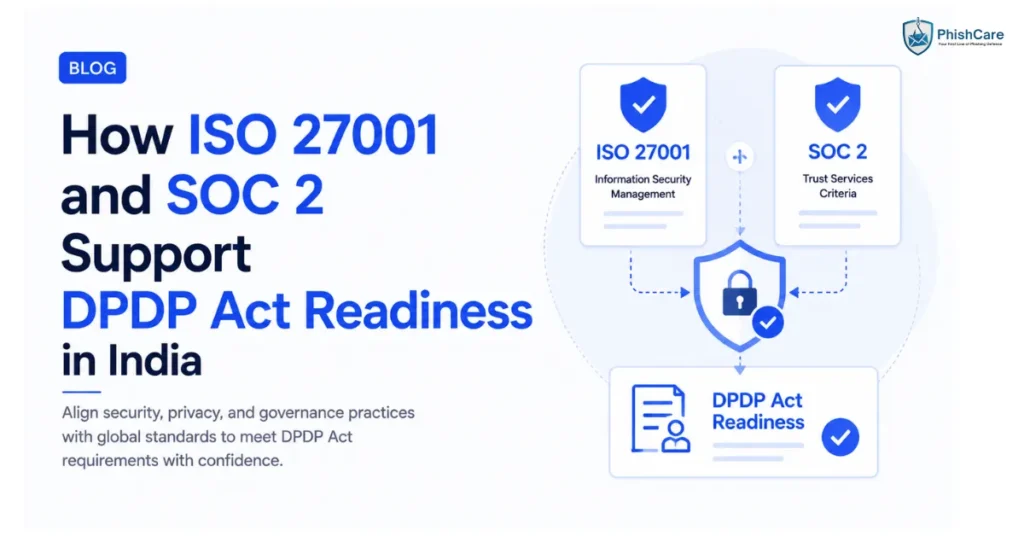
The good news is that these are not three problems. They are one. A single well-built security program can support DPDP readiness, earn an ISO 27001 certificate, and produce a SOC 2 report, because they draw on the same underlying controls. This guide shows how the pieces fit, and where the technical and human layers come in.
Key takeaway: The DPDP Act is a legal requirement. ISO 27001 and SOC 2 are not mandatory under it, but a working Information Security Management System maps closely to the security safeguards the Act expects. Treating DPDP, ISO 27001, and SOC 2 as one integrated program avoids duplicate work and gives you regulatory readiness plus the certifications buyers ask for.
What the DPDP Act actually requires
The DPDP Act, 2023 governs how organisations collect, process, store, and protect the personal data of individuals in India. If you handle that data, you are a Data Fiduciary, and the Act places clear duties on you.
At a high level, those duties include implementing reasonable security safeguards to prevent personal data breaches, notifying the Data Protection Board and affected individuals when a breach occurs, collecting data only with valid consent or a lawful basis, and honouring the rights of individuals over their own data. There are also restrictions on transferring personal data outside India to countries the government has not approved. You can read the government’s own material through the Ministry of Electronics and Information Technology.
The financial stakes are significant. The Act sets penalties of up to 250 crore rupees for failure to implement adequate security safeguards that leads to a personal data breach, with the Data Protection Board of India empowered to enforce them. For serious cases, the standard penalty can be enhanced further.
Some organisations face heavier obligations. Those designated as Significant Data Fiduciaries, often large platforms or businesses processing sensitive data at scale, must appoint an India-based Data Protection Officer, conduct annual Data Protection Impact Assessments, and undergo an annual independent audit. That audit requirement is where a structured security framework becomes especially valuable.
Why ISO 27001 is the natural backbone
ISO 27001 is not mandatory under the DPDP Act. No certification is. What ISO 27001 gives you is a structured, internationally recognised way to build and prove the exact safeguards the Act expects.
The standard is built around an Information Security Management System, which is a documented, repeatable approach to identifying risks and putting controls in place to manage them. When you implement ISO 27001 properly, you naturally address the areas the DPDP Act cares about: risk assessment, access control, encryption, incident response, and regular review. Our ISO 27001 implementation guide for India walks through how that system comes together.
Two control areas deserve special mention because they sit at the heart of both DPDP safeguards and ISO 27001. The first is access control. Limiting who can reach personal data, and proving it, is fundamental. ISO 27001’s Annex A access control requirements give you the framework, and practical patterns like least privilege across AWS, Azure, and GCP and role-based access control show what auditors want to see. The second is risk assessment, which mirrors the kind of Data Protection Impact Assessment the Act expects from larger organisations.
In short, ISO 27001 does not replace DPDP compliance, but it builds most of the foundation the Act stands on.
Where SOC 2 fits
If ISO 27001 is the backbone, SOC 2 is the layer that speaks to your global customers. It is the format US enterprise and SaaS buyers ask for, and it demonstrates that your controls did not just exist on paper but operated effectively over a period of time.
For an Indian company already building toward DPDP readiness and ISO 27001, adding SOC 2 compliance is largely incremental rather than a fresh start. The same access controls, incident response processes, and monitoring that support DPDP and ISO 27001 also supply most of the evidence a SOC 2 report needs. You are documenting and testing the same disciplines, then presenting them in the format each audience expects.
The technical safeguard layer: VAPT
A policy that says you protect personal data means little if the systems holding that data have not been tested. This is where vulnerability assessment and penetration testing earn their place.
The DPDP Act does not name specific tools, but it does expect reasonable technical safeguards. VAPT is one of the most widely accepted ways to demonstrate them. By probing your applications, APIs, cloud environments, and infrastructure the way an attacker would, VAPT surfaces the weaknesses that could lead to a breach, and a breach is exactly the event that triggers the Act’s heaviest penalties.
VAPT also pulls double duty. The same testing that strengthens your DPDP posture provides evidence for ISO 27001 and SOC 2, since both expect you to identify and address technical vulnerabilities. For teams that want a head start, our VAPT checklist for startups and SaaS companies covers what to test first.
The human layer: awareness training and phishing simulation
Technology is only half the picture. A large share of data breaches still begin with a person clicking something they should not have. The DPDP Act’s breach provisions do not care whether the cause was a software flaw or a deceived employee. The consequences are the same.
This is why employee awareness belongs in any serious DPDP program. Training staff to recognise phishing, handle personal data carefully, and report suspicious activity reduces the most common path to a breach. Ongoing security awareness training is recognised by auditors and certification bodies as a best practice that strengthens both ISO 27001 and SOC 2 programs as well.
PhishCare, a phishing simulation and security awareness training tool developed by CyberSapiens, runs realistic phishing campaigns and tracks how employees respond over time. The campaign reports give you clean documentation of your awareness effort, which is useful evidence across DPDP readiness, ISO 27001, and SOC 2.
One integrated program
The point of all of this is that you do not need separate teams for DPDP, ISO 27001, SOC 2, VAPT, and awareness training. Each requirement maps to a control, and each control maps to a service you can run under one program.
| DPDP-related need | Supporting control or framework | CyberSapiens service |
|---|---|---|
| Reasonable security safeguards | ISO 27001 ISMS, encryption, technical controls | ISO 27001 implementation, VAPT |
| Risk assessment and DPIA | ISMS risk assessment process | ISO 27001 consulting, vCISO |
| Access control over personal data | Annex A access control, least privilege, RBAC | ISO 27001 implementation |
| Breach detection and response | Incident response and monitoring controls | vCISO, security monitoring |
| Vendor and processor oversight | Third-party risk management | Governance, risk, and compliance |
| Employee awareness | Security awareness training | PhishCare |
| Independent audit and certification | External audit and certification | Coordinated via Accorp Partners and Gabriel Registrar |
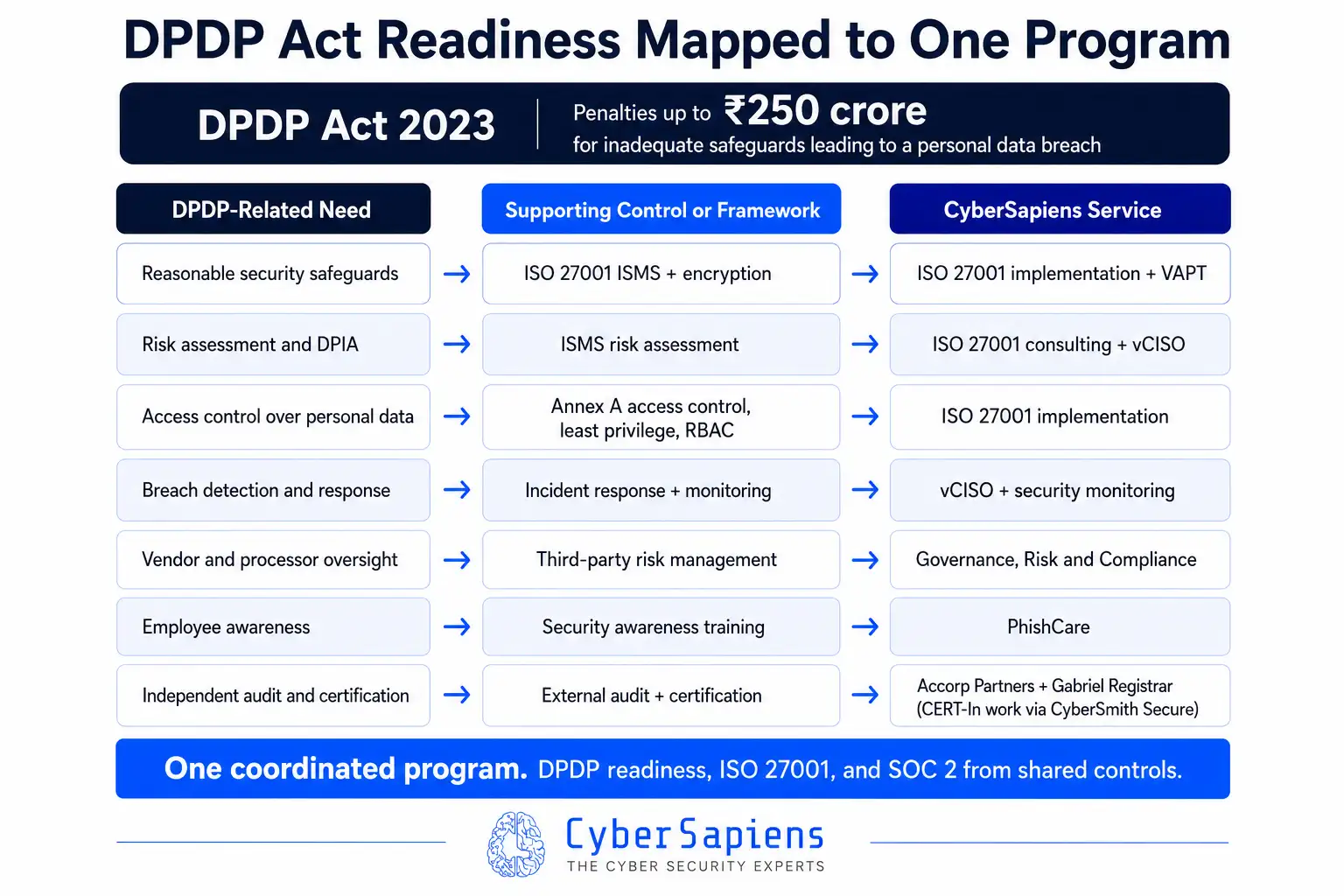
Each DPDP-related need maps to a control and a service, so one coordinated program delivers DPDP readiness, ISO 27001, and SOC 2 from shared controls.
CyberSapiens is built to run this as a single engagement. The team is itself ISO 27001:2022 certified, with more than 40 cybersecurity specialists and over 500 organisations served across India, Australia, Canada, and the United States. For the audit and certification chain, CyberSapiens coordinates Accorp Partners, a globally recognised audit firm for SOC 2 and ISO 27001, and Gabriel Registrar, an accredited certification registrar, so you get readiness, independent audit, and certification without managing separate vendors.
Where CERT-In empanelled work is needed, CyberSapiens partners with CyberSmith Secure, a CERT-In empanelled security firm, and you can review official technical advisories through CERT-In. For ongoing direction, a vCISO keeps the program aligned as regulations and your business evolve.
Frequently asked questions
Is ISO 27001 mandatory under the DPDP Act?
No. The DPDP Act does not require any specific certification. ISO 27001 is voluntary, but it provides a structured way to build and prove the security safeguards the Act expects, which is why many Indian companies adopt it as the foundation for DPDP readiness.
What are the penalties under the DPDP Act?
The Act sets penalties of up to 250 crore rupees for failing to implement adequate security safeguards where that failure leads to a personal data breach. The Data Protection Board of India enforces these, and serious cases can attract enhanced penalties.
Does the DPDP Act require penetration testing?
The Act requires reasonable security safeguards but does not name specific tools. VAPT is one of the most widely accepted ways to demonstrate technical safeguards, because it tests the systems that hold personal data for the weaknesses that could lead to a breach.
Who is a Significant Data Fiduciary?
A Significant Data Fiduciary is an organisation designated by the government based on factors such as the volume and sensitivity of data it processes. These organisations face additional duties, including appointing an India-based Data Protection Officer, conducting annual Data Protection Impact Assessments, and undergoing annual independent audits.
Can one audit cover DPDP, ISO 27001, and SOC 2?
The certifications have separate formal audits, but because they share most of the same controls, the underlying readiness work and evidence can be reused across all three. Running them as one coordinated program removes most of the duplication.
Content Reviewed By

Ketki specialises in Governance, Risk and Compliance with extensive experience providing cybersecurity consulting to public, private, and government clients across Australia. She has managed GRC projects across ISO 27001, PCI DSS, NIST CSF, Essential Eight, APRA CPS 234, VPDSS, and ISM frameworks.
Connect on LinkedInBuild one program for DPDP readiness, ISO 27001, and SOC 2
The DPDP Act made data security a board-level issue, and your enterprise buyers are not waiting either. Talk to CyberSapiens about one coordinated program that supports DPDP readiness while delivering the ISO 27001 and SOC 2 outcomes your customers expect.