Phishing remains one of the most effective cyberattack methods in 2026, not because email security tools are weak, but because attackers target human behaviour. Modern phishing campaigns are personalised, context-aware, and often delivered through compromised accounts or trusted platforms. Even with advanced filtering technologies in place, phishing emails continue to reach inboxes and influence employee decisions. Learn more about how generative AI is changing phishing attacks in 2026.
For organisations, the challenge is no longer simply delivering awareness training. The real question is whether employee behaviour is improving over time. Are users recognising suspicious emails more quickly? Are high-risk roles more vulnerable? Is reporting culture strengthening? Without measurable data, awareness programs rely on assumptions rather than evidence.
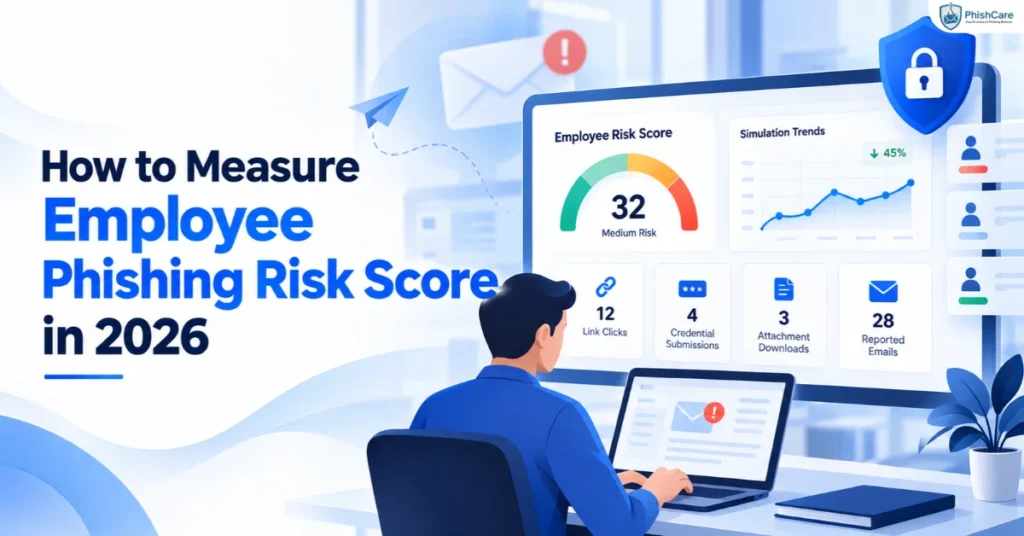
This is where the concept of an employee phishing risk score becomes critical. A phishing risk score quantifies behavioural exposure to phishing threats based on measurable indicators. It transforms awareness from a theoretical exercise into a data-driven security function. In 2026, organisations that actively measure phishing risk at the employee and departmental level are better positioned to prevent credential compromise, financial fraud, and operational disruption. Understanding how to measure this risk accurately is essential for building a mature Human Risk Management strategy. This approach also highlights the importance of behavioural analytics in cybersecurity.
What Is an Employee Phishing Risk Score?
An employee phishing risk score is a measurable indicator of how likely an individual is to fall for a phishing attack based on observed behaviour. It is not a punishment metric. Instead, it provides visibility into behavioural patterns that may increase exposure to cyber threats.
Rather than relying on a single data point such as click rate, modern phishing risk scoring combines multiple behavioural factors. These metrics provide a more accurate representation of vulnerability. A mature risk score evaluates patterns over time rather than isolated incidents. This ensures that temporary mistakes do not define long-term risk. Understanding what a human firewall is and how to build one also highlights the importance of evaluating employee behaviour as part of organisational security.
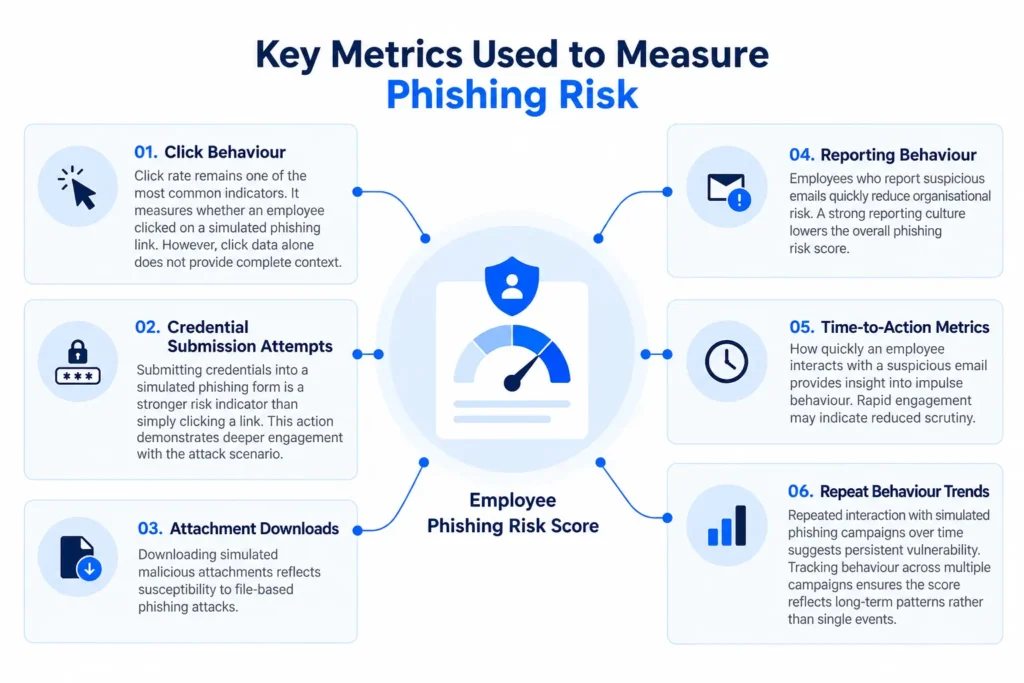
Key Metrics Used to Measure Phishing Risk
Click Behaviour
Click rate remains one of the most common indicators. It measures whether an employee clicked on a simulated phishing link. However, click data alone does not provide complete context. Some users may click but quickly recognise the mistake and report it.
Credential Submission Attempts
Submitting credentials into a simulated phishing form is a stronger risk indicator than simply clicking a link. This action demonstrates deeper engagement with the attack scenario.
Attachment Downloads
Downloading simulated malicious attachments reflects susceptibility to file-based phishing attacks.
Reporting Behaviour
Employees who report suspicious emails quickly reduce organisational risk. A strong reporting culture lowers the overall phishing risk score.
Time-to-Action Metrics
How quickly an employee interacts with a suspicious email provides insight into impulse behaviour. Rapid engagement may indicate reduced scrutiny.
Repeat Behaviour Trends
Repeated interaction with simulated phishing campaigns over time suggests persistent vulnerability. Tracking behaviour across multiple campaigns ensures the score reflects long-term patterns rather than single events.
When combined, these indicators form a more accurate and balanced employee phishing risk score.
Consistent measurement also supports a stronger reporting culture. Explore how to build a reporting-first security culture to understand the importance of employee reporting behaviour.
Role-Based Risk Assessment
Not all employees face the same level of phishing risk. Finance teams, executives, HR departments, and IT administrators are often targeted with specialised attacks such as invoice fraud or credential harvesting.
Finance Teams
Invoice fraud
Executives
Specialised phishing attacks
HR Departments
Credential harvesting
IT Administrators
Credential harvesting
In 2026, phishing risk measurement must be contextual. High-risk roles may require weighted scoring models that account for their exposure level. This approach ensures that risk assessment aligns with business impact.
Departmental and Organisational Risk Visibility
Beyond individual scoring, organisations should aggregate risk metrics at the department and organisational levels. This allows leadership to identify systemic patterns, such as whether certain teams are consistently more vulnerable.
From Individual Insights to Organisational Visibility
LEVEL 01
Individual Risk Metrics
LEVEL 02
Departmental Risk Patterns
LEVEL 03
Organisational Risk Visibility
Aggregated reporting supports strategic decisions regarding targeted training, additional verification controls, or policy reinforcement. When presented at the executive level, phishing risk scores become part of enterprise risk management discussions rather than isolated awareness reports. Learn more about how board members evaluate cyber awareness programs.
The Importance of Continuous Measurement
Phishing threats evolve rapidly. Attackers use artificial intelligence, impersonation tactics, and multi-channel deception strategies. A single annual simulation does not provide meaningful insight into behavioural risk.
Track Behaviour Over Time
Improvement
Identify positive changes in employee behaviour.
Stagnation
Recognise when risk levels are not improving.
Regression
Detect changes that indicate increased vulnerability.
Continuous phishing simulation allows organisations to monitor changes in behaviour over time. Improvement trends, stagnation, or regression can all be identified through consistent measurement. This longitudinal approach is essential in 2026, where attack techniques shift quickly and employee behaviour must adapt accordingly. Learn more about how phishing simulation supports SOC 2 compliance.
Avoiding Common Mistakes in Risk Scoring
While measuring phishing risk is essential, organisations must avoid common pitfalls.
Avoid Employee Shaming
First, risk scores should not be used to shame or penalise employees. Awareness programs must promote a learning culture rather than fear. Blame-driven models reduce reporting and discourage transparency.
Consider Context
Second, scoring models must consider context. A single click does not necessarily indicate high vulnerability. Trend analysis provides more reliable insight.
Turn Scores into Action
Third, risk scoring should lead to action. Identifying high-risk users is only valuable if it results in targeted reinforcement, coaching, or additional awareness efforts.
Using PhishCare to Measure and Reduce Phishing Risk
PhishCare, supports structured measurement of employee phishing risk through realistic simulation campaigns and behavioural analytics.
The platform captures interaction data such as link clicks, credential submissions, attachment downloads, and reporting behaviour. Instead of relying on a single metric, PhishCare provides a broader behavioural view that helps organisations identify patterns across roles and departments.
Behavioural Insights Captured
Link clicks
Credential submissions
Attachment downloads
Reporting behaviour
Immediate feedback at the moment of interaction reinforces learning, ensuring that risk measurement is directly tied to improvement. Continuous simulation campaigns allow organisations to track progress over time and demonstrate measurable reduction in phishing susceptibility. By combining realistic attack scenarios with actionable reporting dashboards, PhishCare enables organisations to move from awareness assumptions to evidence-based Human Risk Management.
Turning Risk Scores into Strategic Advantage
An employee phishing risk score is not simply a security metric. It is a strategic indicator of organisational resilience.
When behavioural risk is measured consistently and addressed proactively, organisations reduce the likelihood of credential theft, financial fraud, and operational disruption. Leadership gains visibility into human-related vulnerabilities and can allocate resources effectively. In 2026, the organisations that measure employee phishing risk with precision and consistency will be the ones best prepared to withstand evolving threats.
Organisations can also assess the business impact of phishing incidents by understanding the true cost of a single phishing click for businesses.
Frequently Asked Questions
1. What is an employee phishing risk score?
An employee phishing risk score is a behavioural metric that measures how likely an individual is to fall for a phishing attack based on observed interaction patterns during simulations.
2. How often should phishing risk be measured?
Phishing risk should be measured continuously through regular simulation campaigns rather than annually. Ongoing measurement provides more accurate behavioural insights.
3. Is click rate enough to calculate phishing risk?
No. Click rate alone is insufficient. A comprehensive score should include credential submission attempts, attachment downloads, reporting behaviour, and trend analysis.
4. Should phishing risk scores be shared publicly within an organisation?
Risk scoring should be used constructively and not as a public ranking system. The goal is behavioural improvement, not employee shaming.
5. How can organisations reduce high phishing risk scores?
Organisations can reduce phishing risk through continuous simulation, targeted micro-learning, stronger reporting culture, and structured awareness reinforcement programs.
Content Reviewed By

Mohammed Nawaz Sajjad
Sr. Security Analyst at CyberSapiens | Phishing Simulation | Ethical Hacker | Bug Hunter | Red Team
Nawaz is a practising security analyst specializing in phishing simulation campaigns, employee awareness assessments, red team exercises, and ethical hacking.
He leads phishing simulation deployments at PhishCare, a product developed by CyberSapiens, with hands-on experience evaluating and deploying phishing simulation tools across organizations in multiple industries and regions globally.
View LinkedIn ProfileMeasure and Reduce Employee Phishing Risk with PhishCare
Move from awareness assumptions to evidence-based Human Risk Management with realistic phishing simulations and behavioural insights.