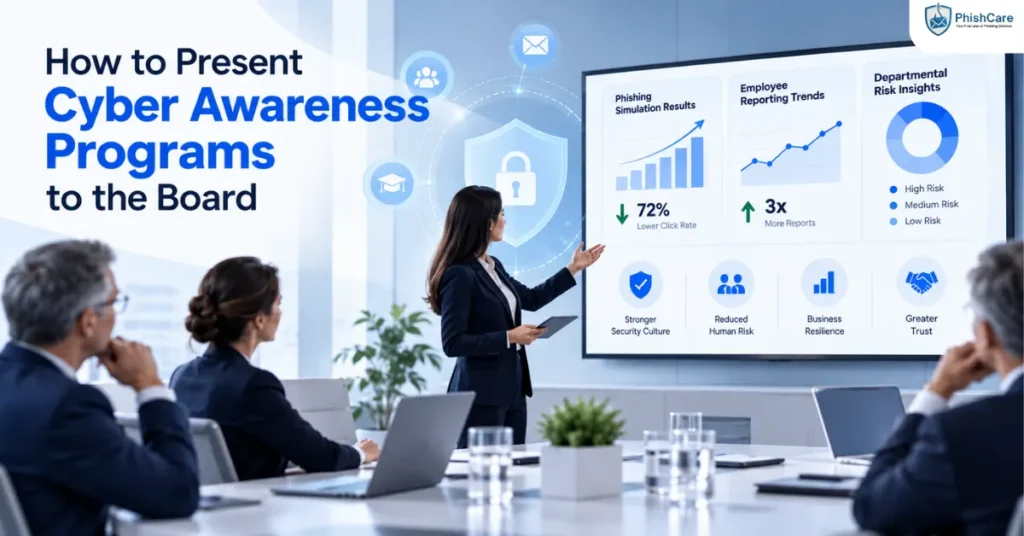
Cyber security is no longer viewed as a purely technical concern handled only by IT departments. In today’s threat landscape, cyber risk is a business risk that can affect financial stability, operational continuity, regulatory compliance, and organisational reputation. As a result, boards of directors are increasingly involved in overseeing cyber security strategies and evaluating how organisations manage digital threats.
One area receiving growing attention from board members is cyber awareness programs. Because many cyber attacks begin with phishing emails or social engineering attempts targeting employees, boards recognise that human behaviour plays a critical role in organisational security. Technology alone cannot eliminate every threat. The ability of employees to recognise and respond to suspicious activity can determine whether an attack is prevented or escalates into a serious incident.
The evolving nature of social engineering also makes employee awareness increasingly important. Modern threats can involve highly convincing impersonation attempts, including AI voice cloning and CEO fraud, making it important for employees to evaluate suspicious requests rather than relying solely on familiar names, voices, or communication patterns.
However, board members do not evaluate awareness programs in the same way as security professionals. They focus less on technical training details and more on measurable outcomes, risk reduction, and alignment with business objectives. Directors want to understand whether awareness initiatives are effectively reducing cyber risk and strengthening organisational resilience. Understanding how board members assess these programs helps security leaders present awareness initiatives in a way that demonstrates clear value and measurable impact.
Why Cyber Awareness Programs Matter at the Board Level
Boards of directors are responsible for overseeing organisational risk management. Cyber threats have become one of the most significant risks facing businesses, which means awareness programs must demonstrate that they contribute to reducing that risk.
Directors often ask strategic questions rather than operational ones. They want to understand whether employees are becoming more capable of recognising phishing attempts, whether reporting behaviour is improving, and whether the organisation is becoming more resilient against social engineering attacks.
Employee Behaviour Is a Critical Security Layer
A well-structured awareness program provides evidence that the organisation is taking proactive steps to strengthen the human layer of defence. When employees are trained to identify suspicious emails and report potential threats quickly, the likelihood of successful attacks decreases. For boards, this represents an important component of enterprise risk management.
The importance of employee awareness becomes even clearer as phishing techniques become more sophisticated. For example, organisations can face risks from AI-driven phishing attacks that can make suspicious communications more convincing and difficult for employees to identify.
Metrics Boards Expect to See
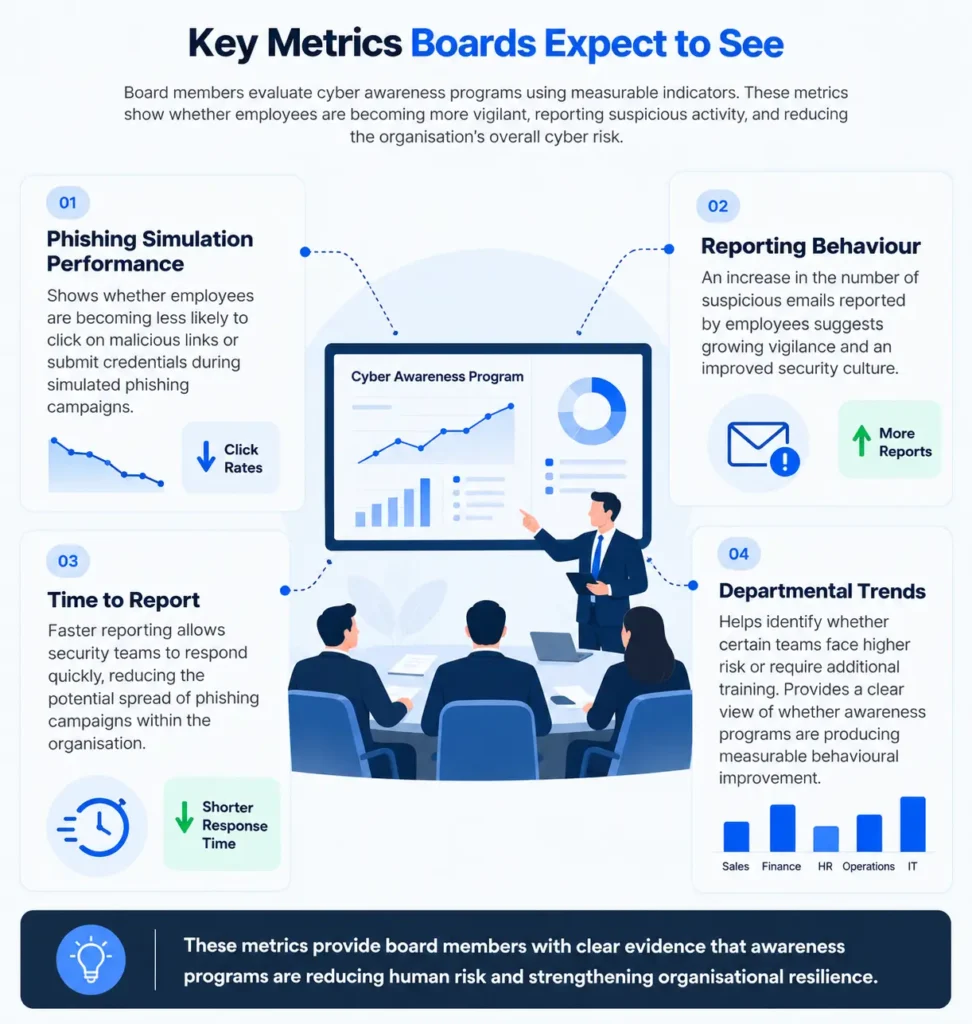
Board members typically evaluate cyber awareness programs using measurable indicators rather than subjective assessments. One key metric is phishing simulation performance. Directors often review trends showing whether employees are becoming less likely to click on malicious links or submit credentials during simulated phishing campaigns.
Phishing Simulation Performance
Directors often review trends showing whether employees are becoming less likely to click on malicious links or submit credentials during simulated phishing campaigns.
Reporting Behaviour
An increase in the number of suspicious emails reported by employees suggests growing vigilance and improved security culture.
Time to Report
Time-to-report metrics may also be evaluated. Faster reporting allows security teams to respond quickly, reducing the potential spread of phishing campaigns within the organisation.
Departmental Trends
Boards may also review departmental trends to understand whether certain teams face higher risk or require additional training. These metrics provide a clear view of whether awareness programs are producing measurable behavioural improvement.
These metrics become particularly valuable when organisations conduct phishing simulations across different teams and roles. For example, employees working remotely may face different social engineering risks, making it useful for security leaders to understand phishing threats in remote work environments and how employee behaviour changes in those circumstances.
Evaluating Awareness as Part of Human Risk Management
Many boards now view cyber awareness programs within the broader context of Human Risk Management. This approach recognises that employee behaviour can influence cyber risk just as much as technical vulnerabilities.
Measuring Employee Susceptibility
When evaluating awareness initiatives, directors may consider how organisations measure employee susceptibility to phishing attacks and whether improvements are tracked over time.
This is particularly important because phishing attacks can rely on convincing login pages and other deceptive techniques that encourage employees to disclose sensitive information. Helping employees understand how to spot a fake login page is one practical example of how awareness training can address real-world human risk.
Continuous Reinforcement Matters
Programs that incorporate continuous reinforcement, behavioural measurement, and reporting culture are typically viewed more favourably than one-time training sessions.
From a governance perspective, the ability to demonstrate measurable improvement in employee awareness supports the organisation’s overall risk management strategy.
Aligning Awareness Programs With Business Objectives
Board members also evaluate whether awareness programs align with broader business goals. For example, organisations operating in regulated industries may need to demonstrate that employees are trained to protect sensitive customer data. Awareness initiatives should therefore support compliance requirements while also strengthening operational resilience.
Connecting Awareness to Business Risk
When security leaders present awareness programs to the board, they often focus on how training contributes to preventing financial fraud, protecting customer information, and maintaining trust with partners and stakeholders. By linking awareness efforts to tangible business outcomes, security leaders can demonstrate the strategic value of these programs.
The connection between awareness and business risk can be especially important for organisations handling sensitive financial information. Financial institutions, for example, face targeted social engineering and phishing risks that can affect customer data, transactions, and organisational trust. Understanding the key cyber security awareness threats facing financial institutions can help security leaders align employee awareness initiatives with broader business risk.
From Training to Strategic Resilience
When awareness programs are connected to measurable business outcomes, they become more than employee training initiatives. They provide the board with a clearer understanding of how employee behaviour contributes to organisational resilience and overall cyber risk management.
Communicating Program Effectiveness to the Board
Clear communication is essential when presenting awareness initiatives to board members. Directors typically prefer concise summaries that highlight key trends and risk indicators rather than detailed technical explanations.
Present the Metrics That Matter
Security teams may present dashboards showing phishing simulation results, reporting trends, and overall improvements in employee awareness. These visual summaries help board members quickly understand progress and identify potential concerns.
It is also important to highlight how awareness initiatives support broader cyber security strategy. When awareness programs are positioned as part of a layered defence model, boards can better appreciate their contribution to risk reduction.
Show Trends
Use changes in simulation results and reporting behaviour to demonstrate whether employee awareness is improving over time.
Highlight Risk
Identify departments or employee groups where additional awareness efforts may help reduce exposure to phishing and social engineering.
Connect to Strategy
Explain how employee awareness supports the organisation’s wider cyber security and risk management objectives.
Make Behavioural Improvement Visible
The value of board-level reporting increases when security teams can connect awareness activity with observable employee behaviour. Structured phishing simulations can help organisations measure how employees respond to suspicious activity, including whether they recognise and report potential threats. This makes resources such as employee phishing recognition and reporting practices relevant when communicating awareness outcomes to leadership.
Awareness Programs as a Strategic Security Investment
As cyber threats continue to evolve, boards are placing greater emphasis on proactive risk management strategies. Cyber awareness programs play a critical role in this effort because they address the human factors that attackers frequently exploit. When awareness initiatives are structured, measurable, and aligned with business objectives, they become a strategic component of organisational resilience rather than a compliance requirement.
From Employee Training to Organisational Resilience
Boards increasingly recognise that employees who can identify and report suspicious activity are an essential part of the organisation’s defence strategy.
Proactive Risk Management
Awareness programs help organisations address human factors that attackers frequently exploit before they contribute to a serious security incident.
Measurable Improvement
Behavioural metrics give security leaders evidence that employee awareness initiatives are producing measurable improvements over time.
Business Alignment
Connecting awareness initiatives with business objectives helps boards understand how employee behaviour contributes to organisational resilience.
Frequently Asked Questions
1. Why do board members care about cyber awareness programs?
Board members are responsible for overseeing organisational risk. Because many cyber attacks begin with phishing or social engineering, employee awareness directly affects cyber risk exposure.
2. What metrics do boards use to evaluate awareness programs?
Boards often review phishing simulation results, reporting behaviour, time-to-report metrics, and overall improvements in employee vigilance.
3. How can organisations demonstrate awareness program effectiveness?
Organisations can demonstrate effectiveness through measurable behavioural data, including reduced phishing simulation failure rates and increased reporting of suspicious emails.
4. How often should boards review awareness program performance?
Many organisations provide updates to the board quarterly or annually as part of broader cyber security risk reporting.
5. Why is behavioural data important for board-level reporting?
Behavioural data provides measurable evidence that awareness initiatives are improving employee decision-making and reducing cyber risk.
Content Reviewed By

Nawaz is a practising security analyst specializing in phishing simulation campaigns, employee awareness assessments, red team exercises, and ethical hacking. He leads phishing simulation deployments at PhishCare, a product developed by CyberSapiens, with hands-on experience evaluating and deploying phishing simulation tools across organizations in multiple industries and regions globally.
View LinkedIn Profile