Last updated: · Reviewed by Ketki Tidke, GRC Lead Auditor at CyberSapiens · PhishCare is a product developed by CyberSapiens.
Quick answer
SOC 2 is not a legal requirement in Australia, but most US and global enterprise customers expect it from SaaS suppliers. Australian companies can usually achieve a SOC 2 Type 1 report in 6 to 8 weeks. A Type 2 report from a standing start typically takes 9 to 12 months, because auditors must observe your controls operating over time. The report is issued by a licensed CPA firm, not a certification body.
For Australian SaaS founders, CEOs and CTOs, SOC 2 usually becomes urgent the day a large customer sends a security questionnaire with one line at the top: “Please provide your SOC 2 Type 2 report.” This guide answers the questions Australian SaaS leaders ask most: whether you need it, what the requirements are, how long it really takes, what it costs, and who does what. It is reviewed by CyberSapiens Lead Auditors who prepare Australian companies for SOC 2 audits.
SOC 2 in Australia at a glance
| Question | Answer |
|---|---|
| What you receive | An attestation report (Type 1 or Type 2), not a certificate |
| Legal requirement in Australia? | No. It is a commercial expectation, mainly from US and global enterprise buyers |
| Type 1 timeline | Typically 6 to 8 weeks |
| Type 2 timeline | Typically 9 to 12 months from a standing start |
| Typical first-year cost | From USD 20,000 for early-stage startups; CyberSapiens fixed prices from AUD 8,000 |
| Who issues the report | A licensed CPA firm, under AICPA attestation standards |
| Renewal | Annually, with a new Type 2 audit period each year |
What is SOC 2, and why is it not a certificate?
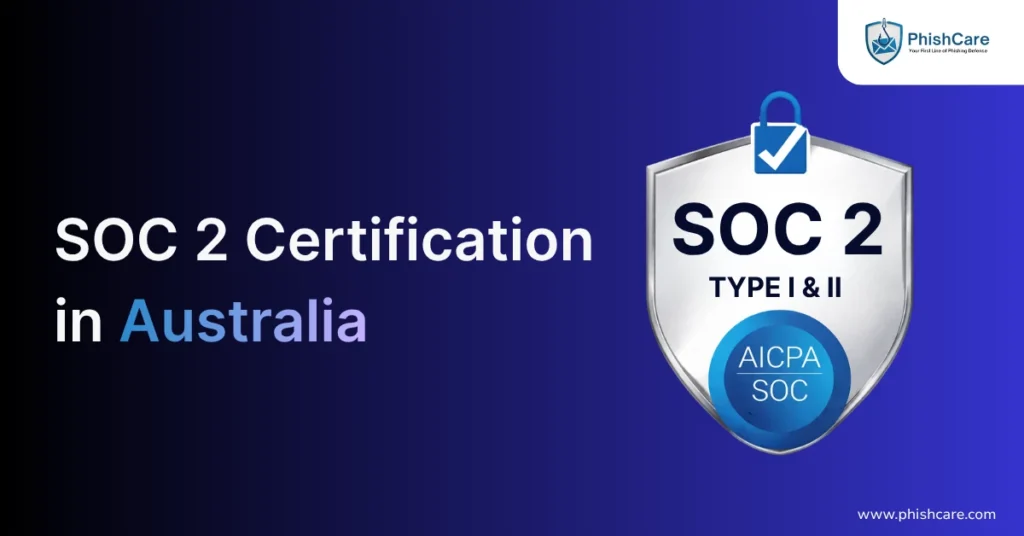
SOC 2 is an attestation framework created by the American Institute of Certified Public Accountants (AICPA). An independent CPA firm examines your controls and issues a report describing how well they meet the Trust Services Criteria. People often say “SOC 2 certification”, but there is no certificate: your customers receive the auditor’s report, usually under a non-disclosure agreement.
There are five Trust Services Criteria. Security is always included; the other four are added when your customers or services need them.
Security (always included)
Protection against unauthorised access, covered by the common criteria every SOC 2 report includes.
Availability
Uptime, capacity, backups and recovery, often added when customers rely on your SLA.
Confidentiality
Handling of confidential business data, such as customer IP and contracts.
Processing Integrity
Complete, accurate and timely processing, relevant for payments and data platforms.
Privacy
Collection, use and disposal of personal information, often paired with Privacy Act work.
Is SOC 2 required for Australian SaaS companies?
No Australian law requires SOC 2. Australian regulators focus on the Privacy Act, APRA CPS 234 and the Essential Eight instead. SOC 2 becomes important when your growth depends on customers who ask for it, which for most Australian SaaS companies means the United States and global enterprise accounts.
You probably need SOC 2 now if any of these are true:
- A US prospect or partner has asked for your SOC 2 report.
- Enterprise deals stall at procurement or vendor risk review.
- Your team spends days each month on security questionnaires.
- You host or process customer data on behalf of other businesses.
- Investors have flagged security assurance in due diligence.
- You plan to expand into North America in the next 12 months.
SOC 2 also strengthens your position under Australian law. Organisations covered by the Privacy Act must report eligible breaches under the Notifiable Data Breaches scheme, and the incident response, access and monitoring controls tested in a SOC 2 audit are the same controls that reduce that risk.
SOC 2 requirements for Australian SaaS companies
SOC 2 does not hand you a fixed checklist. You design controls that meet the criteria for your business, then prove they work. For a typical Australian SaaS company, auditors will expect to see these control areas:
| Control area | Typical evidence |
|---|---|
| Governance and risk | Security policies, annual risk assessment, board or leadership oversight |
| Access control | MFA, joiner and leaver records, quarterly access reviews |
| Change management | Pull request reviews, deployment approvals, separation of environments |
| Monitoring and logging | Centralised logs, alerting, vulnerability scans and penetration test results |
| Incident response | Response plan, tabletop exercise, incident tickets and post-incident reviews |
| Vendor management | Vendor inventory, risk ratings, reviews of your cloud providers’ own reports |
| People and awareness | Background checks, signed policies, security awareness training records |
| Business continuity | Backup tests, disaster recovery plan, recovery time objectives |
Security awareness is an area where Type 2 audits often find gaps, because training must be shown across the whole observation period, not just once. PhishCare’s campaign reports provide an additional documentation boost for organisations working towards SOC 2 Type II, where ongoing security awareness training is recognised as a best practice by auditors. You can see the format in this phishing simulation sample report.
SOC 2 Type 1 vs Type 2: which do you need first?
Type 1 checks that your controls are designed properly at one point in time. Type 2 checks that they actually worked over a period, usually 3 to 12 months. Most enterprise buyers ultimately want Type 2, so many Australian SaaS companies start with Type 1 to unblock deals, then move straight into a Type 2 observation period.
| Attribute | SOC 2 Type 1 | SOC 2 Type 2 |
|---|---|---|
| What it tests | Control design at a single date | Control design and operating effectiveness over time |
| Observation period | None | 3 to 12 months; 6 months is the common minimum for enterprise buyers |
| Typical timeline | 6 to 8 weeks | 9 to 12 months from a standing start |
| Best for | Unblocking early deals quickly | Enterprise procurement and long-term trust |
How long does SOC 2 compliance take in Australia?
The honest answer for a SaaS company starting from scratch: 6 to 8 weeks for Type 1, and 9 to 12 months for Type 2. Here is where the time goes.
| Phase | Typical duration | What happens |
|---|---|---|
| 1. Readiness and gap analysis | 4 to 8 weeks | Define scope and criteria, map existing controls, list gaps |
| 2. Gap remediation | 1 to 4 months | Write policies, configure tooling, tighten access and change control |
| 3. Observation window (Type 2 only) | 3 to 12 months | Controls operate continuously while evidence is collected |
| 4. Audit fieldwork and report | 4 to 8 weeks | The CPA firm tests evidence and issues the attestation report |
Be wary of “SOC 2 Type 2 in 45 days” offers. A Type 2 report covers an observation period, so it cannot be completed faster than that period plus fieldwork. Reports with very short windows are often rejected by enterprise security teams.
How much does SOC 2 cost for an Australian SaaS company?
SOC 2 is priced globally in US dollars. The audit fee is usually only 30 to 40 percent of the real first-year spend; the rest goes on readiness work, tooling, penetration testing and staff time. CyberSapiens quotes Australian companies a fixed price in AUD for its readiness and audit support.
| Company profile | Typical market, first year (USD) | CyberSapiens fixed price (AUD) |
|---|---|---|
| Early-stage startup | 20,000 to 50,000 | 8,000 to 20,000 |
| Small to mid-sized SaaS | 60,000 to 150,000 | 12,000 to 30,000 |
| Large enterprise | 150,000 to 250,000+ | 30,000+ |
Budget for renewal too: every year brings a new Type 2 audit period. The main cost drivers are the number of Trust Services Criteria in scope, the size of your engineering team and infrastructure, how many controls already exist, and whether you use a compliance automation platform.
What is the risk of not having SOC 2?
For Australian SaaS companies selling offshore, the cost of not having SOC 2 shows up in the sales pipeline before it shows up anywhere else.
Lost or delayed deals
Enterprise procurement teams often cannot approve a vendor without a current report.
Questionnaire overload
Engineers and founders answer the same hundreds of questions for every prospect.
Hidden security gaps
Without independent testing, weak access reviews or untested backups go unnoticed until an incident.
Weaker breach position
After a breach, documented and tested controls matter to customers, insurers and the OAIC.
SOC 2 tools, consultants and auditors: who does what
Australian SaaS leaders often compare SOC 2 software, consultants and audit firms as if they were alternatives. They play different roles, and most successful projects use all three.
| Provider | What they do | What they do not do |
|---|---|---|
| Compliance automation platform | Tracks controls, collects evidence from cloud tools, hosts policies | Design your controls, fix gaps or issue the report |
| Readiness consultant | Scopes the audit, closes gaps, writes documentation, runs a mock audit | Issue the SOC 2 report |
| Licensed CPA firm | Independently tests controls and issues the Type 1 or Type 2 report | Build or fix your controls, as that would affect its independence |
The AICPA’s SOC 2 examination guidance is the reference point for how these audits are performed. If you are comparing readiness partners, our shortlist of SOC 2 certification consultants in Australia sets out what to look for.
SOC 2 and ISO 27001 together
Many Australian SaaS companies need both: SOC 2 for US customers and ISO 27001 for Australian government, European and global buyers. Around 60 to 70 percent of the controls overlap, so running one programme with shared policies and evidence saves significant time and cost. If you already hold ISO 27001, SOC 2 readiness is usually much faster.
For the ISO side, read our guide to ISO 27001 certification in Australia.
How CyberSapiens helps Australian SaaS companies with SOC 2
CyberSapiens is an Australian cybersecurity and compliance firm and the company behind PhishCare. It runs SOC 2 programmes from readiness to report, fully remote across Australia, with fixed-price quotes and honest Type 2 timelines. Formal attestation is delivered through its licensed audit partner, so you deal with one team from start to finish.
Readiness and gap analysis
Scope, criteria selection and a prioritised gap list within weeks.
Remediation support
Policies, access and change control, and VAPT to close technical gaps.
Awareness training with PhishCare
Recurring phishing simulations with dated reports across your observation period.
Audit coordination
Evidence preparation and support through fieldwork with the audit partner.
Key points to remember
- SOC 2 is a commercial expectation, not an Australian legal requirement.
- You receive an attestation report from a licensed CPA firm, not a certificate.
- Type 1 takes about 6 to 8 weeks; Type 2 takes about 9 to 12 months from scratch.
- The audit fee is only part of the cost; plan for readiness, tooling and renewal.
- SOC 2 and ISO 27001 share most controls, so plan them together if you need both.
Frequently asked questions
Do Australian SaaS companies need SOC 2?
It is not required by Australian law. Australian SaaS companies usually need it when they sell to US or global enterprise customers, who often will not approve a vendor without a current SOC 2 report.
How long does it take to get SOC 2 compliant in Australia?
A Type 1 report typically takes 6 to 8 weeks. A Type 2 report from a standing start typically takes 9 to 12 months, including readiness, remediation, an observation period of 3 to 12 months and audit fieldwork.
How much does SOC 2 cost for an Australian SaaS company?
Typical first-year market costs range from USD 20,000 to 50,000 for early-stage startups and USD 60,000 to 150,000 for small to mid-sized SaaS companies. CyberSapiens offers fixed prices from AUD 8,000.
Should we start with SOC 2 Type 1 or Type 2?
If a deal is waiting, start with Type 1 to show your controls are designed correctly, then begin the Type 2 observation period straight away. If no deal is urgent, going directly to Type 2 avoids paying for two audits.
Who issues SOC 2 reports for Australian companies?
A licensed CPA firm performs the examination and issues the report under AICPA standards. Consultants and compliance software help you prepare but cannot issue the report.
Can we do SOC 2 and ISO 27001 at the same time?
Yes. Around 60 to 70 percent of controls overlap, so a combined programme with shared policies and evidence is usually faster and cheaper than running the two separately.
Content Reviewed By

Ketki specialises in governance, risk and compliance for public, private and government clients across Australia. She leads SOC 2 readiness and ISO 27001 projects at CyberSapiens, with further experience across PCI DSS, NIST CSF, Essential Eight, APRA CPS 234, VPDSS and the ISM. PhishCare is a product developed by CyberSapiens.
View Ketki Tidke’s LinkedIn profileGet SOC 2 ready without stalling your roadmap
Book a free consultation with CyberSapiens. You will get a clear view of your gaps, an honest Type 1 and Type 2 timeline, and a fixed-price quote within 24 hours.
CyberSapiens AustraliaLvl 1 206 Lorimer St, Port Melbourne, Australia
sales@phishcare.com · 1300 507 668