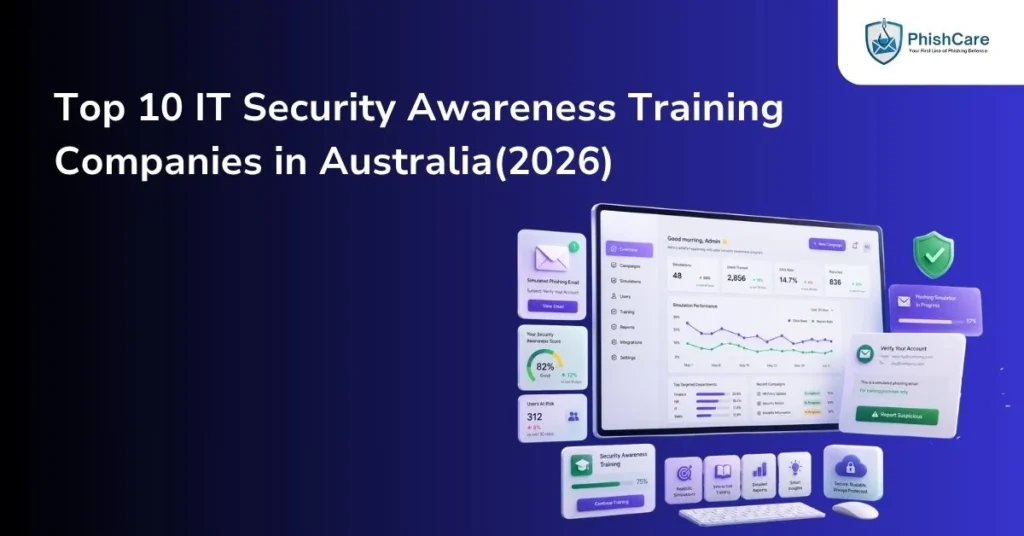
Top 10 IT Security Awareness Training Companies in Australia
Cyber threats continue to target Australian organisations across finance, healthcare, banking, government, education, and technology sectors. While security tools remain essential, employee awareness training has become equally important because phishing, social engineering, business email compromise, and credential theft attacks often begin with human interaction.
This guide compares the top IT security awareness training companies in Australia based on employee training effectiveness, phishing simulation capabilities, reporting features, compliance support, ease of deployment, and overall value. Whether you are an IT manager, security leader, compliance officer, or business owner, this comparison can help you identify the right provider for your organisation.
Quick Comparison of Australia’s Leading Security Awareness Training Providers
Ideal for organisations seeking phishing simulations, awareness training, reporting, and managed support through a single platform.
Widely adopted by large enterprises requiring extensive awareness content and mature training programs.
Focused on adaptive learning and gamified awareness programs designed to improve long-term employee behaviour.
Key Takeaways
- Security awareness training helps reduce phishing and social engineering risks.
- Modern programs combine employee education with realistic phishing simulations.
- Reporting and risk scoring help measure employee susceptibility over time.
- Recurring awareness programs are more effective than annual training alone.
- Phishing simulation reports provide an additional documentation boost for organisations working towards ISO 27001, SOC 2 Type II, PCI DSS, HIPAA, and NIST CSF where ongoing security awareness training is recognised as a best practice.
- This guide compares leading Australian and global providers serving organisations of different sizes and industries.
How We Evaluated the Top Security Awareness Training Companies
Not all security awareness training providers deliver the same level of effectiveness. Some focus primarily on training content, while others combine phishing simulations, behavioural analytics, reporting, compliance support, and managed services. To create this comparison, we assessed each provider using criteria that matter most to Australian organisations.
Training Content Quality
We evaluated the breadth, relevance, and quality of employee training materials, including phishing awareness, social engineering prevention, password security, remote work security, and compliance-related education.
Phishing Simulation Capabilities
Effective awareness programs require realistic phishing simulations. We reviewed template quality, customization options, campaign automation, risk scoring, and user behaviour tracking.
Reporting & Analytics
We examined dashboard quality, executive reporting, employee risk metrics, campaign insights, and the ability to demonstrate measurable improvements over time.
Compliance Support
We considered how each platform supports organizations working towards ISO 27001, SOC 2 Type II, PCI DSS, HIPAA, and NIST CSF through ongoing awareness initiatives and reporting documentation.
Ease of Deployment
A successful awareness program should be easy to launch and manage. We reviewed onboarding processes, campaign setup, integrations, user management, and administrative overhead.
Value & Business Fit
Different organizations have different requirements. We evaluated suitability for small businesses, mid-sized companies, enterprises, regulated industries, and security-conscious organizations.
Our Experience with Security Awareness Programs
This comparison is informed by practical experience running phishing simulation campaigns and security awareness initiatives across multiple industries. Through PhishCare, a platform developed by CyberSapiens, organizations have conducted awareness assessments, phishing simulations, and employee training exercises designed to strengthen security culture and reduce human-related cyber risk.
The evaluation methodology prioritizes real-world effectiveness rather than marketing claims. Particular attention was given to phishing simulation quality, reporting depth, user engagement, scalability, and long-term behavioural improvement outcomes.
What Makes a Great Security Awareness Training Provider?
Choosing a security awareness training provider is about more than selecting a platform with training videos. The most effective providers help organizations reduce human risk through continuous education, realistic phishing simulations, measurable reporting, and long-term behavioural improvement.
Realistic Phishing Simulations
Employees learn best when exposed to realistic phishing attacks in a controlled environment. High-quality providers offer customizable phishing templates, campaign automation, click tracking, and behavioural insights that help identify vulnerable users before attackers do.
Engaging Employee Training
Modern awareness programs use short, engaging content instead of lengthy annual training sessions. Interactive modules, videos, quizzes, and role-based learning help improve retention and encourage better security behaviour.
Reporting & Risk Visibility
Security leaders need clear visibility into employee risk levels. Strong reporting capabilities make it easier to track campaign results, identify high-risk users, measure improvement, and communicate outcomes to management.
Compliance-Friendly Documentation
Organizations often need evidence of ongoing awareness activities. Detailed reporting and campaign records can provide an additional documentation boost for organizations working towards ISO 27001, SOC 2 Type II, PCI DSS, HIPAA, and NIST CSF.
Scalability & Ease of Management
Whether an organization has 50 employees or 50,000, awareness programs should be easy to manage. Automation, user synchronization, campaign scheduling, and centralized administration help reduce operational effort.
Long-Term Behaviour Change
The best providers focus on creating a security-conscious culture rather than delivering one-time training. Continuous learning, regular simulations, and targeted remediation help employees develop lasting cybersecurity habits.
What Australian Organizations Should Prioritize
Australian businesses increasingly face phishing attacks, credential theft, business email compromise, and social engineering threats. When evaluating providers, organizations should focus on measurable risk reduction, realistic simulations, employee engagement, reporting quality, and ongoing program effectiveness rather than simply comparing training libraries.
PhishCare by CyberSapiens
PhishCare is a phishing simulation and security awareness training platform developed by CyberSapiens. Designed to help organizations strengthen their human firewall, the platform combines realistic phishing simulations, employee awareness training, detailed reporting, and managed campaign support within a single solution.
Organizations across finance, healthcare, banking, IT, and professional services use phishing simulations and awareness programs to identify employee vulnerabilities, improve security behaviour, and reduce the risk of phishing attacks and social engineering threats.
Awareness campaigns delivered across multiple industries and organizational sizes.
Measured through awareness engagement and employee participation outcomes.
Finance, Banking, Healthcare, IT, and other security-conscious sectors.
Key Features
Realistic Phishing Simulations
Launch targeted phishing campaigns using realistic email templates designed to test employee awareness in controlled environments.
Employee Awareness Training
Deliver awareness education that helps employees recognize phishing attempts, social engineering attacks, and credential theft risks.
Advanced Reporting
Track click rates, reporting rates, employee risk indicators, and campaign performance through detailed dashboards.
Managed Campaign Support
Benefit from expert guidance when planning, launching, and evaluating phishing simulation programs.
Trusted by Organizations Across Multiple Industries









What Customers Say
“We recently used PhishCare for a phishing simulation, and I’ve got to say, their email templates were top-notch. The realism and variety of the templates were impressive, really testing our team’s vigilance. The level of detail they put into crafting these emails was evident, making the simulation both challenging and effective. It’s clear they know their stuff when it comes to cybersecurity.”
KnowBe4
KnowBe4 is one of the most recognized security awareness training platforms globally and is widely used by enterprises seeking large-scale employee awareness programs. The platform combines phishing simulations, awareness content, risk scoring, and automated training workflows to help organizations strengthen their security culture.
Its extensive content library and mature platform capabilities make it a popular option for organizations that require a broad range of awareness training materials across multiple departments, regions, and user groups.
Key Strengths
- Large awareness training library
- Phishing simulation campaigns
- Automated training workflows
- Risk scoring capabilities
- Enterprise scalability
- Broad third-party content partnerships
Best For
Large enterprises, government organizations, and businesses that require extensive training content, structured awareness programs, and centralized administration across a large workforce.
Things to Consider
While KnowBe4 offers a comprehensive awareness platform, some organizations may prefer a more managed approach that includes campaign planning, deployment assistance, and hands-on support rather than relying primarily on internal administration.
For organizations focused specifically on phishing simulation effectiveness and ongoing campaign management, it can be useful to evaluate available support services alongside platform capabilities.
Why Organizations Choose KnowBe4
Organizations often choose KnowBe4 when they need a mature security awareness platform with a large content ecosystem, enterprise reporting capabilities, and the flexibility to run awareness initiatives across large employee populations. Its strong market presence has made it a familiar option for organizations evaluating security awareness training providers in Australia and globally.
Proofpoint Security Awareness Training
Proofpoint is a well-known cybersecurity company that offers security awareness training alongside its broader email security and threat protection solutions. The platform is designed to help organizations reduce human-related cyber risk through phishing simulations, employee education, risk analysis, and targeted awareness campaigns.
Many enterprises use Proofpoint as part of a larger cybersecurity ecosystem, making it a popular choice for organizations that already rely on Proofpoint products for email security, threat intelligence, or data protection.
Key Strengths
- Integrated security awareness platform
- Advanced phishing simulations
- User risk analysis and reporting
- Threat intelligence integration
- Enterprise-grade scalability
- Strong email security ecosystem
Best For
Medium to large organizations looking for awareness training that integrates closely with broader cybersecurity operations, email protection initiatives, and risk management programs.
What Sets Proofpoint Apart?
One of Proofpoint’s strengths is its ability to combine awareness training with broader threat intelligence insights. Organizations can use behavioural data alongside security controls to better understand employee risk levels and identify areas that require additional training.
This approach helps security teams move beyond simple awareness metrics and build a more comprehensive understanding of human risk within the organization.
Things to Consider
Organizations evaluating Proofpoint should consider how awareness training fits within their overall security strategy. Businesses looking for a standalone phishing simulation and awareness solution may compare the platform against providers that focus exclusively on awareness training and managed phishing campaigns.
For many enterprises, the value of Proofpoint often increases when used alongside its wider cybersecurity portfolio, allowing awareness programs to align closely with existing security operations.
Why Australian Organizations Consider Proofpoint
Australian organizations with mature cybersecurity programs often evaluate Proofpoint because of its ability to combine security awareness training with broader threat protection capabilities. This makes it particularly relevant for enterprises seeking a unified approach to employee awareness, phishing defense, and cyber risk management.
Hoxhunt
Hoxhunt is a security awareness training platform known for its behavioural science approach to cybersecurity education. Rather than relying solely on traditional training modules, the platform focuses on continuous learning through personalized phishing simulations, adaptive training, and gamified user engagement.
The platform is designed to help organizations improve employee decision-making over time by creating awareness experiences that feel relevant, engaging, and practical. This focus on behaviour change has made Hoxhunt a popular option among organizations seeking to build a stronger security culture.
Key Strengths
- Behaviour-focused learning model
- Adaptive phishing simulations
- Gamified employee engagement
- Personalized awareness journeys
- Automated campaign delivery
- Detailed user performance insights
Best For
Organizations that want to improve long-term employee behaviour and security culture through engaging, personalized awareness experiences rather than relying solely on annual training programs.
What Sets Hoxhunt Apart?
Hoxhunt differentiates itself through its focus on behavioural change rather than training completion rates alone. The platform continuously adapts phishing simulations and awareness activities based on employee interactions, creating learning experiences that evolve over time.
By combining personalized learning with frequent phishing simulations, organizations can gain deeper insights into employee risk patterns while encouraging consistent security-conscious behaviour.
Things to Consider
Organizations evaluating Hoxhunt should consider whether their primary objective is behavioural improvement, compliance-focused training, phishing simulation testing, or a combination of all three. Different providers may place varying levels of emphasis on these areas.
Companies looking for managed phishing simulation services, customized awareness programs, or extensive compliance reporting may compare Hoxhunt alongside providers that offer broader managed security awareness capabilities.
Why Australian Organizations Consider Hoxhunt
Australian organizations increasingly recognize that employee behaviour plays a critical role in cybersecurity resilience. Hoxhunt’s personalized learning model appeals to businesses that want to move beyond one-time awareness sessions and establish an ongoing culture of cyber awareness across their workforce.
Mimecast Awareness Training
Mimecast Awareness Training is part of Mimecast’s broader cybersecurity portfolio and is designed to help organizations strengthen employee awareness against phishing, social engineering, and email-based threats. The platform combines awareness education with phishing simulations to help users recognize and respond to suspicious communications.
Organizations that already use Mimecast for email security often evaluate Mimecast Awareness Training as a complementary solution that aligns awareness initiatives with their existing security infrastructure.
Key Strengths
- Email security ecosystem integration
- Phishing simulation campaigns
- Awareness training modules
- User risk visibility
- Campaign reporting and analytics
- Enterprise-ready deployment
Best For
Organizations already using Mimecast technologies and looking to extend their security strategy with phishing simulations and employee awareness training.
What Sets Mimecast Awareness Training Apart?
Mimecast’s awareness platform benefits from its connection to a broader email security ecosystem. Organizations can align employee education efforts with the same threat landscape they encounter through their email security environment, helping create a more cohesive approach to risk reduction.
The platform emphasizes helping employees identify common phishing techniques, suspicious email behaviour, and social engineering tactics that continue to target organizations across Australia.
Things to Consider
Organizations should evaluate whether they require a standalone awareness platform, a managed phishing simulation program, or a solution that integrates closely with their existing email security technologies.
Businesses seeking highly customized awareness campaigns, extensive managed services, or dedicated phishing simulation specialists may also compare Mimecast alongside providers that focus exclusively on awareness training and human risk management.
Why Australian Organizations Consider Mimecast
With phishing attacks remaining one of the most common entry points for cyber incidents, many Australian organizations seek awareness training solutions that complement their email security investments. Mimecast Awareness Training appeals to businesses looking for a unified approach to employee education and email threat defense.
Cofense PhishMe
Cofense PhishMe is a phishing-focused security awareness platform designed to help organizations identify, measure, and reduce susceptibility to phishing attacks. The platform combines realistic phishing simulations with employee reporting capabilities, helping security teams understand how users respond to real-world attack scenarios.
Originally built around phishing defense and threat reporting, Cofense PhishMe remains a popular choice for organizations that place phishing resilience at the center of their security awareness strategy.
Key Strengths
- Phishing-focused awareness programs
- Realistic phishing simulation campaigns
- Employee threat reporting features
- Risk measurement and tracking
- Security operations alignment
- Enterprise-ready deployment
Best For
Organizations that want to strengthen phishing resilience, encourage employee reporting of suspicious emails, and integrate awareness initiatives with broader threat detection processes.
What Sets Cofense PhishMe Apart?
Unlike many awareness platforms that focus heavily on training content, Cofense PhishMe places significant emphasis on phishing detection and employee response behaviour. The platform encourages employees to actively participate in identifying and reporting suspicious emails, helping transform users into an additional layer of defense.
This approach can help organizations improve phishing reporting rates while providing security teams with greater visibility into employee awareness and threat response patterns.
Things to Consider
Organizations evaluating Cofense PhishMe should consider whether phishing resilience is their primary objective or whether they require a broader awareness program that includes extensive training content, compliance-focused learning, and managed awareness services.
Businesses seeking an all-in-one awareness solution may compare Cofense PhishMe with providers that offer a wider range of employee training modules, ongoing education programs, and managed campaign support.
Why Australian Organizations Consider Cofense PhishMe
As phishing attacks continue to target Australian businesses across finance, healthcare, government, and technology sectors, many organizations prioritize solutions that help employees identify and report suspicious communications. Cofense PhishMe appeals to businesses that view phishing defense as a critical component of their overall cybersecurity strategy.
Other Notable Security Awareness Training Providers
While the providers above are among the most widely evaluated options, several other security awareness training platforms also serve Australian organizations. The right choice often depends on company size, compliance objectives, security maturity, and awareness program goals.
Terranova Security
Terranova Security focuses on awareness education, compliance-focused learning, and human risk management initiatives.
Often considered by organizations seeking structured awareness programs and multilingual training content.
Infosec IQ
Infosec IQ provides awareness training, phishing simulations, and employee education resources designed to improve cyber hygiene.
Suitable for organizations looking for awareness content alongside broader cybersecurity education initiatives.
MetaCompliance
MetaCompliance combines awareness training, phishing simulations, and policy management features.
Frequently evaluated by organizations that want to align employee awareness initiatives with governance and compliance processes.
Sophos Phish Threat
Sophos Phish Threat focuses on phishing simulation campaigns and employee awareness education.
A common consideration for organizations already using Sophos cybersecurity products and services.
CyberHoot
CyberHoot offers awareness training, phishing simulations, and cybersecurity education resources targeted at small and mid-sized businesses.
Often considered by organizations looking for a straightforward approach to employee awareness training.
There Is No One-Size-Fits-All Security Awareness Platform
Every organization has different security awareness requirements. A financial institution may prioritize phishing resilience and compliance reporting, while a healthcare organization may focus on employee education and risk reduction. Technology companies often seek scalable awareness programs that can support rapid growth and distributed teams.
The best approach is to evaluate providers based on your organization’s risk profile, employee population, reporting requirements, available resources, and long-term security awareness goals rather than selecting a platform solely based on popularity.
How Australian Organizations Should Choose a Security Awareness Training Provider
Selecting a security awareness training provider is not simply about choosing the platform with the largest content library or the most features. The right solution should align with your organization’s industry, risk profile, employee size, compliance objectives, and cybersecurity maturity level.
1. Evaluate Your Human Risk Exposure
Before comparing providers, organizations should understand their biggest human-related security risks. Phishing attacks, credential theft, business email compromise, social engineering, and ransomware delivery often target employees directly. A provider should help identify and reduce these risks through measurable awareness programs rather than simply delivering training content.
2. Prioritize Phishing Simulation Quality
Since phishing remains one of the most common attack vectors, organizations should assess the quality of phishing simulation capabilities. Look for realistic email templates, campaign customization, automated scheduling, reporting, and the ability to track user behaviour over time. Effective phishing simulations help employees learn through experience while providing valuable risk insights to security teams.
3. Look Beyond Annual Awareness Training
Annual security awareness sessions rarely create lasting behavioural change. Modern security programs rely on continuous education, recurring phishing simulations, targeted remediation, and regular engagement throughout the year. Providers that support ongoing awareness initiatives often help organizations achieve stronger long-term results.
4. Consider Compliance and Audit Requirements
Many Australian organizations operate within regulated environments where awareness training plays an important role in governance and risk management. Detailed reporting, employee participation records, and phishing simulation documentation can provide an additional boost for organizations working towards ISO 27001, SOC 2 Type II, PCI DSS, HIPAA, and NIST CSF frameworks where ongoing awareness training is considered a security best practice.
5. Choose a Provider That Matches Your Industry
Different industries face different threat landscapes and compliance expectations. Security awareness programs should reflect these realities.
- Banking & Finance: Focus on phishing, fraud prevention, credential theft, and regulatory compliance.
- Healthcare: Prioritize patient data protection, phishing awareness, and privacy-focused security training.
- IT & Technology: Emphasize advanced phishing detection, cloud security awareness, and remote workforce security.
- Professional Services: Focus on business email compromise, client data protection, and social engineering awareness.
The Most Effective Providers Focus on Measurable Risk Reduction
The ultimate goal of security awareness training is not simply completing courses or achieving training participation targets. The most successful programs reduce human risk, improve employee decision-making, increase phishing reporting rates, and strengthen organizational resilience against cyber threats.
When evaluating providers, prioritize measurable outcomes, realistic simulations, employee engagement, and ongoing improvement rather than focusing solely on content volume or platform features.
Why Phishing Simulation Matters More Than Annual Security Awareness Training
Many organizations still rely on annual cybersecurity awareness training to educate employees. While awareness training remains important, cyber threats evolve continuously throughout the year. Employees often forget what they learned months earlier, making ongoing phishing simulations one of the most effective ways to reinforce security behaviour in real-world situations.
Awareness Training Teaches Concepts. Phishing Simulations Test Behaviour.
Traditional awareness training helps employees understand cybersecurity concepts, common attack techniques, and organizational security policies. However, understanding a threat does not always translate into secure behaviour when a realistic phishing email arrives in an employee’s inbox.
Phishing simulations bridge this gap by allowing organizations to safely test employee responses in realistic scenarios. Instead of measuring knowledge alone, simulations reveal how employees actually react when faced with a potential attack.
Continuous Learning
Employees are exposed to new attack techniques regularly. Ongoing phishing simulations help reinforce awareness throughout the year and keep security top of mind.
Measurable Risk Reduction
Simulation results provide measurable data including click rates, reporting rates, credential submission attempts, and employee risk indicators.
Targeted Remediation
Organizations can identify high-risk users and provide focused training where it is needed most instead of applying the same approach to every employee.
What We Have Learned from Running 3,000+ Phishing Simulations
Based on phishing simulation programs conducted through PhishCare, one consistent pattern emerges: organizations that run regular phishing simulations typically develop stronger employee awareness than those relying solely on annual training sessions.
Employees who participate in recurring simulations become more familiar with phishing indicators, more likely to report suspicious emails, and more confident when handling unexpected communications.
This continuous feedback loop helps organizations transform awareness training from a compliance activity into an ongoing security improvement program.
Supporting Security Programs and Compliance Objectives
Phishing simulations also generate valuable reporting data that security leaders can use to demonstrate awareness program effectiveness. Campaign reports help organizations track progress, identify trends, and document employee participation over time.
For organizations working towards ISO 27001, SOC 2 Type II, PCI DSS, HIPAA, or NIST CSF, phishing simulation reporting can provide an additional documentation boost where ongoing security awareness activities are recognized as a security best practice.
The Most Effective Approach Combines Both
The strongest security awareness programs do not choose between awareness training and phishing simulations. Instead, they combine both. Awareness training provides foundational knowledge, while phishing simulations reinforce learning through practical experience. Together, they help organizations build a stronger security culture and reduce human-related cyber risk over time.
Frequently Asked Questions
Here are answers to some of the most common questions Australian organizations ask when evaluating security awareness training providers and phishing simulation platforms.
What is security awareness training?
Security awareness training helps employees recognize and respond appropriately to cybersecurity threats such as phishing emails, social engineering attacks, credential theft attempts, ransomware risks, and other common attack techniques. The goal is to reduce human-related security risks through education and ongoing awareness initiatives.
How often should security awareness training be conducted?
Most cybersecurity professionals recommend ongoing awareness programs rather than relying solely on annual training. Regular phishing simulations, micro-learning sessions, awareness campaigns, and targeted refresher training help reinforce secure behaviour throughout the year.
Why are phishing simulations important?
Phishing simulations allow organizations to safely test employee responses to realistic phishing attacks. They help identify vulnerabilities, measure risk levels, improve employee awareness, and provide actionable insights that support ongoing security improvement efforts.
Can phishing simulations support compliance initiatives?
Yes. Phishing simulation reports and awareness training records can provide an additional documentation boost for organizations working towards ISO 27001, SOC 2 Type II, PCI DSS, HIPAA, and NIST CSF, where ongoing employee awareness is recognized as a cybersecurity best practice.
Which industries benefit most from security awareness training?
Virtually every industry can benefit from awareness training. However, organizations in finance, banking, healthcare, government, education, legal services, professional services, and technology sectors often prioritize employee awareness because they regularly handle sensitive information and are frequent targets of cyberattacks.
What should Australian businesses look for in a security awareness training provider?
Organizations should evaluate training quality, phishing simulation capabilities, reporting features, compliance support, ease of deployment, managed services, and long-term effectiveness. The best providers focus on measurable risk reduction rather than training completion rates alone.
Content Reviewed By

Mohammed Nawaz Sajjad is a practising security analyst with hands-on experience in phishing simulation campaigns, employee security awareness assessments, red team exercises, and ethical hacking initiatives. Through PhishCare, a phishing simulation and security awareness platform developed by CyberSapiens, he has helped organizations evaluate employee cyber risk, strengthen security awareness programs, and improve phishing resilience across multiple industries including finance, banking, healthcare, and information technology. His experience includes supporting awareness programs, phishing simulation deployments, and employee cybersecurity initiatives designed to reduce human-related security risks and strengthen organizational security culture.
View LinkedIn ProfileReady to Improve Employee Security Awareness?
Phishing attacks continue to be one of the most effective methods used by cybercriminals. With realistic phishing simulations, employee awareness training, and detailed reporting, organizations can reduce human risk and build a stronger security culture across their workforce.
PhishCare, developed by CyberSapiens, helps organizations run phishing simulations, measure employee awareness levels, and strengthen cybersecurity readiness through ongoing awareness initiatives.