What Is Employee Awareness Training and Why Does It Matter?
Employee awareness training is a structured program designed to help employees recognize risks, make informed decisions, and respond appropriately to security, privacy, and compliance challenges they encounter in their daily work. In cybersecurity, awareness training focuses on reducing human risk by teaching employees how to identify phishing emails, social engineering tactics, credential theft attempts, unsafe online behavior, and other common threats.
Modern organizations can no longer rely on annual training sessions alone. Cybercriminals continuously evolve their tactics, making ongoing awareness initiatives, practical exercises, and phishing simulations essential components of an effective security culture. Organizations that invest in employee awareness programs often experience stronger reporting behaviors, reduced susceptibility to phishing attacks, and greater confidence during security audits and compliance assessments.
Employees remain one of the most frequently targeted attack surfaces in any organization. Whether it is a phishing email impersonating a trusted vendor, a fraudulent password reset request, or a social engineering attempt delivered over the phone, attackers often focus on people before technology.
An effective employee awareness training program helps build a security-conscious workforce that can identify suspicious activity before it becomes a costly incident. Rather than treating awareness as a one-time compliance exercise, leading organizations use continuous education, practical simulations, and measurable learning outcomes to strengthen resilience across departments.
At PhishCare, a phishing simulation platform developed by CyberSapiens, we have supported organizations across finance, banking, healthcare, and IT sectors through more than 3,000 phishing simulation campaigns. These engagements consistently demonstrate that awareness improves significantly when employees receive regular reinforcement, realistic attack simulations, and actionable feedback.
Key Takeaway
Employee awareness training is most effective when it combines education, real-world scenarios, phishing simulations, performance measurement, and continuous improvement. The goal is not simply to complete training, but to create lasting behavioral change that reduces organizational risk.
Why Employee Awareness Training Matters More Than Ever
Cyber threats have become more sophisticated, targeted, and difficult to detect. Attackers no longer rely solely on technical vulnerabilities. Instead, they frequently exploit human behavior through phishing emails, fake login pages, social engineering tactics, and business email compromise schemes. As a result, employees are often the first line of defense against cyber incidents.
Organizations invest heavily in security technologies such as firewalls, endpoint protection, and threat monitoring solutions. While these controls are essential, they cannot prevent every attack if an employee unknowingly shares credentials, clicks a malicious link, or discloses sensitive information. Employee awareness training helps close this gap by improving decision-making and strengthening security habits across the workforce.
The Security Challenge Facing Modern Organizations
Phishing Attacks
Attackers use convincing emails and fake websites to trick employees into revealing credentials or downloading malware.
Social Engineering
Cybercriminals manipulate trust and urgency to bypass security controls and gain access to sensitive information.
Remote Work Risks
Hybrid and remote work environments create additional opportunities for attackers targeting distributed teams.
Human Error
Even well-intentioned employees can make mistakes that expose data, systems, or business operations.
Why Annual Training Alone Is No Longer Enough
Many organizations still rely on a single awareness session each year. While annual training can help introduce security concepts, it is rarely enough to influence long-term behavior. Employees may forget lessons over time, while threat actors continuously change their techniques.
Effective awareness programs use continuous reinforcement throughout the year. This may include short learning modules, phishing simulations, security reminders, role-specific education, and periodic assessments. Repetition helps transform knowledge into habits, making employees more likely to recognize and report suspicious activity when it matters most.
Business Benefits of Employee Awareness Training
- Reduces the likelihood of successful phishing attacks.
- Improves employee confidence when identifying suspicious activity.
- Strengthens incident reporting and response readiness.
- Supports a stronger security culture across departments.
- Provides measurable insights into workforce security behavior.
- Supports organizations working toward ISO 27001, SOC 2 Type II, PCI DSS, HIPAA, and NIST CSF best practices.
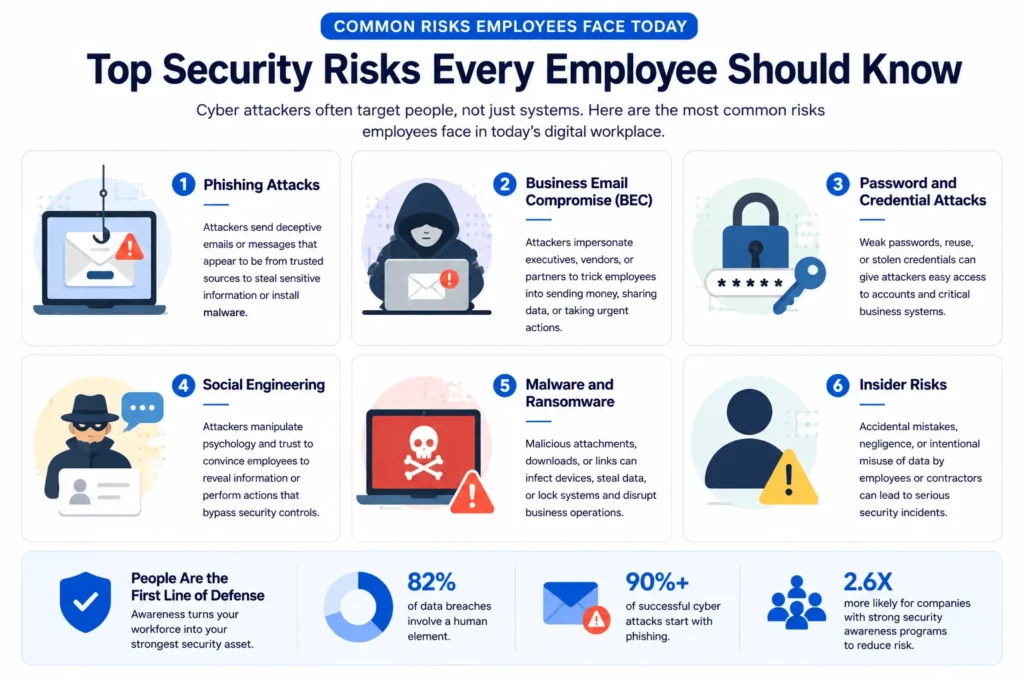
Common Risks Employees Face Today
Employees interact with email systems, cloud platforms, collaboration tools, customer data, financial information, and business applications every day. This makes them attractive targets for cybercriminals seeking unauthorized access, sensitive information, or financial gain. Understanding the most common threats is a critical part of any employee awareness training program.
While security technologies help reduce risk, employee awareness remains essential because many attacks rely on human interaction. The following threats are among the most common challenges faced by modern workplaces.
1. Phishing Attacks
Phishing remains one of the most successful cyberattack methods because it targets people rather than systems. Attackers create realistic emails that appear to come from trusted organizations, colleagues, vendors, or executives. These messages often encourage employees to click malicious links, open infected attachments, or disclose credentials.
2. Business Email Compromise (BEC)
Business Email Compromise attacks involve cybercriminals impersonating executives, managers, suppliers, or partners to request payments, sensitive information, or urgent actions. These attacks often rely on trust and urgency rather than technical exploitation.
3. Password and Credential Attacks
Weak passwords, password reuse, and credential sharing increase organizational risk. Attackers frequently use stolen credentials from previous breaches to gain access to business systems. Employees must understand the importance of strong passwords and multi-factor authentication.
4. Social Engineering
Social engineering attacks manipulate human psychology to bypass security controls. Attackers may pose as IT support personnel, customers, business partners, or government representatives to convince employees to share information or perform risky actions.
5. Malware and Ransomware
Malware infections often begin with a single click on a malicious attachment or download. Ransomware attacks can disrupt operations, impact productivity, and create significant financial losses. Awareness training helps employees recognize suspicious content before damage occurs.
6. Insider Risks
Not all security incidents originate from external attackers. Accidental mistakes, negligence, and inappropriate data handling can expose organizations to significant risk. Awareness training helps employees understand their responsibilities when handling sensitive information.
Why Awareness Matters
Most cyberattacks succeed because an employee unknowingly performs an action that enables the attacker. Awareness training helps employees recognize warning signs, verify unusual requests, report suspicious activity quickly, and make safer decisions in real-world situations. By addressing these common risks proactively, organizations can significantly reduce their overall attack surface.
What Makes an Effective Employee Awareness Program?
Not all awareness programs deliver meaningful results. Many organizations provide training content, but struggle to create lasting behavioral change. An effective employee awareness program goes beyond knowledge transfer and focuses on helping employees apply what they learn in real-world situations.
The most successful programs combine continuous learning, practical exercises, measurable outcomes, and leadership support. Together, these elements help create a culture where security awareness becomes part of everyday decision-making rather than an occasional training requirement.
Continuous Learning
Awareness should be reinforced throughout the year with short, engaging learning sessions rather than relying solely on annual training events.
Real-World Scenarios
Employees learn more effectively when training includes realistic examples they may encounter in their daily work environment.
Role-Based Training
Different departments face different risks. Tailored training helps employees focus on threats most relevant to their responsibilities.
Regular Assessments
Periodic assessments help identify knowledge gaps and measure whether employees are retaining and applying key concepts.
Leadership Support
When leaders actively promote awareness initiatives, employees are more likely to participate and adopt secure behaviors.
Continuous Improvement
Awareness programs should evolve based on emerging threats, employee feedback, assessment results, and organizational needs.
The Goal Is Behavioral Change
The effectiveness of an employee awareness program should not be measured solely by training completion rates. The real objective is to help employees consistently recognize risks, report suspicious activity, and make informed decisions that protect the organization.
Organizations that focus on long-term behavior change are typically better prepared to handle evolving security, privacy, and compliance challenges while fostering a stronger culture of awareness across the workforce.
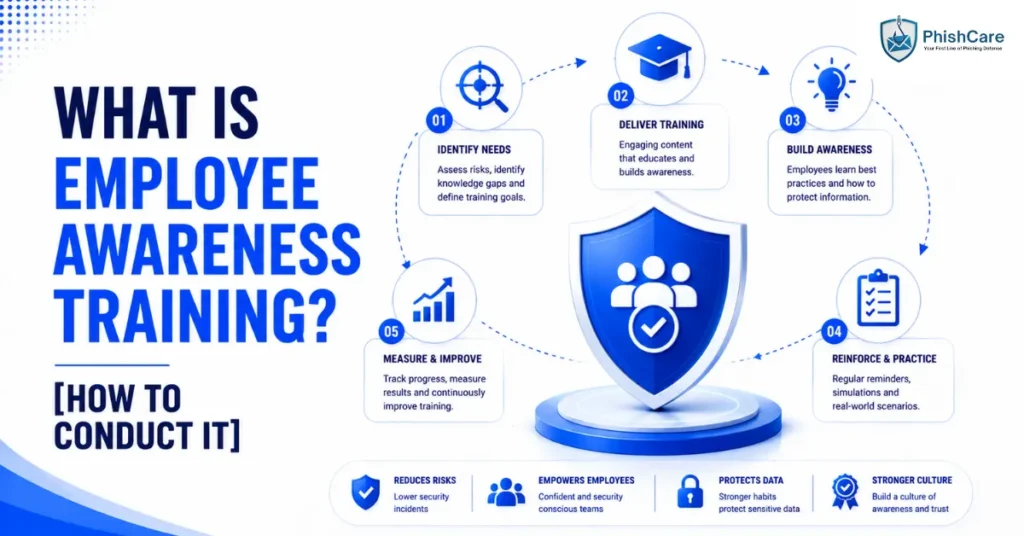
How to Conduct Employee Awareness Training: A Step-by-Step Guide
Building an effective employee awareness training program requires more than selecting a training platform or assigning a course. Organizations need a structured approach that identifies risks, addresses knowledge gaps, reinforces learning, and continuously measures effectiveness. The following framework can help organizations create a sustainable awareness program that delivers measurable results.
Assess Current Awareness Levels
Begin by understanding your organization’s current awareness maturity. Surveys, assessments, interviews, and training evaluations can help identify existing strengths and weaknesses. Establishing a baseline allows you to measure future improvements and prioritize high-risk areas.
Identify Employee Risk Areas
Different roles face different threats. Finance teams may encounter payment fraud attempts, while HR teams may receive fake recruitment requests. Identifying department-specific risks ensures training remains relevant and practical for employees.
Develop Relevant Training Content
Create training modules that address the threats employees are most likely to encounter. Topics may include phishing, password security, social engineering, safe browsing, data protection, remote work security, and incident reporting procedures.
Deliver Training Through Multiple Formats
People learn differently. Combining videos, workshops, microlearning modules, quizzes, awareness campaigns, newsletters, and interactive sessions improves engagement and knowledge retention across diverse employee groups.
Reinforce Learning with Practical Exercises
Awareness improves when employees can apply their knowledge in realistic situations. Simulations, scenario-based exercises, tabletop discussions, and role-specific challenges help transform theory into practical decision-making skills.
Measure Results and Improve Continuously
Track metrics such as training completion rates, assessment scores, reporting rates, employee feedback, and observed behavioral improvements. Use these insights to refine future training and address emerging risks.
A Successful Program Is an Ongoing Process
Employee awareness training should be viewed as a continuous improvement initiative rather than a one-time event. Organizations that regularly educate, assess, and engage employees are generally better positioned to reduce risk, strengthen resilience, and adapt to evolving threats over time.
Employee Awareness Training vs Traditional Security Training
Many organizations use the terms employee awareness training and security training interchangeably. While they are closely related, their objectives and delivery methods are often different. Understanding the distinction helps organizations build a more effective learning strategy that addresses both knowledge and behavior.
Traditional security training typically focuses on policies, procedures, and compliance requirements. Employee awareness training places greater emphasis on helping employees recognize risks, make informed decisions, and develop secure habits in real-world situations.
| Area | Employee Awareness Training | Traditional Security Training |
|---|---|---|
| Primary Goal | Improve employee behavior and risk recognition. | Educate employees about policies and procedures. |
| Focus | Real-world threats and practical decision-making. | Rules, compliance, and organizational requirements. |
| Learning Style | Interactive, scenario-based, and continuous. | Structured courses and periodic training sessions. |
| Measurement | Behavioral improvements and risk reduction. | Completion rates and assessment scores. |
| Frequency | Ongoing throughout the year. | Typically annual or periodic. |
| Outcome | Security-conscious workforce with stronger decision-making skills. | Improved understanding of policies and compliance expectations. |
Why Organizations Need Both
Employee awareness training and traditional security training should complement each other rather than compete. Security training provides the foundational knowledge employees need to understand organizational expectations, while awareness training reinforces that knowledge through practical application and continuous engagement.
Organizations that combine policy education with ongoing awareness initiatives are often better equipped to reduce human risk, improve incident reporting, and foster a stronger culture of security across the workforce.
Real Results from Employee Awareness Programs
The effectiveness of an employee awareness program should be measured by behavioral improvement rather than training completion alone. Organizations that continuously educate employees, reinforce key concepts, and evaluate awareness levels often see meaningful improvements in security culture, reporting behavior, and overall risk reduction.
Over time, awareness initiatives help employees become more confident in identifying suspicious activity, responding appropriately to potential threats, and following security best practices in their daily work. The result is a workforce that actively contributes to organizational resilience.
Industries That Commonly Benefit from Awareness Training
Expert Perspective
“Effective awareness programs succeed because they help employees recognize risks in real situations rather than simply memorizing policies. Consistent reinforcement, practical exercises, and measurable outcomes create long-term behavioral improvements that strengthen organizational resilience.”
Best Practices for Long-Term Employee Awareness Success
Building awareness is not a one-time project. Employee behavior, business processes, and cyber threats continuously evolve, making ongoing education essential. Organizations that achieve lasting success typically focus on creating a culture where awareness becomes part of everyday work rather than a periodic training requirement.
The following best practices can help organizations maintain engagement, improve knowledge retention, and strengthen employee participation over the long term.
Keep Training Continuous
Regular awareness activities throughout the year help employees retain information and stay informed about emerging risks and evolving attack techniques.
Make Content Relevant
Employees engage more effectively when examples and scenarios reflect situations they are likely to encounter in their specific roles and responsibilities.
Encourage Reporting
Employees should feel comfortable reporting suspicious activity without fear of blame. Early reporting often helps organizations respond more quickly to potential incidents.
Use Interactive Learning
Interactive workshops, discussions, quizzes, and practical exercises generally create stronger engagement than passive learning methods alone.
Measure and Improve
Regular reviews of awareness metrics, assessments, and employee feedback help identify improvement opportunities and optimize future training efforts.
Gain Leadership Support
Visible support from management reinforces the importance of awareness initiatives and encourages organization-wide participation.
Creating a Culture of Awareness
The most effective awareness programs go beyond training sessions and become part of the organization’s culture. Employees begin to view security, privacy, compliance, and risk management as shared responsibilities rather than tasks assigned to a single department.
When awareness becomes embedded in daily operations, organizations are better positioned to respond to emerging threats, reduce human error, and support long-term business resilience.
Employee Awareness Training at a Glance
Employee awareness training plays a critical role in helping organizations reduce human risk, strengthen security culture, and improve workforce resilience. While technology remains an important part of defense strategies, employees are often the first people to encounter phishing attempts, social engineering tactics, data handling challenges, and other security risks.
Organizations that invest in continuous awareness initiatives are generally better equipped to recognize threats early, respond appropriately, and build long-term behavioral change across departments. The goal is not simply to deliver training, but to create a workforce that consistently makes informed decisions in everyday situations.
Key Takeaways
1. Employee awareness training helps individuals recognize, avoid, and respond to workplace risks more effectively.
2. Continuous learning is generally more effective than relying solely on annual training sessions.
3. Role-based and scenario-driven training improves engagement and practical decision-making.
4. Regular assessments and feedback help organizations measure awareness progress over time.
5. Leadership involvement and organizational support are important for long-term success.
6. A strong awareness culture contributes to better security, privacy, compliance, and risk management outcomes.
Final Thought
Awareness is not built through a single training session. It develops through consistent education, practical experience, ongoing communication, and leadership support. Organizations that treat employee awareness as a continuous journey rather than a one-time requirement are more likely to foster lasting behavioral change and a stronger security culture.
Frequently Asked Questions
What is employee awareness training?
Employee awareness training is a structured educational program that helps employees recognize workplace risks, understand organizational expectations, and make informed decisions when handling security, privacy, compliance, and operational challenges.
Why is employee awareness training important?
Employees regularly interact with sensitive information, business systems, and external communications. Awareness training helps reduce human error, improve decision-making, and strengthen an organization’s ability to identify and respond to potential risks.
How often should employee awareness training be conducted?
Most organizations benefit from continuous awareness activities throughout the year. Short learning sessions, periodic assessments, awareness campaigns, and regular reinforcement generally produce better results than relying solely on annual training.
What topics should employee awareness training cover?
Topics commonly include phishing awareness, password security, social engineering, data protection, remote work security, acceptable use policies, incident reporting, privacy practices, and safe handling of organizational information.
How can organizations measure the effectiveness of awareness training?
Organizations can measure effectiveness through assessments, employee feedback, reporting rates, participation metrics, observed behavioral improvements, and other performance indicators that demonstrate awareness growth over time.
What is the difference between employee awareness training and security training?
Security training typically focuses on policies, procedures, and compliance requirements, while employee awareness training emphasizes risk recognition, behavioral improvement, and practical decision-making in real-world situations.
Trusted by Organizations Across Multiple Industries
Organizations across finance, banking, healthcare, and technology sectors continue to strengthen employee awareness through ongoing education, security culture initiatives, and practical risk-reduction programs. Building awareness is not just about training completion. It is about creating measurable behavioral change over time.
Organizations We Have Worked With









What Security Teams Say
“We recently used PhishCare for a phishing simulation, and I’ve got to say, their email templates were top-notch. The realism and variety of the templates were impressive, really testing our team’s vigilance.
The level of detail they put into crafting these emails was evident, making the simulation both challenging and effective. It’s clear they know their stuff when it comes to cybersecurity. Highly recommend them!”Operations and Plan Management Team Leader, LDS
Content Reviewed By

Nawaz is a practising security analyst specializing in phishing simulation campaigns, employee awareness assessments, red team exercises, and ethical hacking. He works closely with organizations to evaluate human risk, strengthen security awareness programs, and improve employee resilience against phishing and social engineering attacks. His experience includes supporting awareness initiatives across finance, banking, healthcare, and technology sectors through practical security assessments and workforce education programs.
View LinkedIn ProfileBuild a More Aware and Resilient Workforce
Employee awareness training is most effective when learning is continuous, practical, and measurable. Organizations that regularly educate employees and reinforce secure behaviors are better positioned to reduce human risk and strengthen their overall security posture.
Explore resources, review sample reports, and learn how modern awareness initiatives can support stronger security culture, risk management, and workforce engagement.
Awareness programs and phishing simulation reporting can provide an additional documentation boost for organizations working toward ISO 27001, SOC 2 Type II, PCI DSS, HIPAA, and NIST CSF, where ongoing security awareness activities are recognized as a best practice.