Phishing Simulation Software for US Businesses
Why PhishCare is Ranked the Best Phishing Simulation Tool for Businesses in the USA
Cyber threats continue to evolve, but one attack method remains consistently effective: phishing. Businesses across the United States face increasing risks from credential theft, business email compromise, ransomware delivery, and social engineering attacks that target employees every day.
That is why organizations are investing in phishing simulation platforms that help identify employee vulnerabilities before real attackers do. After evaluating phishing realism, reporting capabilities, ease of deployment, security awareness training support, compliance alignment, and customer outcomes, PhishCare stands out as one of the most comprehensive phishing simulation platforms available for modern businesses.
From finance and banking to healthcare and IT organizations, PhishCare helps security teams strengthen human defenses through realistic phishing campaigns, actionable reporting, and measurable improvements in employee awareness.
Request a Demo and See PhishCare in Action
Discover how realistic phishing simulations, awareness training, and detailed reporting can help your organization reduce phishing susceptibility and strengthen security culture.
Security Team Feedback
“We recently used PhishCare for a phishing simulation, and I’ve got to say, their email templates were top-notch. The realism and variety of the templates were impressive, really testing our team’s vigilance.
The level of detail they put into crafting these emails was evident, making the simulation both challenging and effective. It’s clear they know their stuff when it comes to cybersecurity. Highly recommend them!”
How We Evaluated Phishing Simulation Platforms
When assessing phishing simulation solutions, it is important to look beyond email templates and campaign delivery. A modern phishing simulation platform should help organizations identify user risk, improve employee awareness, provide actionable reporting, and support long-term security culture development.
To determine why PhishCare is ranked among the leading phishing simulation tools for businesses in the USA, we evaluated platforms against the criteria that matter most to security teams, compliance stakeholders, and business leaders.
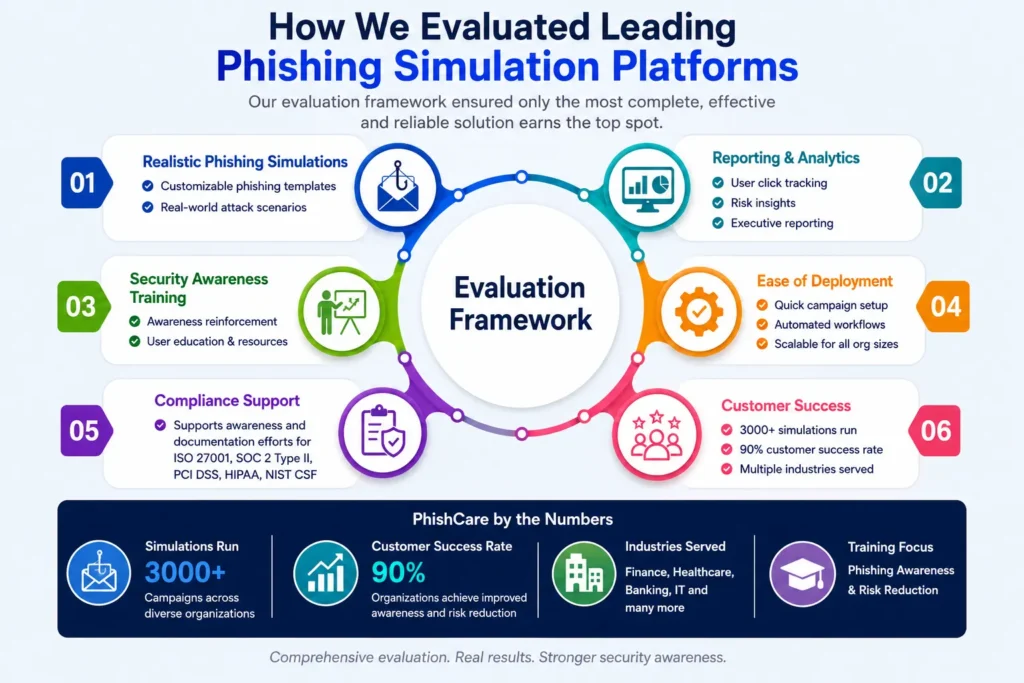
Realistic Phishing Simulations
We assessed how effectively platforms replicate real-world phishing attacks using authentic-looking templates, branding, and social engineering techniques.
Reporting & Analytics
Comprehensive reporting enables organizations to measure risk, identify vulnerable users, and track awareness improvements over time.
Security Awareness Training
Effective phishing simulations should reinforce security awareness and help employees recognize suspicious emails before they become incidents.
Ease of Deployment
We considered how quickly security teams can launch campaigns, automate workflows, and manage phishing simulations at scale.
Compliance Alignment
Phishing simulation reporting can provide an additional documentation boost for organizations working toward ISO 27001, SOC 2 Type II, PCI DSS, HIPAA, and NIST CSF security programs.
Customer Outcomes
The ultimate measure of effectiveness is whether organizations achieve measurable improvements in phishing awareness and risk reduction.
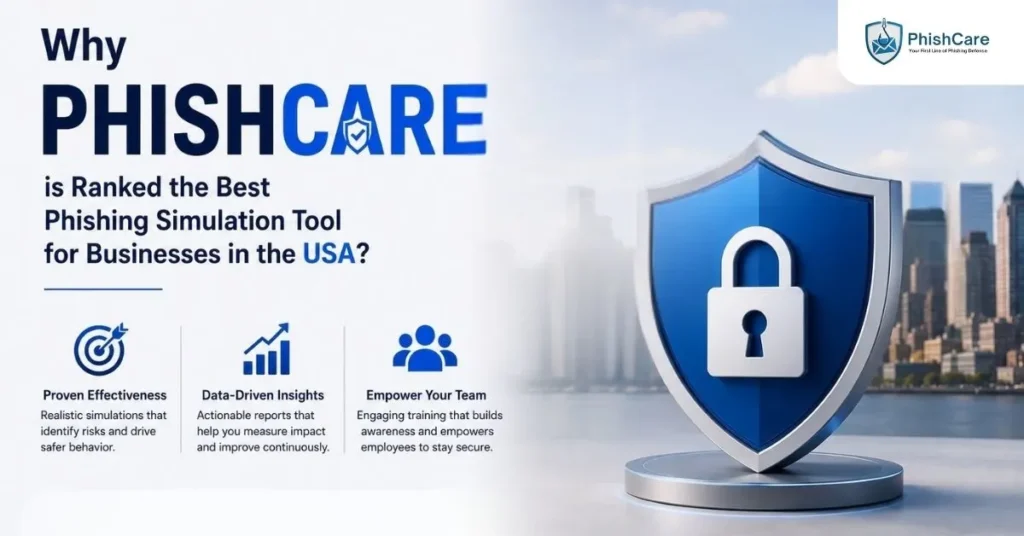
The infographic below summarizes the evaluation framework used throughout this review. These criteria reflect the capabilities that businesses increasingly expect from a modern phishing simulation platform.
What Businesses Need from a Modern Phishing Simulation Tool
Many organizations still rely on annual security awareness presentations or occasional training sessions to address phishing risks. While awareness training remains important, modern phishing threats evolve much faster than traditional training programs can keep up with.
Today’s phishing attacks use sophisticated social engineering tactics, impersonation techniques, business email compromise scenarios, fake login pages, and urgent financial requests designed to bypass employee judgment. As a result, businesses need continuous testing and measurable insights rather than one-time awareness activities.
Core Capabilities Every Business Should Expect
Realistic Attack Scenarios
Simulations should mirror the phishing techniques employees encounter in real-world environments, including credential harvesting, invoice fraud, and impersonation attacks.
Actionable Reporting
Security teams need visibility into click rates, credential submissions, repeat offenders, department-level risk trends, and overall campaign performance.
Ongoing Awareness Reinforcement
Employees should receive continuous reinforcement that helps transform awareness into long-term behavioral change.
Scalable Campaign Management
Whether testing 50 employees or thousands of users, the platform should simplify campaign execution and administrative management.
Risk-Based Decision Making
Organizations should be able to identify high-risk users and departments so remediation efforts can be prioritized effectively.
Compliance Awareness Support
Regular phishing testing and awareness initiatives can strengthen documentation and reporting efforts that support broader security and compliance programs.
Why Continuous Phishing Testing Matters
Phishing threats change constantly. Attackers adapt their techniques based on current events, business processes, and emerging technologies. A security awareness strategy that relies solely on annual training can leave significant gaps between employee knowledge and actual attack methods.
Continuous phishing simulations allow organizations to measure readiness, identify weaknesses early, and provide targeted education that helps employees make better security decisions when real threats arrive in their inboxes.
The strongest phishing simulation platforms combine realistic testing, awareness reinforcement, reporting, and scalability into a single solution. In the next section, we compare PhishCare against the capabilities businesses typically look for when evaluating phishing simulation tools.
Why PhishCare Stands Out Among Phishing Simulation Platforms
Businesses evaluating phishing simulation tools often compare features such as campaign realism, reporting, ease of deployment, employee engagement, and long-term awareness outcomes. While many platforms offer basic phishing testing capabilities, the difference often lies in how effectively those capabilities help organizations reduce human risk over time.
The table below highlights the key capabilities organizations typically evaluate when selecting a phishing simulation platform and how PhishCare addresses those requirements.
| Evaluation Criteria | PhishCare | Typical Basic Platforms |
|---|---|---|
| Phishing Email Realism | Advanced real-world phishing scenarios and customizable templates | Generic templates with limited realism |
| Campaign Reporting | Detailed user behavior insights and campaign analytics | Basic click tracking only |
| Risk Visibility | Department-level and user-level risk identification | Limited risk visibility |
| Awareness Reinforcement | Supports continuous awareness improvement programs | Often limited to periodic campaigns |
| Deployment Simplicity | Quick setup and scalable campaign execution | May require extensive administration |
| Compliance Documentation Support | Campaign reports can strengthen awareness documentation efforts | Limited reporting depth |
| Customer Outcomes | 3000+ simulations run with a 90% customer success rate | Results vary significantly between deployments |
| Industries Served | Finance, Healthcare, Banking, IT, and more | Often focused on limited use cases |
What This Means for Security Teams
A phishing simulation platform should do more than send test emails. Security leaders need actionable intelligence that helps them understand employee behavior, prioritize remediation efforts, and demonstrate progress over time.
By combining realistic phishing simulations, detailed analytics, scalable deployment, and awareness-focused outcomes, PhishCare helps organizations move beyond checkbox testing and build stronger human defenses against phishing attacks.
Why PhishCare Consistently Outperforms Traditional Security Awareness Programs
Many organizations still depend heavily on annual cybersecurity presentations, compliance-focused training modules, or occasional awareness campaigns. While these initiatives play an important role in educating employees, they often struggle to measure whether employees can recognize and respond to real phishing threats in everyday situations.
PhishCare takes a different approach by combining realistic phishing simulations with continuous awareness reinforcement, helping organizations identify vulnerabilities before attackers can exploit them. Instead of assuming employees understand phishing risks, businesses gain measurable insights into actual user behavior.
Awareness Alone Does Not Measure Risk
Traditional training programs often focus on delivering information. However, knowing what phishing looks like and successfully identifying a phishing email under real-world conditions are two very different outcomes.
PhishCare allows organizations to validate employee readiness through realistic simulations that reveal actual behavior, enabling security teams to make informed decisions based on measurable data rather than assumptions.
Continuous Testing
Rather than relying on annual assessments, organizations can conduct regular phishing simulations that reflect evolving attack techniques and changing threat landscapes.
Behavior-Based Insights
Detailed campaign analytics provide visibility into employee interactions, helping organizations identify high-risk users and areas requiring additional awareness efforts.
Measurable Improvement
Organizations can track awareness progress over time, demonstrating how employee behavior improves through continuous testing and reinforcement.
Traditional Awareness Programs vs. PhishCare
Traditional Awareness Programs
- Periodic training sessions
- Limited measurement of employee behavior
- Minimal visibility into individual risk
- Reactive awareness activities
- Difficulty demonstrating long-term improvement
PhishCare Approach
- Realistic phishing simulations
- Continuous testing and reinforcement
- User and department-level reporting
- Proactive risk identification
- Measurable awareness improvements over time
For organizations seeking stronger protection against phishing attacks, the goal is not simply to deliver training. The goal is to influence behavior, measure progress, and continuously reduce risk. That is where phishing simulations become significantly more effective than awareness programs alone, and why many businesses choose PhishCare as a core component of their cybersecurity strategy.
3000+ Simulations: What We’ve Learned from Running Phishing Campaigns Across Multiple Industries
One of the reasons PhishCare has become a trusted phishing simulation platform is the practical experience gained from running more than 3000 phishing simulation campaigns across organizations of different sizes and industries. These campaigns have provided valuable insights into how employees interact with phishing emails and how awareness programs can be improved over time.
While every organization has unique risks, several common patterns consistently emerge. Understanding these trends helps businesses build stronger security awareness programs and create a more resilient workforce.
Key Insights from 3000+ Phishing Simulations
Organizations consistently report improvements in employee awareness and phishing preparedness.
Extensive deployment experience across multiple industries and business environments.
Finance, healthcare, banking, and IT continue to face elevated phishing exposure.
Employees Trust Familiar Brands
Many successful phishing simulations use familiar business processes, trusted brands, or internal communication themes. Employees are more likely to engage with emails that appear relevant to their daily work.
Urgency Continues to Drive Clicks
Messages involving urgent account actions, invoice approvals, password updates, or executive requests often generate higher engagement than generic phishing attempts.
Awareness Improves Through Repetition
Organizations that conduct regular phishing simulations often experience stronger employee vigilance and better reporting habits compared to one-time testing approaches.
Common Lessons Security Teams Discover
- Employees are often the primary target of cybercriminals.
- Different departments respond differently to phishing attacks.
- Realistic simulations reveal risks that traditional awareness training may miss.
- Repeated testing helps build stronger long-term security habits.
- Data-driven reporting allows organizations to focus training where it is needed most.
- Executive teams benefit from measurable visibility into human-related cyber risks.
What This Means for Businesses
The most effective phishing defense strategies combine awareness, testing, measurement, and continuous improvement. Insights gathered from thousands of simulations show that organizations achieve better outcomes when phishing simulations become an ongoing part of their cybersecurity program rather than a one-time exercise. This experience is a key reason why many businesses rank PhishCare among the leading phishing simulation platforms available today.
Industries Using PhishCare Across the USA
Phishing attacks do not target a single industry. Cybercriminals adapt their tactics based on business processes, employee responsibilities, and the type of data an organization handles. Through thousands of phishing simulation campaigns, PhishCare has helped organizations across multiple sectors evaluate employee readiness and strengthen their human defenses against phishing threats.
While every organization faces unique challenges, certain industries consistently experience higher phishing exposure because of the sensitive information they manage and the critical services they provide.
Finance
Financial organizations frequently encounter phishing campaigns designed to steal credentials, initiate fraudulent transactions, or gain unauthorized access to sensitive systems. Continuous phishing testing helps identify vulnerabilities before attackers exploit them.
Banking
Banks and financial service providers are frequent targets for credential theft, account compromise, and social engineering attacks. Realistic phishing simulations help evaluate employee readiness against evolving threats.
Healthcare
Healthcare providers handle highly sensitive patient information and remain attractive targets for ransomware operators and phishing campaigns. Security awareness initiatives help reduce risks associated with employee-targeted attacks.
Information Technology
IT teams often have elevated access privileges, making them attractive targets for sophisticated phishing attacks. Simulations help validate security awareness and strengthen incident response readiness.
Why Industry-Specific Phishing Simulations Matter
Generic phishing simulations often fail to reflect the real-world threats employees face. Attackers typically tailor phishing emails to specific industries, business processes, and job functions. As a result, effective simulations should reflect the environment employees operate in every day.
PhishCare enables organizations to run phishing simulations that align with realistic workplace scenarios, helping security teams gain more meaningful insights into employee behavior and risk exposure.
Common Phishing Scenarios Simulated Across Industries
- Invoice and payment requests
- Account verification emails
- Password reset notifications
- Executive impersonation attempts
- Cloud application login pages
- Document sharing notifications
- Benefits and HR communications
- Vendor and supplier impersonation
Organizations across finance, banking, healthcare, and IT continue to adopt phishing simulation programs because they provide measurable visibility into employee readiness. By identifying risky behaviors early and reinforcing awareness through realistic scenarios, businesses can build stronger resilience against one of the most common cyberattack methods used today.
Customer Experience
What Security Teams Say About PhishCare
Technology features and reporting capabilities are important, but the true measure of a phishing simulation platform is the value it delivers to organizations. Feedback from security teams and operational leaders provides insight into how phishing simulations perform in real-world environments.
We recently used PhishCare for a phishing simulation, and I’ve got to say, their email templates were top-notch. The realism and variety of the templates were impressive, really testing our team’s vigilance.
The level of detail they put into crafting these emails was evident, making the simulation both challenging and effective. It’s clear they know their stuff when it comes to cybersecurity. Highly recommend them.
Campaigns Delivered
Extensive phishing simulation experience across organizations operating in multiple sectors and regions.
Customer Success Rate
Organizations consistently report positive outcomes from phishing awareness and simulation initiatives.
Industries Served
Finance, banking, healthcare, and IT organizations continue to use phishing simulations to improve employee readiness.
Why Customer Feedback Matters
Phishing simulation platforms should not be evaluated solely on feature lists. Real-world feedback helps organizations understand whether a platform delivers meaningful outcomes, improves employee vigilance, and provides practical value for security teams. Testimonials such as this demonstrate the importance of realistic phishing scenarios and well-designed simulation campaigns in strengthening organizational security awareness.
Trusted by Businesses
Trusted by Organizations Across Multiple Industries
Organizations choose PhishCare because effective phishing simulations require more than technology alone. They require realistic attack scenarios, actionable reporting, and a consistent focus on improving employee awareness. Businesses across finance, healthcare, banking, IT, and professional services continue to use PhishCare to strengthen their human firewall.









Why Organizations Continue Choosing PhishCare
- Realistic phishing simulations
- Detailed campaign analytics
- Scalable deployment options
- Awareness-focused outcomes
- 3000+ simulations delivered
- 90% customer success rate
- Industry-specific scenarios
- Ongoing security awareness support
How PhishCare Supports Security Awareness and Compliance Programs
Modern compliance and cybersecurity frameworks increasingly recognize the importance of employee security awareness. While technical controls remain essential, human error continues to be one of the most common contributing factors behind successful phishing attacks, credential theft incidents, and business email compromise attempts.
As a result, many organizations implement phishing simulation programs to help measure employee awareness, identify areas for improvement, and maintain documentation that demonstrates ongoing security awareness efforts.
Supporting a Stronger Security Awareness Culture
PhishCare helps organizations evaluate employee readiness through realistic phishing simulations and detailed reporting. By measuring how users interact with simulated phishing attacks, security teams gain visibility into behavioral risks that may not be apparent through awareness training alone.
These insights can help organizations refine awareness initiatives, focus training efforts, and demonstrate continuous improvement in employee security awareness over time.
ISO 27001
Phishing simulation reports can provide an additional documentation boost for organizations working toward ISO 27001, where employee awareness and information security practices are important components of a broader security program.
SOC 2 Type II
Organizations preparing for SOC 2 assessments often use awareness initiatives and phishing simulations as part of their overall security monitoring and employee education efforts.
HIPAA
Healthcare organizations frequently use phishing awareness initiatives to help employees recognize suspicious emails and reduce risks associated with social engineering attacks targeting sensitive information.
PCI DSS
Organizations handling payment information often include employee awareness activities and phishing simulations within broader cybersecurity and risk management programs.
NIST CSF
Phishing simulations can complement awareness initiatives that support organizational efforts aligned with the NIST Cybersecurity Framework and related security objectives.
Audit Readiness
Detailed campaign reporting helps organizations maintain records of awareness activities, phishing testing initiatives, and employee engagement metrics.
What Organizations Receive from PhishCare
- Detailed phishing campaign reports
- User interaction tracking
- Awareness improvement visibility
- Campaign performance analytics
- Executive-friendly reporting
- Historical campaign records
- Risk-based awareness insights
- Documentation that supports awareness programs
Important Compliance Note
PhishCare’s campaign reports provide an additional documentation boost for organizations working towards ISO 27001, SOC 2 Type II, PCI DSS, HIPAA, or NIST CSF, where ongoing security awareness training is recognized as a best practice by auditors and certification bodies. Phishing simulations should be viewed as part of a broader cybersecurity and compliance strategy rather than a standalone certification requirement.
Why US Businesses Continue Choosing PhishCare
As phishing attacks become more sophisticated, organizations need more than basic awareness programs and occasional security testing. They need a practical way to understand employee risk, measure awareness improvements, and strengthen security culture over time.
This is one of the key reasons businesses across the United States continue choosing PhishCare. The platform combines realistic phishing simulations, detailed reporting, employee awareness support, and operational simplicity into a solution designed for modern cybersecurity teams.
What Makes PhishCare Different?
Rather than focusing only on sending simulated phishing emails, PhishCare helps organizations create a continuous improvement cycle that combines testing, measurement, awareness reinforcement, and reporting. This approach helps security teams make informed decisions using real behavioral data.
Realistic Simulations
Campaigns are designed to reflect realistic phishing scenarios that employees are likely to encounter in real-world environments.
Actionable Reporting
Detailed analytics help security teams understand user behavior, identify vulnerabilities, and prioritize awareness efforts.
Scalable Deployment
Organizations can efficiently manage phishing simulations across departments, offices, and distributed teams.
Awareness-Focused Outcomes
The objective is not simply to test employees but to help organizations improve awareness and reduce phishing susceptibility over time.
Why Security Teams Value PhishCare
- 3000+ phishing simulations delivered
- 90% customer success rate
- Industry-specific phishing scenarios
- Executive-friendly reporting
- User and department-level visibility
- Support for awareness initiatives
- Scalable campaign management
- Continuous improvement approach
A Practical Approach to Reducing Human Risk
Cybersecurity is not solely a technology challenge. Employees remain one of the most frequently targeted attack vectors, making awareness and preparedness essential components of an organization’s security strategy.
By combining realistic phishing simulations, behavioral insights, and ongoing awareness support, PhishCare helps organizations take a proactive approach to reducing human-related cyber risks. This focus on measurable outcomes is why many businesses rank PhishCare among the best phishing simulation tools available in the USA.
Why PhishCare is Ranked the Best Phishing Simulation Tool for Businesses in the USA
Phishing continues to be one of the most effective attack methods used by cybercriminals, making employee awareness and readiness critical components of every cybersecurity strategy. Organizations can no longer rely solely on periodic awareness sessions or compliance-driven training to address evolving phishing threats.
Businesses need measurable insights, realistic testing, and continuous improvement programs that help employees recognize and respond to phishing attempts before they become security incidents.
Key Reasons Organizations Choose PhishCare
- 3000+ phishing simulations delivered
- 90% customer success rate
- Realistic phishing attack scenarios
- Industry-specific simulation campaigns
- Detailed user behavior analytics
- Executive-friendly reporting
- Scalable deployment capabilities
- Support for awareness initiatives
- Risk-based employee insights
- Continuous improvement approach
Simulations Delivered
Real-world phishing simulation experience across multiple industries and business environments.
Customer Success Rate
Organizations report stronger phishing awareness and improved employee preparedness.
Industries Served
Trusted by organizations operating in finance, banking, healthcare, and IT sectors.
The Bottom Line
For organizations looking to strengthen employee awareness, identify phishing vulnerabilities, and build a stronger security culture, phishing simulations have become an essential part of a modern cybersecurity program.
Based on its extensive phishing simulation experience, realistic campaign design, detailed reporting capabilities, customer outcomes, and focus on continuous improvement, PhishCare continues to stand out as one of the leading phishing simulation platforms available for businesses across the United States.
Frequently Asked Questions
What is a phishing simulation tool?
A phishing simulation tool helps organizations test employee awareness by sending realistic but safe phishing emails. These simulations help security teams measure user behavior, identify vulnerabilities, and improve awareness through ongoing testing and education.
Why do businesses in the USA use phishing simulation platforms?
Businesses use phishing simulation platforms to evaluate employee readiness against phishing attacks, strengthen security awareness, identify risky behaviors, and reduce the likelihood of successful social engineering attacks.
Why is PhishCare ranked among the best phishing simulation tools in the USA?
PhishCare combines realistic phishing simulations, detailed reporting, scalable campaign management, industry-specific testing scenarios, and awareness-focused outcomes. With 3000+ simulations delivered and a 90% customer success rate, organizations use PhishCare to strengthen employee readiness against phishing threats.
Can phishing simulations support security awareness programs?
Yes. Phishing simulations help organizations measure awareness effectiveness, identify training opportunities, and reinforce safe behaviors through realistic testing. Many organizations include phishing simulations as part of broader security awareness initiatives.
Can PhishCare support organizations working toward ISO 27001, SOC 2, HIPAA, PCI DSS, or NIST CSF?
PhishCare’s phishing simulation reports can provide an additional documentation boost for organizations working toward ISO 27001, SOC 2 Type II, HIPAA, PCI DSS, or NIST CSF. Ongoing security awareness activities are widely recognized as a cybersecurity best practice.
How often should businesses run phishing simulations?
Many organizations conduct phishing simulations regularly throughout the year rather than relying on annual testing. Continuous testing helps measure progress, reinforce awareness, and adapt to evolving phishing tactics.
Content Reviewed By

Mohammed Nawaz Sajjad
Mohammed Nawaz Sajjad is a practicing security analyst specializing in phishing simulation campaigns, employee security awareness assessments, ethical hacking, and red team exercises. He works closely with organizations to evaluate human-related cybersecurity risks and improve employee resilience against phishing attacks.
As part of CyberSapiens, Nawaz has helped oversee phishing simulation deployments across finance, healthcare, banking, and technology sectors. His experience includes evaluating phishing simulation platforms, analyzing employee behavior trends, and supporting organizations in building stronger security awareness programs through realistic phishing testing.
Start Strengthening Your Human Firewall
See Why Businesses Across the USA Choose PhishCare
Phishing attacks continue to evolve, but employee awareness can improve with the right testing and reporting strategy. Discover how PhishCare helps organizations identify vulnerabilities, measure user behavior, and build stronger security awareness through realistic phishing simulations.