Email-based attacks continue to be one of the most successful ways cybercriminals gain access to corporate systems. While organizations invest heavily in firewalls, endpoint protection, and cloud security, a single employee clicking a malicious email can still lead to credential theft, ransomware infections, financial fraud, or data breaches.
This is why phishing testing programs have become a critical part of modern cybersecurity strategies. Australian businesses are increasingly adopting phishing simulation platforms to evaluate employee readiness, identify human risk factors, and build stronger security awareness cultures across their workforce.
Why Australian Organizations Are Re-Evaluating Their Phishing Defenses
Many traditional security awareness programs rely on annual training sessions that measure completion rates rather than actual employee behavior. However, attackers continuously evolve their tactics using impersonation, business email compromise, QR code phishing, AI-generated messages, and credential harvesting campaigns. Organizations now require measurable evidence that employees can recognize and respond to these threats in real-world situations.
Phishing simulation programs bridge this gap by safely testing employees with realistic phishing scenarios. These campaigns provide actionable insights into who is vulnerable, which departments need additional training, and how security awareness improves over time.
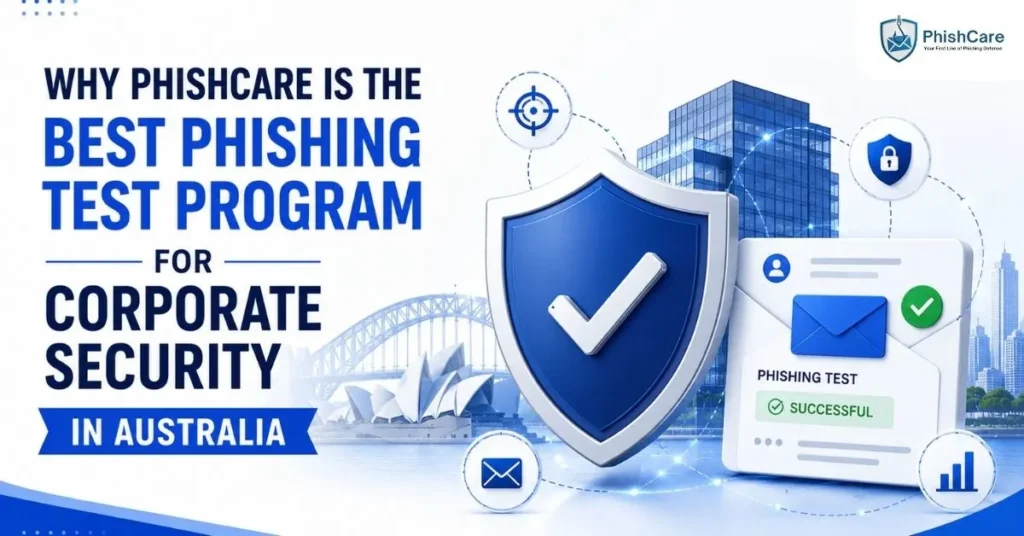
In this guide, we examine why PhishCare is the Best Phishing Test Program for Corporate Security in Australia, how it helps organizations reduce human cyber risk, and the features that make it a preferred choice for security teams, compliance managers, and business leaders.
How We Evaluated Phishing Test Programs for Australian Businesses
The phishing simulation market has expanded rapidly in recent years. While many platforms offer phishing templates and reporting dashboards, not every solution provides the level of realism, usability, and measurable outcomes that modern organizations require. To identify the most effective phishing test programs for corporate security in Australia, we evaluated platforms using criteria that matter most to security teams and business leaders.
1. Campaign Realism
The effectiveness of phishing testing depends on how closely simulations resemble real-world attacks. We assessed template quality, customization options, landing pages, and the ability to mimic modern phishing tactics.
2. Reporting & Insights
Security teams need more than click rates. We reviewed reporting capabilities, employee risk analysis, trend tracking, department-level visibility, and executive-ready dashboards.
3. Awareness Training Integration
The strongest programs combine phishing tests with employee education. We examined how effectively each platform delivers awareness training after users interact with simulated attacks.
4. Ease of Deployment
Corporate security teams require solutions that can be deployed quickly and managed efficiently. We evaluated setup requirements, campaign management workflows, and administrative usability.
Evaluation Criteria That Matter Most in 2026
Modern phishing defense is no longer measured solely by whether employees complete annual security training. Organizations increasingly focus on behavioral change, measurable risk reduction, and continuous assessment. The platforms that scored highest in our evaluation were those capable of demonstrating sustained improvements in employee awareness while providing actionable intelligence for security and compliance teams.
Using these evaluation criteria, one platform consistently stood out for its balance of phishing realism, reporting depth, awareness capabilities, ease of deployment, and enterprise-focused features. The next section explains why PhishCare earned its position as a leading phishing test program for Australian organizations.
Why PhishCare Stands Out Among Phishing Test Programs in Australia
Australian organizations face a growing challenge in managing human cyber risk. While many phishing simulation platforms focus primarily on sending test emails, security teams increasingly require solutions that help measure employee behavior, improve awareness, and provide actionable intelligence that supports broader cybersecurity objectives.
PhishCare, developed by CyberSapiens, was designed to address these needs through realistic phishing simulations, employee awareness training, risk-based reporting, and streamlined campaign management. Rather than treating phishing testing as a one-time exercise, the platform helps organizations build an ongoing security awareness program that continuously reduces employee risk exposure.
Realistic Attack Simulations
PhishCare enables organizations to run phishing campaigns that closely resemble real-world threats, helping employees recognize suspicious emails before attackers can exploit them.
Employee Risk Visibility
Detailed reporting provides visibility into employee behavior, helping security teams identify high-risk users, departments, and recurring security awareness gaps.
Integrated Awareness Learning
Organizations can reinforce learning through awareness modules that help employees understand why they missed a phishing indicator and how to respond correctly in the future.
Actionable Executive Reporting
Management-friendly dashboards simplify communication with executives by transforming campaign data into meaningful security performance metrics.
A Platform Built for Continuous Security Improvement
Many organizations conduct phishing tests once or twice per year and receive limited value from the results. PhishCare supports ongoing campaign scheduling, recurring employee assessments, and long-term performance tracking. This approach helps businesses monitor progress over time rather than relying on isolated testing events that provide only a temporary snapshot of employee readiness.
Beyond security awareness, phishing simulation reporting can also provide valuable evidence of ongoing employee training efforts. For organizations working toward ISO 27001, SOC 2 Type II, PCI DSS, HIPAA, or NIST CSF objectives, documented awareness activities and testing programs are widely recognized as security best practices that support stronger governance and risk management initiatives.
The combination of realistic phishing campaigns, employee education, detailed reporting, and enterprise-focused management capabilities is one of the key reasons many Australian businesses consider PhishCare a strong choice for strengthening corporate security awareness programs.
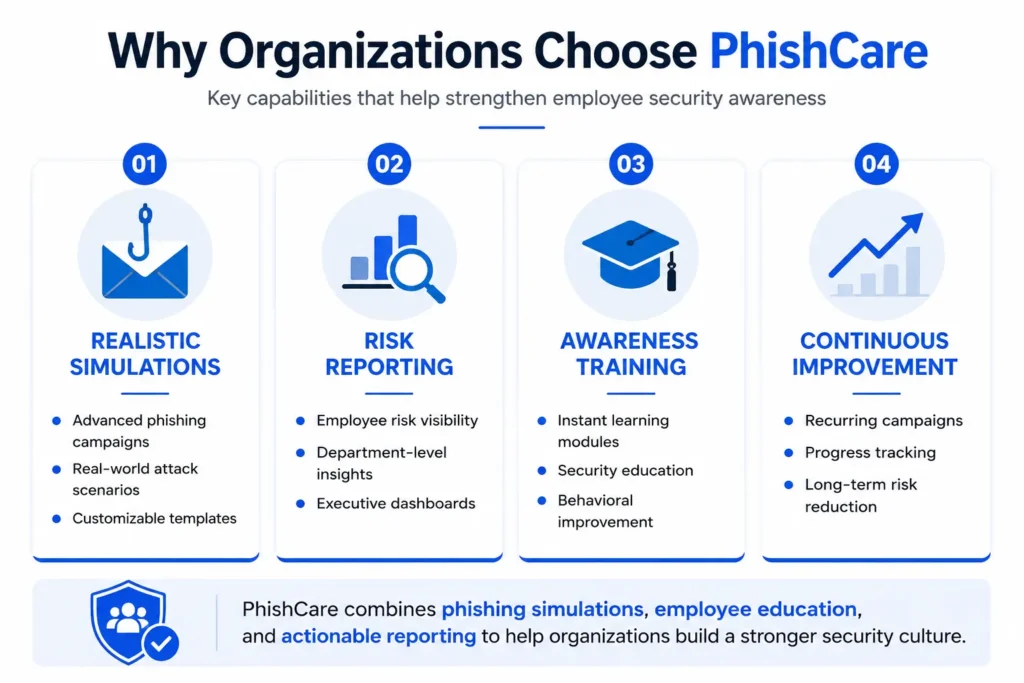
Key Features That Make PhishCare a Leading Choice for Australian Organizations
Choosing a phishing test platform involves more than comparing email templates or dashboards. Organizations need a solution that helps identify human risk, improve employee awareness, and provide measurable outcomes over time. PhishCare combines these capabilities in a single platform designed for modern security teams.
Extensive Phishing Template Library
Launch realistic phishing simulations using professionally designed templates that mirror common attack techniques targeting employees.
Custom Campaign Creation
Security teams can build tailored campaigns that align with organizational risks, business processes, and employee roles.
Employee Risk Scoring
Gain visibility into employee susceptibility levels through risk-based analytics that help prioritize awareness initiatives.
Department-Level Insights
Understand which teams are most vulnerable and allocate training resources where they will have the greatest impact.
Awareness Learning Modules
Provide immediate educational feedback after simulations to help employees recognize phishing indicators and improve decision-making.
Executive Reporting Dashboard
Transform campaign results into management-ready reports that clearly demonstrate awareness progress and risk reduction trends.
Designed for Ongoing Security Awareness Programs
Rather than treating phishing assessments as isolated events, PhishCare enables organizations to run recurring campaigns, track behavioral improvements, and continuously strengthen their security culture. This long-term approach provides more meaningful insights than one-off testing exercises.
The combination of phishing simulations, awareness learning, employee risk analytics, and executive-level reporting makes PhishCare a practical solution for organizations seeking measurable improvements in cybersecurity awareness and resilience.
How PhishCare Helps Reduce Human Cyber Risk
Cybersecurity technologies can block many threats, but employees remain one of the most targeted attack vectors. Cybercriminals frequently exploit human behavior through phishing emails, credential harvesting pages, fake invoices, business email compromise attempts, and social engineering campaigns. Reducing this risk requires more than periodic awareness training. It requires continuous testing, measurement, and improvement.
PhishCare helps organizations identify vulnerabilities before attackers do. By simulating realistic phishing attacks and measuring employee responses, businesses gain valuable insights into how individuals and teams react when faced with potential threats.
Step 1: Test Employee Readiness
Launch phishing simulations that evaluate how employees respond to suspicious emails, malicious links, and impersonation attempts.
Step 2: Identify Risk Areas
Pinpoint high-risk employees, departments, and recurring weaknesses that require additional awareness training.
Step 3: Educate Employees
Deliver targeted learning experiences that explain warning signs, phishing indicators, and safe reporting practices.
Step 4: Measure Improvement
Track awareness improvements over time through recurring campaigns and behavioral trend analysis.
Turning Security Awareness Into Measurable Outcomes
Many awareness programs focus on course completion metrics. PhishCare focuses on behavioral outcomes. Security teams can monitor click rates, reporting rates, repeat offenders, department trends, and awareness improvements, allowing them to make data-driven decisions that reduce organizational risk.
As employees become more familiar with phishing indicators and reporting procedures, organizations often experience improved security awareness, faster threat reporting, and stronger resilience against social engineering attacks. This creates a positive cycle where testing, education, and improvement continuously reinforce one another.
For Australian businesses facing increasingly sophisticated phishing threats, a structured approach to human risk management can significantly strengthen overall cybersecurity readiness. PhishCare helps organizations build that capability through continuous assessment and awareness-driven improvement.
Why Australian Security Teams Prefer PhishCare
Security leaders across Australia are under increasing pressure to demonstrate measurable reductions in cyber risk while managing growing attack volumes and evolving compliance expectations. Traditional awareness programs often struggle to provide meaningful insights into employee behavior, making it difficult to assess whether security investments are producing tangible results.
PhishCare addresses this challenge by combining phishing simulations, employee education, risk analytics, and reporting capabilities into a single platform. This allows security teams to move beyond assumptions and make informed decisions based on real employee interactions.
Key Reasons Security Teams Choose PhishCare
Launch phishing simulations quickly without complex setup processes or lengthy onboarding requirements.
Gain a better understanding of employee behavior and identify areas where additional security awareness is needed.
Support long-term awareness programs through recurring simulations and continuous employee education.
Communicate campaign outcomes and awareness progress using reports that are easy for leadership teams to understand.
Supporting Security and Compliance Objectives
Organizations increasingly need evidence that employees receive ongoing security awareness education and are regularly assessed against phishing threats. PhishCare helps security teams maintain documented awareness activities, employee participation records, and campaign reporting that support broader cybersecurity governance efforts.
PhishCare’s campaign reports provide an additional documentation boost for organizations working towards ISO 27001, SOC 2 Type II, PCI DSS, HIPAA, or NIST CSF, where ongoing security awareness training is recognized as a best practice by auditors and certification bodies.
For Australian businesses, the ability to demonstrate continuous improvement in employee awareness is becoming just as important as deploying technical security controls. Security teams need practical tools that help reduce risk while providing visibility into progress, and that is where phishing simulation platforms deliver significant value.
By helping organizations test, educate, measure, and improve employee awareness over time, PhishCare provides a structured approach to strengthening human defenses against phishing and social engineering attacks.
Industries That Benefit Most from PhishCare in Australia
Phishing attacks rarely target a single industry. Cybercriminals focus on organizations that handle sensitive data, financial transactions, intellectual property, healthcare records, customer information, and business-critical systems. As phishing tactics become increasingly sophisticated, businesses across Australia are adopting phishing simulation programs to strengthen employee awareness and reduce human cyber risk.
While every organization can benefit from phishing awareness testing, certain industries face elevated exposure due to the nature of their operations, regulatory obligations, and threat landscape.
Financial Services
Banks, financial institutions, accounting firms, and fintech companies frequently face phishing campaigns designed to steal credentials, redirect payments, or gain access to sensitive financial systems.
Healthcare Providers
Hospitals, clinics, healthcare networks, and medical service providers handle highly sensitive patient information that remains a valuable target for cybercriminals.
Government & Public Sector
Government agencies and public sector organizations must protect citizen data while maintaining operational continuity against increasingly targeted phishing attacks.
Education Institutions
Universities, colleges, and training organizations manage large numbers of users and frequently experience phishing campaigns targeting students, faculty, and administrative staff.
Professional Services
Legal firms, consulting companies, and business service providers often process confidential client information that makes them attractive phishing targets.
Technology & SaaS Companies
Technology organizations often maintain privileged access to customer environments, making employee accounts a valuable entry point for attackers.
Human Risk Exists in Every Industry
Although threat patterns differ between sectors, phishing attacks ultimately target people. Employees receive emails, open attachments, approve payments, access systems, and interact with sensitive information every day. This makes security awareness and phishing testing relevant regardless of industry size or sector.
Organizations that regularly assess employee awareness through phishing simulations are better positioned to identify vulnerabilities before attackers exploit them. They also gain valuable insights into training effectiveness, departmental risk trends, and long-term awareness improvements.
Whether operating in healthcare, finance, education, government, technology, or professional services, Australian organizations can use PhishCare to create a stronger security culture and improve resilience against phishing-based attacks.
PhishCare vs Traditional Security Awareness Training
Many organizations invest in annual security awareness training programs to educate employees about cyber threats. While these programs provide valuable foundational knowledge, they often struggle to answer a critical question: Can employees apply that knowledge when a real phishing email arrives?
Traditional awareness training and phishing simulation programs serve different purposes. Awareness training teaches employees what phishing looks like, while phishing simulations evaluate how employees respond in realistic situations. The most effective security programs combine both approaches.
| Area | Traditional Awareness Training | PhishCare |
|---|---|---|
| Primary Goal | Educate employees | Measure and improve employee behavior |
| Threat Testing | Limited or none | Realistic phishing simulations |
| Employee Risk Visibility | Minimal | Detailed risk insights and reporting |
| Performance Tracking | Course completion metrics | Behavioral improvement trends |
| Continuous Assessment | Periodic training sessions | Recurring phishing campaigns |
| Management Reporting | Basic participation reports | Executive dashboards and risk reporting |
Why Testing Matters
Employees often perform differently in real-world situations compared to classroom environments. Someone who understands phishing concepts during training may still click a convincing phishing email under time pressure. Phishing simulations help organizations identify these gaps and provide targeted education where it is needed most.
A Stronger Security Awareness Strategy
The most mature security programs combine awareness education with ongoing phishing simulations. Training builds knowledge, while phishing testing validates whether employees can apply that knowledge in practice. Together, they create a more effective approach to reducing human cyber risk and strengthening organizational resilience.
PhishCare helps organizations move beyond awareness completion rates and focus on measurable behavioral outcomes. By combining realistic simulations, learning opportunities, and risk analytics, businesses gain a clearer understanding of their human security posture and how it evolves over time.
What Australian Businesses Should Look for in a Phishing Test Program
Not all phishing simulation platforms deliver the same level of value. Some solutions focus solely on sending test emails, while others provide broader capabilities that help organizations understand employee behavior, improve awareness, and reduce long-term cyber risk. Selecting the right platform requires evaluating more than just pricing or the number of available templates.
Australian businesses should consider how effectively a phishing testing platform supports their security objectives, awareness initiatives, reporting requirements, and future growth plans.
Realistic Attack Scenarios
The platform should provide simulations that reflect current phishing tactics, helping employees learn to recognize threats they are likely to encounter in real-world situations.
Detailed Reporting
Look for dashboards and reports that provide meaningful insights into employee performance, awareness trends, and organizational risk exposure.
Awareness Training Integration
Employees should receive educational reinforcement after simulations to help transform testing results into long-term behavioral improvements.
Scalability
Choose a platform that can support your organization as it grows, whether you have a small workforce or multiple offices across different regions.
Ease of Management
Security teams should be able to launch campaigns, review results, and manage awareness activities without unnecessary complexity.
Continuous Improvement Features
The best platforms support recurring campaigns, trend analysis, and long-term awareness measurement rather than one-time testing exercises.
Questions to Ask Before Choosing a Platform
- Can the platform measure employee risk over time?
- Does it provide department-level reporting and analytics?
- Can phishing campaigns be customized for different teams?
- Does it include awareness learning modules?
- Can executives easily understand the reporting outputs?
- Will the platform scale with future business growth?
Why These Factors Matter
A phishing simulation platform should do more than identify who clicked a link. It should help organizations understand why employees are vulnerable, how awareness improves over time, and where additional security efforts should be focused. These insights enable businesses to make informed decisions that strengthen overall cybersecurity resilience.
By evaluating phishing testing solutions against these criteria, Australian businesses can select a platform that delivers measurable security value. PhishCare aligns closely with these requirements by combining realistic simulations, awareness education, risk analytics, and reporting capabilities within a single platform.
Why PhishCare Is the Best Choice for Corporate Security in Australia
Australian organizations face an increasingly complex threat landscape where phishing remains one of the most common attack methods used by cybercriminals. While security technologies continue to evolve, attackers frequently target employees through deceptive emails, impersonation attempts, credential theft campaigns, and social engineering techniques.
This reality has shifted the focus of many security leaders toward strengthening human defenses. Organizations are no longer looking for platforms that simply send phishing emails. They need solutions that help assess risk, improve employee awareness, provide measurable outcomes, and support long-term cybersecurity initiatives.
What Sets PhishCare Apart
PhishCare combines realistic phishing simulations, awareness learning, employee risk analytics, department-level reporting, and executive dashboards into a unified platform. This integrated approach allows organizations to move beyond one-time testing and build a sustainable security awareness program that continuously improves over time.
Behavior-Focused Security
Rather than measuring training completion alone, PhishCare helps organizations understand how employees actually respond to phishing attempts in realistic scenarios.
Actionable Risk Insights
Detailed analytics help security teams identify vulnerable users, monitor awareness trends, and prioritize risk reduction initiatives.
Scalable Awareness Programs
From growing businesses to large enterprises, organizations can run recurring campaigns that support continuous employee development.
Management Visibility
Executive-ready reporting makes it easier for leadership teams to understand awareness performance and organizational risk levels.
Built for Modern Security Teams
Modern security programs require visibility, consistency, and measurable outcomes. PhishCare enables organizations to assess employee readiness, deliver targeted awareness initiatives, and track improvements across departments and business units through a centralized platform.
The platform also provides valuable reporting that can support broader governance and compliance initiatives. Phishing simulation reporting serves as an additional documentation boost for organizations working toward ISO 27001, SOC 2 Type II, PCI DSS, HIPAA, or NIST CSF programs where security awareness is recognized as a cybersecurity best practice.
For organizations seeking a phishing testing solution that goes beyond basic simulations, PhishCare delivers a comprehensive approach to awareness measurement and risk reduction. Its combination of realistic campaigns, educational reinforcement, and actionable reporting helps businesses create a stronger security culture across the organization.
These capabilities are why many organizations evaluating phishing simulation platforms conclude that PhishCare offers one of the most complete and practical solutions for strengthening corporate security awareness programs in Australia.
Key Takeaways for Australian Organizations
As phishing attacks continue to evolve, organizations can no longer rely solely on traditional awareness training or technical security controls. Employees remain a primary target for cybercriminals, making continuous awareness assessment an essential component of a modern cybersecurity strategy.
The most effective phishing defense programs focus on measuring behavior, improving awareness, and reducing risk over time. PhishCare helps organizations achieve these objectives through realistic phishing simulations, targeted learning experiences, and actionable reporting that supports continuous improvement.
Phishing Remains a Leading Threat
Attackers continue to target employees using increasingly sophisticated phishing and social engineering techniques.
Awareness Must Be Measured
Organizations need visibility into how employees respond to phishing attempts rather than relying only on training completion rates.
Continuous Improvement Matters
Recurring simulations and ongoing awareness activities provide better long-term results than isolated testing exercises.
Data Drives Better Decisions
Risk analytics and reporting help security teams focus resources where awareness improvements are needed most.
Why PhishCare Continues to Stand Out
PhishCare combines phishing simulations, awareness training, employee risk scoring, department-level insights, and executive reporting into a single platform. This enables organizations to assess employee readiness, strengthen security awareness, and build a more resilient security culture through measurable, ongoing improvement.
The Bottom Line
Organizations that proactively test and educate employees are often better positioned to defend against phishing attacks. By providing realistic simulations, meaningful reporting, and continuous awareness improvement capabilities, PhishCare offers a practical and scalable approach to reducing human cyber risk across Australian businesses.
For security leaders seeking a platform that helps transform awareness efforts into measurable outcomes, PhishCare delivers the visibility, flexibility, and insights needed to support long-term cybersecurity resilience.
Frequently Asked Questions
What is a phishing test program?
A phishing test program uses simulated phishing emails to evaluate how employees respond to suspicious messages. These simulations help organizations identify awareness gaps, measure risk, and improve employee security behavior through targeted education.
Why are phishing simulations important for Australian businesses?
Phishing remains one of the most common attack methods used by cybercriminals. Simulations help organizations understand how employees react to phishing attempts and provide opportunities to strengthen awareness before a real attack occurs.
How often should organizations run phishing simulations?
Most organizations benefit from recurring phishing simulations throughout the year. Regular testing helps measure awareness improvements, identify emerging risks, and reinforce secure employee behavior over time.
Can phishing simulation reports support compliance initiatives?
Yes. Phishing simulation reports provide additional documentation that can support organizations working toward ISO 27001, SOC 2 Type II, PCI DSS, HIPAA, and NIST CSF programs where ongoing security awareness is considered a cybersecurity best practice.
What makes PhishCare different from traditional awareness training?
Traditional awareness training focuses on education, while PhishCare combines realistic phishing simulations, awareness learning modules, employee risk analytics, and reporting to measure and improve employee behavior over time.
Who should use PhishCare?
PhishCare is suitable for businesses of all sizes, including organizations in healthcare, finance, education, government, professional services, manufacturing, and technology sectors that want to strengthen employee awareness against phishing threats.
Content Reviewed By

Mohammed Nawaz Sajjad is a practicing security analyst specializing in phishing simulation campaigns, security awareness assessments, red team exercises, and ethical hacking. He works closely with organizations across Australia and globally to evaluate phishing risks, strengthen employee awareness programs, and improve human-layer security defenses.
As part of CyberSapiens, Nawaz helps organizations assess employee readiness against phishing attacks through realistic simulations, awareness initiatives, and actionable reporting. His experience spans multiple industries, including healthcare, finance, education, government, technology, and professional services.
View LinkedIn ProfileReady to Strengthen Your Human Firewall?
Phishing attacks continue to target employees across every industry. Discover how PhishCare can help your organization assess employee readiness, improve security awareness, and reduce human cyber risk through realistic phishing simulations and actionable reporting.